
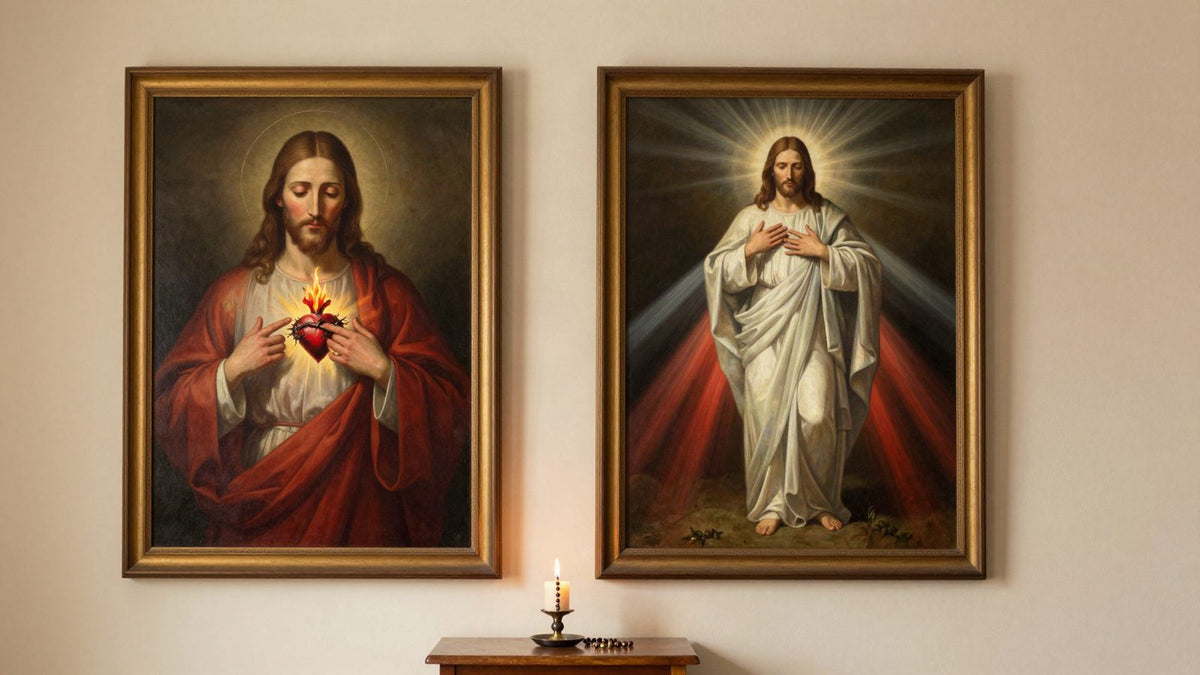
The Sacred Heart and the Divine Mercy are two of the best-loved images of Jesus in Catholic homes, and two of the most often confused. Both show Christ looking out at the viewer, both draw attention to his heart, and both are about his love for humanity. But they come from different centuries and different saints, they use different symbols, and they invite a slightly different kind of prayer.
In this guide you'll learn where each devotion comes from, what every detail in the images means, how to tell them apart at a glance, and how to choose the right one for your home. If you already know which image speaks to you, you can browse our Christian wall art collection to see both.
The Short Answer: Sacred Heart vs Divine Mercy
The Sacred Heart shows Jesus revealing his physical heart, usually burning with flames, wrapped in a crown of thorns and topped with a small cross. It is a devotion to the love of Christ, a love so great that it suffered for us. It became widespread after the visions of Saint Margaret Mary Alacoque in France in the 1670s.
The Divine Mercy shows Jesus walking forward with his right hand raised in blessing, while two large rays, one pale and one red, pour out from his chest. Usually there is no visible heart. It is a devotion to the mercy of Christ, his readiness to forgive anyone who turns to him. It comes from the visions of Saint Faustina Kowalska in Poland in the 1930s, and it is normally painted with the words "Jesus, I trust in You."
A simple way to remember it: flaming heart = Sacred Heart; two rays of light = Divine Mercy.
The Sacred Heart of Jesus: History and Meaning
Where the devotion comes from
Christians have meditated on the heart of Jesus since the early Church. They saw the wound in his side, pierced by a soldier's lance at the crucifixion (John 19:34), as the source of grace and the sacraments. Medieval saints and mystics wrote about resting in the heart of Christ, but the devotion as most people know it today grew from a series of visions in the 17th century.
Between 1673 and 1675, Saint Margaret Mary Alacoque, a Visitation nun at the convent of Paray-le-Monial in France, reported that Jesus appeared to her and showed her his heart, burning with love and wounded by the indifference of the world. He asked that his heart be honored, that people receive Communion in reparation on the first Friday of the month, and that a feast be established in honor of his heart. With the help of her confessor, the Jesuit Saint Claude de la Colombière, the devotion spread through France and then across the Catholic world.
In 1856 Pope Pius IX extended the Feast of the Sacred Heart to the whole Church. Today it's celebrated on the Friday after the second Sunday after Pentecost, which usually falls in June. That's why June is traditionally called the month of the Sacred Heart.
The symbols in a Sacred Heart image
Each detail in a Sacred Heart painting carries meaning:
- The heart itself: the love of Christ, both human and divine. It is shown outside his chest so that nothing hides it.
- The flames: the burning intensity of his love, which is never cold or half-hearted.
- The crown of thorns: the suffering of the Passion and the pain caused by sin and indifference.
- The cross on top: the sacrifice of the crucifixion, freely accepted out of love.
- The wound: the lance that pierced his side, from which blood and water flowed.
- The light or rays around the heart: divine glory and grace radiating out to the world.
- Jesus pointing to his heart: an invitation to the viewer to come close and trust his love.
Some artists paint the full figure of Jesus holding or pointing to his heart. Others show only the heart, surrounded by flames and thorns. Both are traditional.
How the Sacred Heart is honored at home
Many Catholic families practice the Enthronement of the Sacred Heart: they place an image of the Sacred Heart in a place of honor, usually the main living space, and pray together to consecrate the family to Christ. The image becomes a daily reminder that Jesus is the true head of the household. For this reason the Sacred Heart is one of the most popular images for a living room, an entryway or above the family dining table.
The Divine Mercy: History and Meaning
Saint Faustina and the vision of 1931
The Divine Mercy image is much younger. On February 22, 1931, a young Polish nun named Sister Maria Faustina Kowalska was in her convent cell in Płock, Poland, when she reported seeing Jesus dressed in a white garment, one hand raised in blessing and the other touching his chest, from which two large rays came out, one pale and one red. In her diary she recorded his request: "Paint an image according to the pattern you see, with the signature: Jesus, I trust in You."
Faustina couldn't paint, so with the support of her confessor, Blessed Michael Sopoćko, the first Divine Mercy image was painted in Vilnius in 1934 by the artist Eugeniusz Kazimirowski, under her direction. A later version painted by Adolf Hyła in Kraków became one of the best-known versions around the world.
Faustina died in 1938 at the age of 33. Pope John Paul II, himself from Poland, canonized her on April 30, 2000, and on the same day declared the Second Sunday of Easter as Divine Mercy Sunday for the whole Church.
The symbols in a Divine Mercy image
- The two rays: in Faustina's diary, Jesus explains that the pale ray stands for the water that makes souls righteous, and the red ray for the blood that is the life of souls. Together they recall the blood and water that flowed from his side on the cross.
- The raised right hand: a blessing given to the viewer.
- The left hand at the chest: pointing to the source of the rays, his merciful heart.
- The white garment: the risen Christ, in the light of the Resurrection.
- Jesus stepping forward: mercy that comes out to meet us, rather than waiting for us.
- "Jesus, I trust in You": the short prayer at the bottom of the image, and the heart of the devotion: trust.
How the Divine Mercy is honored at home
The Divine Mercy devotion includes the Chaplet of Divine Mercy, a short prayer said on rosary beads, and the custom of pausing at three o'clock in the afternoon, the traditional hour of Jesus' death, to pray for mercy. Many people place a Divine Mercy image where they pray each day, or in a room where someone is sick or grieving, as a reminder that no situation is beyond God's mercy.
How to Tell Them Apart at a Glance
| Sacred Heart | Divine Mercy | |
|---|---|---|
| Main visual sign | A visible heart with flames, thorns and a cross | Two rays of light, one pale and one red, from the chest |
| Main theme | The love of Christ | The mercy of Christ |
| Saint associated | Saint Margaret Mary Alacoque | Saint Faustina Kowalska |
| Where and when | Paray-le-Monial, France, 1670s | Płock and Vilnius, 1930s |
| Jesus' pose | Often pointing to or holding his heart | Walking forward, right hand raised in blessing |
| Words on the image | Usually none | "Jesus, I trust in You" |
| Feast day | Friday after the second Sunday after Pentecost (June) | Second Sunday of Easter |
What the Two Devotions Have in Common
For all their differences, the two images tell the same story from two angles. The Sacred Heart shows why Christ suffered: because he loved us. The Divine Mercy shows what flows from that suffering: forgiveness and new life, offered to anyone who trusts him. Both point to the same moment on the cross, when the side of Jesus was pierced and blood and water flowed out. Many families display both, and there's no conflict in doing so.
Which Image Should You Choose for Your Home?
There's no wrong choice, but these questions can help.
Choose the Sacred Heart if…
- You want to consecrate or "enthrone" your family and home to Christ.
- You're looking for a classic, traditional image for a living room or dining room.
- The gift is for a wedding or a new home. The Sacred Heart is a traditional blessing for a new household.
- You're drawn to the rich reds and golds of traditional religious art.
Choose the Divine Mercy if…
- You're going through a hard time and want a daily reminder to trust.
- You pray the Chaplet of Divine Mercy or the three o'clock prayer.
- You're looking for a comforting gift for someone who is ill, grieving or returning to faith.
- You prefer a brighter image with lots of white and light.
Styles of Sacred Heart and Divine Mercy Art
Both images have been painted in many styles over the centuries, and a modern home can carry them in more than one way:
- Classic oil-painting style: warm colors, soft light and a realistic face, ideal for traditional interiors. See our Sacred Heart of Jesus in a red robe and the golden Sacred Heart canvas.
- Stained glass: bright blues, reds and golds outlined in black, like a church window. Try the stained glass Sacred Heart.
- Mosaic: small tiles of gold and color, inspired by Byzantine churches. See the mosaic Sacred Heart.
- Divine Mercy with radiant light: our Divine Mercy canvas shows the rays flowing from the heart of Jesus in soft, glowing tones.
Where to Hang a Sacred Heart or Divine Mercy Image
Because both are devotional images, give them a place of honor rather than squeezing them into a corner:
- Living room: above the sofa or the fireplace, the traditional spot for a family enthronement. A 24 x 36 inch canvas fits most sofas.
- Entryway: where everyone who enters sees it, as a quiet blessing on the home.
- Prayer corner or home altar: an 18 x 24 inch piece above a small table with a candle, a Bible and a rosary.
- Bedroom: a Divine Mercy image is a peaceful thing to see first in the morning and last at night.
Hang the center of the image about 57 to 60 inches from the floor, and avoid places that feel disrespectful, such as a bathroom. For more ideas, read our guide on where to hang Christian art in your home.
Frequently Asked Questions
Is the Divine Mercy the same as the Sacred Heart?
No. Both images are about the heart of Jesus, but they're separate devotions. The Sacred Heart comes from Saint Margaret Mary Alacoque in 17th-century France and focuses on Christ's love. The Divine Mercy comes from Saint Faustina Kowalska in 20th-century Poland and focuses on his mercy. The easiest way to tell them apart: the Sacred Heart shows a visible heart with flames and thorns, and the Divine Mercy shows two rays of light.
What do the red and pale rays in the Divine Mercy mean?
According to Saint Faustina's diary, the pale ray represents water, which makes souls righteous, and the red ray represents blood, which is the life of souls. They recall the blood and water that flowed from Jesus' side on the cross.
Why does the Sacred Heart have thorns and flames?
The flames represent the burning love of Christ, and the crown of thorns represents his suffering in the Passion and the pain caused by sin. The small cross on top recalls the crucifixion.
Can Protestants display a Sacred Heart or Divine Mercy image?
Both devotions are Catholic in origin, but many Christians of other traditions appreciate them as images of Christ's love and mercy. If you're buying a gift, it's worth knowing the recipient's tradition. A Gospel scene such as Jesus walking on water or the Good Shepherd protecting a lamb is welcome in almost any Christian home.
When is the Feast of the Sacred Heart, and when is Divine Mercy Sunday?
The Feast of the Sacred Heart falls on the Friday after the second Sunday after Pentecost, usually in June. Divine Mercy Sunday is the Second Sunday of Easter, one week after Easter Sunday. Both are good times to hang a new image or give one as a gift.
Bring the Heart of Christ Into Your Home
Whether you're drawn to the burning love of the Sacred Heart or the quiet trust of the Divine Mercy, both images are a daily invitation to come closer to Christ. Browse our full Christian wall art collection to find the one that speaks to you, in canvas, framed print or acrylic glass, printed in the USA and ready to hang.
Designer Brand Art Decor: How to Style Luxury Wall Art
Where to Hang Christian Art in Your Home: Room-by-Room Guide