
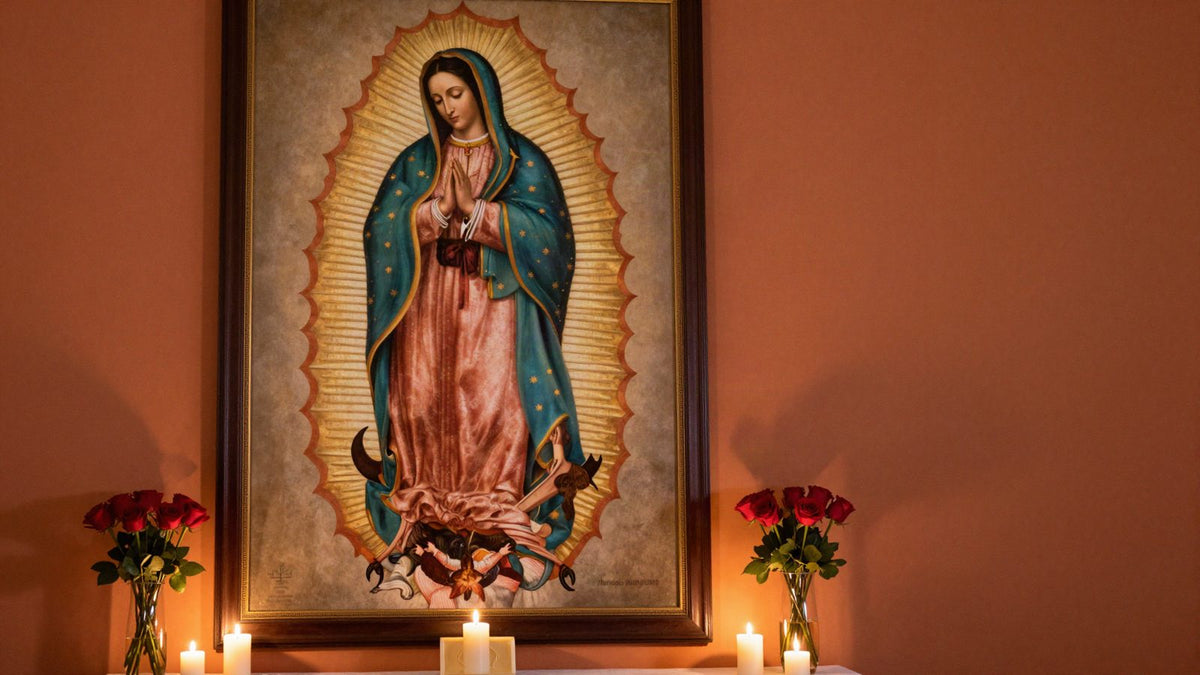
Few images are loved as widely as Our Lady of Guadalupe. Her picture hangs in cathedrals and kitchens, on murals and medals, in homes across Mexico, the United States and the whole of Latin America. For millions of families, La Virgen de Guadalupe is not only a religious image but a symbol of identity, protection and hope.
But where does the image come from, and what do its stars, rays, moon and roses mean? This article tells the story of the apparitions to Saint Juan Diego in 1531, explains each symbol in the image, and shares how families honor Our Lady of Guadalupe at home today. You can see our Our Lady of Guadalupe wall art in the Christian wall art collection.
The Story in Brief
In December 1531, about ten years after the Spanish conquest of the Aztec capital, the Virgin Mary appeared four times to an Indigenous man named Juan Diego on the hill of Tepeyac, just outside what is now Mexico City. She spoke to him in his own language, Nahuatl, and asked him to tell the bishop to build a church on the hill. As a sign for the doubting bishop, she had Juan Diego gather roses that were blooming out of season on the frozen hilltop. When he opened his cloak, called a tilma, in front of the bishop, the roses fell to the floor and the image of the Virgin appeared on the fabric. That tilma is still displayed today in the Basilica of Our Lady of Guadalupe in Mexico City.
Who Was Juan Diego?
Juan Diego Cuauhtlatoatzin was a humble Indigenous farmer and laborer born around 1474. His name in Nahuatl is often translated as "the one who speaks like an eagle." He was among the first generation of Indigenous people to be baptized after the arrival of Spanish missionaries, and he walked many miles each week to attend Mass and religious instruction.
He was no priest, scholar or nobleman, which is central to the story. The Virgin chose a poor, ordinary man, not a powerful one, to carry her message. Pope John Paul II canonized him as Saint Juan Diego in Mexico City on July 31, 2002, making him the first Indigenous saint of the Americas. His feast day is December 9.
The Four Apparitions of December 1531
December 9: "I am the ever-virgin Holy Mary"
Early on a Saturday morning, on his way to Mass, Juan Diego heard beautiful birdsong on Tepeyac hill and a woman's voice calling him by name. At the top of the hill he saw a young woman, radiant like the sun, who introduced herself as the Virgin Mary, Mother of the true God. She asked him to go to the bishop of Mexico, Fray Juan de Zumárraga, and ask that a church be built on that spot, where she could show her love and compassion to all who came to her.
The bishop's doubt
Juan Diego went straight to the bishop's residence. After a long wait, Bishop Zumárraga listened kindly but didn't believe him. That evening Juan Diego returned to the hill, told the Lady he had failed, and begged her to send someone more important. She answered that she had many messengers, but that she had chosen him.
December 10: a request for a sign
The next day Juan Diego returned to the bishop, who questioned him closely and asked for a sign that the message truly came from heaven. Juan Diego went back to Tepeyac, and the Lady promised to give him the sign the following day.
December 12: the roses and the tilma
But on December 11, Juan Diego's uncle, Juan Bernardino, fell seriously ill. Juan Diego stayed to care for him, and early on December 12 he set out to find a priest for his dying uncle, taking a path around the hill to avoid meeting the Lady. She came down to meet him anyway. In one of the most loved passages of the story, she said to him:
"Am I not here, I who am your mother? Are you not under my shadow and protection? Am I not the source of your joy? Are you not in the hollow of my mantle, in the crossing of my arms?"
She told him that his uncle was already healed and sent him to the top of the hill to gather flowers. There, in the frozen December ground where only cactus and thorns usually grew, he found Castilian roses in full bloom. He gathered them into his tilma, and the Virgin arranged them with her own hands.
When Juan Diego stood before Bishop Zumárraga and opened his tilma, the roses tumbled to the floor, and on the rough cloth was the image of the Virgin Mary that the world now knows as Our Lady of Guadalupe. The bishop fell to his knees. His uncle, as promised, had been healed, and said the Lady had also appeared to him and asked to be known as "Santa María de Guadalupe."
The Tilma: A Cloak That Has Lasted Nearly 500 Years
The tilma was woven from plant fibers, a material that would normally last only a few decades. Yet the original image has been venerated for nearly five centuries. It survived the humidity and candle smoke of early chapels, and a bomb hidden in a bouquet of flowers that exploded in front of it in 1921, bending a nearby brass crucifix but leaving the image intact. The bent crucifix is still displayed in the Basilica today.
The Basilica of Our Lady of Guadalupe at the foot of Tepeyac hill is among the most visited Catholic shrines in the world, with millions of pilgrims each year, many arriving around her feast on December 12.
The Symbols in the Image of Our Lady of Guadalupe
For the Indigenous people of 1531, the image was like a message written in pictures. Every detail spoke to them, and still speaks today.
- Rays of the sun behind her: she stands in front of the sun, which the Aztecs worshipped as a god. The message is that she is greater than the sun, yet she points beyond herself to the true God.
- Standing on the moon: the crescent moon beneath her feet recalls the woman of Revelation 12, "clothed with the sun, and the moon under her feet." It also shows that she is greater than the other powers people feared.
- The mantle full of stars: her blue-green mantle is covered with stars, like the night sky, a sign that she comes from heaven.
- Head bowed and hands joined in prayer: she isn't a goddess. She prays to someone greater, her Son.
- The black sash at her waist: in Aztec culture, a sash like this was worn by pregnant women. Our Lady of Guadalupe is pregnant with Jesus, which is why she's honored as patroness of the unborn.
- The four-petaled flower: a small flower over her womb, known in Nahuatl culture as a symbol of the divine and of the center of the universe, marks Christ at the center.
- Her face and skin: her features look neither fully European nor fully Indigenous, which many have seen as a sign that she is mother of all peoples, and of the new mixed (mestizo) people of the Americas.
- The angel beneath her: a small angel carries her, a sign that she comes from heaven and is a royal, holy figure.
Why Our Lady of Guadalupe Matters So Much
A message of dignity
The Virgin appeared to an Indigenous man, spoke his language and wore an image full of symbols from his culture, at a time when Indigenous people were suffering conquest, disease and loss. Her message was one of motherly love and dignity for the poor and the forgotten. In the years after 1531, millions of Indigenous people in Mexico embraced the Christian faith.
Mother of the Americas
Our Lady of Guadalupe has been honored as patroness of Mexico for centuries, and in 1999 Pope John Paul II named her Patroness of all the Americas. She's also honored as a protector of the unborn, because she appears pregnant in the image.
A symbol of identity and home
For many Mexican and Mexican-American families, La Virgen de Guadalupe is part of daily life: on the wall at home, in the car, on a necklace, painted on a neighborhood mural. Her image is a link to family, heritage and faith, which is why it's often the first thing hung in a new home.
How Families Celebrate December 12
The Feast of Our Lady of Guadalupe on December 12 is one of the most important celebrations of the year in Mexico and in many communities in the United States:
- Las Mañanitas: on the night of December 11 and the early morning of the 12th, people gather in churches to sing the traditional birthday song "Las Mañanitas" to the Virgin.
- Pilgrimages: millions walk, bike or travel to the Basilica in Mexico City, and many local parishes hold their own processions.
- Roses: families bring red roses to the church or place them in front of her image at home, in memory of the roses on Tepeyac hill.
- Food and family: tamales, champurrado (a warm chocolate drink) and pan dulce are shared after Mass.
- Matachines and folk dancing: traditional dancers in colorful costumes perform in her honor in many communities.
Honoring Our Lady of Guadalupe at Home
Many families keep a small home altar, an altarcito, with an image of La Virgen, candles, fresh roses and photos of loved ones. A few ideas for displaying her image respectfully:
- Living room or entryway: where the family gathers and where guests enter, as a blessing for the home. An 18 x 24 or 24 x 36 inch canvas works well.
- Above a home altar: hang the image slightly lower than usual (center about 45 to 50 inches from the floor) above a small table with candles and roses.
- Bedroom or nursery: for mothers-to-be and new parents, a reminder of her protection over children and the unborn.
Our Our Lady of Guadalupe canvas is surrounded by red and pink roses and white doves, in rich colors that glow especially well on acrylic glass. For more placement ideas, see our guide on where to hang Christian art in your home. If you love Marian art, you may also like the Virgin Mary in a rose garden and the mosaic Immaculate Heart of Mary.
Frequently Asked Questions
When did Our Lady of Guadalupe appear?
Between December 9 and December 12, 1531, on Tepeyac hill near Mexico City. The image appeared on Juan Diego's tilma on December 12, which is now her feast day.
Why is Our Lady of Guadalupe pregnant in the image?
The black sash around her waist was a sign of pregnancy in Aztec culture, and a small four-petaled flower appears over her womb. She is carrying Jesus. That's why she's honored as patroness of the unborn.
What does "Guadalupe" mean?
Guadalupe is the name of a famous Marian shrine in Spain. Some scholars think the name the Virgin gave in Nahuatl sounded similar to the Spanish word, and the Spanish-speaking bishop understood it as "Guadalupe." Either way, the name has belonged to the Virgin of Tepeyac for nearly 500 years.
Where is the original image of Our Lady of Guadalupe?
The original tilma is displayed in the Basilica of Our Lady of Guadalupe in Mexico City, above the main altar. Visitors can view it from a moving walkway below.
Is Our Lady of Guadalupe only for Catholics?
She's a Catholic devotion, but she's also a cultural symbol loved by many people of Mexican and Latin American heritage, whatever their level of religious practice. Her image speaks of motherhood, protection and dignity.
A Mother for Every Home
"Am I not here, I who am your mother?" These words to Juan Diego are why Our Lady of Guadalupe still means so much nearly five centuries later. Bring her image into your home as a sign of faith, family and protection. Explore our Our Lady of Guadalupe wall art and the full Christian wall art collection, printed in the USA and ready to hang. Looking for a gift? See our guide to Christian gifts for weddings, baptisms and housewarmings.
Christian Gifts for Weddings, Baptisms & Housewarmings
25 Bible Verses for Your Living Room Wall & How to Display Them