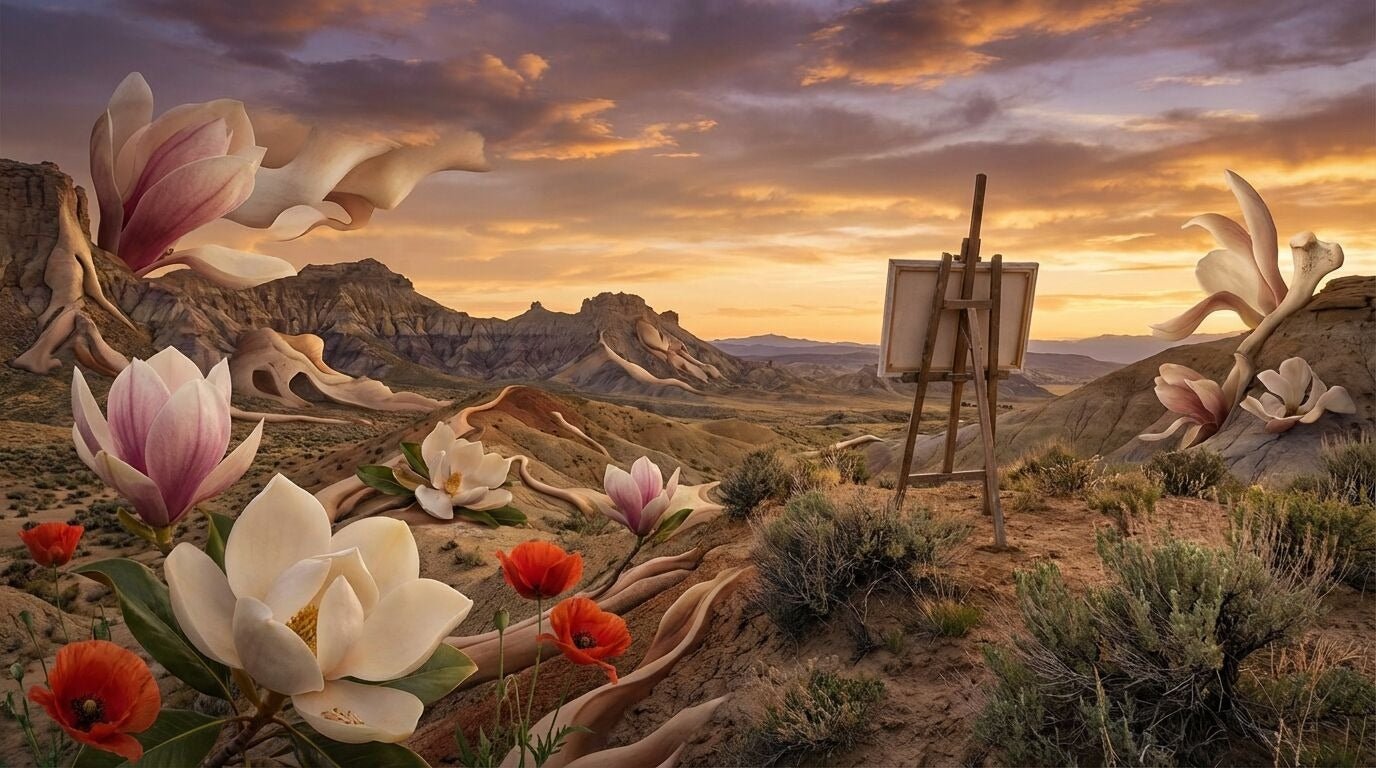
Georgia O’Keeffe’s emergence as a central figure of American Modernism cannot be separated from the profound cultural, geographic, and personal upheavals of the early twentieth century. From her early training in the Midwest to her decisive years in New York and her lifelong dialogue with the vast landscapes of New Mexico, O’Keeffe forged a path that consistently defied categorization. She navigated a male-dominated art world with unyielding independence, blurred the boundary between abstraction and representation, and fiercely resisted interpretations that reduced her work to her gender rather than her vision. Her relationship with Alfred Stieglitz, her commitment to artistic autonomy, and her deep connection to place shaped an oeuvre that challenged both aesthetic conventions and cultural expectations.
Across decades marked by constant reinvention, O’Keeffe’s work evolved alongside the shifting identity of American art itself. From academic foundations to radical abstraction, from the vertical intensity of New York skyscrapers to the stark clarity of desert bones and horizons, each phase reflected a deliberate search for meaning and form. Her paintings, at once intimate and monumental, continue to provoke debate, inviting psychological, formal, and cultural readings that resist closure. More than a singular style or subject, O’Keeffe’s legacy lies in her insistence on authenticity: a sustained exploration of how art can emerge from lived experience while speaking to a broader, enduring sense of place and self.
Who Was Georgia O’Keeffe?
A major figure of American modernism

Georgia O’Keeffe stands as one of the central pillars of American modern art. Born in Wisconsin in 1887, she forged a new visual language and became synonymous with innovation in the twentieth-century art world. Trained initially in imitative realism at the Art Institute of Chicago, O’Keeffe quickly outgrew traditional forms, seeking deeper modes of expression. Her drive to define herself as an artist, rather than as a “woman artist”, a term she disliked, was remarkable at a time when gendered expectations ran high.
Firmly rooted in American soil yet in dialogue with the currents of European abstraction, O’Keeffe’s work demonstrated a singular fusion of place, personality, and creative force. By the 1920s, she was already attracting the attention of critics in New York, especially after her association with Alfred Stieglitz, a leading advocate of modern art. O’Keeffe’s images, ranging from towering structures to subtle organic forms, did not merely reflect her vision of the world, they helped reshape it for future generations of American artists.
Her Artistic Path
From academic training to abstraction
O’Keeffe’s artistic journey began in the halls of the Art Institute of Chicago and the Art Students League in New York. There, she mastered classical techniques yet yearned for more experimental avenues. Exposure to Arthur Wesley Dow’s teachings revolutionized her approach, introducing her to principles of Modernism emphasizing composition, line, and design over strict realism.
Transitioning from commercial art and teaching roles, O’Keeffe was drawn toward abstraction, a pivotal moment in American art’s evolution. In Texas, she created series of charcoal drawings and watercolors, incorporating vibrant streaks and flowing shapes that signaled a sharp break from representational traditions. These works, often created in the quiet isolation of Palo Duro Canyon, were among the first in America to explore abstraction with an emphasis separate from European trends.
Alfred Stieglitz and recognition
The turning point in O’Keeffe’s career arrived when her early abstractions were shown to Alfred Stieglitz, a champion of modern abstract wall art in New York. Stieglitz immediately recognized her talent, arranging her first major exhibition at his influential 291 Gallery. Their relationship, both intensely personal and creatively rich, became legendary. Stieglitz photographed O’Keeffe extensively, contributing to her public persona and the mythology surrounding her work.
While their partnership brought her critical acclaim, it also fueled complex debates: critics often interpreted her images through psychoanalytic or gendered lenses, sometimes overshadowing her technical innovation and commitment to formal abstraction. Still, with Stieglitz’s support and her own insistence on artistic autonomy, O’Keeffe became a standard-bearer for American Modernism, challenging the boundaries between abstraction and representation.

Key Themes in Her Work
Flowers: scale, form, intensity
O’Keeffe’s bold, large-format flower paintings secured her fame and divided audiences. Blowing up petals and stamens to monumental scale, she invited viewers to reconsider the ordinary, forcing an emotional and sensory engagement. While many critics and even viewers saw eroticism or overt femininity in her flowers, O’Keeffe herself strongly disputed such readings, stating her intent was to focus on “shape, color, and texture”, qualities of Abstract Wall Art, rather than gendered symbolism.
Her flowers, then, exist in a state of androgyny, celebrating abstraction, yet grounded in real forms. Through these works, she developed a unique signature: intense coloration, attention to the nuances of nature, and a sense of stillness that invites infinite contemplation.
Cities and modern America

In the heart of New York City, O’Keeffe turned her gaze upwards, painting skyscrapers and cityscapes at a time when few American artists considered the urban environment fit for high art. Pieces like “Radiator Building, Night, New York”, with its luminous windows and geometric forms, cemented her connection to the Precisionism movement and postwar optimism.
Her urban works reflect the energy, dynamism, and verticality of the new American metropolis. These paintings showcase the interplay between the concrete and the abstract, mirroring the nation’s search for identity, and establishing O’Keeffe as an artist who could distill modernity itself into line and color. For those interested in experimenting with expressive city backgrounds, inspirations from O’Keeffe can be explored among Self-Portrait Background Ideas for Unique Paintings.
New Mexico landscapes and bones
The arid, sun-drenched regions of New Mexico became O’Keeffe’s muse. Her paintings from this period feature weathered animal bones, bleached skulls, and infinite horizons, a motif that fuses life and death, the ephemeral and the eternal. These works, such as “Cow’s Skull: Red, White, and Blue,” are not simply studies of objects but meditations on the landscape and existence itself.
-
Attention to light: O’Keeffe captured the unique intensity of Southwestern sunlight, creating paintings that seem to glow from within.
-
Integration of environment: She merged bones, flowers, and cliffs, a practice that symbolized the interconnectedness of nature and the individual.
With abstraction always at the forefront, O’Keeffe’s Southwestern works became icons of American art, deeply influencing interpretations of the region’s beauty and mystery.
New Mexico: A Turning Point
Ghost Ranch and Abiquiú

O’Keeffe first traveled to New Mexico in 1929, falling under the spell of its stark beauty and open skies. Her homes at Ghost Ranch and later Abiquiú provided solitude, inspiration, and an ever-changing landscape for her art. Cowgirls, local artisans, and the indigenous history of the region filtered into her imagination, coloring her compositions and deepening her connection to place.
The move also marked her growing independence, away from New York and the dominant cultural scene orchestrated by Stieglitz. In New Mexico, she redefined her sense of identity, rooted not in relationships or expectations, but in communion with earth, stone, and endless sky.
Painting place as identity
O’Keeffe’s paintings from New Mexico offer more than topographical record; they are acts of self-definition. As she once quipped, “God told me if I painted it enough, I could have it.” In depicting the endless mesas, red hills, and local flora of the region, O’Keeffe harnessed the environment as an essential medium for art, proving that painting place can become painting the self.
This rootedness echoes profoundly for modern artists. The manner in which O’Keeffe merged site and self remains a model for those aiming to infuse personal experience into their artistic vision. Even beginners can draw inspiration from her approach, as illustrated by modern Art Projects for Kindergartners that focus on translating one’s immediate environment into creative form.
Late Work and Legacy
Painting beyond physical limits
Despite failing eyesight in her later years, O’Keeffe’s creative drive did not wane. She adapted by working with assistants, exploring new media like sculpture and ceramics, and pushing the boundaries of what it meant to be an artist facing physical limitations. Even in her advanced age, the luminous hues and stark forms of her New Mexico paintings persisted, bearing testament to a lifelong commitment to art.
Her perseverance continues to inspire artists with disabilities or those facing creative block. O’Keeffe’s example underscores the importance of innovation and adaptability, qualities essential to ensuring art remains a vital force for expression. Her devotion to abstraction and experimentation is frequently cited in contemporary debates surrounding modern abstract wall art and the blurring of artistic categories.
A lasting influence
O’Keeffe’s impact on American art is immeasurable. Major retrospectives at the Museum of Modern Art and the Whitney Museum have secured her status as a master. The Georgia O’Keeffe Foundation and Museum in Santa Fe serve as living repositories of her estate and educational vision, while ongoing scholarly interest ensures her contributions remain at the core of American Modernist narrative.
Her role as a role model for women in art extended beyond the canvas: O’Keeffe was active in the National Woman’s Party and worked tirelessly to upend the art world’s biases. Through self-determination, unrelenting pursuit of abstraction, and defiance of cultural limitations, Georgia O’Keeffe established a legacy that guides both future generations and seasoned professionals exploring the evolving landscape of art.
|
Key Period |
Main Location |
Main Themes |
|---|---|---|
|
1910s |
Texas, Palo Duro Canyon |
Abstraction, experimentation |
|
1920s-1930s |
New York City |
Skyscrapers, urban energy |
|
1930s-1986 |
New Mexico |
Flowers, bones, landscape |
|
Influence |
Reason |
|---|---|
|
Women Artists |
Broke gender barriers, redefined artistic ambition |
|
Modernism |
Advanced abstraction and integration of place |
|
Art Education |
Inspired curriculum from Art Institute of Chicago to K-12 projects |
What made Georgia O’Keeffe’s art distinct from her contemporaries?
O’Keeffe’s work stands out for its synthesis of abstraction and representation, monumental treatment of natural forms, and her focus on personal vision rather than prevailing trends. Her deep engagement with place, especially the landscapes of New Mexico, and her refusal to accept gendered interpretations set her apart.
How did Alfred Stieglitz influence O’Keeffe’s career?
Alfred Stieglitz, as gallery owner and partner, provided critical exposure for O’Keeffe’s art in New York and shaped her public image through photography and promotion. Their dynamic was instrumental in her recognition as a leading Modernist, though it also led to interpretations of her work through intimate, sometimes controversial, lenses.
Why do O’Keeffe’s flower paintings provoke debate among critics?
Many critics interpreted her large-scale flower paintings as erotic or emblematic of femininity, though O’Keeffe consistently rejected such readings. She maintained that her focus was on the abstract qualities of shape, color, and form, an approach that has fueled decades of scholarly and popular debate.
What role did New Mexico play in O’Keeffe’s artistic development?
New Mexico provided O’Keeffe with solitude, new landscapes, and intense light that dramatically influenced her art. The environment inspired many of her signature works, especially paintings of bones, cliffs, and desert flora, enabling her to explore abstraction while remaining deeply rooted in physical reality.
Is O’Keeffe’s legacy still relevant to contemporary artists?
Absolutely. O’Keeffe’s relentless pursuit of personal vision, commitment to innovation, and her role as a pioneer continue to inspire artists across mediums, genders, and backgrounds. Her work offers powerful lessons on the integration of place, abstraction, and authenticity.
Art Projects for Kindergartners: Easy, Fun, and Educational Ideas
Why Were Renaissance Walls Covered With Frescoes and Giant Paintings?