
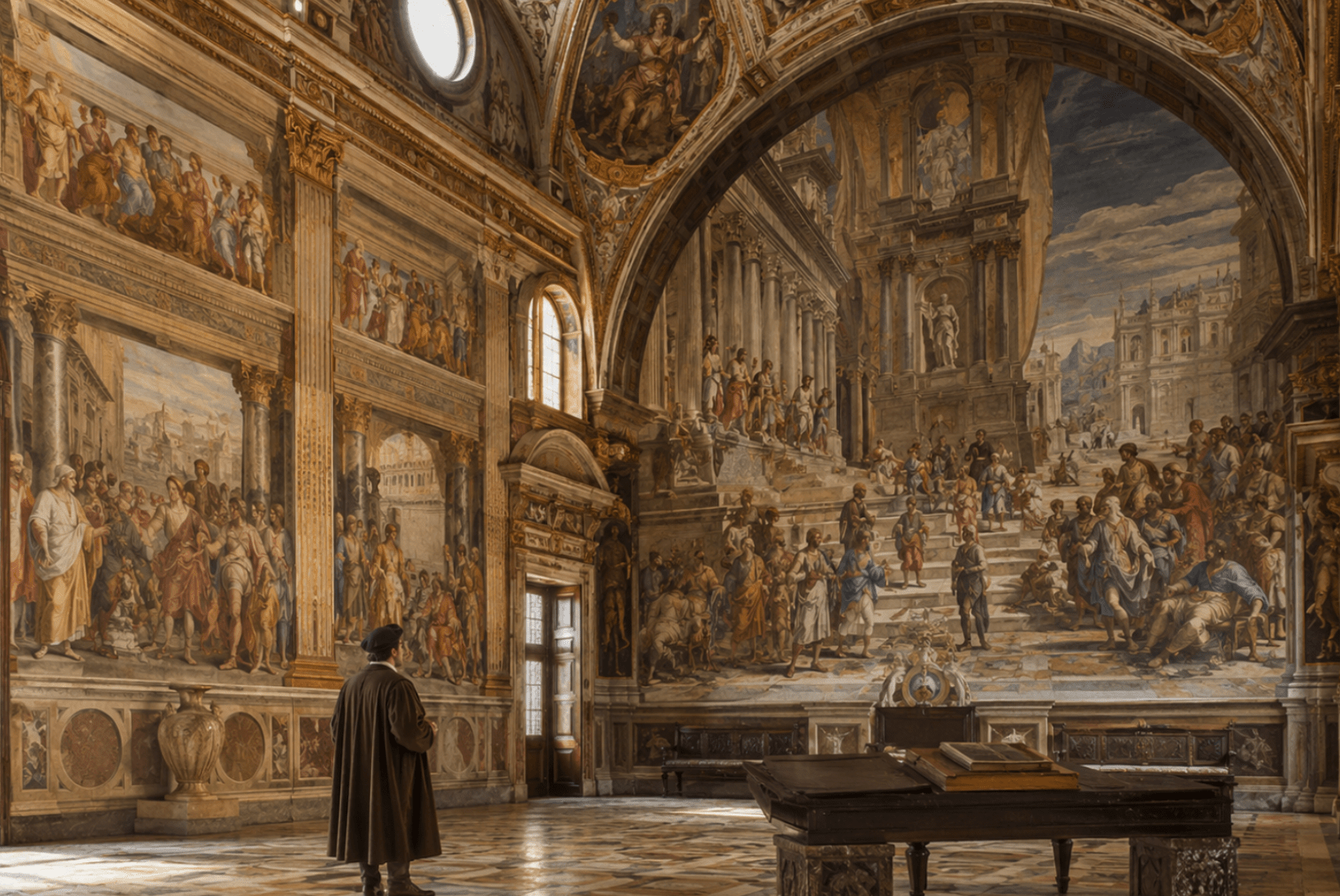
Renaissance walls were covered with frescoes and giant paintings because the wall was the largest surface in the room and the easiest way to control how the room felt. A bare wall stopped at the edge of the plaster. A painted wall could seem to open, deepen, rise, or even move. That mattered in houses, reception rooms, villas, and court spaces where image and setting had to work together.
This is the part that often gets missed. These paintings were not made to act like separate pictures hung on a surface. They were made to turn the surface into an environment. Perspective, painted stonework, false openings, distant views, and ceiling effects changed the room itself. They pulled viewers into a world that felt larger than the built space. 400 years later, image decorations play the same role, making environments more immersive, from graffiti to digital and real wallpapers which have more psychology behind them than one might think..
The wall as atmosphere
Renaissance artists understood that people respond to spaces more deeply when an image fills the room instead of sitting at its edge. To explain how true this is, and to emphasize how Renaissance minds understood a concept that is crucial in the 21st century, we will look at digital environments.
Las Vegas casinos duplicated the idea of immersiveness like masterminds. They painted the walls with ambient colors, created nice decorations on the ceilings along with bright lights, and put gorgeous carpets on the floor, ensuring some kind of 360° immersiveness. Later, online casinos developed this idea even further, and if physical casinos had limitations, digital environments were unlimited in their capacity, as everything a designer imagines can be implemented with several lines of code. That’s what slot games and famous bingo games showed us.
When people play bingo online on smartphones, they usually do not enter a plain screen with numbers on a blank background. They enter a themed space. The card remains clear, but the area around it is built with wallpapers, color sets, animated markers, sound cues, icons, and room-style frames. Those details create mood without getting in the way of play. The screen starts to feel like a place.
Bingo is especially well suited to this approach because its structure is stable. The core action stays easy to follow while the visual setting can change from one room to the next. That gives designers room to build an atmosphere around the game. Holiday rooms, garden scenes, travel themes, gold halls, vintage lounges, and fantasy backdrops all do the same job a fresco once did on plaster. They wrap a simple system in a richer sensory frame.
This is one reason themed design is so common in online casino games, and why bingo often carries it so well. Bingo rounds unfold in a steady rhythm. Players stay inside the same visual field long enough for the theme to matter. The background has time to settle into the experience. That makes immersion easy to build and easy to repeat.
How painted rooms controlled the viewer
Look at the image below, which is from the Ducal Palace in Italy. The room visible in the image is Mantegna’s Camera Picta - a great showcase of illusionistic paintings. They cover the walls and the ceilings, and even the painted light matches the real light coming into the room. That makes the painting feel connected to the actual space, or in other words, expands the space itself into vast immersiveness.
These details show that immersive wall painting still depends on space, timing, and controlled attention.
|
Site |
Current figure |
Why it matters |
|
Palazzo Ducale, Mantua |
About 35,000 square meters and more than 1,000 rooms |
Fresco programs belonged to a very large interior system |
|
Camera degli Sposi, Mantua |
1,500 entries per day |
The room still needs tight visitor control |
|
Camera degli Sposi, Mantua |
Groups of 26, maximum stay 5 minutes |
Immersion depends on how the room is entered and viewed |
|
Villa Farnesina, Rome |
Open 9:00 a.m. to 2:00 p.m., last admission 1:15 p.m. |
The visit still centers on timed movement through painted rooms |
The Old Art of Making Viewers Feel Inside the Image
The Metropolitan Museum of Art mentions: “Renaissance paintings invite the viewer to look into habitable spaces.” These walls were built to do more than display skill. They were made to turn vision into occupancy, to make a room feel entered twice, once by the body and once by the eye.
Original visual material, specifically created for this article.
That same goal now appears in museum digital work. Villa Farnesina’s current digital page presents four tools for extending the painted environment beyond a simple walk-through: an app, the Digital Loggia, a reconstruction of Chigi’s stables, and a 3D reconstruction of the atrium. The site says these projects let visitors explore frescoes and rooms through interactive digital tours and up-close viewing.
That is a modern version of the same old idea. The material has changed, but the goal is still the same: make the viewer feel like they are inside the image, and make the room feel bigger than its real walls.
Georgia o'keeffe - life and legacy