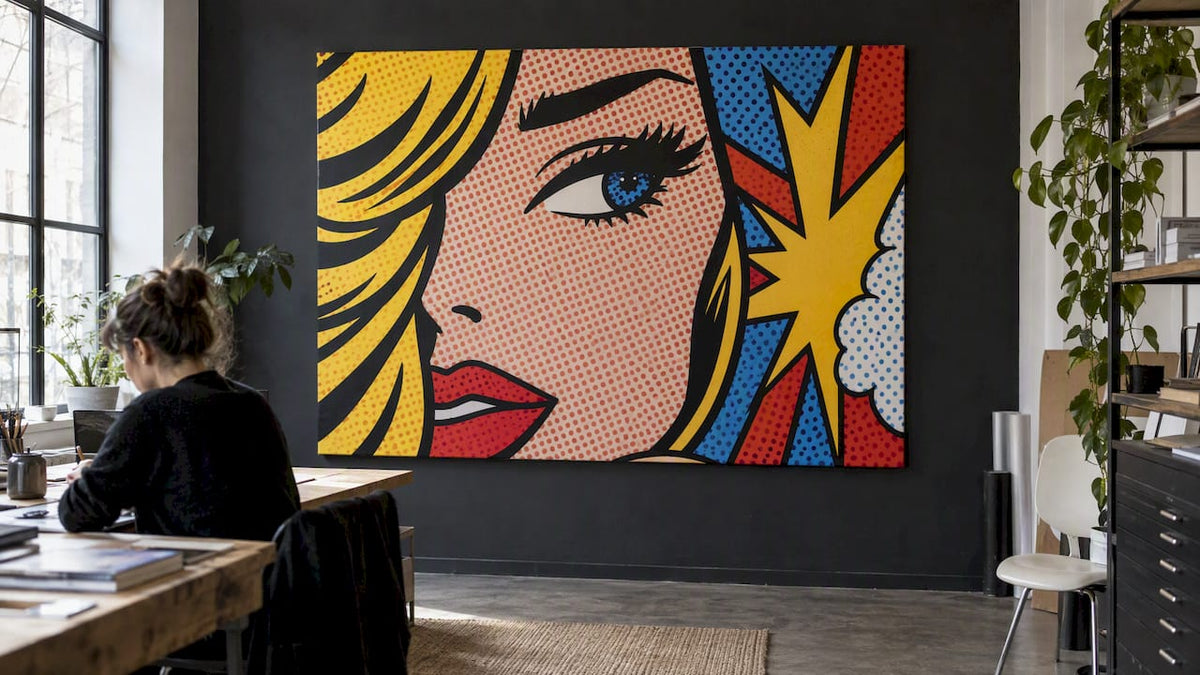
Comic pop art style is the look of a 1960s comic panel blown up to gallery scale: thick black outlines, flat primary colors, visible dots and a frozen dramatic moment, often with a speech bubble. It began with painters who borrowed from newsstand comics, and it now works as one of the most energetic ways to decorate a wall. This guide covers where the style came from, how to recognize it, how it differs from general pop art, and how to choose and hang a piece in your own space.
Table of Contents
- What comic pop art style actually is
- Where it came from: Lichtenstein and the 1960s
- Comic pop art vs. general pop art
- Why the style still works on a wall
- How to choose a comic pop art canvas
- Where to hang it
- Our perspective: comic style is about confidence, not nostalgia
- Browse comic-style canvases
- Ways to make the style your own
- Common mistakes to avoid
- FAQ
- Sources
What comic pop art style actually is
Pop art took its subjects from everyday commercial culture: advertising, packaging, newspapers, celebrity. Comic pop art narrows that to one source, the comic strip and comic book.
Five visual ingredients make the style instantly readable:
- Heavy black outlines. Every shape is closed in a bold contour, like ink on a comic page.
- Flat, saturated color. Red, yellow, blue and white sit in solid blocks with no soft blending.
- Ben-Day dots. Visible dot patterns create shading, skin tones and texture.
- Dramatic cropping. Close-ups, diagonals and cut-off figures put you inside the action.
- Text as image. Speech bubbles, captions and onomatopoeia are part of the composition.
If a piece has at least three of these, most people will call it comic pop art on sight.
Where it came from: Lichtenstein and the 1960s
Roy Lichtenstein (1923 to 1997) is the name that comes up first. According to the National Gallery of Art, he considered his 1961 painting Look Mickey his first pop painting, and he began exploring comic-strip imagery in the late 1950s and early 1960s. MoMA describes his career as grounded in imitation, starting with images borrowed from comic books and advertisements.
His most famous comic-derived work, Whaam!, dates from 1963. It is a two-panel painting that was bought by the Tate in 1966 and has hung at Tate Modern since 2006. It shows why the style works at scale: a small printed panel becomes a canvas more than 13 feet wide, and the drama grows with it.
Lichtenstein was not alone. Pop art as a movement included Andy Warhol, Robert Indiana, James Rosenquist, Tom Wesselmann and others, and The Met holds a portfolio that brings several of them together. But for the comic-panel branch, Lichtenstein is the reference point.

The dots were handmade
Ben-Day dots come from commercial printing, where tiny dots of ink let cheap newsprint reproduce more colors. Lichtenstein did not photocopy them. Per the National Gallery of Art, he used a perforated metal screen to paint the dots by hand, imitating an industrial process with a manual one.

That detail matters when you choose decor. The mechanical look is a deliberate, labor-intensive visual language, and it is part of why the style feels both playful and serious.
An honest footnote on credit
The style has a contested side. The Smithsonian reported that comic artists whose panels inspired Lichtenstein, including Russ Heath, received little credit or money while the paintings sold for millions. It is worth knowing if you collect: the strongest contemporary comic-style pieces are original compositions that borrow the visual grammar of comics rather than copying a specific artist’s panel.
Comic pop art vs. general pop art
People often use the terms interchangeably, but a designer would separate them. ArtStyles’ comparison puts the difference in narrative structure: general pop art centers on an iconic image, while comic pop art uses panel framing, action and speech bubbles to suggest a specific moment in a story.
| Comic pop art | General pop art | |
|---|---|---|
| Typical subject | A comic scene: a kiss, an explosion, a dramatic close-up | A celebrity, product, logo or advertisement |
| Signature marks | Ben-Day dots, black contours, speech bubbles | Repetition, bold flat color, graphic simplicity |
| Mood in a room | Motion, story, humor | Bold, iconic, graphic |
| Best for | Living rooms, creative offices, game rooms | Entryways, dining rooms, statement walls |
Neither is better. The choice depends on whether you want your wall to tell a story or deliver a single punchy image.
Why the style still works on a wall
The appeal is the clash between high and low. A mass-produced, disposable comic becomes a museum-scale canvas, and that tension is exactly what many collectors enjoy about it. It signals that you have a sense of humor and a sense of art history at the same time.
There is a practical side too. Because the style leans on extreme cropping, diagonals and close-ups, it draws the eye and works naturally as a focal point, whether in a living room or a creative office. And the style is a doorway: the National Gallery of Art’s curator Harry Cooper notes that Lichtenstein later moved well beyond comics while keeping his graphic vocabulary of dots and bold lines. If you start with a comic piece, you are not locked into one look.
How to choose a comic pop art canvas
Match the scene to the room
An action scene, with a burst, a diagonal or a close-up of a face mid-shout, brings energy to a space that needs it: a living room, a home studio, a gym, a creative office. A softer romantic or vintage panel suits a bedroom or a reading corner. Think about what you want to feel when you walk past it every day.
Pick a palette you can live with
Classic comic color is red, yellow, blue, black and white. That palette sits well against white, gray, black or natural wood. If your room is already full of color, look for pieces dominated by black, white and one accent, which keeps the comic structure without competing with your furniture.
Decide on scale and format
- One large canvas over a sofa or console gives the cleanest, most gallery-like result. Comic art loses nothing when it gets big, since the style was designed for scale.
- A multi-panel layout echoes a comic page layout, with each panel acting as a frame. It suits wide walls.
- A small piece works as a surprise in a hallway, bathroom or beside a desk.
Check the build quality
The style depends on crisp black lines and clean color fields, so print quality shows quickly. Look for archival inks, solid stretcher bars and a ready-to-hang setup so the canvas arrives with hardware attached. Muddy blacks or blurred dots are the giveaways of a weak print.
Where to hang it
Living room. Center it over the sofa at roughly eye level for the middle of the piece, and leave breathing room on each side. Let the rest of the wall stay quiet.
Home office or creative studio. Comic pop art reads as confident and playful without being childish. It suits agencies, studios and founders’ offices, as well as client-facing reception areas where you want a first impression with some personality.
Apartments and rentals. A single large canvas on a hook turns a blank wall into the room’s identity without any renovation. For more ideas on placement and scale, this living room art styling guide walks through practical arrangements.
Game rooms and dens. This is where multi-panel comic layouts shine, and where you can pair the canvas with other pop culture pieces.
A simple rule: one loud piece per sightline. If the canvas is the star, keep other wall art in black and white or in muted frames.
Our perspective: comic style is about confidence, not nostalgia
We work with pop art, graffiti and fashion-driven designs every day, and one pattern keeps repeating. People who buy comic-style canvases are rarely trying to recreate 1962. They want a wall that says something with a bit of attitude, the same way a good pair of sneakers or a designer bag does.
That is why we see comic pop art as a close cousin of street art and fashion graphics. All three take everyday visual language and make it bold. Our catalog of over 1,000 designs spans pop art, graffiti, black and white pieces and fashion-inspired art, and comic-style canvases tend to be the pieces that start conversations when guests walk in.
Our advice is to buy for the room, not the trend. Stand in the space, picture the piece at full size and ask whether it gives the room energy or just adds noise. If it gives energy, go bigger than you think you should. We make each canvas in the USA with archival inks, because a style built on crisp lines and flat color only works if the print holds up for years.
— James
Browse comic-style canvases
If you want to see the style on a wall, start with our Comic Pop Art Canvas or the Comic Book Pop Art Canvas. For a wider range of looks, the full Pop Art Canvas Prints collection covers everything from comic panels to collage and vintage styles. Every piece is ready to hang, made in the USA with archival inks and museum-quality materials.
Other comic-adjacent options include the Comics Pop Art Canvas and the Vintage Pop Art Canvas. If you like the graphic punch but want something grittier, our graffiti and street art collection is the natural next step.
Ways to make the style your own
You do not have to stay with literal comic panels. A few directions that keep the comic DNA:
- Portrait in dots. A face rendered with black outlines and halftone shading gives you the comic look without a scene.
- Typography first. Big onomatopoeia words or a speech bubble with a short phrase make a graphic statement that works in offices.
- Collage. Several comic fragments in one composition bring the energy of a page full of panels. Our Pop Art Collage Canvas is one example.
- Fashion crossover. Pairing comic color and outlines with luxury fashion references blends high style with street culture, a direction we know well.
Mixing with a neutral room is the safest path. Mixing with other bold art is possible but needs discipline: share one color across pieces so the wall feels intentional.
Common mistakes to avoid
- Hanging too small. A comic panel at the size of a magazine page looks like a poster. Go large or go multi-panel.
- Too many competing colors. The primary palette is strong. Let it be the only strong thing in the sightline.
- Hanging too high. The center of the piece should sit near eye level, roughly 57 inches from the floor is a common gallery rule of thumb.
- Ignoring light. Direct sun can fade any print over time. Hang away from harsh, unfiltered windows where you can.
- Choosing a copy of a famous panel. An original composition in the comic idiom avoids the credit problem described above and feels fresher.
FAQ
Is comic book art considered pop art?
Comic art itself is a commercial craft, but when painters adopted its conventions in the early 1960s as fine art, the result became a branch of pop art. Lichtenstein’s work is the clearest case. Today the term covers any piece that uses the comic look, whether it is a painting, print or canvas.
What comic art style uses dots?
The dots are called Ben-Day dots, a printing technique used to build color and shading on cheap paper. In pop art they are a visible hallmark, and Lichtenstein painted them by hand through a perforated metal screen. Modern canvas prints reproduce the dot texture digitally.
Who are the famous pop artists besides Lichtenstein?
Andy Warhol, Robert Indiana, James Rosenquist, Tom Wesselmann, Claes Oldenburg, Jim Dine, Robert Rauschenberg, Mel Ramos and Richard Hamilton are often grouped with the movement, though their styles differ a lot. The Smithsonian’s piece on Robert Indiana is a good look at one of them beyond his famous LOVE design.
What is the difference between comic pop art and regular pop art?
Regular pop art focuses on a single iconic image from consumer or celebrity culture. Comic pop art uses panel framing, action and speech bubbles to suggest a moment in a story. On a wall, that means comic pieces bring motion and narrative, while general pop art brings a clean graphic hit.
What size canvas works best for comic pop art?
Large. The style was built for scale, so a big single canvas over a sofa or desk usually looks best. For wide walls, a multi-panel set echoes the comic page layout.
Sources
- Roy Lichtenstein, National Gallery of Art
- Roy Lichtenstein, MoMA
- Roy Lichtenstein, Wikipedia
- Whaam!, Wikipedia
- Comic strip art, Tate
- The Comic Artists Who Inspired Roy Lichtenstein, Smithsonian Magazine
- Comic Book Pop vs Pop, ArtStyles
- Lichtenstein audio guide, National Gallery of Art
- 11 Pop Artists Portfolio, The Metropolitan Museum of Art
- Robert Indiana archives, Smithsonian Magazine
Interior Designer Art Sourcing: A Practical Playbook