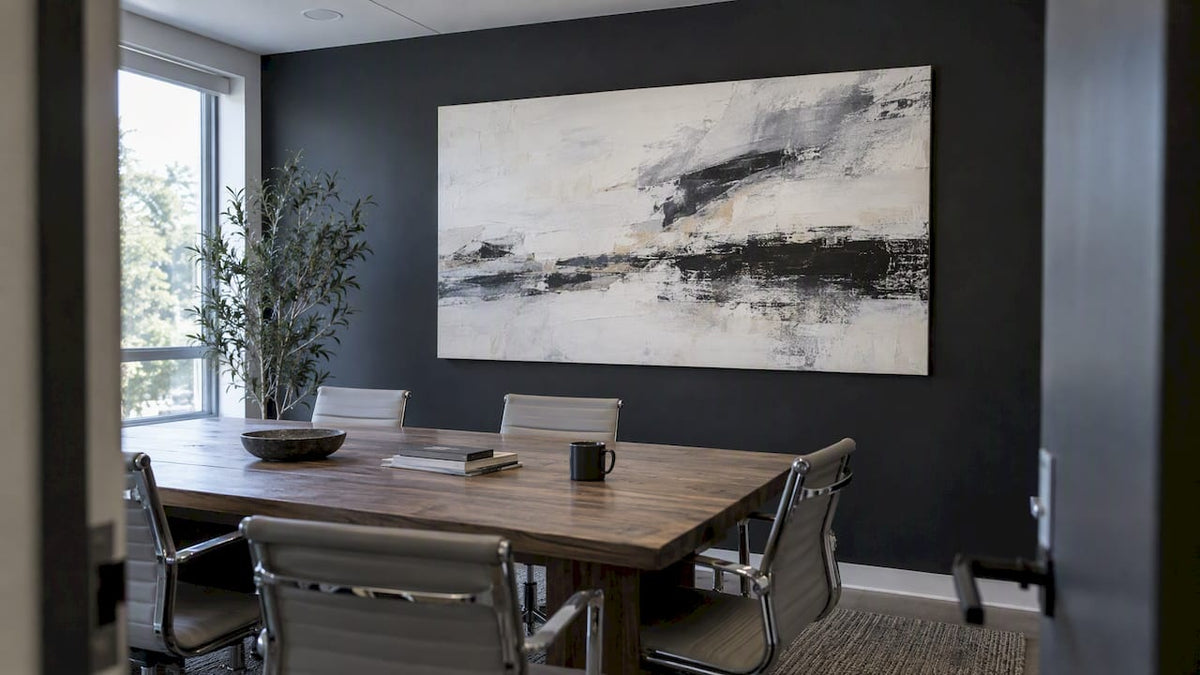
The best conference room wall art is matte, sized to the wall, and kept off the wall behind your screen and camera. Put your boldest piece on a side wall, choose canvas over glass-fronted frames, and pick imagery that supports the meeting instead of competing with it. The rest of this guide shows how to do that, room by room, including sales offices and call centers.
TL;DR
- Choose canvas or other matte finishes. Reflective glass in framed prints causes glare for people in the room and flare on camera.
- Keep the wall behind the display and camera clean and neutral. Use side walls for statement pieces.
- Size art to the wall, not to the sofa-sized habits of a home. Large single pieces or a tidy series read better than scattered small frames.
- Match the image to the room’s job: calm and tonal for boardrooms, energetic for sales and creative teams.
- Order samples of the look in your actual lighting before you commit a whole floor.
Table of Contents
- What a conference room asks of its walls
- Material: why canvas wins in meeting rooms
- Placement: protect the camera wall
- Scale: go bigger than you think
- Style: calm background or conversation starter?
- Can art improve acoustics?
- Perspective: what we see when offices order art
- Sales offices
- Call centers
- Reception and the walk to the meeting room
- A short buying checklist
- Order canvas art for your conference room
- FAQ
- Sources
What a conference room asks of its walls
A living room wall only has to look good. A conference room wall has to look good while people stare at a screen, a camera captures the room, and a dozen people sit under the same lights for an hour.
That gives you four constraints before you think about style:
- Light. Workplace guidance suggests targeting 300 to 500 lux of ambient light for clear video, with 3500 to 4000 K LEDs for neutral skin tones. Anything shiny on the wall will bounce that light straight back.
- Sightlines. Remote participants see whatever sits behind the speakers. In-person participants see the side walls for most of the meeting.
- Sound. Hard, bare walls make rooms echo. Art can help, but only if you choose it for that purpose.
- Mood. The wall should set a tone, not demand attention in the middle of a negotiation.
Get these four right and almost any style can work. Get them wrong and even a beautiful piece becomes an annoyance.
Material: why canvas wins in meeting rooms
Glass is the usual culprit. Guidance from Logitech’s room design team is to avoid framed prints with reflective glass in conference rooms, because they create distracting glare for attendees and camera flare during hybrid sessions. Canvas or matte prints are the alternative.
Canvas has practical advantages beyond glare:
- It has no glass to crack or to smudge from cleaning.
- It is light, so large formats are easier to hang on drywall or glass-partition-adjacent walls.
- Gallery-wrapped edges mean no frame to knock and no visible hardware.
- It diffuses light instead of reflecting it, which keeps the piece readable from every seat.
Our canvases are made in the USA with archival inks and ship ready to hang, which matters when facilities teams do not want to arrange a framing job. You can browse the range on the Luxury Art Canvas homepage.
Placement: protect the camera wall
Hybrid meetings changed where art goes. The rule that comes up again and again in room-design guidance: keep the wall behind the screen and camera clean and neutral to avoid glare and visual distraction for remote participants. Impact pieces belong on the side walls.
A simple layout for a rectangular room
| Wall | Role | What to hang |
|---|---|---|
| Display wall (behind screen and camera) | Quiet backdrop | Nothing, or a low-contrast tonal piece |
| Wall behind the speakers on camera | Video background | Simple, soft-toned canvas; no fine patterns |
| Long side wall | Statement | One large canvas or a triptych |
| Entry wall | First impression | Brand-led or conversation-starting piece |
Height and spacing
Hang the visual center at roughly eye level for a standing person, which is what most designers do in galleries and offices. In a conference room, remember that most people are seated, so a piece hung too high disappears above the sightline. If you are placing a series, keep gaps small and consistent so the group reads as one object.
Scale: go bigger than you think
The most common mistake is undersized art. A lone small frame on a long wall looks accidental. Our guide to art scale in large offices explains how to size pieces to the space, and our 60 to 75% wall rule for offices gives a quick way to check that a wall is neither bare nor crowded.
A workable process:
- Measure the usable wall width, subtracting doors, windows, switches, and the display.
- Decide whether you want one dominant piece, a triptych, or a horizontal series.
- Size the art to fill most of that usable width.
- Tape craft paper cut to size on the wall and look at it from the far end of the table.
Long rooms with long tables suit horizontal formats and three-panel sets. They echo the shape of the table and lead the eye along the room.
Style: calm background or conversation starter?
Research on modern offices points in a consistent direction. Work Design Magazine reports that office managers favor flexible, ambiguous environments over rigid, static ones, so artwork works best as a calm background rather than a focal point that disrupts a meeting. Newsweek’s coverage of neuroaesthetics adds that soft curves and natural light are associated with reduced cognitive fatigue, which is one reason designers are moving away from sharp, hyper-corporate rooms.
That does not mean beige. It means matching intensity to the room’s purpose.
Boardrooms and client-facing rooms
Choose restrained, high-quality imagery: black and white compositions, abstract fields of tone, or minimalist line work. Our minimalist office wall art and minimalist prints suit rooms where the conversation should stay on the table. For firms that want a more established feel, the vintage office decor guide shows how to pair classic imagery with modern spaces.
Creative, marketing, and product teams
These rooms can carry more energy. Graffiti, street art, and pop art signal that the team thinks differently. Browse our graffiti and street art canvases or pop art canvas prints. Put them on a side wall, away from the camera, and let neutral furniture carry the rest.

Fashion, retail, and luxury brands
If your business lives near fashion, brand-adjacent imagery makes sense in a client room. Our luxury art collection and hypebeast art bring a high-fashion, street-culture feel that suits showrooms, agencies, and studios.
Nature and biophilic touches
Buro Seating describes biophilic design as a core office strategy, and notes that natural materials such as stone, linen, and timber matter more than isolated plants. In a room without windows, landscape imagery in natural tones is a simple way to borrow that effect. A Japanese study on biophilic design and conference room communication looked at how these elements affect group communication, if you want to read the research itself.
Can art improve acoustics?
Sometimes, but not canvas alone. A standard stretched canvas will not fix an echoing room. Acoustic-rated art panels will. A 2024 conference paper on recycled PET felt panels in meeting rooms assessed how such panels reduce reverberation and improve speech intelligibility, and panels rated NRC 0.75 or higher are the usual benchmark for effectiveness.

Our advice: if your room echoes, solve that first with dedicated acoustic panels, then use canvas for the walls that remain. If you want both, ask your installer to place acoustic panels on the largest bare wall and keep decorative canvas on the rest.
Perspective: what we see when offices order art
We sell canvas art, so we see the same pattern in office orders. People start with the image and forget the room. They pick something they love, and then it ends up behind the screen, under glossy lights, or too small for the wall.
Our view is simple. Choose the wall before the picture. Decide which wall is the camera wall and leave it quiet. Pick a matte format. Then choose imagery that fits what the room is for. A conference room is not a gallery, but it is also not a waiting room, and a bold piece in the right place does more for a company’s culture than a dozen generic stock landscapes.
We also think office art should be bought the way a designer buys it: for a specific wall, with measurements in hand. Our guides on types of art for office environments and what commercial art installation means walk through that thinking. If you lease your space, our office wall art ideas for leased spaces covers what to hang without damaging walls.
— James
Sales offices
A sales floor is different from a boardroom. The goal is energy and momentum, and a lot of people pass through it every day. Walls can take stronger color and graphic imagery.
What tends to work:
- Large, high-contrast pieces that read from across an open floor.
- Motivational or achievement-themed imagery that is visual rather than a block of text. Quote-heavy art ages quickly and can feel preachy.
- A consistent set across the floor, so the space feels designed and not accumulated.
Keep the client-facing demo or pitch room calmer than the floor. A visitor should feel the energy on the way in and then settle into a room where they can concentrate.
Call centers
Call center walls work hard. People sit for long stretches, and visual fatigue is real. Colorado State University’s risk management team notes that poorly positioned or excessive light can cause reflected glare and visual discomfort, which is another reason to keep reflective frames off these walls.
For call centers, we suggest:
- Matte canvas only, hung where agents can rest their eyes on it during a break from the screen.
- Calming imagery such as landscapes or soft abstract work near workstations.
- Brighter, more graphic pieces in break rooms and corridors, not directly in front of desks.
- Large formats that fill walls, since small pieces get lost in rows of partitions.
Reception and the walk to the meeting room
The conference room is part of a journey. Visitors see reception, a corridor, then the room. Treat them as one sequence. Our piece on reception area wall art for offices covers the first impression, and our guide to refreshing outdated office decor with canvases helps if the whole floor needs an update rather than one room.
A short buying checklist
- Measure usable wall width and height for every wall you plan to cover.
- Mark the camera wall and the display wall as quiet zones.
- Choose canvas or another matte finish, not glass-fronted frames.
- Decide on one hero piece, a triptych, or a series per wall.
- Check the image at distance, and avoid fine patterns that shimmer on video.
- Confirm the colors suit your lighting in the room.
- Order for the number of rooms in one go, so the pieces look consistent.
Order canvas art for your conference room
We make ready-to-hang canvas wall art in the USA, with more than 1,000 designs across graffiti, pop art, black and white, abstract, motivational, and luxury fashion themes. For a conference room, start with our black and white, abstract, and photography collections for calm rooms, or the pop art canvas prints for rooms that should feel more energetic. Ordering for several rooms or a whole office? Our positioning includes volume discounts, so mention the size of your project when you get in touch.
FAQ
What is the best material for conference room wall art?
Canvas is our pick, along with other matte finishes. It scatters light instead of reflecting it, so it will not create glare for people in the room or flare on camera. Framed prints with reflective glass are the option to avoid.
Where should I hang art in a conference room?
Keep the wall behind the screen and camera clean and neutral. Hang your main piece or series on a side wall, where people can see it without it appearing behind speakers on video. Size it to fill most of the usable wall.
What style of art suits a conference room?
It depends on the room’s job. Boardrooms and client rooms suit calm, tonal work such as black and white or minimalist pieces. Creative and sales teams can handle bold graffiti or pop art, ideally on a side wall.
Can wall art help with echo in a meeting room?
Only acoustic-rated panels do that reliably. Standard canvas is mainly decorative. If your room is echoey, add acoustic panels first, then use canvas on the other walls for style.
Comic Pop Art Style: Origins, Look and How to Hang It
Home Office Wall Art Ideas That Make Work Feel Better