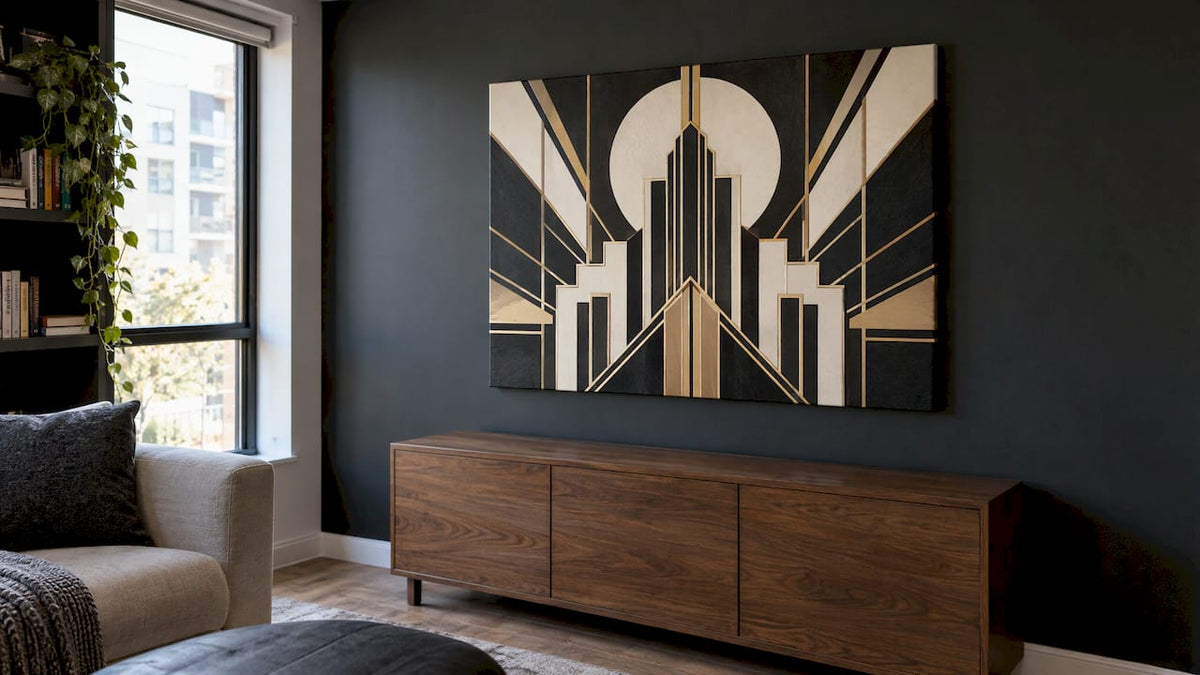
Art Deco canvas decor works best when you treat it as one confident statement, not a theme for the whole room: a large, symmetrical, geometric canvas in a jewel tone or a black-and-metallic palette, hung low enough to sit with your furniture and surrounded by quieter pieces. Designers now call this approach Neo Deco, and it suits a rented apartment, a new home or an office wall equally well. Below is how to recognize the style, pick colors, size and hang the piece, and keep it from feeling like a costume. If you want geometric and abstract canvases made in the USA and ready to hang, our modern wall art collection is a natural place to start.
Table of Contents
- What makes a canvas Art Deco
- Colors that read as Deco
- Neo Deco: the version people are decorating with now
- How to choose size, format and placement
- Styling Art Deco canvas room by room
- Combining Deco canvas with other art without clutter
- Canvas pieces that carry the Deco look
- Our view: pick the piece the room can build around
- Bring the look home
- FAQ
What makes a canvas Art Deco
Art Deco is a design movement that peaked between the world wars and left its mark on skyscrapers, cars, radios, jewelry and posters. On a canvas it comes down to a handful of visual habits.
Symmetry and geometry. TheArtStory describes Art Deco works as symmetrical, geometric, streamlined and often simple, built from repeating linear shapes such as triangles, zigzags, trapezoids and chevrons. Figures, when they appear, are highly stylized and simplified rather than realistic.

A forward-looking attitude. The Frist Art Museum’s American Art Deco educator guide explains that American designers favored a modern outlook that embraced industrial and technological progress, using abstract designs and stylized forms to symbolize a dynamic future. That is why a good Deco canvas feels sleek and a little bold, never fussy.
Luxury, but made accessible. The same guide notes that in the United States, costly European materials were often replaced by industrial ones: plastics for ivory, aluminum, steel and chrome for silver, and stained maple or walnut for mahogany and ebony. The glamour was meant to reach more people. For a modern buyer, this is useful permission: Deco does not require antiques or a big budget. It requires the look of polish, contrast and order.
Rich surfaces around the art. Architectural Digest lists lacquered surfaces, brass, stainless steel, gilt, high-end upholstery fabrics and ornamental lighting such as chandeliers and sconces as typical Deco interior elements. Your canvas does not have to supply all of that. It only has to sit comfortably next to it.
A quick test for any canvas you are considering: if you can draw a line down the middle and the two halves roughly mirror each other, and the main shapes are made of straight lines, arcs or repeated motifs, you are in Deco territory. If the image is loose, painterly and asymmetrical, it is a different style, however gold the frame.
Colors that read as Deco
Color is where Art Deco canvases earn their drama. According to Architectural Digest, traditional 1920s Deco used rich jewel-tone palettes with beiges, creams and muted yellows as complements, black for contrast and metallics, including silver, gold and rose gold, for shine. Modern interpretations can lean more minimalist but often keep bold color.
Three palettes cover most rooms:
| Palette | What it looks like | Best for |
|---|---|---|
| Black and gold or silver | High contrast, graphic, formal | Entryways, offices, dining rooms |
| Emerald, navy or deep teal with cream | Rich but calm, jewel-toned | Living rooms, bedrooms |
| Black and white with one metallic | Crisp, minimal, gallery-like | Small apartments, rentals |
Contrast is the point. An antique identification guide notes that Deco schemes favored dramatic pairings such as black with gold or silver, and emerald green with ivory. Benjamin Moore’s Art Deco palette page suggests a bold green, a cheery yellow, dusty rose, elegant navy and two neutrals, and shows saturated hues set against zebra, checkerboard and geometric patterns. If your walls are already a deep green or navy, choose a canvas with cream and metallic accents so it stands out instead of disappearing.
If your space is mostly neutral, you have the opposite option: let the canvas bring the color. A jewel-toned geometric piece over a cream sofa does more for the room than any number of throw pillows.
Neo Deco: the version people are decorating with now
True period Deco can feel heavy in a modern home. Architectural Digest’s report on the 2026 Neo Deco trend says it is less about overhauling a home in the Art Deco image and more about folding Deco-inspired elements into existing spaces, pairing rich woods such as walnut and mahogany with softer materials like wool, linen, honed stone and plaster.
The Inman real estate site describes the same trend as holding onto Deco’s geometry and symmetry with a more minimalist bent: muted jewel tones, mixed metallics and tactile materials like velvet, bouclé, fluted glass and ribbed wood. A designer quoted by Architectural Digest, Amy Pariser, sums up the contemporary approach as being about restraint and authenticity: a few good natural materials, with glossy pieces balanced by matte ones.
Interest is following. One 2026 fall decor forecast reported by Food & Drink Life says search interest in Neo Deco grew 210% year over year, and that 79% of surveyed designers chose brass over chrome for 2026. Treat those as signals of direction, not rules, but they explain why geometric canvases with warm metallic notes feel current.
For wall art, Neo Deco means a few practical choices:
- Favor clean geometry over ornate flourishes. A single bold pattern beats a crowded one.
- Choose a slightly muted jewel tone instead of a saturated primary.
- Pick one metallic family (brass and gold, or silver and pewter) and repeat it in the room.
- Let texture, such as velvet, wood grain or plaster, do the softening so the canvas can stay graphic.
How to choose size, format and placement
Most disappointing wall art fails on scale, not taste. A canvas that is too small floats; one that is too tight crowds the furniture. The guidance below comes from a statement-art styling guide, so treat it as a reliable starting point and adjust to your room.
- Size: a single oversized Art Deco canvas should measure 36 inches or more on its long side.
- Width relative to furniture: aim for two-thirds to three-quarters of the width of the sofa, console or bed below.
- Gap above furniture: start 6 to 10 inches above the top of the piece.
- Height: center the artwork around 57 to 60 inches from the floor, roughly eye level.
The same guide points out that one big piece calms a small room more than five small ones, which is the best argument for a single large canvas in an apartment.
Choosing orientation. Symmetry suits a landscape canvas above a sofa or bed, a vertical canvas in a narrow hall or beside a doorway, and a square canvas on a clean stretch of wall where you want stillness. Triptychs, three panels forming one image, bring a stepped, architectural rhythm that echoes Deco skyscraper silhouettes, as long as the gaps between panels stay even.
Canvas versus framed. A gallery-wrapped canvas, where the image wraps around the stretcher bars, has no frame to compete with your metals and reads modern. If you want a Deco feel, you can pair it with a nearby brass mirror or lamp instead of a gilt frame.
Styling Art Deco canvas room by room
Living room
The canvas goes above the sofa, where it anchors the seating. One written guide suggests a jewel-tone velvet or deep neutral sofa, a geometric statement mirror, a brass sculptural floor lamp and geometric cushions for Neo Deco living rooms, per Clevar Closet’s 2026 guide. You do not need all of it. Pick the canvas, one brass or metallic accent and one textured fabric, and stop.
Bedroom
The headboard wall is the natural spot. The same guide recommends a fan-arch or geometric upholstered headboard as the anchor, with deep-tone bedlinen and warm amber lamp shades. If your headboard is already patterned, choose a quieter canvas with fewer shapes and hang it a little higher; if it is plain, a bold geometric canvas can provide the pattern.
Apartments and rentals
Renters need impact without renovation. A single large canvas in black, white and one metallic does the most for the least effort and leaves only one or two nail holes. Because canvas is lightweight compared with a mirror or framed glass, it is also easier to move at the end of a lease.
Offices and commercial spaces
Deco’s order and symmetry read as confident and professional. A reception wall or conference room suits a wide, black-and-gold or deep-navy canvas that is centered on the furniture or the door. Keep it to one dominant piece per wall so the space reads as deliberate rather than busy.
Combining Deco canvas with other art without clutter
A Deco canvas is strongest when it leads. The 21Oak guide to blending Art Deco with your existing style advises going about half-and-half, adding jewel-toned blues and greens, pinks and creams through accents, and finishing with a few statement pieces so neither style dominates.
For walls with several works, Architectural Digest’s gallery wall guide quotes a designer who recommends anchoring the wall with at least one commanding piece and placing the rest around it, varying sizes and orientation. The same advice asks you to balance warm and cool colors, visually heavy and light pieces, and graphic, painterly and photographic works.
Applied to Deco, that gives you a simple routine:
- Hang the large geometric canvas first and treat it as fixed.
- Add one or two smaller works in a different style, such as a black-and-white photograph, with matching tones.
- Leave empty wall around the group. Space is part of the Deco look.
- Check that metals repeat: if the canvas has gold, echo it once in a lamp or frame, not five times.
We also wrote a guide to mixing and matching canvas art if you are building a larger arrangement.
Canvas pieces that carry the Deco look
Our catalog is not a period reproduction shop. It is contemporary wall art, and several pieces share Deco’s logic of geometry, symmetry and contrast. If you are shopping for that effect, start with these:
- Abstract Geometric Canvas Wall Art for repeated shapes and a graphic, balanced composition.
- Geometric Design Minimalist Wall Art for a restrained, Neo Deco feel in smaller rooms.
- Geometric Shapes Modern Wall Art when you want a bolder pattern as a focal point.
- Green Abstract Wall Art for an emerald note that pairs with cream, brass and velvet.
Our view: pick the piece the room can build around
Most people who write to us about Deco are not trying to recreate 1925. They want a room that feels polished and a little theatrical without looking like a set.
Our advice is to choose the canvas first, then the supporting cast. A strong geometric or black-and-white piece gives you a palette, a mood and a focal point. The lamp, the cushion and the brass accent follow naturally. Going the other way, buying the accents first and hunting for art to match, usually ends in a compromise.
That is also why we make canvases ready to hang, in the USA, with archival inks and materials. A large piece should be easy to put up and should hold its color for years, because it will be the first thing guests see. With more than 1,000 designs across geometric, abstract, black-and-white, luxury and pop styles, the aim is that one of them fits the wall you are standing in front of.
James
Bring the look home
If you are ready to choose, browse our Luxury Art collection for bold, high-contrast pieces suited to an entryway, living room or office. Each canvas is made in the USA with archival inks and ships ready to hang, so the work of putting up a statement piece is mostly measuring: the width of your furniture, the height from the floor, and the center point.

If you prefer a quieter, more minimal approach, our Modern Wall Art collection has geometric and abstract designs to match a Neo Deco room. Designers and business owners who need several matching pieces for a project can see the full range from our homepage.
FAQ
Is Art Deco canvas decor still in style?
Yes. Architectural Digest named Neo Deco a designer-approved trend of 2026, describing it as Deco-inspired elements integrated into existing spaces. The look is more restrained than the 1920s original, with geometry and symmetry but fewer ornaments.
What colors go best with Art Deco wall art?
Black with gold or silver is the classic pairing. Deep emerald, navy and teal with cream also work well, and brass or gold accents in the room tie them together. Use one dominant color from the canvas and repeat it once or twice in the room.
How big should an Art Deco canvas be?
For a statement piece, aim for 36 inches or more on the long side, and about two-thirds to three-quarters of the width of the sofa or bed below it. Hang it roughly 6 to 10 inches above the furniture, with its center near 57 to 60 inches from the floor.
Can I use Art Deco canvas in a small apartment?
Yes, and one large canvas usually works better than a cluster of small ones, which can make a small room feel busy. Choose black and white with one metallic if you want the style without heavy color.
Sources
- American Art Deco educator guide, Frist Art Museum
- Art Deco Interior Design, Architectural Digest
- Art Deco Movement Overview, TheArtStory
- Art Deco color palette ideas, Benjamin Moore
- Art Deco Complete ID Guide 2026, Antique Identifier
- Neo Deco trend of 2026, Architectural Digest
- Fall home design trends 2026, Inman
- Art Deco is back, Food & Drink Life
- Art Deco statement art guide, AI Home Decor
- Neo Deco Interior Design, Clevar Closet
- Blending Art Deco with your existing aesthetic, 21Oak
- How to Choose the Right Art for a Gallery Wall, Architectural Digest
Secure Wall Art in Public Spaces: A Practical Guide