
Which types of canvas art work best in open-plan spaces?
Open-plan homes demand art that does more than decorate. The right canvas actively defines zones, anchors sightlines, and holds a sprawling space together visually. The most effective types of canvas art for open plans fall into five core categories, each with distinct qualities that suit the scale and flow of open layouts.
- Stretched canvas prints are the most versatile option: ready to hang, lightweight, and available in virtually any size. Their clean profile works with both traditional and contemporary interiors.
- Gallery wrapped canvases carry the image around the edges, eliminating the need for a frame. That frameless look reads as modern and uncluttered, which suits open-plan rooms where visual noise is already a risk.
- Framed canvases add a polished border and, critically, reduce glare from natural light. In open-plan homes with large windows, anti-glare framing makes a real difference in how art reads throughout the day.
- Giclée prints reproduce fine art with exceptional color accuracy and archival durability. They suit homeowners who want gallery-quality pieces as long-term investments rather than seasonal updates.
- Split canvas and triptych sets are purpose-built for wide, open walls. Three or more panels spread across a horizontal span, creating the visual weight of a single large piece while adding rhythm and depth.
Interior design experts consistently point to large-scale abstract and cityscape canvases as the strongest anchors for open-plan rooms. A single oversized piece with perspective elements, layered depth, or architectural texture gives the eye a natural resting point, preventing the space from feeling scattered.
How wall art defines zones in open floor plans
Without physical walls, open-plan rooms rely on visual cues to separate the living area from the dining space, the kitchen from the study nook. Canvas art is one of the most effective tools for drawing those invisible lines.
- Scale signals function. A large, bold canvas behind the sofa immediately reads as “living zone.” A smaller, quieter piece above the dining sideboard signals a shift in purpose without any physical barrier.
- Subject matter sets tone. Large cityscape canvases establish spatial structure and emotional atmosphere in primary living areas. Softer landscapes or florals work better in dining zones, where the mood calls for something less commanding.
- Placement anchors furniture groupings. Hanging a canvas directly behind the sofa or above a dining credenza ties the artwork to the furniture below, creating a cohesive zone rather than a collection of unrelated objects.
- Color bridges adjacent areas. When the canvas in the living zone shares at least one tone with the piece in the dining area, the two zones read as connected rather than competing.
- Triptychs create soft boundaries. Three panels spread across a wide wall define the zone they occupy without closing it off. The gaps between panels let the space breathe while still asserting a clear visual territory.
- Rugs and art work together. A canvas anchors the wall; a rug anchors the floor. Together, they frame a zone from two directions, which is far more convincing than either element alone.
Pro Tip: Place your largest canvas in the primary living zone first, then choose dining and kitchen pieces that echo its palette. Working outward from one anchor keeps the whole floor plan visually coherent.
How to style canvases for cohesion and balance across open plans
The single biggest mistake in open-plan decorating is treating each zone as its own independent gallery. When every area has a high-impact statement piece, the room feels scattered rather than curated.
- Establish one palette family. Designers recommend choosing a single color family, such as earth tones or coastal neutrals, and carrying it across every canvas in the space. The zones read as variations on a theme rather than separate rooms.
- Use a size hierarchy. One dominant “lead” piece belongs in the primary living zone. Supporting canvases in adjacent areas should be noticeably smaller and quieter. Giving every zone equal visual weight creates the visual competition that makes open plans feel chaotic.
- Keep spacing consistent. For triptychs and gallery walls, maintain a gap of 2–4 inches between frames. Consistent spacing creates visual connection; uneven gaps make an arrangement look accidental.
- Mix orientations deliberately. Vertical canvases draw the eye upward and work well in rooms with tall ceilings. Horizontal canvases widen a wall and suit standard 8–9 foot ceilings above sofas or sideboards. Mixing both in a single open plan adds rhythm without confusion.
- Limit statement pieces to one zone. Bold, high-contrast art belongs in the living area. The dining and kitchen zones support that anchor with subtler, complementary works.
Pro Tip: Before hanging anything, cut kraft paper templates to the exact canvas dimensions and tape them to the wall. You’ll catch proportion problems and awkward gaps in minutes, not after you’ve drilled.
A detailed look at canvas print types and styles
Understanding the technical differences between canvas print types helps you choose not just what looks good, but what holds up and performs well in open-plan lighting conditions.
| Type | Edge style | Finish options | Best for open plans | Durability |
|---|---|---|---|---|
| Stretched canvas | Bare wood edge | Matte, satin, glossy | Versatile anchor pieces | High |
| Gallery wrapped | Image wraps edge | Matte, satin | Modern, frameless look | High |
| Framed canvas | Decorative frame | Anti-glare glass | Well-lit rooms, glare control | Very high |
| Giclée | Varies | Archival matte | Fine art reproductions | Very high |
| Photo canvas | Bare or wrapped | Satin, glossy | Personal photography | High |
| Split/triptych | Separate panels | Matte, satin | Wide horizontal walls | High |
| Fine art canvas | Varies | Archival matte | Gallery-quality statements | Very high |
| Hand-embellished | Varies | Textured, mixed media | Tactile focal points | High |
| Rolled canvas | None (unframed) | Matte | Storage, custom framing | Medium |
The nine main canvas print types each serve a different purpose in open-plan settings. Here is what actually separates them in practice.

Stretched and gallery wrapped canvases are the workhorses of open-plan decorating. Stretched prints sit flush against the wall with a clean wood-edge profile. Gallery wrapped prints carry the image around the sides, so the artwork continues even at the edges. Both hang without frames, which keeps the visual weight low in rooms that already have a lot going on.
Framed canvases add structure and refinement. The frame creates a small gap between the print and the border, so the full image stays visible. More practically, framed prints with anti-glare glass handle direct sunlight far better than bare canvas, which matters in open-plan homes where windows often flood the main living area.
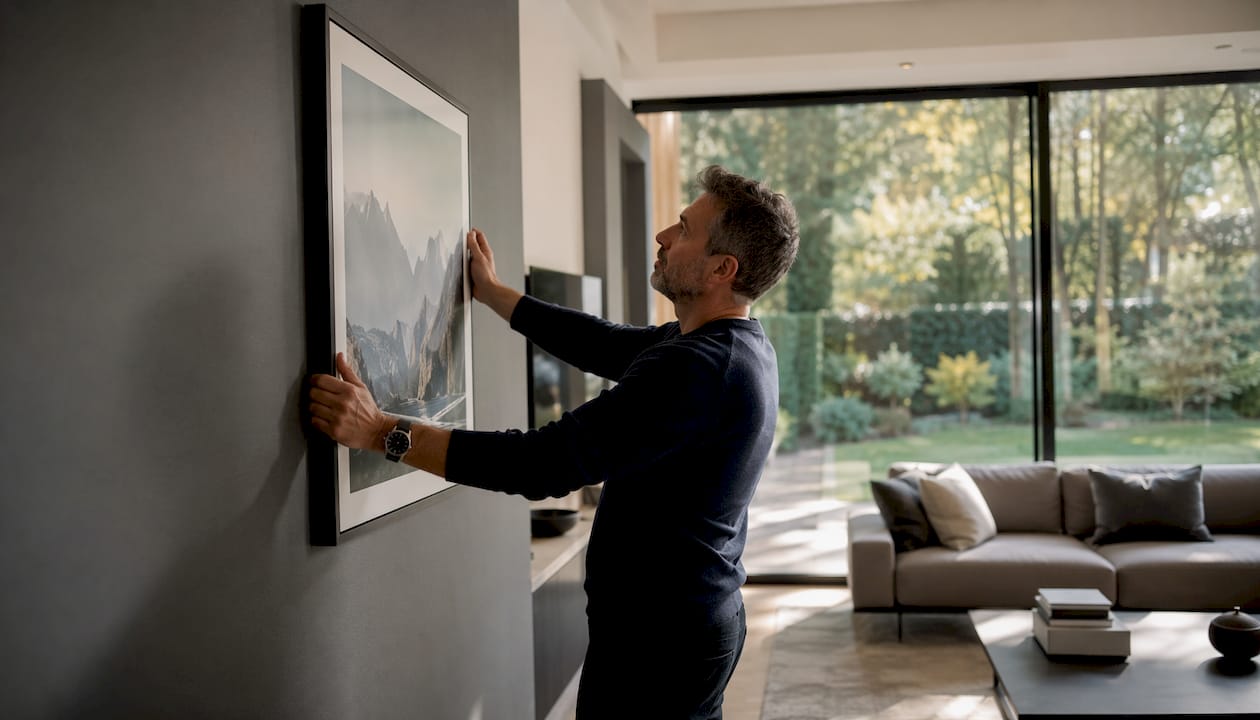
Giclée and fine art canvases use archival inks and high-resolution printing to reproduce original artwork with accuracy that holds up at large scale. If you’re hanging a 60×40-inch piece as the room’s primary focal point, giclée quality prevents the pixelation and color drift that cheaper prints show over time.
Split canvas and triptych sets solve a specific open-plan problem: wide walls that need visual weight but can’t support a single canvas large enough to fill them. Three coordinated panels spread across 6–8 feet of wall create the impact of an oversized piece with better proportional flexibility. Abstract compositions and cityscape panoramas translate especially well to this format.
Hand-embellished canvases add physical texture through brushwork applied over the printed surface. In open-plan rooms with strong natural light, that texture catches and shifts with the light throughout the day, giving the piece a quality that flat prints can’t replicate.
How to choose and personalize canvas art for your open-plan home
Sizing is where most decorating decisions go wrong. A canvas that looks proportional in a product photo can disappear on a large open-plan wall, or overwhelm a modest dining nook.
- Follow the 50–75% rule. Professional sizing standards recommend that canvas art above furniture should cover 50–75% of the wall width. For a standard 84-inch sofa, designers typically recommend canvases between 55 and 60 inches wide.
- Hang at eye level. The industry standard is to position the center of the canvas 57–60 inches (145–152 cm) from the floor. This holds across most rooms regardless of ceiling height.
- Size up for great rooms. In open-plan spaces with high ceilings or long sightlines, the two-thirds rule often produces a canvas that reads as too small. Professionals adapt by going larger, using oversized pieces as dominant spatial anchors rather than decorative accents.
- Match finish to lighting. Glossy finishes amplify natural light but create glare near windows. Matte finishes absorb light evenly and read more consistently throughout the day. In open-plan rooms with mixed natural and artificial light, matte or satin is usually the safer choice.
- Personalize through theme, not just color. Abstract art, graffiti-inspired pieces, and pop art all work at large scale in open plans. The key is choosing a theme that holds its energy at the size you need. A bold graffiti canvas that commands attention at 48×60 inches can anchor a living zone the way a quiet botanical print simply cannot.
- Integrate with existing décor. Pull one accent color from your rug or throw pillows into the canvas palette. That single shared tone ties the art to the furniture grouping and makes the zone feel intentional rather than assembled.
- Avoid clutter through restraint. One large canvas almost always reads better than three small ones covering the same wall area. In open plans especially, fewer, larger pieces create calm. More pieces create noise.
Luxuryartcanvas has the statement pieces your open plan needs

Open-plan walls call for art with presence. Luxuryartcanvas specializes in bold, large-format canvases crafted in the USA, with over 1,000 designs spanning graffiti, pop art, and fashion-inspired prints from iconic names. Every piece is built for visual impact at the scale open-plan rooms demand.
Browse the graffiti canvas collection for statement anchors that command a living zone, or explore the pop art canvas range for vibrant focal points that hold their energy across a wide open floor plan. Backed by 10,000+ satisfied customers, Luxuryartcanvas delivers the kind of art that makes a room.
Key takeaways
Open-plan homes need canvas art that anchors zones, maintains a unified palette, and scales to the wall rather than the furniture alone.
| Point | Details |
|---|---|
| Lead with one anchor piece | Place the largest, boldest canvas in the primary living zone and let adjacent areas support it. |
| Follow the 50–75% sizing rule | For balanced proportion, canvas width above furniture should cover 50–75% of the wall width. For a standard 84-inch sofa, designers recommend a canvas between 55 and 60 inches wide. |
| Use a single palette family | Carry one color family across all zones so the open plan reads as cohesive, not competing. |
| Hang centers at 57–60 inches | Position the canvas center 57–60 inches (145–152 cm) from the floor for comfortable, balanced viewing. |
| Match finish to light conditions | Choose matte or satin finishes in rooms with strong natural light to avoid glare and color shift. |
Branded Office Wall Decor: What It Is and Why It Works
What Is High-End Graffiti Art? A Collector's Guide