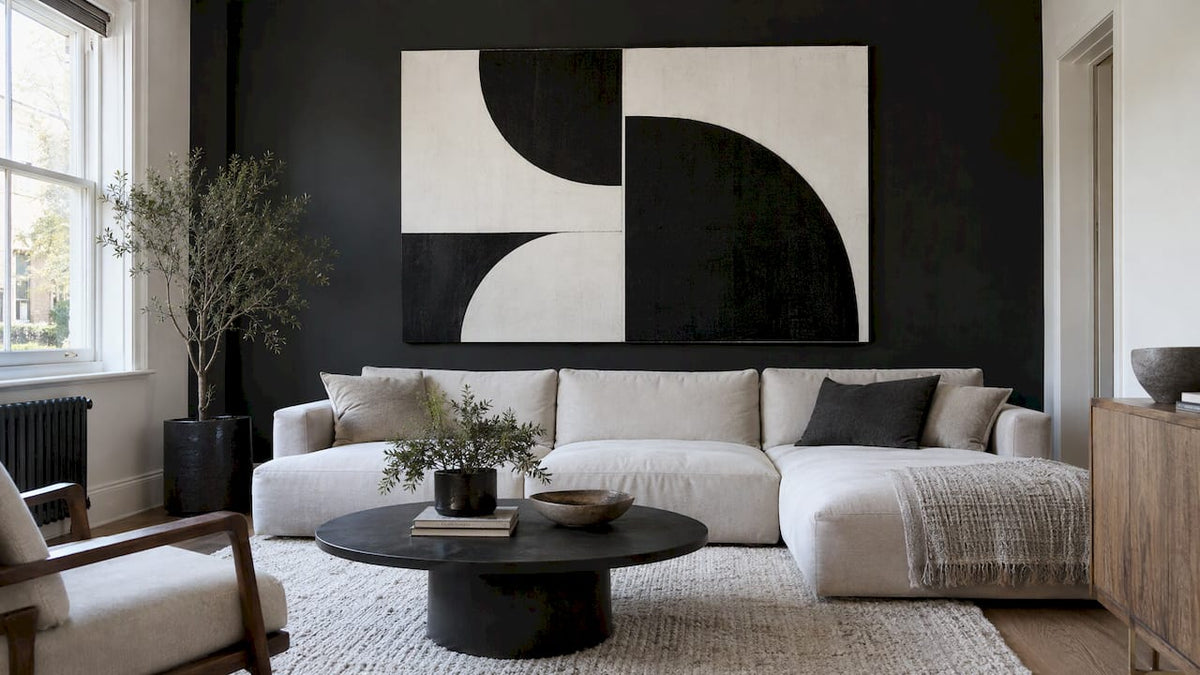
A minimalist statement canvas is one large, quiet piece of art that anchors a wall through scale, negative space and a restrained palette instead of busy detail. To get it right, pick one direction (line art, geometric shapes or tonal abstract), size the canvas to the furniture below it, hang it with its center near eye level, and let the wall around it stay empty. This guide walks through each decision, with examples for living rooms, offices and bedrooms.
TL;DR
- A statement canvas works through scale and restraint: one big piece, few colors, plenty of empty wall around it.
- Choose a lane first (line art, geometric shapes, black and white abstract or soft neutral), then the size, then the placement.
- Aim for a canvas roughly two-thirds the width of the sofa, bed or console beneath it, with its center near eye level.
- Keep it out of direct sunlight and leave deep cleaning to a conservator.
- Ready-to-hang canvases made in the USA are available from us in line art, geometric and abstract minimalist styles.
Table of Contents
- What makes a minimalist canvas a statement piece
- Four minimalist directions to choose from
- How to choose the size
- How to choose the colors
- Where and how to hang it
- Matching minimalist canvas to your interior style
- Minimalist canvas for living rooms, offices and bedrooms
- Our perspective on minimalist statement art
- Caring for your canvas
- Find your piece
- FAQ
- Sources
What makes a minimalist canvas a statement piece
Minimalism and “statement” sound like opposites. One is about taking things away, the other about being noticed. They meet in a single idea: when everything else in the composition is stripped back, the few things left carry all the weight.
The art movement behind the word helps explain this. Tate describes Minimalism as an extreme form of abstract art that developed in the USA in the 1960s, typified by simple geometric shapes based on the square and rectangle, with no attempt to represent outside reality. A canvas inspired by that tradition does not tell a story or compete with your furniture. It sets a tone.
In a home or office, a minimalist piece becomes a statement through four things:
- Scale. A small print reads as an accessory. A large canvas reads as architecture. Size does more to turn a quiet design into a focal point than any other choice.
- Contrast. A few confident black lines on a white ground, or a single dark shape on a pale field, are visible from across the room.
- Negative space. The empty area inside the canvas, and the blank wall around it, is part of the design. Crowding it with neighbors removes the effect.
- Finish and materials. With little to look at, the quality of the surface matters more. Crisp edges, even ink and a sturdy stretched frame are what the eye registers.
The result is a room that feels composed rather than decorated. That is why designers reach for this kind of piece when a space needs a clear point of view without clutter.
Four minimalist directions to choose from
Before you measure a wall, decide which kind of minimal you want. Once you pick a lane, the size, the frame style and even the room tend to follow. Here are the four we see most often.
Line art
Continuous lines, single-stroke faces and simple figures on a plain background. Line art feels personal and light, and it suits bedrooms, reading corners and entryways. Our Minimalist Line Art and Minimal Line Abstract Wall Art canvases are examples of this direction, and Minimalist Drawing Wall Art sits close to it with a more sketched feel.
Geometric shapes
Circles, arches, rectangles and overlapping forms in a limited palette. This is the direction closest to the 1960s movement’s love of basic forms, and it works well in rooms with straight lines such as modern living rooms and offices. See Abstract Geometric Canvas Wall Art and Abstract Shapes Minimalist Wall Art.
Black and white abstract
High contrast, no color decisions to make. A black and white canvas pairs with almost any palette and gives you the strongest read from a distance. Our Minimalist Black And White Abstract Art is built for this role.
Soft tonal abstract
Creamy whites, sand, stone and gentle gradients. These pieces calm a room rather than energize it, which makes them a natural choice for bedrooms and open living spaces with warm light. Minimalist Abstract Wall Art fits here.
If you cannot decide, choose by the feeling you want when you walk in. Calm points to tonal abstract or line art. Sharp and architectural points to geometric or black and white.
How to choose the size
Size is where most minimalist wall art goes wrong, and almost always in the same direction: too small. A modest canvas floating on a large wall looks like an afterthought, and the minimalist idea of “less” turns into “not enough.”
A widely used designer rule of thumb is to make the artwork about two-thirds the width of the furniture beneath it. Treat it as a starting point rather than a law.
| Wall situation | Starting point for the canvas |
|---|---|
| Above a sofa | About two-thirds of the sofa’s width, one large piece or a wide horizontal |
| Above a bed | About two-thirds of the headboard or bed width, often horizontal |
| Above a console or sideboard | Slightly narrower than the console so it sits inside its edges |
| Empty wall with no furniture | A tall vertical or an oversized square, with generous space on each side |
| Narrow wall or hallway | A vertical canvas, or a pair of identical verticals |
To test a size before you commit, cut a piece of kraft paper or painter’s paper to the dimensions you are considering and tape it to the wall. Live with it for a day. If it feels slightly bigger than you expected, it is probably right.
One large canvas usually beats a cluster of small ones in a minimalist room. If one piece does not suit the space, a diptych (two matching canvases hung with a narrow, even gap) keeps the calm while covering more width.
How to choose the colors
Start from what is already in the room, then decide how much you want the canvas to stand apart from it.
- Blend in. Pick tones already present in the walls and textiles, such as warm white, greige or stone. The canvas adds depth without adding a new color.
- Contrast. Pick black, charcoal or a single deep accent against a pale wall. This is the stronger statement and the easier one to see from the door.
- Echo one object. Pull a single color from a rug, a chair or a piece of ceramics and repeat it in the canvas. The room feels planned.
Limit yourself to two or three colors in the artwork. That limit is part of what keeps a piece minimalist. If your space is already full of pattern, a black and white or tonal canvas will rest the eye. If your space is neutral, a canvas with a single bold shape gives it the focus it lacks.
Where and how to hang it
The most repeated guideline in gallery and interior practice is to hang art so its center sits near average eye level, commonly cited as about 57 inches from the floor. Measure to the center of the canvas, not to the top or the hook, then work out where the hook goes from the canvas’s hanging hardware.
Above furniture, leave a gap of roughly 6 to 10 inches between the top of the sofa back or headboard and the bottom of the canvas, so the two read as one grouping instead of two separate objects. If the ceiling is high, keep the gap rather than lifting the art toward the ceiling.
A few placement habits that suit minimalist pieces:
- Give it a clear wall. Do not hang a statement canvas next to a mirror, a shelf of objects and a clock. Let it be the one thing.
- Use symmetry or deliberate asymmetry. Center it over the furniture, or offset it on purpose with a plant or a floor lamp beside it. Avoid “almost centered.”
- Mind the light. Soft side light from a window or lamp makes textured and tonal pieces look deeper. Harsh direct sun, discussed below, is another matter.
- Think about the sight line. Hang the canvas where you will see it from a seated position as well as standing, such as across from a sofa or at the end of a hallway.
Because our canvases arrive ready to hang, the work comes down to measuring, marking the wall and mounting.
Matching minimalist canvas to your interior style
Minimalist art is flexible, which is why it suits so many homes. What changes from style to style is the lane, the palette and the scale.
Modern and contemporary
Geometric or black and white abstract canvases echo clean lines in the furniture. Keep the frame simple and the wall color pale or deep and uniform.
Scandinavian and Japandi
Tonal abstract and soft line art in warm whites and light neutrals fit light wood, linen and plants. Choose a horizontal format above a low sofa or bed to keep the room’s low, calm profile.
Industrial
Black and white pieces and bold single shapes stand up to brick, concrete and metal. Go large, because rough surfaces can swallow a small canvas.
Transitional and traditional
A single line art or tonal abstract canvas adds a contemporary note without clashing with classic furniture. It is a simple way to update a room without replacing anything.
Eclectic and maximalist rooms
A minimalist statement canvas works as a pause. Hang one large, quiet piece in a room of pattern and collected objects, and give it space around it.

Minimalist canvas for living rooms, offices and bedrooms
Living room. The sofa wall is the natural home for the main canvas. A wide horizontal in geometric or tonal abstract anchors the seating area. We offer a Living Room Minimalist Wall Art piece made with this wall in mind.
Office. A professional space benefits from art that signals focus without distraction: black and white abstract, or geometric shapes in two colors. Place it behind the desk, where video calls will frame it, or opposite the entrance so visitors see it first. See our Minimalist Office Wall Art for a piece chosen for working spaces.
Bedroom. Line art and soft tonal canvases above the headboard set a quiet mood. Keep the palette close to the bedding and walls for a restful effect. Minimalist Nude Art is a line-based figure study that suits adult spaces such as bedrooms and dressing rooms.

Entryway or hallway. A tall vertical canvas gives a narrow space a focal point without crowding it.
Our perspective on minimalist statement art
We build our catalog around the idea that wall art should make a space feel like someone’s. Most people know that bold graffiti or fashion-inspired pieces do that. Fewer realize that a quiet canvas can do the same job when it is sized and placed with intent.
What we see over and over is that minimalist buyers do not want “safe.” They want a piece that holds up under daylight and close inspection, because there is nothing busy to hide behind. That is why our canvases are crafted in the USA with archival inks and high-quality materials, and why we design them to arrive ready to hang.
Our advice is to buy bigger than feels natural, pick one direction and give the piece room. A single large canvas in line art, geometric shapes or black and white abstract will do more for a wall than a gallery of small prints. If you want a pairing, put one minimalist piece in the calm room and one of our bolder pop art or graffiti canvases in the room where you entertain.
James
Caring for your canvas
A minimalist piece shows its surface plainly, so keep it in good condition from day one.
- Avoid direct sunlight. The Canadian Conservation Institute advises that direct sunlight should be totally avoided because light damage cannot be reversed. When choosing a wall, favor one that does not get hours of sun on the canvas.
- Dust gently. Use a soft, dry, clean brush or cloth and light strokes. Skip sprays and household cleaners.
- Leave deeper cleaning to a professional. The same institute says cleaning a painting’s surface or repairing damage is best left to a professional conservator. If a canvas is marked, stained or damaged, contact a conservator rather than treating it yourself.
- Keep the air steady. Hang away from radiators, vents and damp walls, and out of the direct line of a kitchen range or a shower.
Find your piece
If you are ready to choose, start with our minimalist range and pick the lane that fits your room. Every canvas is made in the USA, arrives ready to hang and is part of a catalog of more than 1,000 designs.

Browse our Black & White Art, Abstract Art and other collections to compare formats and styles. If you want a bolder companion piece for another room, our Luxury Art collection pairs well with a calm minimalist canvas.
FAQ
What size should a minimalist statement canvas be?
As a starting point, choose a canvas about two-thirds the width of the furniture below it, such as a sofa, bed or console. Go larger on an empty wall, since oversized pieces create the statement. Tape a paper template to the wall first to see the scale.
What is minimalism in art?
Tate defines Minimalism as an extreme form of abstract art developed in the USA in the 1960s, built on simple geometric shapes with no attempt to depict the outside world. Today the word also describes decor with simple compositions, limited color and generous empty space.
How high should I hang a minimalist canvas?
A common guideline is to place the center of the canvas near eye level, often cited as about 57 inches from the floor. Above a sofa or bed, leave a gap of roughly 6 to 10 inches between the furniture and the canvas so they read as one group.
Can I hang minimalist art in a busy room?
Yes. One large, quiet canvas gives a patterned or crowded room a place to rest. Keep the wall around it clear, and choose a palette that repeats one color already in the room.
How do I look after a canvas?
Keep it out of direct sunlight, dust it gently with a soft dry cloth and avoid cleaning sprays. For stains or damage, the Canadian Conservation Institute recommends a professional conservator.
How to Avoid Canvas Glare at Home and in Photos