Money themed wall art is any piece built around cash, currency or the idea of wealth. That covers a close-up dollar bill on canvas, a pop art hundred, graffiti with stacks of cash, and abstract work in green and gold. It works best when you treat it like a statement piece, not a gag. Pick one strong image, size it to the wall, keep the rest of the room calm, and hang it at eye level. This guide shows you how to do that, and what to check before you buy a canvas.
TL;DR
- Money canvases come in four main looks: realistic currency, pop art, graffiti and street art, and abstract or luxury work that hints at wealth without showing a bill.
- One large piece beats several small ones. Let it be the loudest thing on the wall and keep the nearby colors quiet.
- Check the canvas before you buy: gallery-wrapped stretcher bars, archival inks, a finished edge and hanging hardware already attached.
- In the US, color images of currency are legal when they meet the size rules in the Counterfeit Detection Act of 1992, so reputable art is scaled accordingly.
- Hang the center of the piece at about 57 inches from the floor, and map the layout with painter’s tape first.
Table of Contents
- What counts as money themed wall art
- A quick look at the legal side
- Which rooms suit money themed art
- How to style a money canvas so it feels intentional
- Size, orientation and panels
- What to check before buying a canvas
- Perspective: why money art works when it is done well
- Where to find a money-inspired canvas from us
- A simple plan for choosing yours
- FAQ
- Sources
What counts as money themed wall art
The search results for this topic are a mix of shop categories, marketplace listings, Pinterest boards and digital downloads. That tells you the market is wide, and it is easy to buy the wrong thing. A digital download is a file you still have to print, trim and mount. A DIY board is a craft project. A finished canvas is the only one of the three that arrives ready to hang.

If you want a finished piece, these are the styles you will meet.
Realistic dollar bill art
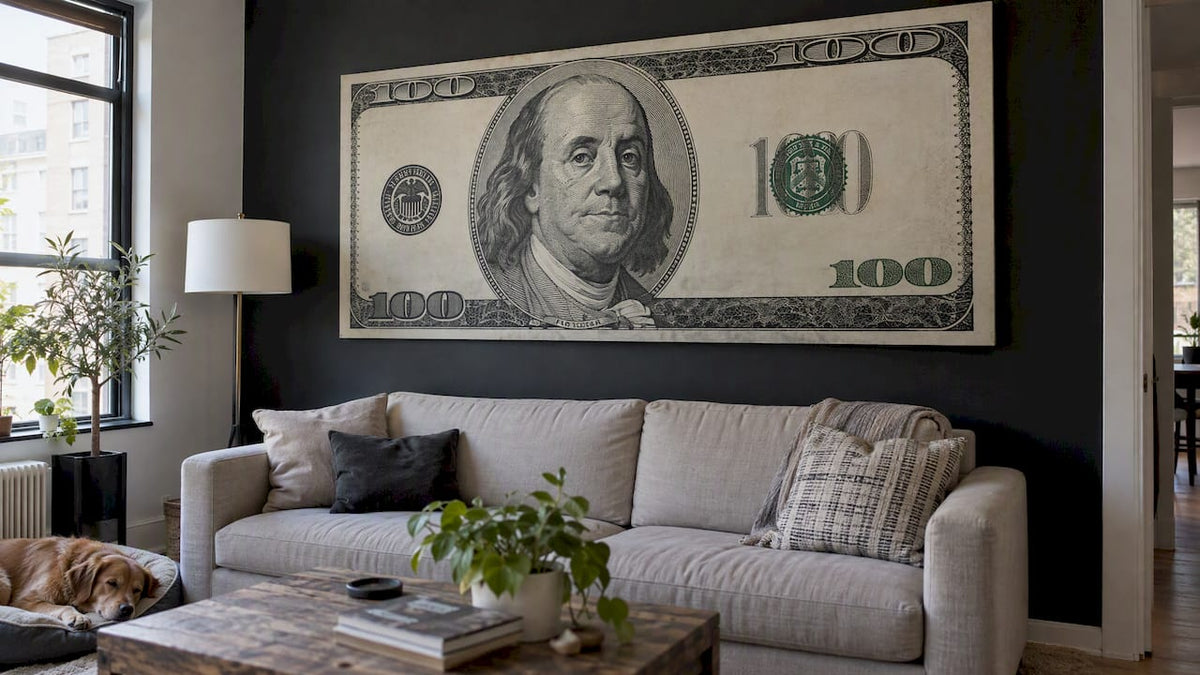
This is the most literal category. A single bill, often a hundred, is enlarged so the portrait, the ink texture and the fine lines become the artwork. Some versions use the original green, others recolor it in red, black and white, or gold. It suits readers who want the object itself, not an interpretation.
The risk is that it reads as a joke if it is small and cheaply framed. It reads as a design choice when it is large, cropped tightly and given space.
Pop art money
Pop art takes the bill and flattens it into bold color blocks, repeated panels or halftone dots. It sits in the tradition of turning everyday consumer objects into art, and it is the easiest style to place in a modern living room or office because the color is deliberate. If this is your direction, our pop art canvas prints are the place to start.
Graffiti and street art money
Cash is a recurring subject in street art: spray-painted notes, stacks of bills, dripping dollar signs, stencils with a satirical edge. These pieces have energy and texture, and they suit apartments, studios, game rooms and creative offices. Browse graffiti wall art and street art canvas for this look.
Luxury and fashion-flavored wealth art
Some buyers want the feeling of money without a literal bill. That is where designer-inspired work comes in: monograms, fashion editorial imagery, gold and black palettes. It says success through taste instead of through cash. Our luxury art collection and HypeBeast art lean this way, and they pair well with a money piece if you want a gallery wall with one theme.
Abstract and minimalist takes
A green, gold and black abstract canvas can carry the same mood in a subtler way. It is the safest choice for a shared space or a client-facing office. See abstract modern canvas wall art or minimalist prints if you want the idea without the dollar sign.
A quick look at the legal side
People often ask whether it is allowed to put a dollar bill on a wall in enlarged form. In the US, the rules come from the Counterfeit Detection Act of 1992. According to a summary of the rules on reproducing money, color illustrations of US currency are permitted when they are smaller than three-quarters or larger than one and one-half times the linear size of any part of the bill, and the other conditions in that rule are met.
The practical takeaway for a buyer: a large canvas of a bill is by definition far over 150 percent of the original, so it falls on the right side of the size test. If you are commissioning a custom piece, or you are a business that wants to use a currency image in marketing as well as on the wall, ask a qualified attorney or check the Secret Service’s guidance first. Decorative art on your own wall is a different matter from advertising.
Which rooms suit money themed art
Not every room can carry the same piece. Here is how the styles map to spaces.
| Space | Best style | Why it works |
|---|---|---|
| Home office | Realistic bill, abstract green and gold | Keeps focus on goals without looking like a joke |
| Living room | Large pop art or luxury piece | A big, single focal point over the sofa |
| Apartment or studio | Graffiti and street art | Adds energy and texture to plain rented walls |
| Game room or den | Graffiti cash, HypeBeast | Casual setting, so louder is fine |
| Commercial office or lobby | Abstract, minimalist, black and white | Signals ambition while staying professional |
| Bedroom | Quiet abstract or monochrome | Money themes tend to be too loud for a place to rest |
A few notes on this table.
Home offices are the natural home for this art. Many buyers want a piece that reminds them why they work, and a motivational angle is built in. Put it where you see it from your desk, not behind your chair where only visitors on a video call will.
Living rooms can take the boldest piece if the furniture is simple. A single large canvas above a sofa sets the tone for the whole room.
Business spaces need more care. Clients and staff see the art. A realistic hundred-dollar bill in a reception area can feel off-message for some industries, such as healthcare or nonprofits, and perfectly right for a trading floor, a barbershop, a creative agency or a real estate office. If you are not sure, go for pop art or abstract work.
How to style a money canvas so it feels intentional
Bold art goes wrong in one of two ways: it fights with everything around it, or it sits on the wall looking lonely. These rules keep it balanced.
Pick one hero and let it lead
Decide which piece is the focal point and give it room. If the canvas is the loudest object on the wall, the sofa, rug and lamp should be calmer. A money piece with a lot of green looks best next to neutrals: charcoal, cream, warm gray, black, natural wood.
Pull two colors from the art
Look at the canvas and choose two colors in it, such as the deep green and a gold or cream. Repeat one of them in a cushion, a vase or a throw. You do not need to match everything. Echoing a single color is enough to make the art look planned.
Add texture below the art
Graphic, flat art looks sharper against something tactile. Natural materials such as wood, linen, leather or a hide rug soften the visual punch. If you want ideas for building that kind of warmth around a statement wall, this piece on styling a living room with goatskin shows how a single natural texture can anchor a room.
Keep the surrounding wall quiet
Do not surround a dollar bill canvas with six small frames. If you want a gallery wall, keep one dominant piece and let the others be smaller, simpler and in a matching color family. Black and white work is a reliable support act, and it ties together well with a green or gold lead. See our black and white art and Vintage prints for options that sit comfortably alongside.
Match the humor to the room
Money art has a wink built in. Decide how much of it you want. A cropped, slightly abstract bill is dry and stylish. A cartoonish stack of cash with a dollar-sign neon glow is playful. Neither is wrong, but the room should agree with the choice. A bar, studio or game room can take playful. A dining room usually cannot.
Size, orientation and panels
Size is where most buyers go wrong, and almost always in the same direction: too small.
- Wide wall over a sofa or bed: choose a horizontal canvas, or a multi-panel set, that fills roughly two-thirds of the furniture width. A rule of thumb many designers use, but not a law, so test it with tape.
- Narrow wall, hallway or beside a window: a vertical canvas draws the eye up and suits tight spaces.
- Big blank wall: go large with one piece, or a triptych with even gaps between the panels.
- Small room: one medium canvas with generous empty wall around it looks more expensive than several small ones.
A bill is naturally a horizontal rectangle, so realistic dollar art usually runs landscape. Pop art and abstract pieces are more flexible. Multi-panel sets work well for a wide wall because the gaps give the eye a rhythm, but the panels must be hung with equal spacing or the whole thing looks off.
Map it before you drill
Interior designers recommend laying out the arrangement before making holes. In an Architectural Digest guide to hanging pictures, designer Tara McCauley suggests using painter’s tape to mark the layout on the wall, or laying the pieces on the floor first, to get visual balance. Cut a paper template to the canvas size, tape it up, and live with it for a day. It is the cheapest way to avoid a second set of holes.
Height
The common gallery guideline is to hang a piece so its center sits about 57 inches from the floor, roughly average eye level. Park West Gallery’s hanging guide describes it this way, and notes that you measure the artwork’s height, halve it, and work out where the hanger goes from there. Over a sofa, the bottom edge should sit a hand’s width or more above the back, so it relates to the furniture and not floats away from it. In a home office, hang slightly lower if you spend most of the day seated and the wall is behind your screen.
What to check before buying a canvas
A photo of a nice design tells you nothing about how the product is made. Check these points.
- Gallery-wrapped construction. The image should wrap around the edges of a solid stretcher frame so you do not need an outer frame. Look for the frame depth and whether the sides are printed or white.
- Print quality and inks. Fine lines, like the engraving on a bill, show any softness in a print. Archival or pigment-based inks resist fading, which matters for green and gold tones in a bright room.
- Material. Canvas has a woven texture that gives a painterly feel. Check what the canvas is made of and whether the surface is coated for protection.
- Finish. A matte surface cuts reflection in a bright room. A glossy one deepens color but catches light.
- Hanging hardware. Ready-to-hang means the wire or brackets are attached and the piece can go on the wall the day it arrives.
- Origin and shipping. Where it is made and how it is packed affects both lead time and the risk of a dented corner.
- Return terms. For a large piece, find out the policy before you order.
A marketplace listing often leaves most of these blank. A specialist shop should answer all of them on the product page.
Perspective: why money art works when it is done well
We sell canvas wall art built around the crossover between high fashion and street culture, so we see what people actually put on their walls. Money art is a good example of a theme that looks very different depending on execution. The same idea can look like a novelty or like a deliberate part of a collection.

Our view: the difference is almost never the subject. It comes down to scale, print quality and restraint. A large, crisp print with a quiet room around it looks confident. A small, soft print crowded by other items looks like a joke that went on too long. We make our canvases in the USA with archival inks and ready-to-hang construction because the physical quality is what decides whether a bold image stays on a wall for years.
We also tell buyers not to limit themselves to the literal bill. Many of our customers who start by searching for dollar art end up with a pop art or luxury piece, because it says the same thing in a way that fits the room better. If you are building a space around ambition and success, whether it is a home office, a studio or a business lobby, choose the image that you would still enjoy looking at in five years.
— James
Where to find a money-inspired canvas from us
If you like the energy of money art but want it in a more design-led form, we have more than 1,000 designs across pop art, graffiti, luxury, black and white, motivational and abstract collections. Each canvas is made in the USA and arrives ready to hang. Start with pop art canvas prints for bold color, or the luxury art collection for a refined look, or browse the full range on the Luxury Art Canvas home page. For fashion lovers, we also carry designer-inspired work such as Louis Vuitton canvas art and Dior wall art.
A simple plan for choosing yours
- Choose the room and the mood. Playful, ambitious or refined? That decides realistic, pop art or abstract.
- Measure the wall. Note the width of the furniture beneath it and the empty wall around it.
- Choose the size first, image second. A good image at the wrong size will never work.
- Tape the layout. Use painter’s tape or paper templates and check it at different times of day.
- Confirm the build. Gallery wrap, archival inks, hardware attached.
- Hang at eye level. Center at roughly 57 inches, adjusted for seated rooms and furniture.
- Style the surroundings. Repeat one color from the art and add one natural texture.
FAQ
Is it legal to hang a large dollar bill canvas?
In the US, color illustrations of currency are allowed under the Counterfeit Detection Act of 1992 when they meet the size limits, and a wall canvas is far larger than the bill. Using the image in advertising or for commercial products is a different question, so ask an attorney if that is your plan.
What room is best for money themed wall art?
A home office is the most natural fit, followed by a living room, studio or game room. In a business, choose by industry: a creative agency or real estate office can carry a bold piece, while a quieter abstract suits most reception areas. We would skip it in a bedroom, where calmer art tends to work better.
How big should a dollar bill canvas be?
Bigger than you think. Over a sofa, aim for roughly two-thirds of the furniture’s width, and use painter’s tape to mark the size on the wall before you buy. A single large piece looks more intentional than several small ones.
How high should I hang it?
The usual gallery guideline puts the center of the piece at 57 inches from the floor. Lower it a little in rooms where people sit most of the time, and keep the bottom edge a hand’s width or more above any sofa or console.
Do I need a frame for a canvas?
Not if it is gallery-wrapped, because the image continues around the edges of the stretcher bars and the piece is finished as it is. A floating frame is optional and suits traditional rooms.
Sources
- Dollars & Cents: Fundamental Facts About U.S. Money, rules about reproducing money
- What’s The Best Way to Hang a Picture? Architectural Digest
- Three Simple Rules for Hanging Art, Park West Gallery
Coffee Shop Wall Art Ideas That Make Guests Stay