
Ready to hang means the artwork arrives with a hanging solution already attached or built in, so you can put it on the wall without buying a frame, stretching a canvas, or installing extra hardware. Most often that’s a gallery-wrapped stretched canvas or a framed print with wire or D-rings already on the back. A ready to hang painting typically arrives mounted on a stretcher or in a finished frame with hardware attached, which is the whole point of the label.
Here’s the catch: not every seller uses the term the same way.
- Gallery-wrapped canvas: stretched over wood bars, edges painted or wrapped, no frame required.
- Framed print: glass or acrylic front, mat if needed, hanging hardware on the back.
- Rolled or flat print: not ready to hang, no matter what the listing says, until it’s stretched or framed.
Always check the fine print before you buy, since the phrase isn’t regulated and definitions vary by seller.
Key Takeaways
Ready to hang means an artwork ships with hanging hardware attached and either a finished frame or a stretched canvas structure, requiring no further assembly.
| Point | Details |
|---|---|
| Core definition | The piece arrives mounted (stretched or framed) with hardware attached, no assembly needed. |
| Format check | Gallery-wrapped canvas and framed prints qualify; rolled or matted-only pieces do not. |
| Hardware matters | Confirm wire, D-rings, or sawtooth hangers and their weight rating before hanging. |
| Placement rule | Mount hardware in the top third of the frame so the piece sits flush against the wall. |
| Multi-panel prep | Number each panel and include a layout drawing before shipping to a show or gallery. |
Table of Contents
- Ready to Hang Meaning: The Main Formats You’ll Encounter
- A Quick Checklist for Confirming Ready to Hang Status
- Hanging Hardware Explained: Wire, D-Rings, and Sawtooth
- Framed vs. Gallery-Wrapped vs. Rolled: Which One Fits You
- Shipping and Exhibition Rules for Ready-to-Hang Art
- Luxury Art Canvas Tips for Hanging With Confidence
- Why the “Ready to Hang” Label Deserves More Scrutiny Than It Gets
- Sources
Ready to Hang Meaning: The Main Formats You’ll Encounter
Four formats show up under this label constantly, and only some of them earn it honestly.
Gallery-wrapped stretched canvas is the format most people picture. The printed or painted image wraps around wooden stretcher bars, so the sides show a continuation of the image or a solid color instead of raw staples. No frame necessary. It hangs the moment it’s out of the box.
Framed works pair a print or painting with a finished frame, a backing board, and hardware already screwed in. This is the standard for anything under glass, since the frame protects the surface and holds everything rigid.
Matted pieces under glass only count as ready to hang if they’re fully framed with hardware attached. A mat alone does nothing for you. If a listing shows a matted print with no visible frame or backing, ask before you buy.
Rolled or unstretched canvas is the one format that consistently gets mislabeled. It ships flat in a tube or box, which is great for shipping cost, but a rolled canvas requires stretching or framing before it can be displayed. If a seller calls a rolled print “ready to hang,” that’s a red flag worth a follow-up question.
A Quick Checklist for Confirming Ready to Hang Status
Whether you’re buying, selling, or shipping a piece to a show, run through this before you assume anything:
- Check for hanging hardware. Look for wire, D-rings, or sawtooth hangers already mounted on the back, and note the weight rating if it’s listed.
- Look for a rigid structure. Stretcher bars on a canvas or a finished frame with backing on a paper piece both count. Loose paper or a rolled tube doesn’t.
- Ask about numbering for multi-panel sets. Diptychs and triptychs need a layout diagram or numbered backs so the pieces get hung in order.
- Request packing and hanging notes for shipped work. Galleries and exhibitors expect written instructions, not guesswork, especially for pieces submitted with hanging fixtures already attached.
Pro Tip: If a listing photo doesn’t show the back of the piece, message the seller and ask for one. A five-second photo saves you from a $200 surprise framing bill.
There’s no enforced industry standard here, and one seller resource put it bluntly: it’s often just a sales term, and the only reliable test is whether the piece arrives with a secure hanging solution or finished framing. Trust the hardware, not the label.
Hanging Hardware Explained: Wire, D-Rings, and Sawtooth
The hardware on the back tells you more than the listing copy ever will. Picture wire strung between two screw eyes is the most common setup for mid-sized framed pieces and lets you adjust the hanging point slightly. D-rings with cord serve the same purpose but sit flatter against the wall, which is preferable for larger or heavier canvases where wire can bow. Sawtooth hangers are the lightest-duty option, fine for small prints under a few pounds but not built for anything substantial.

For heavier or oversized pieces, a French cleat (a pair of interlocking wood strips, one on the wall and one on the frame) distributes weight far more evenly than a single nail. Heavier pieces generally require mounting into a wall stud or using a rated anchor rather than relying on drywall alone.
Placement matters as much as hardware. Mounting hardware in the top third of the frame or stretcher, rather than dead center, helps the piece sit flush against the wall instead of tilting forward at the bottom. It’s a small detail that makes a noticeable difference once the art is up.
- Wire and D-rings: adjustable, standard for most framed work
- Sawtooth: lightweight pieces only
- French cleat or fixed brackets: heavier canvases and oversized frames
- Weight rating: check before hanging anything over 15 pounds on a single point
When in doubt on load capacity, a framer or professional installer can tell you in about thirty seconds whether your hardware matches your wall type.
Framed vs. Gallery-Wrapped vs. Rolled: Which One Fits You
Each format solves a different problem, and none of them is universally “better.”
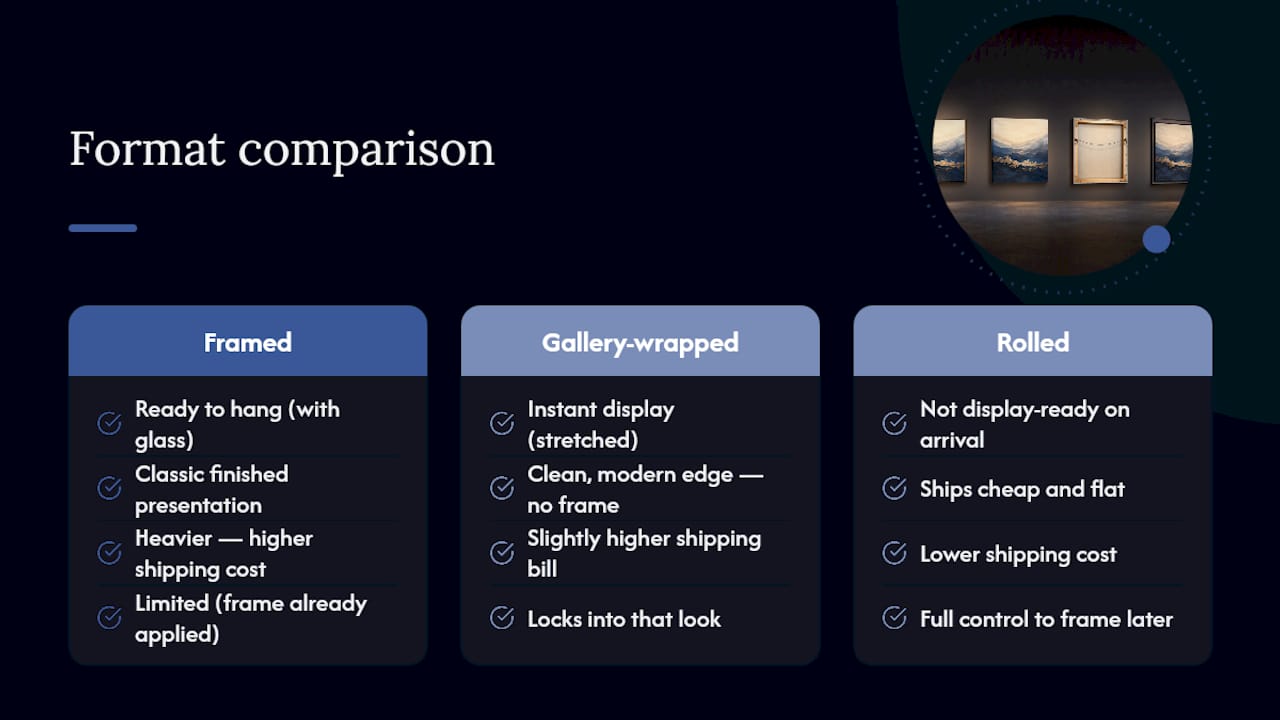
Gallery wrap gets you instant display and a clean, modern edge with no visible frame, but it locks you into that look. Once it’s stretched, you can’t easily swap in a different frame style later.
Framed pieces protect works on paper behind glass and give you a classic, finished presentation right out of the box. The tradeoff is weight and shipping cost. Glass and heavier hardware add up fast, especially for large pieces.
Rolled prints ship cheap and flat, and they give you full control over framing later, but they’re not display-ready the moment they arrive. You’re committing to an extra step (and likely an extra expense) before it goes on the wall.
Buyers who want a piece up the same day it arrives tend to lean toward stretched canvas, even with a slightly higher shipping bill, while those who want framing flexibility often prefer the lower cost and customization of a rolled print. If you’re buying as a gift or don’t want to deal with a framer, gallery wrap or a pre-framed piece is the safer bet.
Shipping and Exhibition Rules for Ready-to-Hang Art
Getting a piece labeled correctly matters just as much when you’re the one shipping it. Stretched canvases need corner protectors and a rigid outer box, since stretcher bars can warp under pressure. Framed work under glass needs additional padding at the corners, where glass most often cracks in transit.
- Number each panel on the back for multi-panel or diptych/triptych sets, and include a layout drawing showing the intended arrangement.
- Write a short condition report noting any existing wear, plus special hanging instructions if the piece needs a specific orientation.
- If a piece isn’t stretched, framed, or fitted with hardware, label it “requires framing,” not “ready to hang.” Mislabeling costs everyone time at drop-off.
Luxury Art Canvas Tips for Hanging With Confidence
Every gallery-wrapped canvas from Luxuryartcanvas ships with hardware already attached, but knowing how to place it makes the difference between a piece that looks intentional and one that looks tacked on. Start by measuring both the wall space and the artwork, then mark the center point where you want the piece to sit. Choose hardware rated for the canvas weight (most mid-size wraps do fine on a single stud anchor), and mount at the top-third point so the canvas rests flat.
- Measure wall and canvas dimensions before marking anything
- Mark center height (roughly 57 to 60 inches to the middle of the piece is a common eye-level standard)
- Choose a wall anchor rated above the canvas weight
- Level and secure before stepping back to check
For a full walkthrough, Luxuryartcanvas’s guides on hanging canvas art and hanging flat canvas without warping cover wall types and leveling tricks in more detail. If you want extra protection or a more formal look, adding an external frame around a gallery-wrapped canvas later is straightforward and doesn’t require re-stretching.
Pro Tip: Use painter’s tape to mark your hanging point before drilling. It’s removable, so you can adjust twice without patching extra holes.
If you’re staging a gallery wall or displaying a collectible piece, the placement principles from collectible display guides apply just as well to framed art as they do to other wall-mounted pieces.
Ready to see what ready-to-hang actually looks like done well? Luxuryartcanvas’s Louis Vuitton wall art and Pop Canvas collections ship gallery-wrapped with hardware attached, so there’s no framing, stretching or guesswork between checkout and hanging it on your wall.
Why the “Ready to Hang” Label Deserves More Scrutiny Than It Gets
Most buyers treat “ready to hang” as a formality, a checkbox next to the product photo. It shouldn’t be. The label carries no legal weight and no industry enforcement, which means it means exactly what each seller decides it means that day. That’s the gap conventional advice glosses over: guides tell you what the term should mean without warning you that plenty of listings use it loosely.
What actually matters is the back of the piece, not the front. A photo of the canvas edge or the frame hardware tells you more in three seconds than any product description will. I’d rather see a buyer ask one blunt question, “does this have hanging hardware attached?”, than read five paragraphs of marketing copy.
The other thing overlooked constantly: placement hardware in the top third isn’t a nice-to-have, it’s the difference between art that sits flat and art that leans forward and casts a shadow. Prioritize checking the hardware and its position before you worry about frame style or wall color. Everything else is aesthetics.
— James
What Is a Gallery Wrapped Canvas? Definition and Buying Guide
Six Marilyn Monroe Wall Art Ideas for Every Room Style