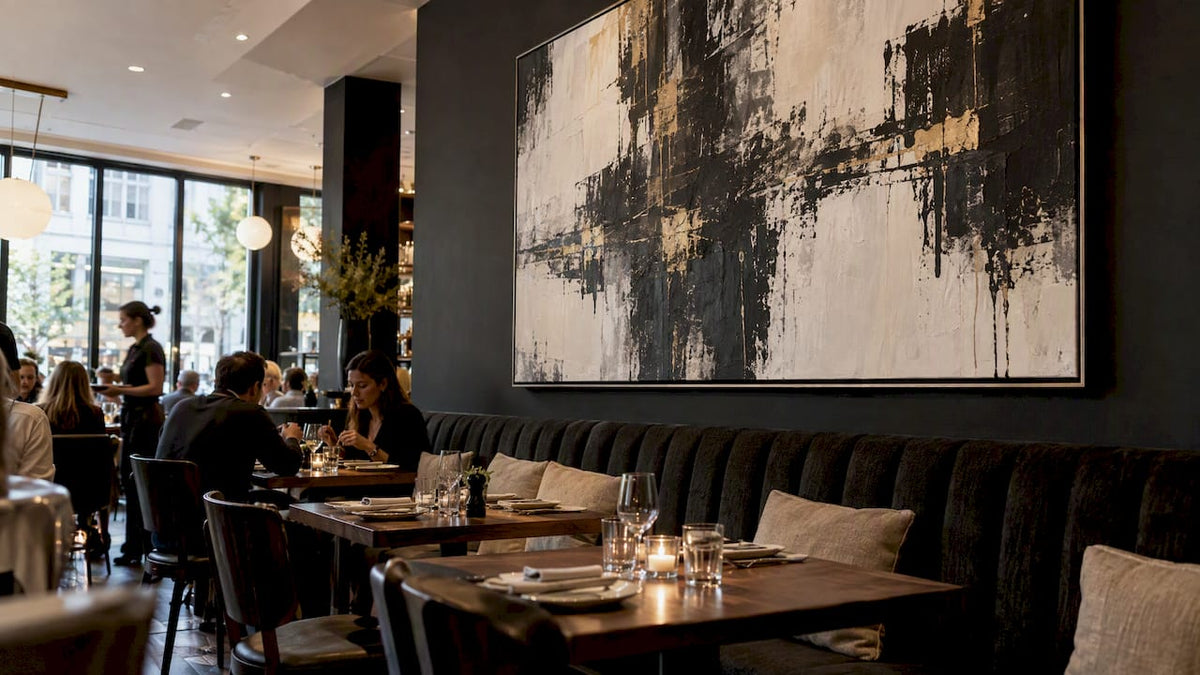
The best restaurant wall art does three jobs at once: it tells guests what kind of place they are in, it makes a big room feel intimate, and it survives a busy service. Start with your concept, pick one idea big enough to be noticed (a mural, a large canvas, a tight gallery wall), repeat a motif elsewhere in the room, and choose materials that can handle splashes, traffic and cleaning. The ideas below show how to do that, with real restaurant examples and practical rules for scale, lighting and durability.
TL;DR
- Choose art that matches your concept and daypart. Bold graffiti and pop art suit casual, high-energy rooms; black-and-white photography and restrained abstracts suit quieter dining.
- Go bigger than feels natural. A few large pieces make a blank wall feel designed; many small ones make it feel busy.
- Repeat one motif across surfaces (art, tile, mirrors, menus) so the room feels planned rather than decorated.
- Put durability first near the pass, booths and corners: commercial-grade wallcoverings, wipeable surfaces and protected lower walls.
- Let art work harder: some installations hide sound-absorbing panels behind the imagery.
Table of Contents
- Start with the concept, not the wall
- Unique wall designs that restaurants have actually built
- Murals, wallpaper and other feature wall options
- Modern restaurant wall art styles that work
- How to build a gallery wall for a restaurant
- Scale, lighting and placement
- Art that also fixes noisy rooms
- Durability checklist for busy dining rooms
- Our perspective: art is part of the menu
- Finding the right canvas for your dining room
- FAQ
- Sources
Start with the concept, not the wall
Most restaurants buy art the wrong way round. They see a bare wall, then look for something to fill it. Reverse that. Write down three words that describe the experience you sell, for example “loud, fun, late-night” or “calm, seasonal, intimate”. Then test every piece against those words.
A few useful pairings:
| Concept | Art direction | Why it works |
|---|---|---|
| Burger joint, taqueria, late-night bar | Graffiti, street art, pop art | Color and attitude match fast, casual energy |
| Steakhouse, cocktail lounge | Black-and-white photography, moody abstracts | Contrast reads as confident and grown-up |
| Modern bistro, wine bar | Minimalist prints, muted abstracts | Quiet art lets food and lighting lead |
| Cafe, brunch spot | Playful pop art, botanical or food-themed pieces | Bright, approachable, photographs well |
| Upscale or fashion-adjacent venue | Designer-inspired luxury art | Signals polish and a sense of occasion |
The fastest way to spot a mismatch is to imagine the wall in a photo posted by a guest. If the art fights the food, the lighting or the uniforms, it is the wrong piece.
Unique wall designs that restaurants have actually built
It helps to see how far the best operators push a wall. A few documented examples:
- A painted story. At the P.F. Chang’s Waikiki flagship, a two-story hand-painted samurai-woman mural and a dragon mural at the bar are repeated through Chinese characters and dragon-scale details. The art is not a single focal point; it is a visual language.
- Local history as the backdrop. In rd+d’s profile of Old Crow, a brick wall exposed when drywall came down became the setting for hand-painted cowboy and Old West murals by a local artist. Black-and-white ranch photographs, reclaimed barn wood and corrugated metal carried the theme further, with concealed RGB LED backlighting.
- The unexpected installation. Designer Rick McCormack points to a conversation-starting feature as a way to create an Instagrammable moment: Ruby’s Diner built an authentic Airstream trailer into the wall between the dining area and kitchen, with a service window facing guests.
- Photos of the place itself. California Pizza Kitchen’s Chicago remodel paired reclaimed wood and chalkboard graphics with photos of Chicago landmarks.
The pattern across all four: the art says something specific about the restaurant or its location. Generic “restaurant” art, like a coffee-cup print in a steakhouse, is the one thing guests never remember.
If your concept draws on a culture or heritage, authentic pieces can anchor the room. For a sense of how curators think about placing traditional sculpture and temple pieces in hospitality spaces, see this piece on temple art in lobby design.
Murals, wallpaper and other feature wall options
A feature wall is where you spend your boldest idea. The main routes:
Painted murals
Murals can be painted directly onto existing architecture. Architectural Digest’s coverage of Chicago’s About Last Knife describes murals applied to features such as brick, embracing a building’s history and imperfections. If you have exposed brick, think twice before covering it. Commission a local artist and you also get a story for your social feed and menu.

Wallcoverings
Restaurant wall-covering guides list custom-printed vinyl, wallpaper, painted murals and moss wallcoverings as feature wall options. A bold pattern can be echoed in nearby tile or other architectural details, which adds texture and identity.
Be realistic about wear. rd+d’s guidance recommends commercial-grade, wipeable wallcoverings and advises avoiding delicate wallpaper in high-traffic, service and exposed-corner areas, using durable finishes or protecting wallpaper with a lower wall wainscot.
Large-format canvas
Canvas is the flexible middle path. It has the impact of a mural without a painter’s schedule, it can be moved when you change concepts, and a damaged piece is replaced rather than repainted. It also suits leased spaces where you cannot alter the walls. Order oversized pieces for the focal wall and keep them away from direct splash zones.
Repeat a motif
McCormack recommends a recurring visual motif across several surfaces. In his Ritz Prime Seafood example, coral appears in illuminated mirrors, carved wood, etched stainless steel, a metal ceiling canopy and travertine wall tiles. You can do a smaller version: if your canvas features a certain color, bring it back in a napkin, a booth cushion or a menu cover.
Modern restaurant wall art styles that work
Here is how the main styles behave in a dining room.
Graffiti and street art
The obvious choice for burger bars, taco shops, ramen counters and craft-beer venues. Large graffiti canvases bring color and movement to a plain wall. Look at large graffiti wall art for scale, or browse the graffiti and street art collection to compare palettes. Pick two or three pieces with a shared color family so the wall reads as one statement.
Pop art
Pop art is playful and photographs well, which suits cafes, diners and dessert shops. Food-related pop art is a natural fit for a casual menu; the pop art burger canvas is an example of the genre. Explore more in the pop art canvas collection.
Black-and-white and minimalist
Monochrome art sits quietly behind candlelight and works in rooms where the food provides the color. Minimalist prints suit wine bars and tasting-menu rooms, where restraint signals confidence.
Luxury and fashion-inspired art
Cocktail lounges, hotel restaurants and upscale brunch spots can lean into glamour. Designer-inspired pieces, such as luxury art and fashion-house themes, bring a boutique feel. They are best used sparingly: one or two statement pieces, well lit, beat a wall crowded with logos.
Vintage
For a neighborhood tavern or Italian trattoria, vintage prints give a lived-in warmth that suits dark wood and brass.
How to build a gallery wall for a restaurant
Gallery walls suit long banquette walls, hallways to the restrooms, and corners that need softness. Done well, they feel collected; done badly, they look like a thrift store.
- Choose a theme before you choose frames. The theme can be color (all black and white), subject (neighborhood scenes), or style (all street art).
- Use a few anchor pieces. Pair one or two large canvases with smaller works so the eye has a place to land.
- Keep the spacing consistent. Even gaps between pieces make an arrangement look planned, even when the sizes differ.
- Lay it out on the floor first. Cut paper templates, tape them to the wall and live with them for a day before drilling.
- Hang by the seated eye line. Guests spend the meal sitting, so art above a banquette should sit lower than art in a retail space or gallery. Keep the whole arrangement related to the furniture beneath it rather than floating.
- Mix, but with a rule. Mismatched frames work when the art shares a palette. Matching frames work when the art varies.
For a bar or lounge, a gallery wall can even act as a rotating exhibit: swap a few pieces each season to give regulars something new to notice.
Scale, lighting and placement
Art that is too small is the most common mistake in restaurants. A tiny frame on a long wall looks apologetic. Go for fewer, larger pieces, or group small works into a single block that reads as one object.
Lighting then does half the work. Architect Elizabeth Roberts uses lower-placed murals and sconces to make high-ceilinged spaces feel cozy for diners, showing how scale and light shape intimacy. Some practical takeaways:
- In a tall room, bring the visual weight down. Hang large art lower than you would at home, and use sconces or picture lights to pull attention to the dining zone.
- Light the art, not the guest’s eyes. Avoid glare on glossy surfaces by angling spotlights to the side.
- Keep color temperature warm and consistent so canvas colors do not look washed out or muddy after dark.
- Concealed LED backlighting, as at Old Crow, can turn a mural or wall panel into ambient lighting.
- Stay clear of heat and grease. Do not hang canvases directly over fryers, open flame or dish stations.
Art that also fixes noisy rooms
Loud dining rooms are a common complaint, and walls are an obvious place to address it. Sunset’s report on VERSE in Los Angeles describes 26 sound-absorbing wall panels concealed beneath branch-and-flower imagery, proof that decoration and acoustics can share a surface.

If your hard walls cause ringing or echo between two parallel surfaces, read about treating flutter echo in a room before deciding where to put art. The simple rule: do not hang art only on the loudest, flattest wall and leave everything else bare. Mix surfaces with different textures so sound has somewhere to go.
Durability checklist for busy dining rooms
- Placement: keep canvas out of reach of passing trays and bags. Corners and the pass are high-risk.
- Protection: pair delicate finishes with a wainscot or chair rail on the lower wall.
- Cleaning: wipe frames and canvas surfaces gently with a dry or slightly damp cloth; never spray cleaner directly onto a canvas.
- Fastening: use proper wall anchors for large pieces, and check them on a regular schedule.
- Replacement plan: if a piece takes a hit, a ready-to-hang canvas is quick to swap, which is why many operators choose canvas for high-traffic rooms.
Our perspective: art is part of the menu
We make canvas art for a living, and we have learned that people judge a room within seconds. The wall they see when they sit down sets expectations about price, pace and personality before anyone picks up a menu.
Our advice to restaurant owners is simple. Choose one wall for a statement. Commit to scale. If your concept is casual and youthful, graffiti and pop art are an easy way to communicate energy; if you are going for polish, a pair of large black-and-white or luxury-themed pieces does more than a dozen small ones. Keep the palette tight, repeat it somewhere else in the room, and treat the art like part of the guest experience, not an afterthought.
We also like canvas for restaurants because it is forgiving. Each piece is ready to hang, made in the USA with archival inks, and can move with you if you change layouts, open a second location or refresh the concept. It is hard to say the same about a mural once the paint is dry.
— James
Finding the right canvas for your dining room
If you want to see how bold canvas art looks in a hospitality-style space, start with our graffiti and street art collection for casual venues and our luxury art collection for lounges and upscale rooms. With more than 1,000 designs across graffiti, pop art, black-and-white and contemporary styles, you can build a consistent set for one wall or a full dining room. For more layout inspiration, see our guide to Instagrammable wall art ideas with ready-to-hang canvases.
FAQ
What kind of art should hang in a restaurant dining room?
Art that supports your concept and mood. Choose bold graffiti or pop art for casual, high-energy venues, and restrained photography or abstracts for quieter rooms. Keep the palette consistent and favor larger pieces over many small ones.
What are some stylish feature walls for a restaurant?
Options include painted murals, custom-printed vinyl, wallpaper, moss wallcoverings and large-format canvas groupings. Exposed brick can be left as it is or painted with a mural. Whatever you choose, match its durability to the traffic around it.
How big should restaurant wall art be?
Bigger than most owners expect. A large piece or a tightly grouped set should fill a good portion of the wall above a banquette or in a focal area. In high-ceilinged rooms, hang art lower and add sconces to keep the space feeling intimate.
Can restaurant wall art help with noise?
Yes. Some installations hide sound-absorbing panels behind printed or painted imagery, as at VERSE in Los Angeles. If noise is your main concern, plan acoustic treatment first and then choose art for the remaining surfaces.
Is canvas a good choice for a restaurant?
It can be, when placed sensibly. Canvas is lightweight, easy to install and easy to replace, but keep it away from grease, steam and direct contact points. Use it on dining-room walls rather than next to the kitchen line.
Sources
- rd+d: A New Experience at P.F. Chang’s
- rd+d: Old Crow Takes Flight with Kicked-Up Design
- rd+d: Readers Choices, Rick McCormack’s Top Picks
- Restaurant Business: Starting the next chapter at California Pizza Kitchen
- Architectural Digest: About Last Knife, Chicago
- rd+d: Wall Coverings
- rd+d: Form + Function, Wall Coverings in Restaurant Design
- Architectural Digest: AD100 Designer Elizabeth Roberts
- Sunset: VERSE, Los Angeles
Money Themed Wall Art: How to Choose and Style It