

Size a triptych to fill 60 to 75% of the furniture it hangs above, or 50 to 60% of open wall space with no furniture anchor. Keep a 2-inch gap between panels as your default, tightening to 1 inch for small pieces or widening to 3 inches on large-scale or long-viewing-distance walls. Center the whole arrangement at 57 inches from the floor, and install it by hanging the middle panel first, then working outward with paper templates and a laser level.
Table of Contents
- What Is a Triptych, and When Should You Choose One?
- Which Photos Work Best When Split Into Three Panels?
- How Big Should Each Panel Be, and How Far Apart?
- Which Layout Style Fits Your Wall?
- How Do You Actually Hang a Triptych Without Ruining the Wall?
- Does Canvas Depth or Framing Change How the Gaps Look?
- What Common Mistakes Ruin an Otherwise Good Triptych?
- How Luxury Art Canvas Builds Triptychs That Hang Right
- The Rule Most Guides Get Backwards
- Ready to Order Your Triptych?
- Sources
- FAQ
What Is a Triptych, and When Should You Choose One?
A triptych is three connected canvas panels that read as one artwork, either a single wide image sliced into thirds or three related photos or designs hung as a set. The format solves problems a single canvas can’t.
- Wide, low walls. A triptych fills a long sofa wall or hallway run without needing one oversized (and expensive) canvas.
- Shipping and install ease. Three smaller panels are far easier to carry up a staircase or through a narrow doorway than one 6-foot canvas, and modular multi-panel art reduces freight complexity compared to shipping a single oversized piece.
- Visual rhythm. Three panels create movement across a wall that a single static image often can’t match.
Choose a single large canvas instead when you want a formal, unbroken image, when ceilings run tall enough that seams would feel busy, or when the artwork itself, a landscape or portrait, loses meaning when interrupted by gaps.
Which Photos Work Best When Split Into Three Panels?
Two approaches dominate: one panoramic image sliced into thirds, or three separate but visually coordinated photos hung as a set. The split-panoramic route gives you continuity and a dramatic, wall-filling sweep, but it demands a photo with enough native resolution and a composition that survives being cut. Three coordinated photos are more forgiving. You control cropping on each panel independently, but you need to match color grading and lighting tone across all three so they don’t look like three unrelated frames.
- Never place a face, horizon line, or focal point directly on a panel seam. It reads as a mistake, not a design choice.
- Build a rough mockup (even in free software or a printed thumbnail layout) before ordering, so you can see exactly where each seam falls.
- For prints in the 16 to 24 inch panel range, source images at 300 DPI at the intended print size to avoid pixelation at close viewing distances.
Pro Tip: Zoom into your source image at 100% and check the exact pixel column where the seam will land. If that spot lands on an eye, a hand, or a logo, shift the crop before you order.
How Big Should Each Panel Be, and How Far Apart?
Sizing a triptych comes down to one ratio and one gap number. If the piece hangs above furniture, a sofa, console, or bed, aim for total display width equal to 60 to 75% of the furniture’s width. Above a 72-inch sofa, that’s a 43 to 54-inch total span across all three panels and both gaps.
Run the math with real numbers: three 24-inch panels with 2-inch gaps between them come to 24 + 2 + 24 + 2 + 24, or 76 inches total.
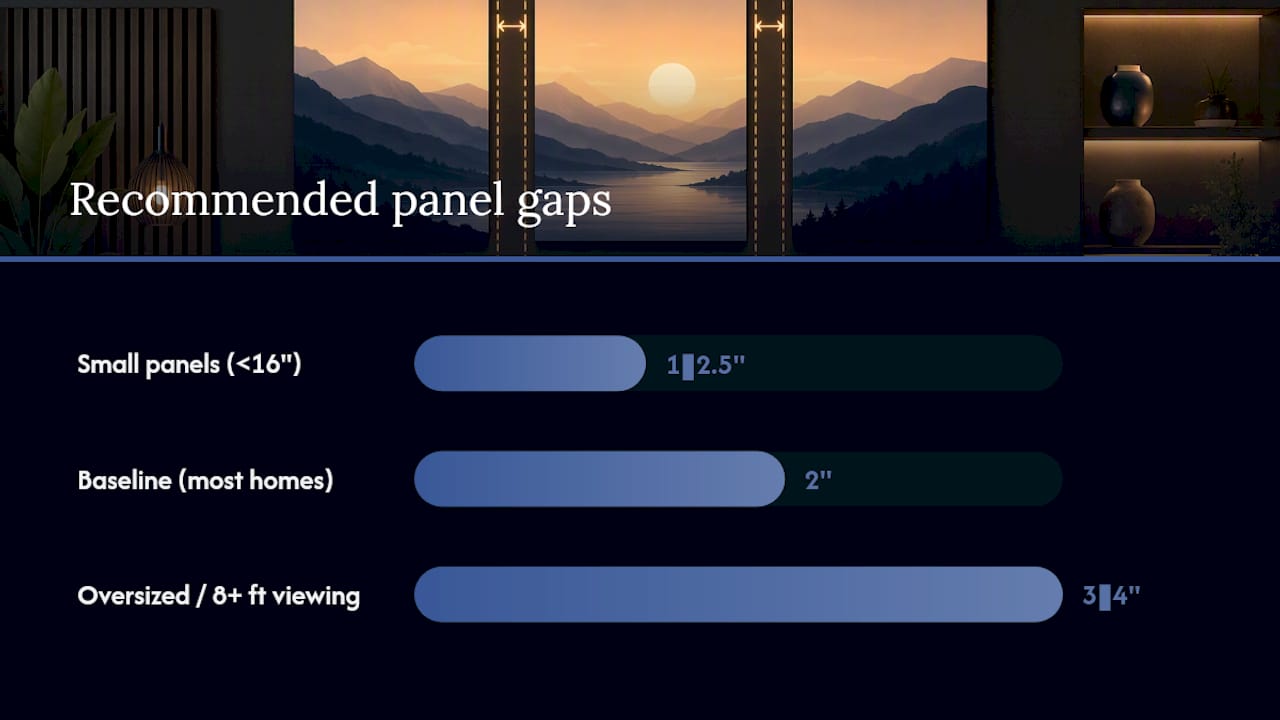
The spacing baseline: A gap of about 2 inches works for most residential triptychs. Drop to 1 to 1.5 inches for small panels under 16 inches, since a wide gap on small art breaks the visual connection between pieces. Open it up to 3 to 4 inches for oversized panels or rooms where viewers stand more than 8 feet back, otherwise the gap disappears visually and the set reads as one blurry mass.
Height placement follows the same logic museums use. Center the artwork’s midpoint 57 inches from the floor, the standard adopted across most galleries to align with average adult eye level. Two adjustments matter in real homes:
- Lower the center a few inches in rooms where people sit most of the time, a living room, den, or dining room.
- Raise it slightly in tall entryways or above furniture that pushes the bottom edge higher than a typical console.
Which Layout Style Fits Your Wall?
Three layout families cover almost every triptych situation, and picking the wrong one is the most common design mistake homeowners make.
- Row or panoramic layout. Three equal panels hung in a straight horizontal line, ideal above a sofa, credenza, or long console. A common combo is three 20x30-inch portrait panels with 2-inch gaps, or three 16x16-inch squares for a tighter, more graphic look.
- Vertical or portrait layout. Panels stacked or arranged in a narrow vertical run, built for staircases, tall hallways, or slim wall segments beside a doorway. Three 12x24-inch panels stacked with 2-inch vertical gaps handle a stairwell well because each panel stays visible at every step height.
- Asymmetrical large-center layout. One dominant center panel flanked by two smaller side panels, which builds visual hierarchy instead of pure repetition. A 30x40-inch center flanked by two 20x30-inch sides works in rooms where you want one focal image to lead, with the side panels acting as support rather than equals.
Match the layout to the wall’s proportions before you match it to the art. A 4-foot-wide wall segment simply can’t carry a row layout gracefully; it wants vertical.
How Do You Actually Hang a Triptych Without Ruining the Wall?
The single biggest install mistake is drilling before measuring the full assembly. A reliable center-out method avoids that:
- Measure total display width, panel widths plus both gaps, and mark the wall’s vertical center at your chosen height (57 inches to the artwork’s midpoint, adjusted for seating).
- Build paper templates. Cut kraft paper to the exact size of each panel, tape the templates to the wall in position, mark where each hanger will land, and mark hook positions using tape.
- Live with the templates for a day. Walk past the wall at different times and from your main seating spot before committing to a single hole.
- Hang the center panel first, using the wall’s center mark as your anchor point.
- Calculate and place the side panels by adding half the center panel’s width, plus the gap, plus half the adjacent panel’s width, a formula that reduces alignment errors versus eyeballing spacing panel by panel.
For tools, a laser level projects one continuous horizontal line across all three panels at once, which beats a spirit level for catching drift across a wide span. Run a stud finder before hanging anything heavier than a light canvas, and use toggle anchors in drywall where studs don’t line up with your hook positions. If you’re setting up a full wall composition rather than a single triptych, the same template logic applies to broader gallery wall planning.
Pro Tip: Mark hook height on the paper template itself, not just the panel outline. When you peel the template off, the hook mark stays exactly where the hanger needs to go, no re-measuring required.
Does Canvas Depth or Framing Change How the Gaps Look?
Gallery-wrapped canvas typically runs 1.5 inches deep, and that depth casts a shadow line along each panel’s edge. Under strong side lighting, that shadow can visually compress your gap. A 2-inch gap can read as noticeably tighter than it measures once shadow compression kicks in.
The fix is small: increase your measured gap by roughly a quarter inch in rooms with strong directional side light, a window wall or a single lamp throwing long shadows across the canvas edges.
- Unframed gallery wraps give a cleaner, more continuous look between panels, since there’s no frame edge breaking the eye’s path across the gap.
- Framed panels, especially in matching solid oak wood frames, add contrast at each edge, which can make the whole set feel more formal but also makes the gap read as a firmer visual break.
- Even wall-wash lighting or a picture light aimed straight on reduces shadow compression far more reliably than nudging the gap measurement alone.
What Common Mistakes Ruin an Otherwise Good Triptych?
Parallax is the sneaky one: a triptych that looks perfectly level from the doorway can look tilted from the couch. Always do your final check from the room’s main seating or standing spot, and lean on a laser level over a spirit level when you can, since it projects one line across all three panels simultaneously instead of three separate readings.
- Tape up paper templates and live with them for a full day before drilling a single hole.
- Use adhesive bumpers, adjustable D-rings, or thin shims to nudge a panel’s tilt without adding new holes.
- Modular triptychs move easily since each panel travels on its own, but for very large spans, bring in a professional installer rather than risk a wall full of holes.
How Luxury Art Canvas Builds Triptychs That Hang Right
Luxuryartcanvas makes its gallery wraps in the USA using archival inks, and every panel ships ready to hang out of the box, no stretching, no framing required before it goes on the wall. The catalog’s pop art and graffiti and street art collections lend themselves especially well to panoramic triptych splits, since their bold color blocking survives being cut across three panels without losing punch. Buyers working with a split image or a custom three-photo set can often request crop guidance or a mockup before production.
The Rule Most Guides Get Backwards
Most triptych advice treats the 57-inch center rule and the 2-inch gap like fixed laws. They’re not. They’re starting points that only work once you’ve measured your own furniture, your own wall, and where people actually sit in the room.
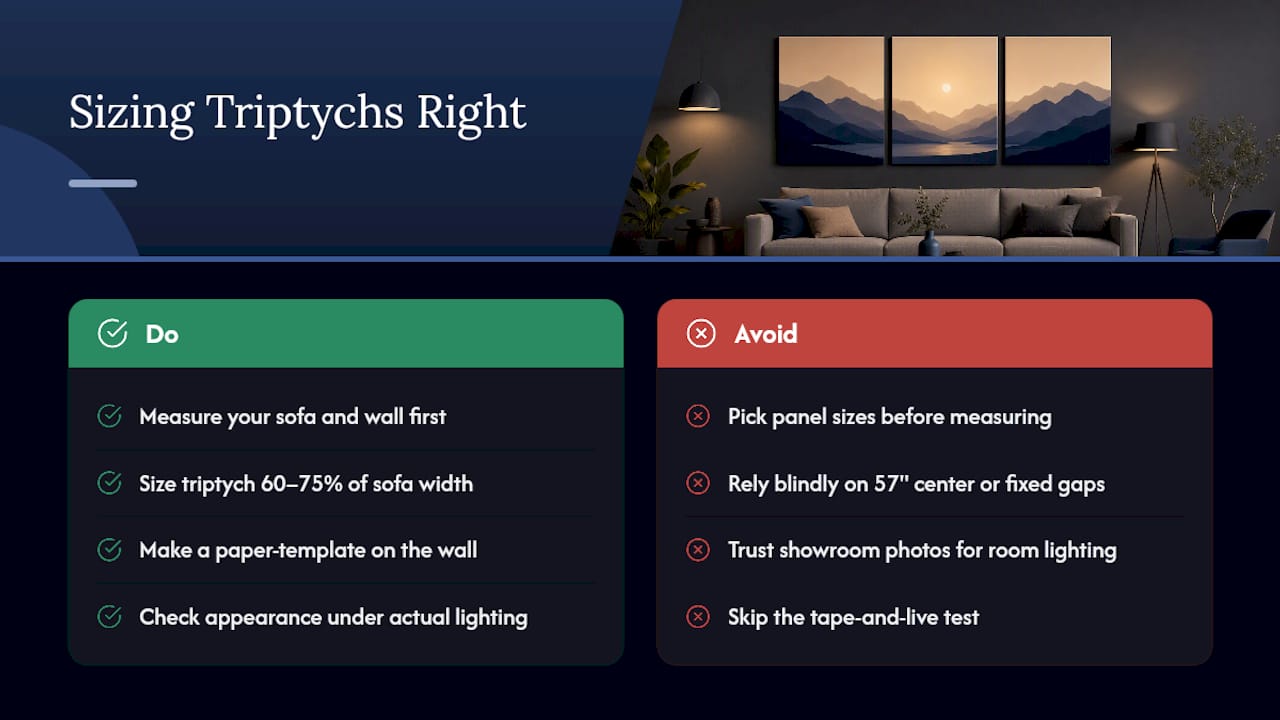
The bigger error I see isn’t picking the wrong gap width, it’s picking panel sizes before measuring the furniture at all. A triptych sized to 90% of a sofa’s width looks bloated and cramped no matter how perfect the 2-inch gaps are. Get the 60 to 75% furniture ratio right first, and the spacing decisions become almost trivial by comparison.
The other thing conventional advice underplays: lighting changes the math. A gap that looks generous in a lit showroom photo can look starved in a room with one lamp and heavy side shadows. If you take one thing from this guide, let it be the paper-template step. It costs you a day of living with tape on the wall, but it catches nearly every sizing and placement mistake before it becomes a permanent hole.
— James
Ready to Order Your Triptych?
Once you know your panel sizes and gap width, the harder part is finding artwork that actually holds up when split across three canvases. Luxuryartcanvas ships gallery wraps crafted in the USA with archival inks, so panels arrive ready to hang with no framing step in between measuring and mounting.

If you’re leaning toward a bold, graphic split image, the pop art canvas collection has designs built around strong color blocking that reads well across three seams. For an urban, high-contrast look, the graffiti and street art collection works especially well in row layouts above a long console or sofa. Browse either collection now, and if you’re working from your own photo or a custom three-panel concept, reach out for crop guidance before you order so the seams land exactly where you planned them.
FAQ
How far apart should triptych panels be spaced?
Two inches is the standard baseline gap for most residential triptychs, according to spacing guidelines used across gallery-style installations. Shrink that to 1 to 1.5 inches for panels under 16 inches, or widen it to 3 to 4 inches for large-scale panels or rooms with long viewing distances.
How do I create a triptych image from a single photo?
Choose a high-resolution panoramic or wide-format photo, then divide it into three equal vertical sections using photo editing software or a print provider’s layout tool. Keep faces, horizons, and focal points away from the two seam lines, and build a mockup before ordering so you can confirm exactly where each cut falls.
How do you frame a triptych painting?
Gallery-wrapped canvas needs no frame at all and gives the cleanest, most continuous look between panels. If you do frame each panel, matching wood frames, like a solid oak frame set, keep the three pieces visually unified while adding a bit more formal contrast at each edge.
How do you hang three-piece canvas art correctly?
Measure the full width including both gaps, mark the wall’s center at your chosen height, and hang the center panel first. From there, calculate hook placement for each side panel using panel width plus gap distance, a center-out approach that professional installers rely on to avoid drift across a wide span.
What height should the center of a triptych be?
Most galleries center artwork at 57 inches from the floor to match average eye level. Lower that by a few inches in rooms where people mostly sit, and raise it slightly in tall entryways or above furniture with a higher bottom edge.
Mantel Math for Homeowners: Exact Art Widths for 48, 60, 72 in Mantels
57 Inch Rule Guides Hallway Canvas Art for Homeowners and Renters