
Museums and galleries center artwork between 57 and 60 inches from the floor, and that same rule works in almost any home. This article breaks down the exact math for finding your hook position, the adjustments that matter for furniture and room type, and how to keep a gallery wall from looking scattered. Luxuryartcanvas also builds its ready-to-hang canvases around these same standard dimensions, so the formula below applies directly to what you’re hanging.
Table of Contents
- What Is the Standard Canvas Hanging Height?
- How High Above a Sofa or Bed Should Canvas Art Hang?
- How Do You Hang a Gallery Wall at the Right Height?
- Should You Adjust Canvas Height for Different Rooms?
- What Hardware Keeps a Canvas Level and Secure?
- Why Does My Canvas Look Off on the Wall?
- Quick Hanging Checklist
- Why the “One Height Fits All” Advice Falls Short
- Ready-to-Hang Canvas Sized for This Exact Math
- Sources
What Is the Standard Canvas Hanging Height?
The museum and gallery standard puts the vertical center of a piece at 57 to 60 inches from the floor, a number based on average adult eye level. Interior designers often shorthand this to “57 inches on center,” which has become a practical home standard you’ll see repeated across showrooms and staging guides.
But you’re not hanging a nail at random. You need the exact hook position, and that requires a short formula:
- Pick your center height. Use 57 inches for a shorter household, 60 for a taller one, or split the difference at 58 or 59.
- Add half the artwork’s height. A 30 inch tall canvas contributes 15 inches.
- Subtract the distance from the top of the frame to the wire or hardware. If your wire sits 4 inches down from the top, subtract 4.
So for a 30 inch canvas with a wire 4 inches below the top edge, centered at 57 inches: 57 + 15 − 4 = 68 inches to the hook. That’s where the nail goes, not where the canvas center lands.
How High Above a Sofa or Bed Should Canvas Art Hang?
Furniture changes the math. A canvas that looks fine on a bare wall can feel disconnected once a sofa or console sits underneath it, so the baseline height gets adjusted downward in most living rooms and bedrooms.
- Keep the bottom edge of the canvas a few inches above the furniture below it. This gap keeps the piece visually tied to the couch or headboard instead of floating near the ceiling.
- Aim for artwork that’s roughly two-thirds the width of the furniture it hangs above. A 90 inch sofa pairs well with a canvas around 60 inches wide.
- Low-slung sofas and platform beds often mean you’ll land closer to the 6 inch minimum, since the furniture line sits lower than average.
- Tall upholstered headboards or high consoles push you toward the 10 inch mark, or slightly beyond, to avoid a cramped look.
Our guide on canvas art above sofa placement walks through sizing scenarios if you’re staring at an oddly proportioned wall.
How Do You Hang a Gallery Wall at the Right Height?
A cluster of canvases behaves like one large piece, not several small ones. Measure the entire arrangement, including the gaps between frames, then treat that full rectangle as your artwork.
- Measure the total footprint. Include spacing between every frame in your height and width calculations.
- Find the center of the whole group. That center point, not any single canvas, gets aligned to your baseline height (57 to 60 inches, unless a room calls for an exception).
- Space frames a few inches apart. Tighter spacing reads as cluttered; wider spacing breaks the visual connection between pieces.
- Start with your largest or most important canvas. Hang that anchor piece first at the correct center, then build the arrangement outward so the whole group stays balanced.
Our step-by-step piece on hanging canvas art covers layout templates if you’re working with three or more pieces.
Should You Adjust Canvas Height for Different Rooms?
The 57 to 60 inch range is a starting point, not a law. Viewing distance, ceiling height, and who actually uses the room all shift the right answer.
- Hallways: Raise the center to roughly 60 to 66 inches. People pass close to hallway walls and rarely stop to look up, so a slightly higher hang keeps the piece at a natural glance level; consider using hallway makeover ideas for treatments that affect sightlines and art placement.
- Rooms with tall ceilings: Nudge the center up a few inches from the standard, but keep it proportional to the furniture below rather than the ceiling above.
- Living rooms built around seating: Lower the center to about 50 to 54 inches. This improves the view from a couch, where eye level sits several inches below standing height.
- Kids’ rooms: Hang art for children at their eye level, generally 42 to 48 inches, not yours.
Our room-by-room breakdown of wall art arrangement ideas covers more of these edge cases if your layout doesn’t fit a standard room type.
What Hardware Keeps a Canvas Level and Secure?
Getting the height right only matters if the canvas stays put. Single nails typically suffice for small, light pieces; larger pieces require sturdier support.
- Use two hooks spaced apart rather than one for larger canvases to improve stability. A single point of contact lets larger pieces tilt over time, especially with foot traffic or door drafts nearby.
- Match your anchor to the wall. Drywall generally needs a plastic anchor and screw for anything heavier than a few pounds; plaster walls often do better with a picture hook rated for the canvas weight, tapped in at a slight angle.
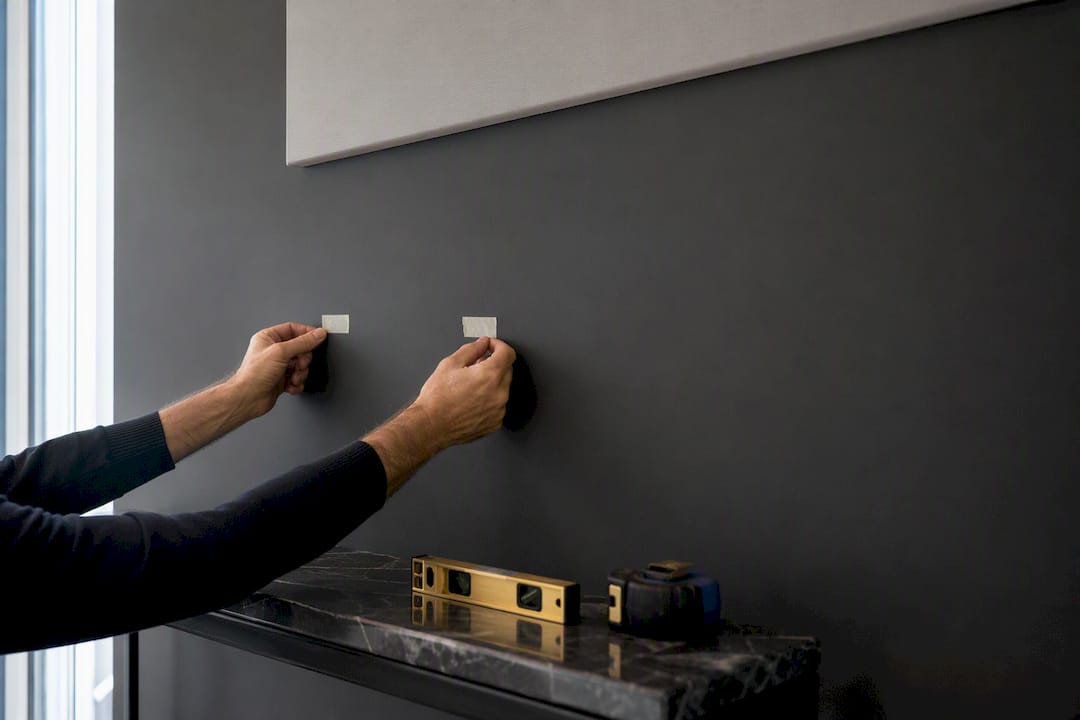
- Convert your calculated center point to the hook location using the formula above, then hang and check level with a small bubble level or your phone’s level app before stepping back to look.
- Renters can use removable hanging strips for lightweight canvases, generally under 15 to 20 pounds depending on the product’s rated capacity, though two hooks still beat one even with strips.
Our guide to hanging flat canvas on a wall covers anchor types in more detail if you’re unsure what your wall needs.
Pro Tip: Mark both hook positions with painter’s tape before drilling anything. Step back and check the spacing looks right from across the room, since a level that’s off by even a quarter inch is far easier to fix on tape than in drywall.
Why Does My Canvas Look Off on the Wall?
Most hanging problems trace back to one of four issues, and each has a quick fix.
- Too high or too far from furniture: If the canvas feels disconnected from the sofa or bed below it, lower it until the gap reads closer to 6 to 10 inches.
- Too narrow for the furniture: A canvas that looks lost above a wide sofa usually needs to hit that two-thirds width ratio. Size up, or add a second piece beside it.
- Visible tilt: Add a second hook, install wall bumpers on the back bottom corners, or check that the wire hasn’t loosened over time.
- Floating on a large, empty wall: A single small canvas on an oversized wall reads as an afterthought. Scale up the piece or add complementary art around it, which our oversized wall art placement guide covers in more depth.
Quick Hanging Checklist
- Measure the canvas height and divide by two to find its center point.
- Choose your baseline (57 to 60 inches) or an adjusted center for the room.
- Run the formula: center + half height − wire distance = hook position.
- Mark the hook location, install the right anchor for your wall type, hang, and level.
- Add wall bumpers if the canvas sits flush against the wall.
- Step back from your main viewing spot and make small adjustments before calling it finished.
Why the “One Height Fits All” Advice Falls Short
Most hanging guides quote 57 or 60 inches and stop there, as if every wall and every household has identical proportions. They don’t. A family of tall adults, a room built around seated conversation, or a hallway with heavy foot traffic all call for real adjustments, not a rigid number pulled from a museum wall label.
What actually works is starting with the baseline, then asking who looks at this wall, from where, and how often. Luxuryartcanvas builds its canvases with standard dimensions specifically so this math stays simple, and our own how-to resources walk through the same formula used here for hallways, staircases, and gallery arrangements. Get the center right, and the room does the rest.
Ready-to-Hang Canvas Sized for This Exact Math
Once you’ve run the formula, the fastest path is a canvas built to standard dimensions from the start. Luxuryartcanvas lists exact height and width on every product page, so you can plug those numbers straight into the hook placement math above instead of guessing at proportions.

If you’re hanging above a standard sofa or console, browse graffiti canvas art in the wider format sizes that fit the two-thirds width rule, or check out pop art canvas pieces for a bedroom or seating area where a slightly lower center works better. Every design ships ready to hang, made in the USA with archival materials built to hold up over years on the wall. Pick a size that matches your furniture width, note the listed dimensions, and run them through the formula before you drill a single hole.
Museum Quality Made in USA Chanel Wall Art Ideas That Read Chic
5 Weekend DIYs for Contemporary Canvas Art and 2026 Styling Rules