On a 60-inch mantel, choose artwork spanning roughly between sixty and three-quarters of the mantel width. The sections below cover how to measure, real examples for the most common mantel widths, hanging height, layout choices, and styling once the piece is up.
Table of Contents
- How Do You Measure for Art Above a Fireplace?
- What Size Art Fits Common Mantel Widths?
- How High Should Art Hang Above a Mantel?
- Should You Hang One Piece, a Pair, or a Gallery?
- How Do You Style Art to Anchor the Room?
- Is It Safe to Hang Art Directly Over a Working Fireplace?
- How Luxury Art Canvas Makes Sizing Easier
- What Else Competes for Attention Above the Mantel?
- Does the Fireplace Style Change the Art Size?
- How Does Room Size Change the Ideal Art Dimensions?
- How Should Framing and Mat Size Match the Fireplace?
- A Decorator’s Shortcut for Sizing Art Above a Fireplace
- Find the Right Canvas Size for Your Mantel
- Sources
- FAQ
How Do You Measure for Art Above a Fireplace?
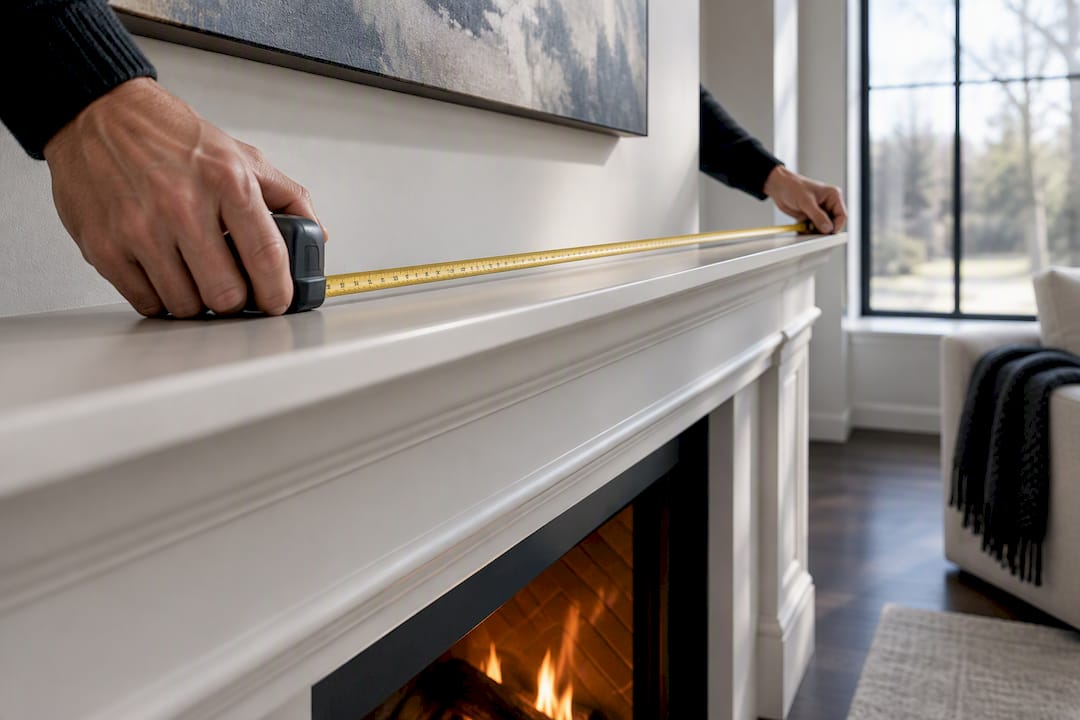
Measure the mantel shelf itself, not the fireplace opening or the surround. Run a tape measure from one end of the shelf to the other, then note the width in inches. If your mantel has decorative brackets or a wide overhang, measure the usable flat span, since that’s the visual anchor your eye reads, not the trim.
Once you have that number, the two-thirds to three-quarters rule does the rest of the work. Multiply the mantel width by 0.6 for the low end of your range, then by 0.75 for the high end. A 54-inch mantel gives you a target between 32 and 40 inches. That range isn’t arbitrary. Anything narrower and the art looks lost, floating above the mantel like an afterthought. Anything wider and it crowds the edges, competing with whatever sits on the mantel shelf itself.
Deciding whether to lean toward the smaller or larger end of that range depends on a few practical factors:
- Choose the larger end (closer to 75%) if your mantel has minimal decor on top, if the wall above is otherwise bare, or if the room is large and needs a bigger visual anchor.
- Choose the smaller end (closer to 60%) if you’re styling with candlesticks, vases, or a mirror leaning against the wall, since those objects need room to breathe.
- Avoid the two most common mistakes: hanging something so small it looks marooned in a sea of wall, or stretching a piece edge-to-edge with the mantel, which reads as stiff and overly matched rather than curated.
The same 60%–75% math applies to art hung over any furniture anchor, whether that’s a sofa or a console, so once you’ve got the formula down, it works everywhere in the house.
What Size Art Fits Common Mantel Widths?
Here’s where the math turns into an actual shopping list. These figures come straight from the two-thirds to three-quarters rule, translated into the mantel widths most homes actually have:
- 48-inch mantel → aim for 32 to 36 inches of artwork
- 60-inch mantel → aim for 40 to 45 inches of artwork
- 72-inch mantel → aim for 48 to 54 inches of artwork
Those ranges line up neatly with standard canvas sizes, so you’re rarely stuck between options. A 36-inch canvas is a common stock size that hits the top of the 48-inch mantel range exactly. For a 60-inch mantel, a 40x30 or 44x33 canvas both land inside the target zone without any custom framing.
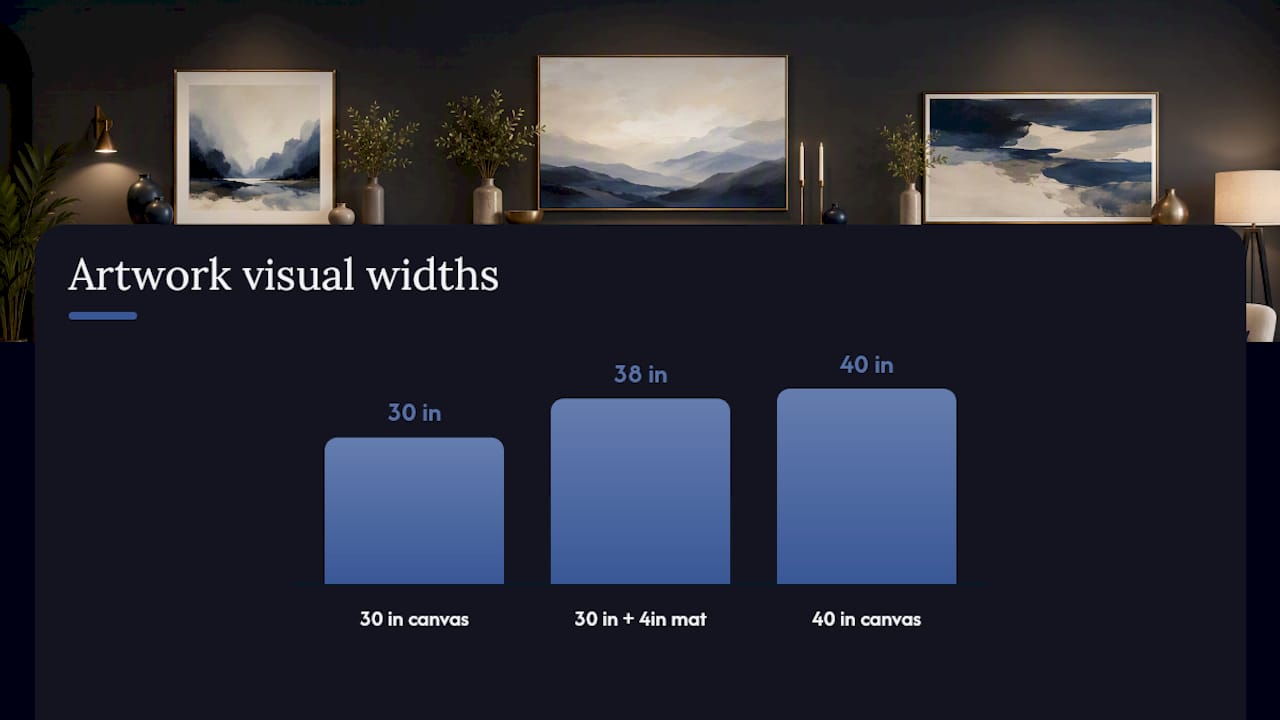
If a single piece in your target range feels underwhelming, a matted frame or a wider frame border can add several inches of visual footprint without changing the canvas itself. A 30-inch print in a 4-inch mat suddenly reads as a 38-inch piece on the wall. That trick matters most on wider mantels, where jumping from a 40-inch canvas to a 48-inch one might mean a custom order, but adding a mat gets you there for less money and less waiting.
Fireplace mantels sold at retailers like Home Depot and Lowe’s vary widely in listed widths and actual installed widths, thanks to overhangs and end caps. Always measure your own shelf rather than trusting the product spec sheet.
How High Should Art Hang Above a Mantel?
Most wall art follows the “57 to 60 inches from the floor to the center” gallery rule, a formula meant to put artwork at average eye level. Above a fireplace, that rule gets thrown out, because the mantel itself becomes the visual reference point instead of the floor.
Here’s the method that actually works for mantel placement:
- Measure your mantel height from the floor to the top of the shelf.
- Add 4 to 8 inches to that number. That’s where the bottom edge of your artwork should sit, close enough to feel anchored to the mantel, far enough to avoid crowding anything displayed on the shelf.
- Mark that spot with a pencil and a level before you touch a hammer, checking it against both ends of the frame, not just the center.
- Hang with two people if the piece is large or heavy. One holds, one checks the level from a few steps back, since eyeballing width from directly underneath a canvas is nearly impossible to do accurately.
Go tighter than 4 inches and the piece looks crammed against the mantel. Go looser than 8 and it starts to float, disconnected from the fireplace it’s supposed to complement. Our canvas hanging height guide walks through the exact formula step by step if you want a printable reference.
Should You Hang One Piece, a Pair, or a Gallery?
Mantel width and the texture of your surround usually decide this for you before personal taste even enters the conversation.
A single large piece works best on mantels up to about 60 inches, especially when the surround itself has some texture or pattern, like stacked stone or shiplap. One bold canvas gives the eye a single place to land instead of competing with a busy backdrop. Wider mantels, 72 inches and up, tend to swallow a single piece unless it’s genuinely oversized, which is where pairs and triptychs earn their keep.
Less conventional layouts, like a large canvas leaning against the wall on the mantel shelf itself, or an asymmetrical grouping of three different sizes, can look striking in a casual or eclectic room. They tend to look sloppy in a formal living room where everything else is symmetrical. Our gallery wall guide covers spacing templates if you’re leaning toward a grouped arrangement over a single statement piece.
- Single piece: mantels up to 60", busy or textured surrounds
- Pair or triptych: mantels 72"+, treat the combined width as one shape
- Leaning or offset groups: casual rooms only, skip in formal spaces
Pro Tip: *If you’re torn between a single large canvas and a pair, measure your mantel width, then picture the pair as one continuous shape including the gap between them.
How Do You Style Art to Anchor the Room?
Sizing gets the proportions right, but color is what makes the piece feel like it belongs, rather than looking like it was hung as an afterthought. Pull one color directly from the artwork and repeat it somewhere else in the room, on a throw pillow, a vase on the mantel, or the edge of an area rug. That single repeated color creates a visual through line that ties the whole space together without matching everything exactly.
Dark or heavily textured surrounds, think black slate, dark brick, or reclaimed wood, need higher contrast art to actually register as a focal point. A moody, low-contrast piece will simply disappear into a dark stone surround, no matter how correctly it’s sized. Brighter palettes or bold graphic pieces cut through that visual noise instead.
Framing and matting change more than the visual footprint. A wide mat adds a sense of formality and scale, useful for making a smaller print feel intentional rather than undersized. A heavier, wider frame adds visual weight, which matters if your mantel and surround are already substantial and a thin floating frame would look flimsy by comparison.
- Pull one color from the art and repeat it in two other spots in the room
- Choose higher contrast pieces for dark or heavily textured surrounds
- Use a wide mat to boost formality and perceived size on smaller prints
- Use a heavier frame to balance a substantial stone or brick surround
Is It Safe to Hang Art Directly Over a Working Fireplace?
Heat rises, and a working fireplace pushes warm air, and sometimes soot, directly up the wall it sits against. That’s a real concern for delicate media like unvarnished watercolors or works on unprotected paper, which can discolor or warp with repeated exposure over years of use.
Canvas prints handle this far better than paper originals, since the material and the inks used in production are more heat tolerant and easier to wipe clean. Heat-resistant framing hardware is worth the small upcharge if your fireplace sees regular use in colder months.
- Canvas holds up better than paper or watercolor originals over an active fireplace
- Skip unvarnished or fragile paper pieces directly above the mantel
- Hang higher, or choose a different wall entirely, for anything irreplaceable
If the piece is a valuable original rather than a print, it’s worth a conversation with a conservator before committing to that wall at all. Heat and soot exposure compounds slowly, and by the time damage is visible, it’s usually done.
How Luxury Art Canvas Makes Sizing Easier
Matching a mantel to the right canvas gets a lot simpler when the product itself is built for the wall it’s going on.
Browsing the Pop Art Canvas Prints or Graffiti Wall Art collections, you can filter by width and cross-check against your mantel measurement before adding anything to cart. Bold, high-contrast pieces in these collections also solve the dark-surround problem covered earlier, since graphic pop art and street art tend to hold their own against stone, brick, or shiplap. If you’re weighing a single statement canvas against a pair, the sizing math stays the same either way, and our decorating a fireplace guide covers additional styling once the piece is hung.
What Else Competes for Attention Above the Mantel?
A fireplace rarely exists in isolation. Most living rooms have at least one other strong focal point, a large window, a media console, a statement light fixture, or a bookshelf wall, and the art above the mantel has to hold its own against that competition without overwhelming it.
If your television sits directly above or beside the fireplace, scale the art down slightly from the top of the 60%–75% range, since two large visual elements fighting for attention in the same sightline tend to cancel each other out rather than both landing. A room with a dramatic window wall opposite the fireplace can support a slightly bigger, bolder piece above the mantel, because the eye has more room to travel and won’t feel boxed in by two competing anchors sitting close together.
The safest approach is to walk to the doorway of the room and look at the space as a whole before finalizing size. If your eye jumps between three different “main” elements, something needs to shrink. Usually that’s whichever piece is newest or least essential to the room’s daily function, and mantel art, being decorative rather than functional, is often the one that should flex first. A large sculptural light fixture or an oversized bookshelf wall should usually win that contest, with the art above the fireplace sized to complement rather than compete.
Does the Fireplace Style Change the Art Size?
A minimalist linear gas fireplace with a floating concrete mantel calls for different art than a traditional wood-burning fireplace with a carved marble surround, even if both mantels measure the same width. The visual weight of the surround matters as much as the raw dimension.
Sleek, minimal surrounds with clean lines often look best with equally clean, simply framed art, and pushing toward the smaller end of the range keeps the whole composition from feeling busy.
Mantel height plays a role too. A tall, substantial mantel, common in older homes with high ceilings, usually pairs with a taller piece of art rather than a wide, short one, since the vertical proportions of the mantel itself are asking for a vertical answer above it. A low, shallow modern mantel often looks better with a horizontal piece that echoes its low, wide profile. None of this changes the core width math from the two-thirds rule, but it does affect whether you’re shopping for a portrait or landscape orientation within that target width.
How Does Room Size Change the Ideal Art Dimensions?
Mantel width sets the baseline, but the room itself sets the ceiling on how big you can realistically go.
The extra breathing room on either side of the canvas keeps the wall from feeling cramped, especially if the room already has a lot of furniture competing for wall space.
Larger, open-concept living rooms can handle the top of the range, or even art that runs slightly past the mantel’s edges as part of a pair or triptych, because the surrounding negative space absorbs that extra visual weight without the room feeling top heavy. Ceiling height matters here too. A room with 10 or 12 foot ceilings can often support taller art above the mantel that would look stretched or awkward under a standard 8 foot ceiling. If your walls run floor to ceiling on either side of the fireplace with minimal other decor, that’s usually a sign you can lean bigger rather than smaller.
How Should Framing and Mat Size Match the Fireplace?
Frame width and mat size aren’t just finishing touches, they’re scaling tools that let you fine-tune a piece’s visual footprint without changing the canvas or print itself. A thin, minimal frame barely changes the footprint at all, which works well against a sleek modern surround but can look undersized next to a heavy stone mantel.
A wider frame, particularly in a substantial wood or matte black finish, adds several inches of visual mass and formality, useful when your fireplace surround has real heft and a thin frame would look flimsy by comparison. Matting does something slightly different: it adds breathing room around the image itself, which reads as more gallery-like and can make a smaller print feel intentionally scaled rather than simply too small for the space.
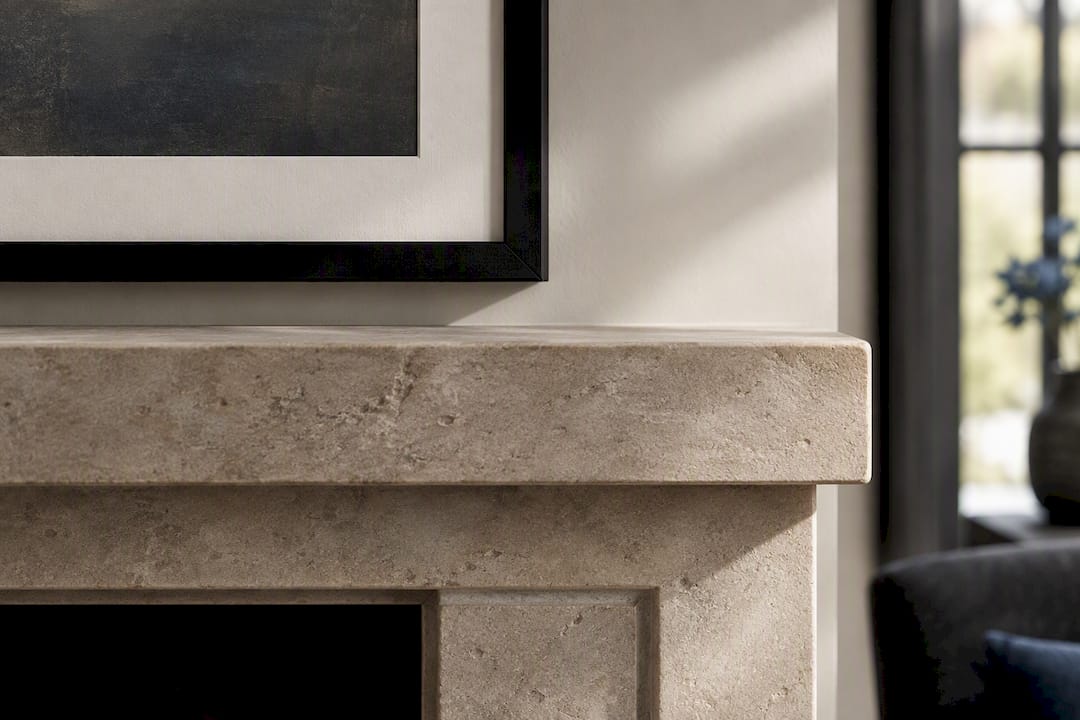
The relationship between frame, mat, and fireplace scale generally works like this: heavy stone or brick surrounds pair well with wider, heavier frames and minimal matting, since the frame itself provides the visual weight. Cleaner, more minimal surrounds, tile, painted brick, simple wood mantels, tend to look better with narrower frames and a generous mat, letting the white space do the work instead of a bulky frame fighting the mantel’s own clean lines. Our guide to wall art types for living rooms breaks down framed versus unframed options in more detail if you’re deciding between the two.
A Decorator’s Shortcut for Sizing Art Above a Fireplace
When in doubt, size slightly larger rather than smaller. An undersized piece above a mantel is the single most common styling mistake, and it’s far easier to fix by adding a mat or wider frame than by starting over with a bigger canvas.
For a quick decision: go with a single piece if your mantel is 60 inches or under, and reach for a pair once you’re past 72 inches. That one rule solves most of the back and forth homeowners get stuck on when a mantel falls in that awkward middle ground between a single statement canvas and a full grouped arrangement.
— James
Find the Right Canvas Size for Your Mantel
Once you know your target width, the actual shopping gets a lot faster than digging through generic art marketplaces hoping something happens to fit. Ready-to-hang canvases sized to match the mantel widths covered throughout this guide are available, simplifying the choice for a 60-inch mantel.

Start with the Pop Art Canvas Prints collection for bold, high-contrast pieces that hold their own over a fireplace, or browse Graffiti Wall Art & Street Art Canvas if you want something with more edge for a modern living room. If you’d rather see everything at once and filter by size and style, the full Luxuryartcanvas catalog covers more than 1,000 designs across styles from black and white photography to motivational art. Measure your mantel, pull up your target range, and start filtering.
FAQ
What Is the Two-Thirds Rule for Wall Art?
On a 60-inch mantel, that works out to roughly 40 to 45 inches of art.
What Is the 70/30 Rule in Art?
There’s no universally standard proportion rule in interior design the way there is for the two-thirds mantel guideline.
What Kind of Art Looks Good Above a Fireplace?
Bold, higher-contrast pieces tend to work best, especially over dark or heavily textured surrounds like stone or brick, since low-contrast art can blend into a busy backdrop rather than standing out. Graphic pop art, abstract pieces, and photography all read well as focal points, and collections like Pop Art Canvas Prints are built specifically for that kind of statement placement.
What Is the 57-Inch Rule for Hanging Art?
The 57 to 60 inch rule places the center of a piece of art at average eye level from the floor, and it’s the standard for most gallery-style wall hanging. Above a mantel, that rule gets replaced by a different measurement: hang the bottom edge of the art 4 to 8 inches above the mantel shelf instead, since the mantel becomes the visual reference point rather than the floor.
Tight Foyer Entryway Wall Art Ideas With Ready to Hang Canvases
60–75% Sofa Rule: Triptych Canvas Layouts Centered at 57 Inches