
Street art became fine art through a combination of cultural reach, reproducibility, institutional adoption, and market mechanisms that transformed ephemeral public gestures into ownable, auctionable objects. Three forces accelerated that shift faster than almost anyone predicted:
- Jean-Michel Basquiat’s crossover from Lower East Side walls to blue-chip galleries in the early 1980s proved that street-born artists could command serious critical attention.
- MOCA’s 2011 Art in the Streets survey gave the movement its first major American museum retrospective, reframing decades of public work as art history.
- Sotheby’s auction results, including a Banksy piece that resold for £18.58 million (approximately $25.4 million) three years after a famous shredding event, signaled that the market had fully arrived.
What follows traces the full arc: origins in 1960s–70s New York and Philadelphia, the definitional split between graffiti and street art, the concrete market mechanisms that made works sellable, the artists who built the bridge, the institutions that formalized it, and the ethical debates that still haven’t been resolved.
Key Takeaways
Street art became fine art when cultural reach, reproducibility, and institutional adoption converged with market mechanisms that made ephemeral public works ownable, auctionable, and critically legitimate.
| Point | Details |
|---|---|
| Origins in 1960s–70s U.S. cities | Tagging cultures in NYC and Philadelphia created the foundation; subway visibility gave graffiti its early reach. |
| Image over text unlocked institutions | The shift from letter-based tags to stencils and imagery made works reproducible and legible to curators and collectors. |
| Exchangification drove market entry | Objectification, classification, and valuation practices turned ephemeral works into ownable, auctionable objects. |
| Auction results confirmed legitimacy | A Banksy work resold for £18.58 million at Sotheby’s; Basquiat’s 1982 skull painting sold for $110.5 million in 2017. |
| Commercialization carries real costs | Gentrification, ownership disputes, and loss of context remain unresolved tensions in street art’s institutional rise. |
Table of Contents
- Why did street art become fine art? The roots go back further than you think
- How does graffiti differ from street art, and why does it matter?
- How street art entered galleries and auction houses
- The artists who built the bridge between street and gallery
- How media, festivals, and museums shifted public perception
- What are the real tensions in street art’s commercialization?
- Where is street art accepted today?
- What scholars and practitioners say about the transition
- An editorial perspective on what this history actually means
- Sources
Why did street art become fine art? The roots go back further than you think
The history of street art as a recognized practice begins in the late 1960s, though its precedents stretch back further. Soldiers’ “Kilroy Was Here” markings during World War II and hobo symbols from the Depression era both show the impulse to leave a mark in public space. What changed in the late 1960s was scale, community, and ambition.
Philadelphia gets credit for the first organized tagging scene. Writers like Cornbread and Cool Earl were leaving their names across the city by 1967, and local press noticed. New York followed quickly. By the early 1970s, a teenager writing “TAKI 183” across Manhattan subway cars had earned a New York Times profile, the first mainstream media treatment of graffiti as a cultural phenomenon worth explaining rather than simply condemning.
The subway system was the critical infrastructure. A single painted car traveled the entire length of a line, carrying a writer’s name from the Bronx to Brooklyn in a single run. That mobility gave graffiti a reach no gallery could match. By the mid-1970s, whole cars were covered in elaborate “wildstyle” lettering and characters. The shift from tags to full compositions was already underway.
The first gallery incursions came in 1973, when Hugo Martinez founded United Graffiti Artists and staged a show at the Razor Gallery in SoHo. The work was transferred to canvas, the writers were presented as artists, and the critical reception was mixed but real. That experiment planted a question that would take another decade to answer: could work born on a subway car survive the white cube?
How does graffiti differ from street art, and why does it matter?
The distinction is not just semantic. It determines which work institutions could absorb and which they couldn’t.
Graffiti in its traditional form is text-based: tags, throw-ups, and wildstyle lettering that prioritize the writer’s name and reputation within a subculture. The audience is other writers. Legibility to outsiders is often beside the point, sometimes deliberately so. The practice is almost always illegal, and its value is tied to risk, location, and community standing.
Street art shifted the equation in several ways:
- Intent: from notoriety within a subculture to communication with a general public.
- Form: from letter-based signatures to images, stencils, wheatpaste posters, and murals that anyone can read.
- Legality: often still unauthorized, but increasingly commissioned, permitted, or at least tolerated.
- Reproducibility: a stencil can be reused; a wheatpaste image can be photographed, printed, and sold.
That last point is what made institutional adoption possible. Contemporary street art evolved from 1960s–70s graffiti but expanded to include images and stencils, shifting from writer-focused tagging to public-facing visual communication. A tag is a site-specific, ephemeral signature. A Banksy stencil is a portable image that documents well, prints cleanly, and carries meaning independent of its original wall. Curators, collectors, and auction specialists can work with the latter in ways they simply cannot with the former.
The crossover from pop art and street art also helped blur the line. Artists like Haring and Basquiat absorbed the visual language of both movements, making their work legible to audiences already comfortable with Warhol and Lichtenstein.
How street art entered galleries and auction houses
The path from wall to auction block required specific, observable steps. None of it happened automatically.
The first step was material translation. Artists who wanted gallery careers moved their practice to canvas, paper, and studio production. Basquiat made this transition deliberately and rapidly. Haring opened the Pop Shop in 1986, selling prints and merchandise that extended his imagery into a retail format. The work remained visually connected to the street but existed in forms that galleries and collectors could handle, store, and resell.

Provenance-building was equally important. Market acceptance required practices that made works materially ownable through studio pieces, certified prints, and documented provenance. Without those steps, street-origin works remain difficult for established auction and gallery systems to process. A photograph of a wall painting is documentation; a signed, numbered print is a commodity.
The academic concept that explains this process is exchangification: the objectification, classification, and valuation practices that transform ephemeral public works into exchangeable market products. Dealers assigned attribution, galleries assigned price, and auction houses assigned provenance. Each step added a layer of institutional legitimacy that made the next step easier.
Market milestone: A Banksy work that was famously shredded at a Sotheby’s event in 2018 resold three years later for £18.58 million (approximately $25.4 million), demonstrating that even a deliberately self-destructed piece could appreciate dramatically once the auction system had absorbed it.
MOCA’s 2011 Art in the Streets exhibition in Los Angeles was the institutional turning point in the United States. It treated 1970s subway writers alongside contemporary street artists in a single museum survey, collapsing the distinction between historical graffiti and contemporary practice. Christie’s and Sotheby’s followed the institutional signal, adding street-origin works to major contemporary art sales. City mural programs, corporate commissions, and curated festivals like Wynwood Walls in Miami created additional infrastructure: legal walls, professional fees, and documented commissions that generated clean provenance from the start.
The artists who built the bridge between street and gallery
No five careers illustrate the transition more clearly than Basquiat, Haring, Banksy, Shepard Fairey, and Mr. Brainwash.
Jean-Michel Basquiat
Basquiat began as SAMO, leaving cryptic text-based tags across Lower East Side walls in the late 1970s. By 1981 he was showing at the Annina Nosei Gallery in SoHo. By 1983 he was represented by Larry Gagosian. His paintings retained the raw mark-making and text of street work but operated fully within the gallery system. His 1982 untitled skull painting sold at Sotheby’s in 2017 for $110.5 million, a record for an American artist at auction at that time.
Keith Haring
Haring’s chalk drawings in unused subway advertisement spaces from 1980 onward were technically illegal but widely photographed and celebrated. He moved into gallery work and public murals simultaneously, never abandoning either register. The Pop Shop, opened in 1986, was a deliberate experiment in democratic access: affordable prints and merchandise that kept his imagery circulating outside gallery walls.
Banksy
Banksy operates anonymously and has never confirmed his identity, which is itself a market strategy. His stencil-based work appears on walls across the UK, Europe, and the Middle East, but authenticated prints and canvas works sell through major auction houses. The shredding incident at Sotheby’s in 2018 generated more press than almost any contemporary art event that year, and the resale price confirmed that spectacle and provenance can compound rather than cancel each other.
Shepard Fairey
Fairey’s OBEY campaign began in 1989 as a sticker and wheatpaste project. His 2008 Hope poster for Barack Obama’s presidential campaign reached an audience of hundreds of millions, demonstrating that street-derived imagery could operate at the scale of mass media. He has shown at major galleries and institutions while maintaining a public-art practice.
“Street art’s rise wasn’t the result of one institution deciding to open its doors. It was timing, cultural inclusivity, and the medium’s ability to speak to people who had never set foot in a gallery.” Shepard Fairey, Observer
Mr. Brainwash
Thierry Guetta, known as Mr. Brainwash, became widely known through Banksy’s 2010 documentary Exit Through the Gift Shop. His large-scale shows in Los Angeles and New York drew massive crowds and generated significant sales, though critical reception was divided. His career illustrates both the opportunity and the risk of the street-to-gallery model: high visibility does not guarantee critical legitimacy.
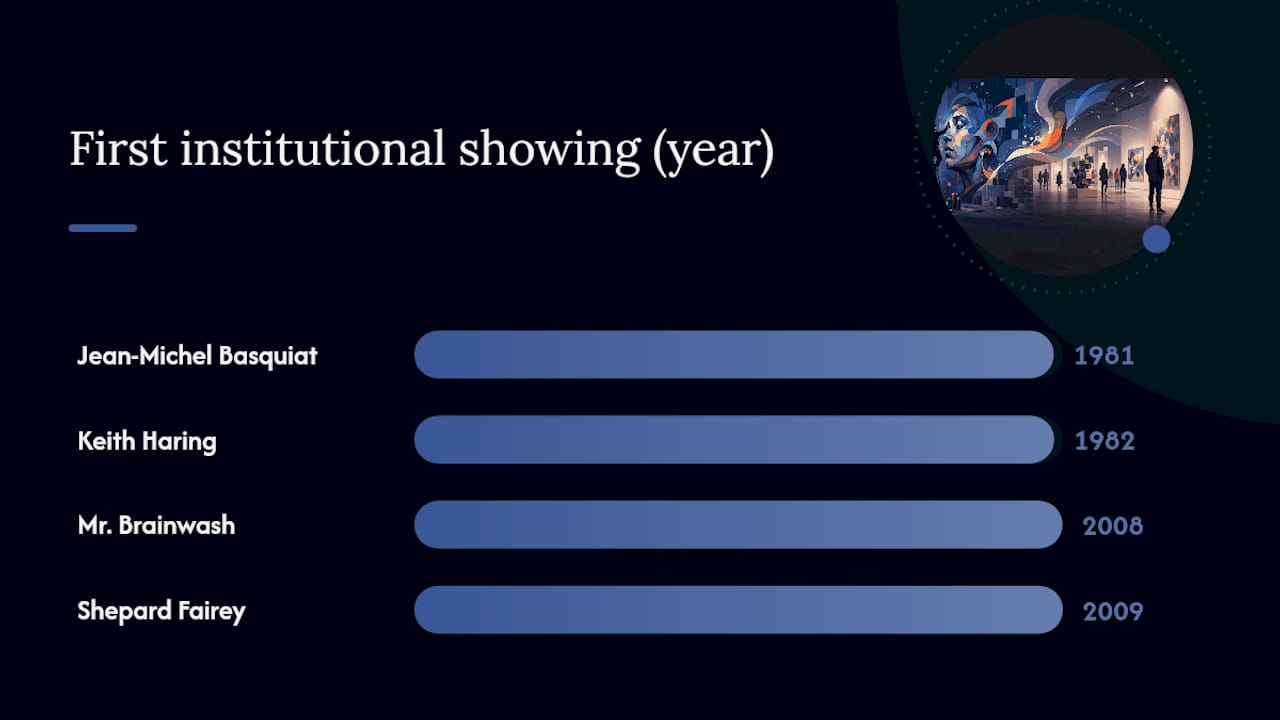
| Artist | Street origin | First major institutional showing | Market milestone |
|---|---|---|---|
| Jean-Michel Basquiat | SAMO tags, NYC, late 1970s | Annina Nosei Gallery, 1981 | $110.5M at Sotheby’s, 2017 |
| Keith Haring | NYC subway chalk drawings, 1980 | Tony Shafrazi Gallery, 1982 | Pop Shop opened 1986; global licensing |
| Banksy | UK stencil works | Barely Legal, LA | £18.58M resale at Sotheby’s |
| Shepard Fairey | OBEY sticker campaign, 1989 | ICA Boston, 2009 | Hope poster, 2008 presidential campaign |
| Mr. Brainwash | LA street installations | Life Is Beautiful, LA, 2008 | Featured in Exit Through the Gift Shop, 2010 |
How media, festivals, and museums shifted public perception
No single exhibition or article flipped public opinion. The shift was cumulative, and it ran through several channels simultaneously.
Documentary films played an outsized role. Style Wars (1983) gave subway graffiti a serious cinematic treatment. Exit Through the Gift Shop (2010) reached mainstream audiences and generated genuine critical debate about authenticity and commercialization. Both films did something galleries couldn’t: they put the work in context, showed the artists as people with ideas, and made the practice legible to viewers who had never thought about it as art.

Wynwood Walls in Miami, launched in 2009 by Tony Goldman, transformed a warehouse district into a curated outdoor gallery. The model was deliberate: invited internationally recognized artists, commissioned large-scale murals, documented everything, and created a destination. It worked. Wynwood became a template for similar programs in cities across the country, and it generated the kind of press coverage that moves collector attention.
City mural programs added another layer of legitimacy. When a municipality commissions a mural, it creates a legal work with a documented artist, a fee, and a public record. That documentation is exactly what the market needs. Philadelphia’s Mural Arts Program, founded in 1984, has commissioned thousands of murals and helped normalize the idea of public art as a civic good rather than a criminal act.
Museum exhibitions provided the final institutional seal. MOCA’s Art in the Streets drew over 200,000 visitors in Los Angeles before traveling. The Brooklyn Museum, the Tate Modern in London, and the Museum of Contemporary Art in Chicago all mounted significant street-art programming in the decade that followed. Each show generated catalog essays, critical reviews, and collector interest.
What are the real tensions in street art’s commercialization?
The transition to fine art status created genuine problems alongside the opportunities, and critics have been pointing them out since the early 1980s.
The core tension is contextual. A Banksy stencil on a wall in Bristol comments on its surroundings: the neighborhood, the building, the passersby. The same image on a canvas in a Chelsea gallery comments on the art market. Both are real, but they are not the same work. Removing street art from its public context alters meaning and audience demographics in ways that critics argue constitute a fundamental loss.
Ownership disputes make this concrete. When publicly sited works are removed, sold, or diverted, property owners often hold the strongest legal claim, not the artists who created them. Building owners have sold sections of walls bearing famous murals, sometimes without notifying the artists. The legal framework in most U.S. jurisdictions gives property owners significant control over what happens to art on their buildings, even when that art has substantial market value.
The main criticisms cluster around several points:
- Loss of ephemerality: Street art’s power partly comes from its impermanence. Preservation and sale remove that quality.
- Gentrification: Famous murals attract tourism and investment, which raises rents and displaces the communities that originally produced the culture.
- Marketplace pressure: Artists who depend on gallery income may self-censor work that would alienate collectors or institutions.
- Community control: Work created for a neighborhood is removed from that community’s control the moment it enters private hands.
| What the market gives | What the market takes |
|---|---|
| Income and financial stability for artists | Ephemerality and site-specific meaning |
| Preservation of imagery | Community ownership and context |
| Wider audience through galleries and media | Risk and spontaneity that defined the practice |
| Critical legitimacy and institutional recognition | Control over where and how work is displayed |
Where is street art accepted today?
The contemporary picture varies significantly by city and by the legal and cultural infrastructure each place has built.
New York City remains the origin point and the benchmark. The city’s 5Pointz complex in Queens was demolished in 2013 after a legal battle that resulted in a $6.75 million damages award to artists under the Visual Artists Rights Act, establishing that even unauthorized murals can carry legal protections under certain conditions. The High Line features commissioned public art. Brooklyn’s street-art scene continues to generate internationally recognized careers.
Los Angeles has Wynwood’s West Coast equivalent in the Arts District, where warehouse walls serve as rotating galleries. The city’s permitting infrastructure for murals is relatively developed, and the proximity to the entertainment industry creates a steady stream of corporate commissions.
Miami’s Wynwood Walls remain the most visited street-art destination in the United States, drawing collectors, tourists, and artists from across the world during Art Basel Miami Beach each December. The concentration of galleries, collectors, and media in one week creates a market event that no other American city replicates.
London and Paris operate under different legal frameworks but have produced some of the most internationally recognized street artists. London’s Shoreditch and Paris’s 13th arrondissement function as open-air galleries, with local authorities taking an increasingly permissive approach to commissioned and semi-legal work.
Social media accelerated all of this. Instagram, in particular, gave street art a global audience without requiring physical travel. A mural in Detroit can reach collectors in Tokyo within hours of completion. That visibility compresses the timeline from street to market, and it has created careers for artists who might never have been discovered through traditional gallery channels.
What scholars and practitioners say about the transition
The academic explanation for how street art entered the market centers on the concept of exchangification: the practical steps that actors take to make ephemeral public works amenable to markets. Those steps are objectification (creating a physical, ownable object), classification (assigning attribution, style, and period), and valuation (establishing price through comparable sales and expert opinion). Without all three, even a famous street work cannot circulate in established art markets.
Practitioners tend to emphasize cultural factors over institutional ones. Shepard Fairey’s account of street art’s rise credits timing and inclusivity: the medium reached people who had been excluded from traditional art institutions, and it did so at a moment when those institutions were looking for ways to appear more relevant.
“The culture was ready for something that felt democratic and urgent. Street art didn’t ask permission, and that was exactly what made people pay attention.” Shepard Fairey, Observer
Both explanations are right, and they operate at different levels. Exchangification describes the mechanism; cultural timing describes the conditions that made the mechanism work.
Pro Tip: When evaluating a street-origin work for purchase, ask for documentation of the artist’s direct involvement in the studio or print version you’re buying. A signed, numbered print with a certificate of authenticity from the artist’s studio is a fundamentally different object than a photograph of a wall, regardless of how famous the wall is.
An editorial perspective on what this history actually means
The story of street art’s institutional rise is usually told as a triumph: outsider practice earns insider recognition, artists get paid, culture wins. That framing is not wrong, but it leaves out the part where the original audience loses something.
The communities that produced graffiti and early street art in New York and Philadelphia were not primarily interested in gallery validation. They were building a culture that operated outside institutions precisely because those institutions had excluded them. When the institutions arrived with checkbooks, the terms of the exchange shifted. The artists who navigated that shift most successfully, Basquiat, Haring, Fairey, were the ones who understood they were operating in two registers simultaneously and made that tension part of their work rather than trying to resolve it.
What that means for anyone looking at street-derived work today, in a gallery, at auction, or on a wall, is that the most interesting question is not “Is this fine art?” The market settled that decades ago. The better question is whether the work retains any of the friction that made it matter in the first place. A mural commissioned by a real estate developer to attract tenants is not the same thing as a tag left on a subway car at 3 AM, even if both involve spray paint and a skilled hand.
Sources
- Street Art and Graffiti: From Vandalism to Blue Chip | Masterworks Academy
- Street art
- Exchangification of Art
- Interview: Shepard Fairey on Wynwood Walls and street art evolution | Observer
How to Layer Statement Canvases in a Gallery Wall
Why Bold Art Suits Hospitality Business Interiors