
Street art influences luxury interiors because it delivers curated authenticity — a quality no showroom collection can manufacture. Where polished, coordinated decor signals wealth, a well-chosen urban canvas signals taste, cultural fluency, and a willingness to take a real aesthetic position. Trend reporting confirms rapid adoption of urban-inspired wall decor across homes, offices, restaurants, and boutique hotels, and Resident.com’s analysis shows graffiti and abstract murals now paired deliberately with marble, brass, and velvet to create visual tension that reads as sophisticated rather than accidental. This guide covers placement, materials, sourcing, legal checks, and maintenance so you can apply the approach confidently.
Table of Contents
- Why does street art work so well in luxury interiors?
- How do designers incorporate street art into high-end spaces?
- What materials and production choices actually matter?
- Where do you source street-art-inspired work, and what does it cost?
- What does a real installation look like?
- Quick rules for mixing street art with luxury furnishings
- Key Takeaways
- The staying power of street art in luxury design
- Museum-quality street-art canvases, ready to hang today
- Useful sources and further reading
Why does street art work so well in luxury interiors?
The short answer: it resists uniformity. Mass-produced decor, however expensive, tends to flatten a room into something that could belong to anyone. Street art carries a specific cultural moment, a named hand, and a visual vocabulary built from urban memory, pop-culture shorthand, and typographic force. That combination gives a room a point of view.
Designers now treat this quality as foundational to contemporary luxury rather than a counterpoint to it. Interior designers consider street art essential to high-end spaces precisely because it provides individuality that mass-produced art cannot. The psychological pull is real: crowns, masks, bold lettering, and portrait-scale faces all create immediate emotional contact in a way that abstract watercolors rarely do.
Scale amplifies the effect. A large-format canvas in a double-height entry or above a long dining table commands the room the way a fireplace or architectural feature does. Pair that with calm, neutral furniture and the art reads as intentional. Crowd it with competing patterns and it reads as noise. The contrast between urban imagery and luxury finishes is precisely what makes the combination feel sophisticated rather than jarring.
- Curated authenticity: Street art signals personal narrative, not showroom selection.
- Cultural immediacy: Urban iconography connects a space to living culture, not art history.
- Emotional directness: Bold scale and symbolic imagery create instant visual impact.
- Contrast value: Graffiti against marble or velvet creates productive tension, not chaos.
How do designers incorporate street art into high-end spaces?
The focal-point strategy is where most designers start: one large-scale canvas anchors the room, and smaller complementary works create visual continuity in adjacent spaces. Think of it as a hierarchy. The anchor piece earns the most prominent wall; everything else supports it.
- Choose your focal wall first. Living room feature walls, the wall above a console in an entry, and the dining-room wall opposite the main seating are the highest-impact positions. A large-format graffiti canvas in one of these spots sets the tone for the entire floor.
- Match scale to ceiling height. A canvas that stops well below the ceiling in a high-ceilinged room looks timid. Aim for a piece that fills a substantial portion of the wall height in rooms with higher ceilings.
- Frame to preserve urban character. Thin metal or raw wood floaters keep the street-art energy intact. Heavy ornate gilded frames fight the work. When in doubt, go frameless with a gallery wrap.
- Light it directionally. Track lighting or adjustable picture lights at a 30-degree angle from the wall reveal texture and protect color accuracy. Warm white (2,700–3,000K) suits most pigment-based canvases; cooler temperatures (3,500K+) can wash out warm tones. Expert installation guidance stresses multiple directional lights over a single overhead source.
- Pair with calm, neutral furnishings. Cream, charcoal, natural linen, and raw stone let the art carry the room. Busy upholstery patterns compete with the canvas and dilute the effect.
- Extend the look to secondary spaces. A hallway, home office, or guest entry can carry a smaller complementary piece that echoes the palette of the anchor work without duplicating it.
Pro Tip: When a room already has strong architectural elements — patterned tile, exposed brick, a bold rug — scale back the canvas complexity. A high-contrast black-and-white typographic work reads cleanly against busy surfaces where a multi-color mural would fight for attention.
Street art adapts well across building types, not only industrial lofts. Suburban homes, boutique hotels, and corporate lounges all absorb urban-inspired work when scale and palette are calibrated to the environment.

What materials and production choices actually matter?
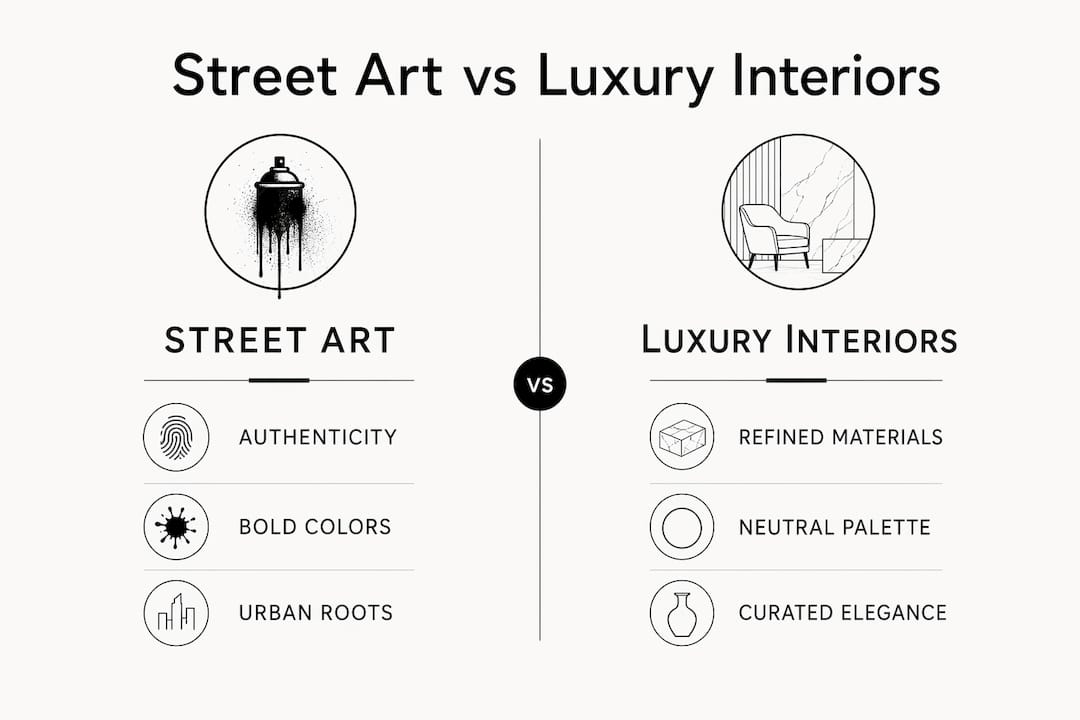
The medium you choose determines longevity, maintenance burden, and how the piece ages. Here is a practical comparison:
| Medium | Best for | Longevity | Key consideration |
|---|---|---|---|
| Original street-art work | Investment, provenance, uniqueness | Decades with proper care | Requires provenance documentation and insurance |
| Limited-edition print | Collectibility at lower cost | Archival | Verify edition size and certificate of authenticity |
| Museum-quality canvas print | Immediate installation, rotation | Archival inks | Choose acid-free substrate and UV-resistant coating |
| Standard poster/print | Budget, temporary use | years | Fades quickly without UV protection |
For most homeowners and designers, museum-quality canvas prints on archival pigment inks and acid-free substrates hit the sweet spot between cost, durability, and visual impact. Made-in-USA production with proper stretcher bars means the canvas arrives ready to hang without warping.
- Finish choice: Matte finishes reduce glare and suit most residential lighting; gloss finishes intensify color saturation but can create hotspots under track lighting.
- UV protection: A UV-resistant varnish or coating is the single most important longevity decision. Direct sunlight degrades pigment inks faster than almost any other factor.
- Humidity: Avoid placing canvases in bathrooms or near exterior walls prone to condensation. High moisture causes substrate warping and edge lifting.
- Cleaning: Dust with a soft, dry brush. Never use liquid cleaners on an unvarnished canvas surface.
Framing and UV protection are the two variables that most consistently determine whether a piece looks as good in ten years as it does on installation day.
Where do you source street-art-inspired work, and what does it cost?
Sourcing options range from ready-to-hang retail canvases to full studio commissions, and the right path depends on your budget, timeline, and how much provenance matters to you.
| Sourcing path | Typical price range | Timeline | Notes |
|---|---|---|---|
| Ready-to-hang museum-quality canvas | $50–$500 | 3–10 business days | Immediate; confirm archival materials |
| Limited-edition print (gallery) | $500–$5,000 | 2–6 weeks | Verify edition certificate |
| Studio commission (emerging artist) | $1,000–$10,000+ | 6 weeks | Includes consultation, sketch, production |
| Commissioned mural (residential) | $5,000–$50,000 | weeks | Requires wall prep, artist travel, installation |
Commissioning timeline (studio piece):
| Phase | Typical duration |
|---|---|
| Initial consultation and brief | 1–2 weeks |
| Sketch and concept approval | 2–4 weeks |
| Production | 3 weeks |
| Delivery and installation | 1–2 weeks |
For ready-to-hang graffiti canvases, Luxuryartcanvas offers over 1,000 designs produced in the USA with archival inks, which removes most of the sourcing friction entirely.
Legal and ethical checklist before any purchase:
- Confirm the seller holds or has licensed the copyright from the original artist.
- Request written artist attribution and provenance documentation.
- For commissioned works, get a signed transfer-of-rights agreement that specifies display, reproduction, and resale terms.
- For Banksy-inspired or brand-referencing works, verify the piece is a licensed reproduction or original interpretation, not an unauthorized copy.
What does a real installation look like?
A designer working with a client on a 3,200-square-foot suburban home in the mid-Atlantic region faced a common brief: the entry and open-plan living area needed a focal point that felt personal and culturally current, not gallery-sterile. The client had admired Basquiat-influenced work and wanted something that referenced urban culture without feeling out of place in a family home.
The solution was a large-format museum-quality canvas, 48 by 36 inches, placed on the entry feature wall at eye level with the second-floor landing visible above it. The piece used bold typographic elements and a crown motif against a neutral ground, echoing the client’s existing charcoal and warm-white palette. Installation took under an hour using the pre-mounted hanging hardware included with the canvas.
Luxuryartcanvas carries over 1,000 designs across graffiti, pop art, and brand-inspired collections, backed by more than 10,000 satisfied customers. The made-in-USA production and archival materials mean the canvas performs the same way five years from installation as it does on day one.
Quick rules for mixing street art with luxury furnishings
Pairing urban art with high-end furniture is less about matching and more about editing.
- Limit competing patterns. If the canvas is busy, keep upholstery solid and rugs geometric or plain.
- Pull one dominant color from the art and repeat it in a single accent: a throw, a vase, a cushion. More than one repetition tips into theme-park territory.
- Use texture contrasts deliberately. A raw-edged canvas against a polished marble surface or a velvet sofa creates the productive tension that makes the combination feel designed.
- Respect sightlines. The art should be visible from the room’s primary seating position without requiring the viewer to turn their head more than 45 degrees.
- Give the work breathing room. A canvas crowded by tall furniture or adjacent shelving loses its authority. Treat the surrounding wall as part of the composition.
- Match scale to furniture height. A canvas that sits below the top of a sofa back reads as an afterthought. The bottom edge should clear the sofa back by at least six inches.
A typographic canvas works particularly well in a study or home office, where the text element adds intellectual energy. A stencil portrait in a guest entry sets a confident, personal tone from the moment visitors arrive. In a marble-finished kitchen, a single bold pop-art piece on an otherwise bare wall is enough.
Pairing bold art with updated architectural details like contemporary interior doors amplifies the intentional, curated feel without adding visual clutter.
Key Takeaways
Street art influences luxury interiors by delivering curated authenticity, scale, and cultural immediacy that no mass-produced decor can replicate, and museum-quality archival canvases are the most practical way to bring that quality home.
| Point | Details |
|---|---|
| Curated authenticity drives demand | Street art signals personal narrative and cultural fluency, qualities affluent buyers now prize over showroom uniformity. |
| Scale and placement are decisive | One large-format anchor canvas on a focal wall, paired with calm neutral furnishings, delivers the strongest impact. |
| Archival materials protect your investment | Archival pigment inks, acid-free substrates, and UV-resistant coatings are the minimum standard for longevity. |
| Provenance and rights matter | Always confirm artist attribution, copyright licensing, and a written transfer of rights before purchasing or commissioning. |
| Luxuryartcanvas simplifies sourcing | Over 1,000 made-in-USA designs with archival materials arrive ready to hang, removing the friction of commissioning or gallery sourcing. |
The staying power of street art in luxury design
The conventional take on street art in luxury interiors frames it as a trend — something that will cycle out when the next aesthetic arrives. I think that misreads what is actually happening. The designers and homeowners who are doing this well are not chasing graffiti as a style; they are using it as a tool for specificity. A room that contains a piece with a named hand, a cultural reference, and a visual argument is a room that has something to say. That quality does not age the way a color palette does.
What will change is production quality and bespoke options. Archival materials are already better than they were a decade ago, and the gap between a commissioned studio piece and a museum-quality ready-to-hang canvas has narrowed considerably. For most clients, the practical advice is straightforward: if you want immediacy and proven durability, buy ready-to-hang. If you want a one-of-a-kind piece with full provenance, commission it and budget the time.
Museum-quality street-art canvases, ready to hang today
Luxuryartcanvas produces every canvas in the USA using archival pigment inks and acid-free materials, so the piece you order performs the same way in year five as it does on installation day. The collection spans over 1,000 designs across graffiti, pop art, and high-fashion-inspired work featuring Chanel, Louis Vuitton, Dior, and more, with sizing options that scale from a single accent piece to a room-anchoring statement.
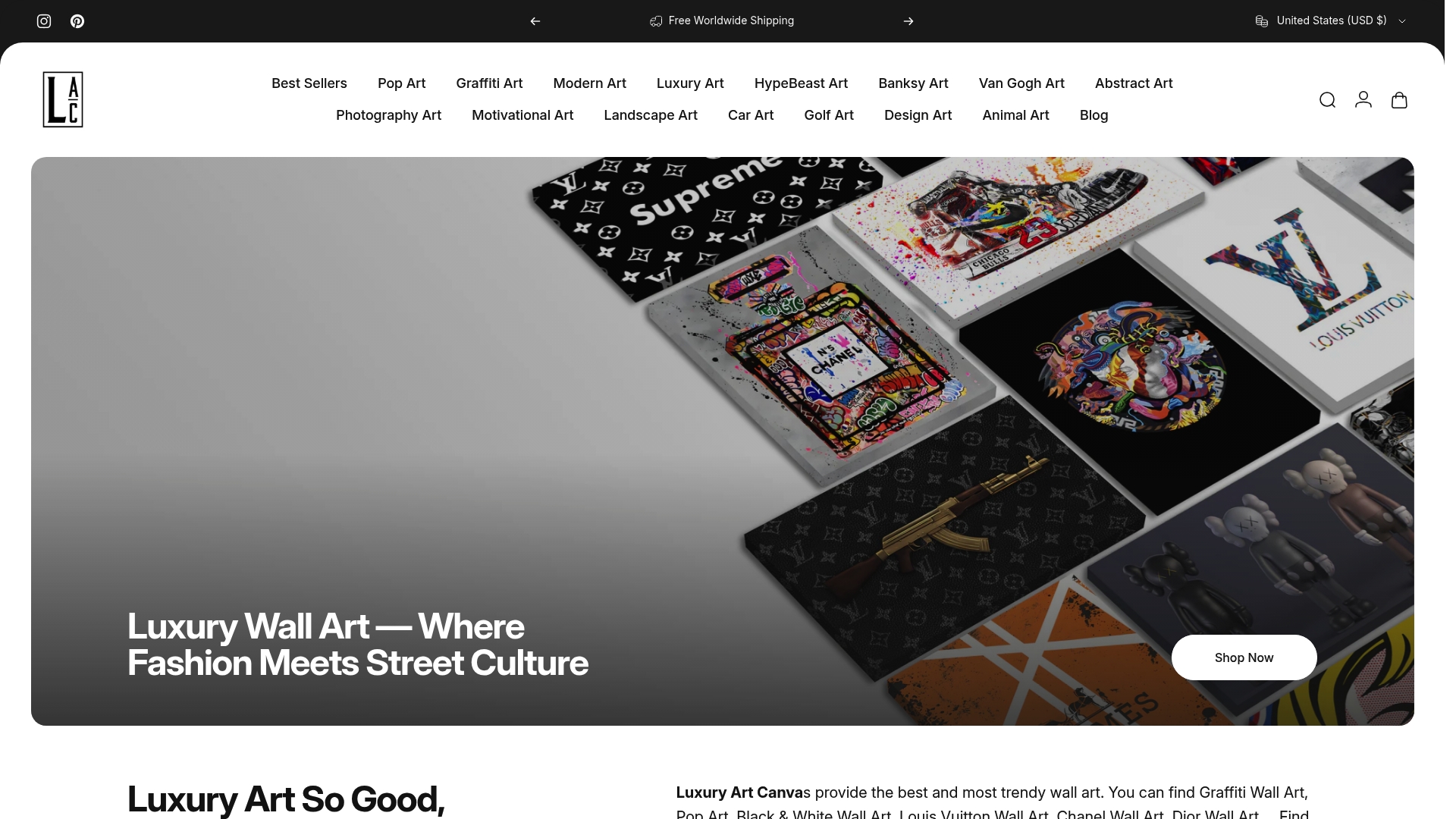
For designers sourcing a focal-wall piece, the large-format graffiti collection is the fastest path to a museum-quality result without commissioning delays. If brand-inspired work fits your brief, the Louis Vuitton canvas collection delivers that high-fashion street-culture crossover in ready-to-hang format. Order with measured dimensions, consider professional hanging for pieces above 36 inches, and request artist attribution details on any culturally inspired design. Browse the full collection at Luxuryartcanvas and find the piece that makes your space say something.
Useful sources and further reading
- Street Art Wall Decor and the Rise of Urban-Inspired Interiors — WorleyGig: trend analysis on how urban-inspired decor has moved into homes, offices, and hospitality spaces.
- The Rise of Street Art and Abstract Murals in Luxury Interior Design — Resident.com: covers how graffiti and murals pair with luxury finishes to create intentional visual contrast.
- 5 Tips for Installing Street Art in Your Home — Artsy: practical installation guidance on lighting, framing, and UV protection for domestic settings.
- How to Incorporate Street Art Into High-End Interior Design — Frippo Home: placement and pairing tactics for treating street art as a curated statement piece.
- How Street Art Powerfully Inspires Interior Design — The Street Blogger: examples of urban-inspired decor adapted across building types and architectural styles.
Street Culture Art for Bedroom Walls: Styling & Buying Guide
Top Canvas Art Trends for Living Spaces in 2026