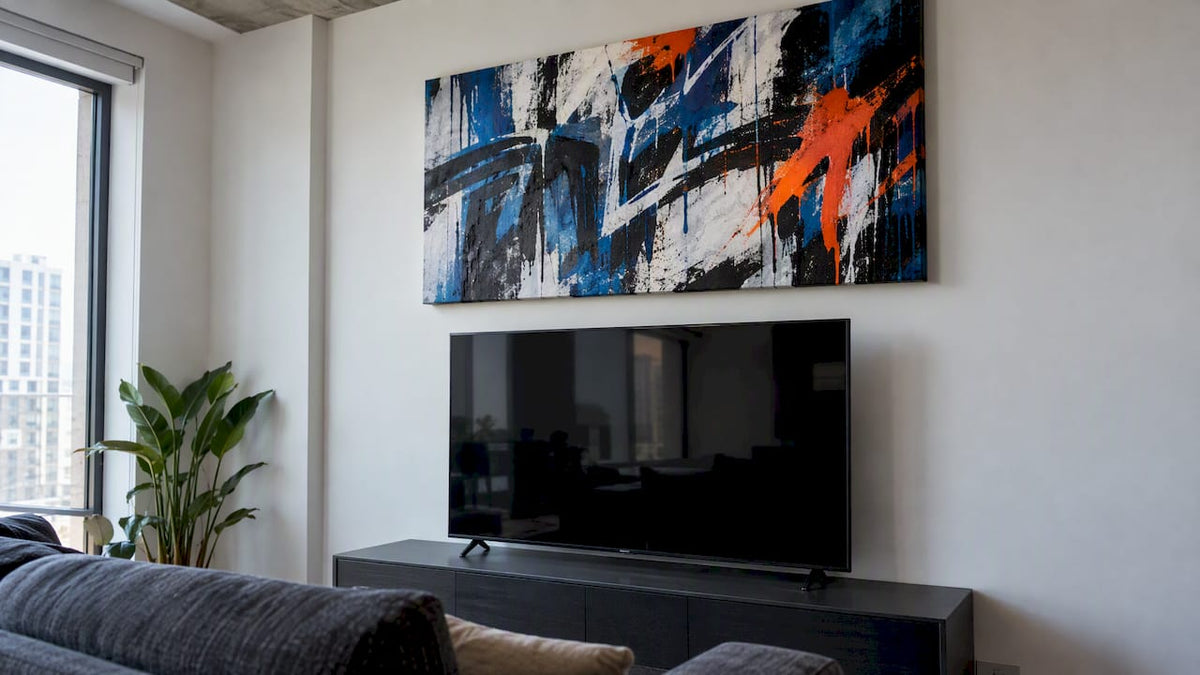
The best general approach is a low, horizontal piece of art or a slim floating shelf hung about 8 to 10 inches above the screen, which visually folds the television into the wall instead of framing it like a sore thumb. When ceilings run low or the gap above the TV is shallow, skip the wall entirely. We build large-format canvases, including bold graffiti and pop art pieces, specifically for this kind of horizontal placement.
Table of Contents
- 8 Practical Ideas to Style Above and Around a TV
- How to Size and Place Art Above a TV: Exact Measurements
- Plan and Hang a Gallery Wall That Includes the TV
- Design Moves That Minimize the TV’s Visual Impact
- Frame, Color, and Material Tips for Art Near a TV
- The TV-Above-Mantel Debate: Comfort Versus Convenience
- Incorporating Luxury and Street Culture Art Above the TV
- Maintenance and Cleaning Advice for Canvas Art Near a TV
- A Few Tradeoffs Worth Weighing Before You Commit
- Make These Looks Easy to Execute With Ready-to-Hang Canvas
- FAQ
- Sources
8 Practical Ideas to Style Above and Around a TV
Most successful above-TV layouts fall into a handful of repeatable patterns. Pick the one that matches your wall height, ceiling, and how much you want the screen to disappear.
- Long horizontal canvas: size it to match or slightly exceed the TV’s width so the whole arrangement reads as one unit.
- Panoramic triptych: three narrow panels spread wider than the screen create rhythm without one oversized piece.
- Slim floating shelf: styled with low books, small sculptures, or framed photos, it should run slightly wider than the screen and stay shallow enough to avoid crowding the room.
- Picture lights or wall sconces: mounted above the art, they pull the eye upward and add evening ambiance without stacking more objects vertically.
- Gallery wall grouping: frames arranged around the TV turn the screen into one piece in a larger composition rather than the obvious focal point.
- Leaning art on a console: a large canvas propped against the wall behind a credenza below the TV adds scale without drilling a single hole.
- Dark paint or paneling: a darker background behind the TV lowers the contrast between the black screen and the wall, making the screen recede.
- Nothing at all: on walls under 9 feet tall or with a shallow gap above the TV, leaving the space bare often looks more intentional than a cramped piece of art.
Each option solves a slightly different problem, so the right pick depends on your ceiling height, how much wall space you have, and whether you want the TV to vanish or simply share the spotlight.
How to Size and Place Art Above a TV: Exact Measurements
Precision is what separates a styled wall from a cluttered one. A few numbers do most of the work.
- Set the gap first. Leave 6 to 12 inches between the top of the screen and the bottom of your art or shelf, with 8 to 10 inches as the sweet spot for most living rooms. Tighter gaps around 6 inches suit smaller TVs or shorter walls; the fuller 12 inches works when the TV itself is large and needs more visual breathing room.
- Match the width. A single horizontal canvas should equal or slightly exceed the TV’s width, with balanced space on each side so the piece doesn’t look like it’s floating off-center.
- Check the eye-level baseline. Standard gallery guidance centers artwork around 57 inches from the floor, but with a TV in play, let the screen’s position dictate the art’s placement instead of forcing that exact center height.
- Mock it up before drilling. Trace the art’s outline on kraft paper, cut it out, and tape it to the wall to confirm spacing and width.
- Mark and mount. Note hanger points on the paper, transfer them to the wall, locate studs where possible, and use the right anchors for the piece’s weight.
- Level before the final fix. Use a level on the frame itself, not just the paper template, since walls and trim aren’t always perfectly square.
Pro Tip: Keep a spare cutout from the kraft-paper stage. If you ever swap the TV for a larger model, you’ll already have a template to check whether your old spacing still works.
Plan and Hang a Gallery Wall That Includes the TV
A gallery wall works around a TV when the screen is treated as just one more rectangle in the composition, not the centerpiece everything else orbits.
- Choose a focal piece first, usually the largest canvas or the TV itself, and build the rest of the layout around it.
- Trace every frame on kraft paper and tape the cutouts to the wall to test the arrangement before committing to any holes.
- Space frames 3 to 6 inches apart, giving larger pieces more room to breathe than small ones.
- Balance visual weight by pairing one large piece with a cluster of smaller frames on the opposite side rather than mirroring everything symmetrically.
- Hang the anchor piece first, then work outward, measuring from its edges rather than eyeballing each new frame.
- Match anchors to weight: picture hooks suit lightweight prints, while heavier framed canvases need wall anchors or a stud whenever one lines up.
Once the paper mockup looks right on the wall for a day or two, the real hanging takes a fraction of the time.
Design Moves That Minimize the TV’s Visual Impact
A few techniques consistently make a screen feel less like the room’s main event.
- Paint or panel the wall dark behind the TV. Reducing contrast between a black screen and a light wall is one of the simplest ways to make the TV recede.
- Group the TV with framed art so it reads as one element in a composition instead of a standalone appliance.
- Consider a recessed or art-mode display, or a sliding panel that covers the screen when it’s off, letting a large painting take over the wall entirely.
- Add picture lights or linear wall lights above the art to create a visual field that draws attention upward and softens the screen’s presence after dark.
None of these require replacing the TV itself. They work by shifting what the eye lands on first.
Frame, Color, and Material Tips for Art Near a TV
The right frame and finish keep art above a TV from looking like an afterthought.
- Thin black frames suit modern, high-contrast rooms and echo the TV’s own bezel.
- Float frames give canvas a gallery feel without the bulk of a traditional frame.
- Frameless canvas reads cleaner in minimalist or contemporary spaces and is how most of our own pieces ship.
- Pull a color from the room such as a pillow or rug shade into the artwork to tie the wall into the rest of the space.
- Canvas suits modern rooms with its softer, matte edges, while framed prints read more formal and traditional.
- Avoid tall vertical pieces directly above a TV. They exaggerate height imbalance and compete with the screen’s own rectangle. Horizontal or low-profile pieces almost always look more settled.
The TV-Above-Mantel Debate: Comfort Versus Convenience
Placing a TV above a fireplace mantel is one of the most debated layouts in living room design, and for good reason. Designers often caution that mounting a TV too high above a mantel creates an awkward, top-heavy look and forces viewers to tilt their heads back, which can get uncomfortable during long viewing sessions.
The ergonomic concern is real: a screen centered well above standard eye level puts strain on the neck over time, especially on a couch positioned close to the fireplace wall. Even so, practical layout constraints often make the above-mantel position the only workable option in smaller living rooms where the fireplace wall is the only flat surface large enough for a TV.
When that’s the case, a few adjustments soften the tradeoff. Pulling seating slightly closer can offset some of the added height. A tilting mount angled downward helps reduce the neck strain from a lower seating position. And framing the TV with art on either side, rather than leaving it isolated above the mantel, makes the elevated placement look designed rather than forced.
If the room allows it, a separate media wall away from the fireplace solves the ergonomic issue outright. But for the many households where the mantel wall is the only option, a thoughtful arrangement around the TV matters more than its height alone.

Incorporating Luxury and Street Culture Art Above the TV
Bold art styles like graffiti, pop art, and designer-inspired pieces can work especially well above a TV because the screen itself already reads as a modern, graphic object. Pairing it with equally graphic art, rather than something quiet or traditional, tends to look intentional instead of mismatched.
A single large graffiti canvas in bold color blocks can anchor the wall the same way a horizontal landscape would, while giving the room more personality. Pop art pieces featuring saturated colors or recognizable motifs work well when the rest of the room leans neutral, letting the art and the TV share visual energy instead of competing for it.
Designer-inspired pieces, such as our Chanel or Louis Vuitton canvases, tend to suit rooms with a more polished, fashion-forward palette: think black, white, and gold accents that echo the branding itself. These pieces work best as a single statement rather than part of a busy gallery wall, since the branding already carries visual weight on its own.
The key across all of these styles is restraint elsewhere in the room. A bold graffiti or luxury-branded canvas above the TV reads strongest when the furniture and wall color stay simple enough to let the art do the talking.
Maintenance and Cleaning Advice for Canvas Art Near a TV
Canvas art positioned above a TV faces two things that most wall art doesn’t: a steady stream of heat from the screen and more exposure to dust pulled in by electronics.
A soft, dry microfiber cloth is the safest way to dust a canvas surface. Light, even strokes in one direction lift dust without pressing it into the fibers. Avoid household glass cleaners or anything with ammonia, since they can dull or discolor printed canvas over time.

Keep art at least a few inches clear of the TV itself, which is part of why the 8 to 10 inch gap matters beyond looks. It also gives the canvas distance from the heat the screen generates during long viewing sessions, which can otherwise dry out canvas fibers faster than normal room conditions would.
If the canvas needs a deeper clean, a barely damp cloth, wrung out well, can lift stubborn dust without soaking the material. Let it air dry fully before rehanging. Direct sunlight hitting the wall at certain times of day can fade colors faster than typical indoor lighting, so a room with strong afternoon sun may call for occasional repositioning or a UV-filtering window treatment nearby.
A Few Tradeoffs Worth Weighing Before You Commit
Comfort should come before style every time you’re deciding where art and a TV share a wall. A stunning gallery arrangement loses its appeal fast if everyone on the couch is tilting their neck to watch a show.
Where the room allows it, pairing ergonomics with aesthetics isn’t a compromise. For maximum visual impact, a single large horizontal canvas still wins. For flexible, multi-use rooms, a lower-contrast approach, like a dark wall behind the TV or a concealable panel, tends to age better than a fixed, elaborate arrangement. Our own canvases are US-made and ready to hang, part of a catalog of over 1,000 designs that has earned 10,000+ customer reviews.
— James
Make These Looks Easy to Execute With Ready-to-Hang Canvas
Most of the ideas above hinge on one thing: finding art sized and styled correctly for the space above a TV, then hanging it without a production. That’s the exact problem our Pop Art Canvas Prints and Graffiti Wall Art & Street Art Canvas collections solve. Pieces arrive ready to hang, and the bold horizontal formats in both collections are built for exactly the kind of statement wall a TV setup calls for.

The collection includes many canvas designs spanning graffiti, pop art, and designer-inspired pieces.
| What you need | What we offer |
|---|---|
| Horizontal canvas sized for above a TV | Large-format pop art and graffiti prints |
| Bold, gallery-worthy style | 1,000+ designs across multiple art styles |
| No framing or finishing work | Ready-to-hang canvas, US-made |
Browse the Graffiti Wall Art & Street Art Canvas collection to find a piece sized for your wall.
FAQ
How far above a TV should art be hung?
Most designers recommend leaving 6 to 12 inches between the top of the screen and the bottom of the artwork, with 8 to 10 inches working best for average-sized living rooms. Smaller gaps suit compact TVs, while larger TVs often look better with a bit more breathing room above them.
What is the best type of art to put above a TV?
A single long horizontal canvas, sized to match or slightly exceed the TV’s width, is the simplest way to visually integrate the screen with the wall. Panoramic triptychs and slim floating shelves styled with low objects are strong alternatives when you want more texture than one flat canvas provides.
Should I put a TV above a fireplace mantel?
Designers often caution against it because the resulting height can strain the neck during long viewing sessions, but many living rooms don’t have another flat wall large enough for a TV. When the mantel wall is the only option, a tilting mount and art framing the TV on either side help offset the ergonomic tradeoff.
How much space should be between gallery wall frames?
A spacing of 3 to 6 inches between frames is the standard guideline, with larger pieces needing more room than small ones. Testing the layout with kraft-paper cutouts and painter’s tape before hanging anything helps confirm the spacing looks balanced on your specific wall.
How do I make a TV blend into the wall instead of standing out?
Painting or paneling the wall behind the TV in a darker tone lowers the contrast between the screen and the wall, which makes the TV less visually dominant. Grouping the TV with framed art, or concealing it behind a sliding art panel, are two other proven ways to shift attention away from the screen itself.
Sources
- How to Decorate Around a TV: Wall Ideas and Heights | Interior Design Trends
- How to Hang a Gallery Wall in 5 Easy Steps
- How To Make a TV-Hiding Sliding Art Accent Wall | Apartment Therapy
Art Placement Around Windows: Set 3–6 Inches Between Frames
Neon Pop Art Without Wiring: Get the Look on Ready to Hang Canvas