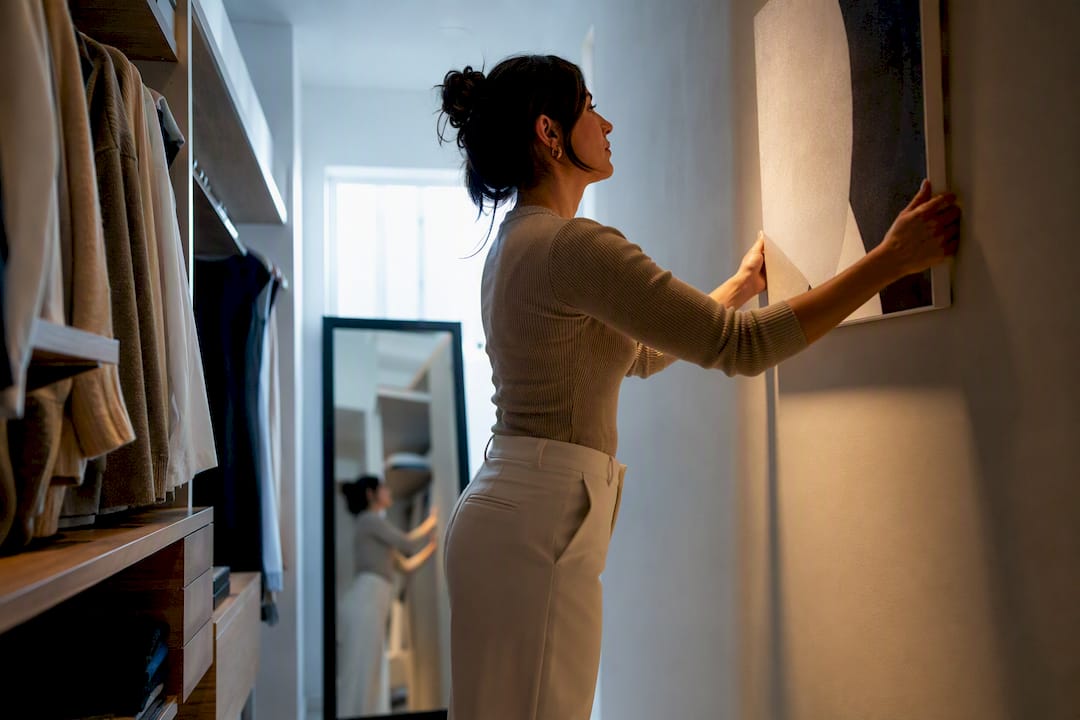
The fastest fix for a dull closet is a lightweight, ready-to-hang canvas or a removable accent (a small gallery or a peel-and-stick mural) paired with one mirror and a strip of warm LED light. It works whether you own the place or rent it, costs little to change your mind about, and reads boutique within an afternoon.
Table of Contents
- Closet Wall Art Ideas That Actually Work in Tight Spaces
- Why Material and Placement Matter More Than People Think
- Designer Perspective on Closet Wall Art
- Bring the Look Home With a Ready-to-Hang Canvas
- Sources
- FAQ
Closet Wall Art Ideas That Actually Work in Tight Spaces
Closets are unforgiving rooms to decorate. Narrow walls, low light, and zero margin for error mean the usual living-room playbook (big framed prints, heavy mirrors, gallery walls sprawling six feet wide) just doesn’t fit. What follows are ten approaches sized for reach-in and walk-in closets, ranked roughly by how much visual impact you get for the effort involved.
1. Build a scaled-down gallery wall. Forget the sprawling arrangements you see in dining rooms. In a closet, the 2/3 guidance works best: let your art cluster cover roughly two-thirds of the available wall height hung around eye level, and mix two or three frame sizes rather than five. Keep spacing between pieces to two or three inches. On narrow walls, a vertical stack of three small pieces reads cleaner than a horizontal spread.
2. Add peel-and-stick wallpaper on the back wall. This is the single highest-impact, lowest-risk move for renters. A patterned mural or bold wallpaper on just the back wall of a walk-in gives you a dramatic focal point without touching the surrounding walls, and it comes down clean at move-out. Choose a smaller-scale pattern for reach-in closets so it doesn’t overwhelm the space; bigger walk-ins can handle a larger motif.
3. Lean one large canvas instead of hanging it. A single oversized, lightweight canvas leaned against the wall (behind a bench, beside a dresser, or propped on a shelf) delivers more visual weight than three small framed pieces, and it requires zero holes. This is one of the more renter-safe tricks in the whole list because you can swap it out in seconds.
4. Use mirrors as art. A full-length mirror or a set of mirrored panels does double duty: it functions as art and tricks the eye into reading the space as larger. Placing a mirror opposite a window, or angled to catch your light source, amplifies both.
5. Style a floating shelf with small framed pieces and objects. A single shallow shelf above a dresser or bench gives you a rotating display surface for postcard-sized art, a small vase, or a candle, and you can restyle it seasonally without new hardware. Pair it with a stick-on LED strip underneath.
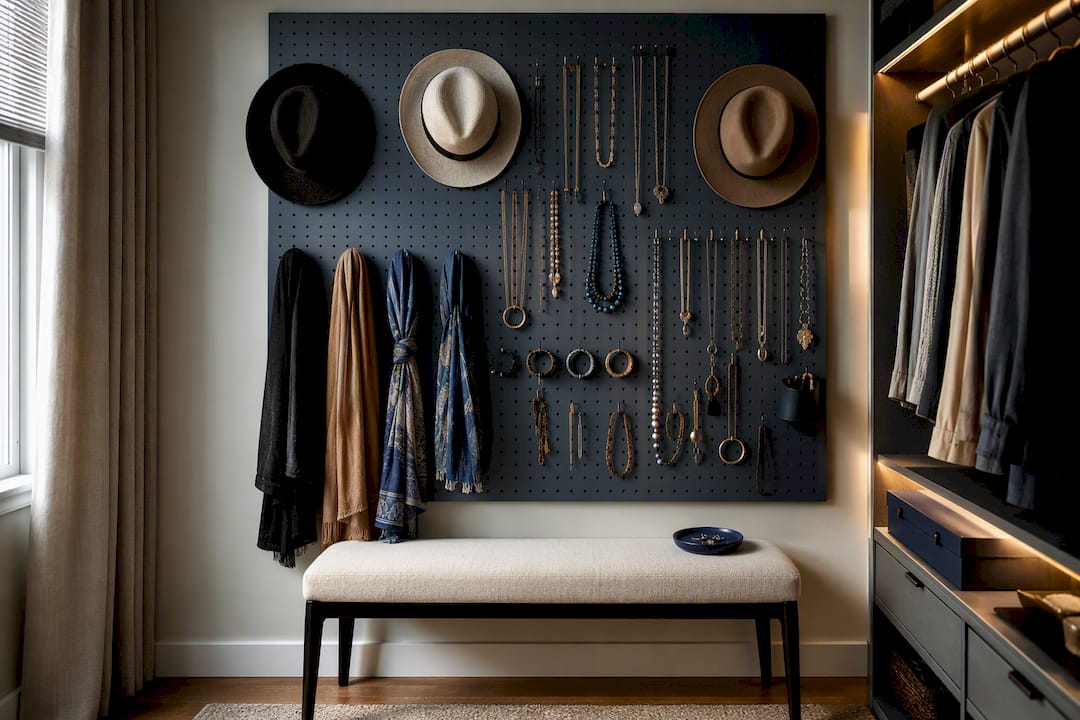
6. Install a pegboard or jewelry board. This is decor and storage in one panel. A painted pegboard holds necklaces, hats, or scarves while doubling as a textured wall feature, and most versions mount with just a couple of screws or strong adhesive hooks.
7. Hang a framed textile or fabric panel. A piece of patterned fabric stretched over a lightweight frame, or a small woven wall hanging, adds texture without the permanence of paint or wallpaper. It’s an easy renter swap and costs far less than commissioned art.
8. Layer in statement lighting. Battery-powered sconces, stick-on LED strips along a shelf edge, or a small pendant fixture in a walk-in instantly upgrade the mood. Warm white light (not cool white) flatters both skin tone and artwork.
9. Paint or stencil an accent wall. If you own your space, a bold color or a hand-stenciled pattern on the back wall costs a can of paint and an afternoon, and it’s the most custom-looking option on this list for the money.
10. Build a rotating mood board. A cork or felt panel lets you pin fabric swatches, postcards, and photos that change with your mood or the season, which is ideal if you like variety over permanence.
Pro Tip: If you’re torn between two ideas, pick whichever one you can change your mind about later without a headache. Closets get more foot traffic than you think, and the fastest way to feel bored of a space is to commit to something you can’t easily undo.
A few quick pairings that tend to work better together than alone:
- Mirror + warm LED strip: doubles light and depth in one move.
- Leaned canvas + floating shelf: gives you height variation without extra wall damage.
- Pegboard + small framed print: mixes function and art on the same panel.
Why Material and Placement Matter More Than People Think
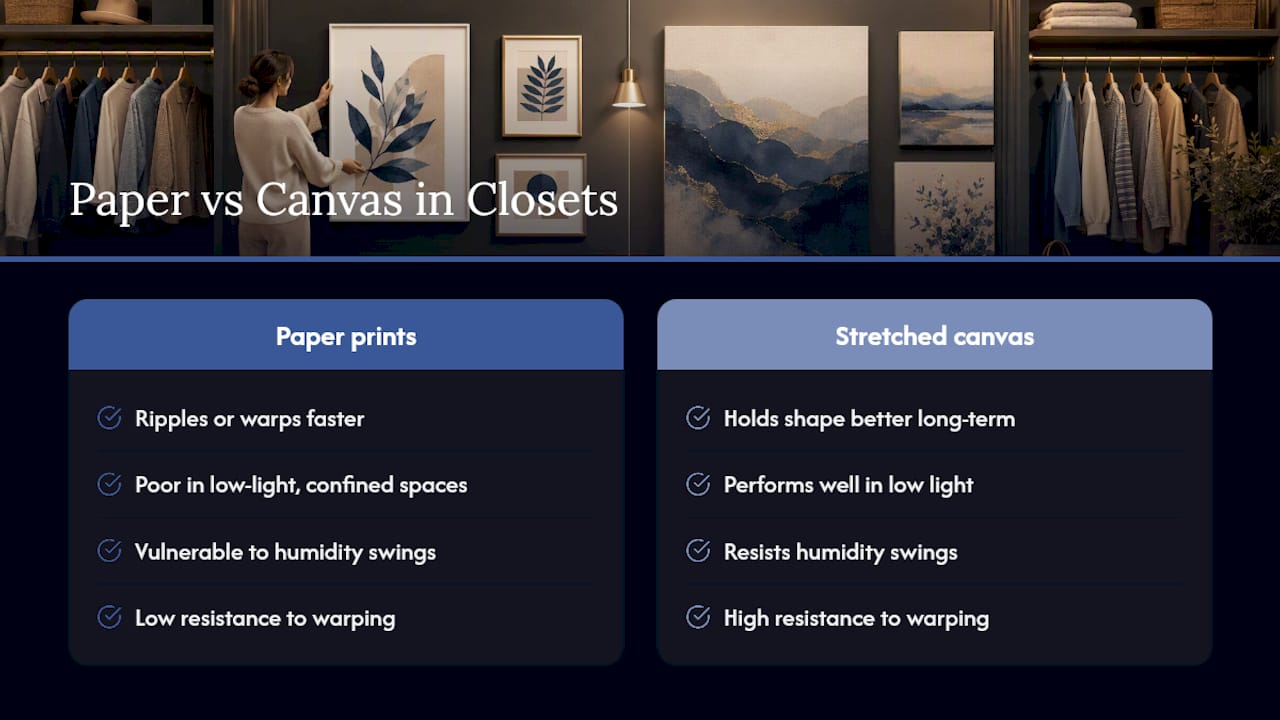
Most closets have poor airflow, limited natural light, and humidity swings that a living room never sees. Paper prints in that environment tend to ripple or warp faster than art printed on stretched canvas, which holds its shape better in confined, low-light spaces. That’s a practical reason to favor canvas over paper for anything staying up long term.
Designers who work on closet renovations tend to treat decor as a functional tool, not just decoration. Placing a piece of art or a mirror at the entrance to a walk-in creates a visual “zone,” marking where the dressing area starts and, in practice, giving you a reason to keep that corner tidy.
For hanging, match the method to the wall. Command-style adhesive strips work fine for lightweight pieces under a few pounds on painted drywall. Anything heavier, or textured plaster, needs a proper anchor. Leaning is the safest option of all in a tight closet, since there’s no risk of a nail catching a sleeve or a hook snagging clothing on the way in.
Canvas holds up better than paper in closets specifically because of the airflow problem: low humidity swings and no ventilation are exactly the conditions that cause paper prints to ripple over time, while canvas stretched on a frame resists it.
Every piece is built on stretched canvas, shipped ready-to-hang, helping avoid framing and warping issues while offering a wide selection of designs to suit different decor styles.
Designer Perspective on Closet Wall Art
The conventional wisdom on closet decor treats it as an afterthought: hang whatever leftover print you had, call it done. That’s backwards. A closet is the room you stand in front of a mirror in every single morning, which makes it one of the highest-frequency-viewed walls in your entire home. It deserves more intention than the guest bathroom, not less.
Where most advice falls short is treating renters as an edge case instead of the default reader. Command strips, leaning art, and peel-and-stick wallpaper aren’t compromises. They’re often the smarter choice even for homeowners, because your taste in two years won’t match your taste today, and a closet is cheap and fast to refresh compared to a living room.
If you do one thing first, make it lighting. A gorgeous canvas in a dim closet still looks flat. A mediocre print under warm LED light looks intentional. Fix the light, then build around it.
— James
Bring the Look Home With a Ready-to-Hang Canvas
Luxuryartcanvas solves the exact problem this article just walked through: finding art that’s light enough to lean or hang safely in a tight space, durable enough to survive a closet’s low airflow, and distinctive enough that it doesn’t look like a leftover print from the garage.

Every canvas ships ready-to-hang, printed in the USA on archival-grade materials that resist the warping paper prints struggle with in closets. If you want a bold focal piece for a walk-in, browse the Pop Art Canvas Prints collection for something graphic enough to anchor a gallery wall, or check Luxury Art for a more understated, minimalist accent that won’t compete with a mirror or a wallpapered back wall.
Start by measuring your wall’s usable height (remember the two-thirds guidance from above), pick a canvas size that fits without crowding your shelving, and choose your hanging method based on the wall: command strips for lightweight pieces, anchors for anything heavier. Then browse the full catalog at Luxuryartcanvas to see which of the 1,000-plus designs fits your zone.
Sources
- Moody modern traditional closet overhaul - Chris Loves Julia
- This Easy $140 DIY Makes My Closet Look Custom (It Tripled the Storage Too!) | Apartment Therapy
FAQ
How do you decorate a closet wall?
Start with one focal piece, either a leaned canvas or a small gallery cluster sized to about two-thirds of the wall height, then add a mirror and a strip of warm LED lighting. For renters, stick to peel-and-stick wallpaper, command strips, or leaning art so nothing damages the walls.
What is the 2/3 rule for wall art?
The 2/3 rule suggests your art or gallery cluster should cover roughly two-thirds of the wall’s available height rather than stretching edge to edge, which keeps the arrangement feeling balanced rather than cramped. In closets, this guidance also accounts for shelf height and sightlines from the doorway.
What closet trends should you expect in 2026?
Closets are increasingly styled like small dressing rooms, combining organization with display: mirrors, LED lighting, floating shelves, and rotating art rather than static built-ins. Removable, renter-friendly materials like peel-and-stick wallpaper and lean-against-the-wall canvases continue to gain ground over permanent installations.
Is canvas better than paper prints for a closet?
Yes, in most cases. Closets typically have low airflow and light, which causes paper prints to ripple or warp faster than art printed on stretched canvas, making canvas the more durable choice for a space you rarely ventilate.
What’s the safest way to hang art in a small closet?
Use command-style adhesive strips for lightweight pieces on painted drywall, wall anchors for anything heavier, or simply lean a large canvas against the wall for zero risk at all. Leaning also works best in tight walk-ins where a protruding hook could catch on clothing.
Editorial vs Designer Looks: Fashion Inspired Wall Art, Stylist Rules
Tight Foyer Entryway Wall Art Ideas With Ready to Hang Canvases