
For the biggest visual impact, pick one of four approaches: a large-format statement piece for open reception areas, a curated gallery wall for personality-driven private offices, acoustic art panels for noisy open floor plans, or renter-friendly peel-and-stick options for leased space. Luxuryartcanvas supplies U.S.-made, ready-to-hang canvases that cover the first two categories out of the box.
Table of Contents
- Office Wall Art Ideas Worth Copying, Ranked By Impact
- How Do You Choose the Right Idea for Your Wall?
- Room-By-Room Wall Art That Fits The Space
- Materials, Mounting, And Renter-Friendly Installation
- Making The Walls Say Something About Your Brand
- What Should You Actually Budget For This?
- Where To Actually Buy This Stuff
- An Editor’s Take On What Actually Gets This Wrong
- How To Get This Look On Your Own Walls
- Sources
Office Wall Art Ideas Worth Copying, Ranked By Impact
The mistake most offices make is treating walls as an afterthought, something to fill once the furniture arrives. A wall has a job to do, whether that’s calming a loud open floor or telling a client who you are before anyone speaks. The ideas below are ranked by how much visual and functional payoff you get for the effort.
1. Large-format statement canvases. One large-format abstract or photographic print generally creates more impact than multiple smaller pieces in a commercial space. Aim for a large piece that spans a considerable portion of the reception or lobby wall; anything smaller reads as an afterthought against high ceilings and open sightlines.
2. Curated gallery walls. A gallery wall works when it’s disciplined, not improvised. Stick to 5 to 7 pieces, one dominant color palette, and no more than 2 to 3 frame styles. Odd-numbered groupings look intentional; even numbers tend to look accidental. Pick one anchor piece, usually the largest or most colorful, and build outward from it.
3. Acoustic art panels. Geometric felt tiles or fabric-wrapped panels in color blocks absorb sound while reading as intentional design rather than a retrofit. This is the fastest-growing category in 2026 corporate design, and it solves a real problem: open-plan offices are loud, and most companies fix that with ugly foam instead of art that doubles as treatment.
4. Typography and neon accents. A single well-chosen word or short phrase in metal or neon works in creative studios and startups. It reads as forced in a law firm or accounting practice, so match the medium to the culture before you commit.
5. Biophilic wall treatments. Preserved moss panels and botanical prints are showing up across corporate lobbies because they soften hard surfaces without any watering schedule. They pair especially well with walnut slat walls, another trend gaining traction this year.
6. Peel-and-stick murals and removable wallpaper. For leased space, this is the lowest-risk way to add color and pattern to an entire wall without a security deposit fight later.
7. Functional art. Framed whiteboards, corkboards inside a decorative frame, or modular multi-panel canvases that double as room dividers give you visual interest and a job the wall is actually doing.
Pro Tip: Before buying anything, stand where clients or employees actually stand and look at the wall from that distance. A piece that looks perfect up close can disappear from 15 feet away, and vice versa.
How Do You Choose the Right Idea for Your Wall?
Start with three questions before you shop:
- What job does this wall need to do (brand statement, sound control, focal point, mood)?
- Who sees it, and from how far away? A hallway glance needs bolder contrast than a desk you sit at for eight hours.
- Are you renting, and will you move within a few years?
Sizing follows a simple rule: center artwork at roughly 57 to 60 inches from the floor, and if it hangs above furniture like a console or credenza, keep the piece around two-thirds the width of that furniture. Above a desk, place it slightly higher than eye level so it doesn’t land directly behind someone’s head on video calls.
Match material to function: canvas for warmth and low glare, metal for a sharper modern edge, acoustic felt where echo is a problem, and moss or botanical panels where you want texture without upkeep. Reversible mounting (strips, hooks, freestanding easels) beats drilling whenever the lease is short or the wall isn’t yours to alter permanently.
Room-By-Room Wall Art That Fits The Space
Different rooms need different treatments, and using one style everywhere is how offices end up feeling flat.
- Reception: Go big and sculptural. A single large-format piece or a tightly scaled multi-panel set makes a stronger first impression than a scatter of small frames, since visitors judge the space in seconds, not minutes.
- Conference rooms: Choose horizontal, restrained pieces that don’t compete with a presentation screen or fight for attention during a video call.
- Open plan: Acoustic panels arranged in a repeating rhythm double as visual zone markers, breaking up long sightlines while cutting noise.
- Private offices: Personalize with pieces that look good behind you on camera, favoring calm backgrounds over busy patterns.
- Hallways and corridors: A repeating motif or a numbered series creates flow instead of feeling like a random gallery.
- Break rooms: Keep it relaxed, and rotate pieces occasionally since this is the one space where change feels welcome rather than disruptive.
Materials, Mounting, And Renter-Friendly Installation
Canvas is forgiving, lightweight, and low-glare, which matters in offices full of monitors and windows. Metal prints look sharper but reflect more light. Framed prints add formality but weigh more, meaning you need proper anchors, not just adhesive strips, for anything over a few pounds.
- Use wall anchors rated for the piece’s weight; a 3-foot canvas is usually fine on strips, a metal print over 20 pounds is not.
- For rented space, peel-and-stick wallpaper, cork tiles, and freestanding panels avoid landlord disputes entirely since none of them touch the drywall permanently.
- Check glare from windows and overhead lighting before finalizing placement, especially near video-call setups.
- Dust canvas and felt panels with a dry cloth; avoid glass cleaner on framed pieces with UV coating.
Pro Tip: If your office runs on video calls all day, choose a matte canvas finish over glossy metal. Glare from ceiling lights bounces straight into the camera on reflective surfaces.
Making The Walls Say Something About Your Brand
Generic motivational posters, the kind with a mountain and a single word in bold type, have become wallpaper in the least interesting sense: nobody actually looks at them anymore. Art that reflects your company’s actual identity through color, subject matter, or custom imagery tends to hold attention longer and says more about who you are.
That doesn’t mean skipping quotes entirely. A well-chosen line from your founder, your mission statement rendered in your brand typeface, or a custom illustration tied to your industry reads as intentional rather than borrowed from a stock catalog. The difference is specificity: a phrase that could belong to any company on earth doesn’t do much work, while one that only makes sense next to your logo does.
Color is doing more work than most people realize here. If your brand palette is navy and gold, a wall of muted gray abstracts undercuts the identity even if the art itself is beautiful. Matching hue and tone to your existing brand colors is a fast way to make disparate pieces feel like they belong to the same company, and it’s worth understanding the psychology behind color choices in branding before you commit to a palette. For a deeper look at building this kind of identity-driven wall, branded office wall decor that skips generic posters entirely tends to age better and gets referenced by visitors more often.
What Should You Actually Budget For This?
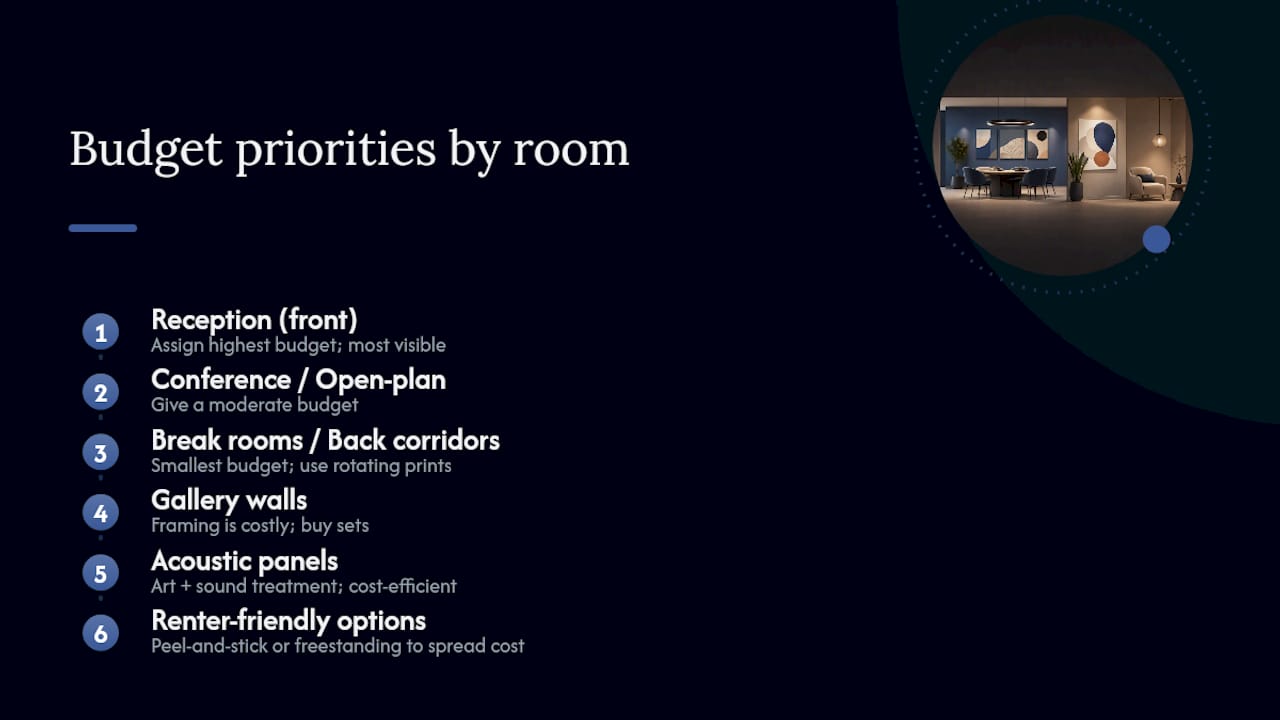
Costs swing wildly depending on scale and sourcing, so the first decision is really about priorities, not price tags. A single large-format canvas for a reception wall is a one-time purchase that covers the highest-visibility spot in the building, which makes it a reasonable place to spend more than you would on, say, a hallway.
Gallery walls get expensive fast if you’re framing each piece separately, since framing often costs more than the print itself. Buying pre-framed or canvas-mounted pieces designed as a set avoids that markup entirely. Acoustic panels function as both art and sound treatment, so their cost can offset what you’d otherwise spend on separate acoustic foam or ceiling baffles, making them one of the more efficient line items on an office renovation budget.
A practical way to plan: assign your highest budget to the wall your clients or interviewees see first, a moderate budget to conference and open-plan zones, and the smallest budget to break rooms and back-of-house corridors, where rotating cheaper prints keeps things fresh without a big spend. Renter-friendly peel-and-stick options and freestanding panels also let you spread cost over time, since you’re not committing to permanent installation you’d need to redo at the next move. If you’re renovating during a relocation, coordinating the art install with your office move timeline avoids paying for installation twice.
Where To Actually Buy This Stuff
Local artists and independent studios are worth pursuing if you want a one-of-a-kind piece and have the lead time, often four to eight weeks for a commission. The tradeoff is unpredictability: pricing, timelines, and final results vary artist to artist, and you’re usually buying a single unrepeatable piece rather than something you can reorder in a different size later.
Online platforms solve the speed and consistency problem. You see the exact piece before buying, sizing is standardized, and most ship within days rather than weeks. The tradeoff here is that you’re choosing from an existing catalog rather than commissioning something custom, though catalogs with 1,000 or more designs give you enough range that “custom” often isn’t necessary.
Custom commissions sit in between: some retailers will adjust an existing design’s color palette, size, or cropping to fit your space without the full timeline of a from-scratch artist commission. This works especially well for branded pieces, where you want an existing style adapted with your company’s colors rather than an entirely new concept.
For most offices working against a lease timeline or an opening date, a platform with ready-made inventory and fast U.S. shipping removes the biggest risk in the buying process: waiting on a piece that isn’t finished when the walls need to be.
An Editor’s Take On What Actually Gets This Wrong
Most office wall art fails for one reason: someone bought what looked good on a screen without checking scale against the actual wall. A 24-inch print that looked substantial in a product photo disappears on a 12-foot reception wall, and no amount of good taste fixes that after installation.
The bigger issue I see is companies defaulting to generic motivational prints because they’re safe, when brand-aware art in the company’s own colors does more work for the same wall space. A tech startup hanging the same “hustle” poster as the accounting firm down the hall isn’t saying anything about who they are.
Buy ready-made when you need speed, standardized sizing, and a design you can see before committing, which covers most reception and open-plan needs. Commission custom work when the piece needs to reference something specific to your company that no catalog will have. Luxuryartcanvas makes canvases in the U.S., carries over 1,000 designs, and has more than 10,000 positive reviews from buyers making exactly this call.
— James
How To Get This Look On Your Own Walls
Once you know which idea fits your space, the actual buying decision gets simple: measure the wall, decide if you want one large statement piece or a multi-panel set, and check the mounting guidance before you order. Luxuryartcanvas skips the local-artist wait time and the framing markup by shipping ready-to-hang, U.S.-made canvases directly, often faster than a commissioned piece could even get started.
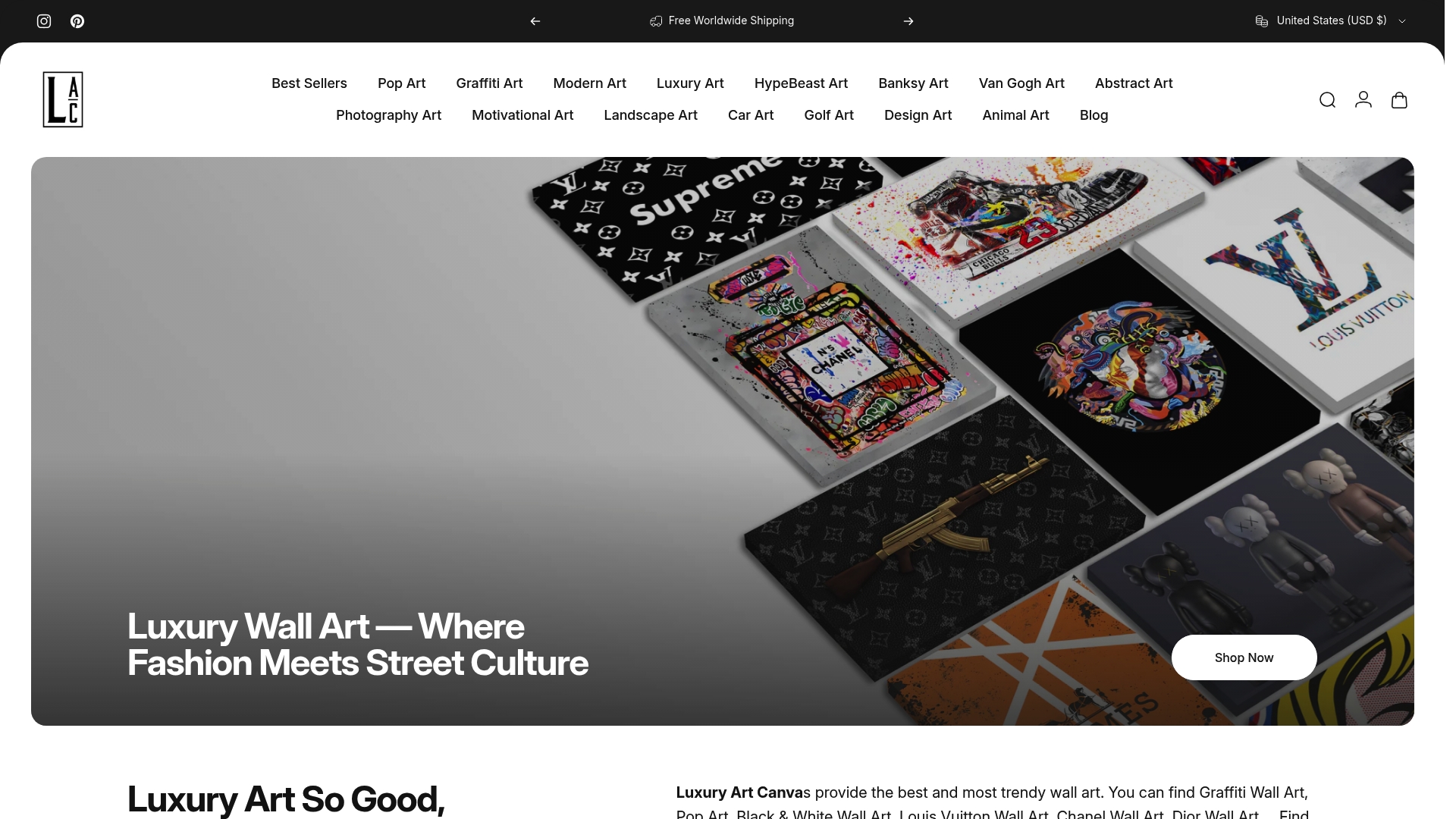
For reception walls and lobbies that need scale, the large-format and multi-panel sets built for exactly that job. If your brand leans toward bold, fashion-forward energy, the graffiti pop art canvas collection and Louis Vuitton wall art pieces bring high-fashion polish into a creative studio or agency without the wait of a custom commission. A more restrained office looking for a private-office backdrop should start with the minimalist office wall art line instead.
Measure your wall, pick a size using the two-thirds rule from earlier in this guide, and order. Every canvas ships ready to hang, no framing shop, no six-week wait, and no guesswork about how it’ll look once it’s actually on the wall.
Sources
- 10+ Modern Corporate Office Wall Design Ideas In 2026
- Gallery wall ideas for your office: Style guide
Homeowners: Keep Canvas Art at 40–55% RH and Avoid Harmful Swings
75–200 Years: Choose Mid Century Modern Canvas for Luxury Interiors