The fastest way to update a room is one oversized contemporary canvas: choose from abstract color-block, geometric line art, botanical line drawings, pop or graffiti statements, or a textured mixed-media piece. Pick one wall, then either commit to a ready-made large-format canvas or try one of the DIY projects below. Either route gets you gallery-quality results without a gallery-sized budget.
Table of Contents
- 15 Contemporary Canvas Art Ideas by Style and Room
- Five DIY Canvas Techniques You Can Finish This Weekend
- Getting the Size and Spacing Right
- Canvas Types and Finishes That Define the Contemporary Look
- Styling Contemporary Canvas Art With Furniture and Light
- What to Look for in a Ready-Made Canvas
- How to Keep a DIY Canvas Looking Fresh for Years
- Customizing Canvas Art to Match Your Space
- Choosing a Palette That Actually Works on Your Wall
- A Beginner Project From Blank Canvas to Finished Wall Art
- Why Buying Beats DIY for Most People, and Why That’s Fine
- Ready-Made Contemporary Canvas Art, Made in the USA
- Sources
15 Contemporary Canvas Art Ideas by Style and Room
Contemporary wall decor ideas break down into a handful of families, and knowing which one fits your room matters more than any single trend. Here’s how they sort out.
Oversized abstract and color-block
- A single large abstract in muted neutrals with one jewel-tone accent works over a sofa or bed headboard; best large, spanning a substantial portion of the furniture width below it.
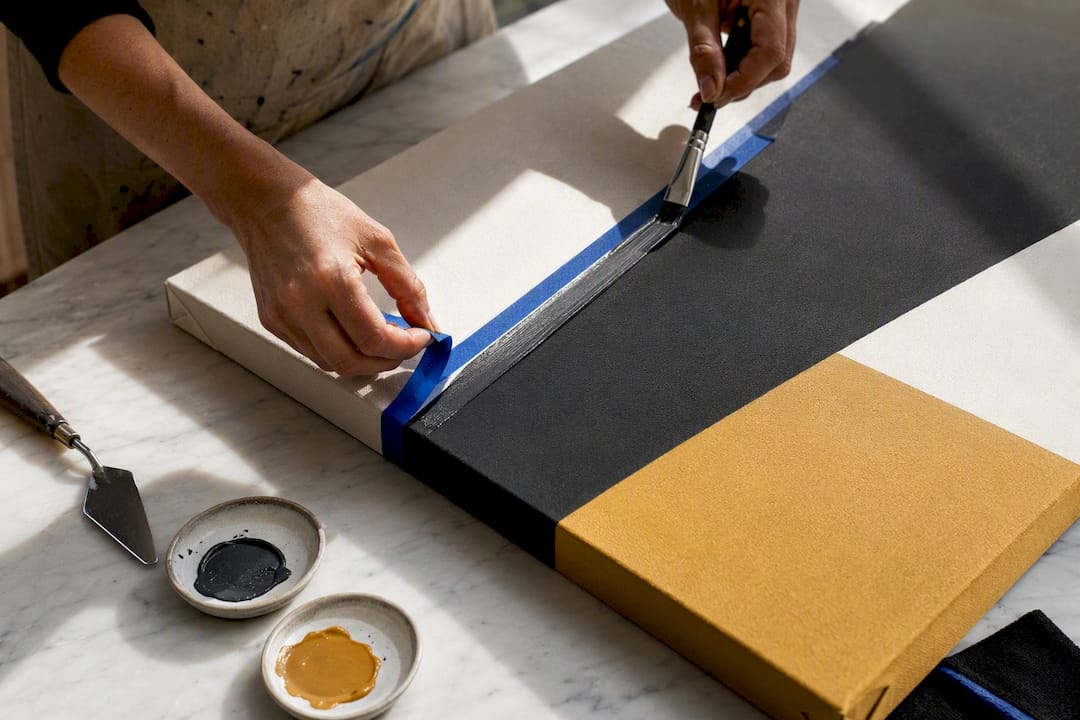
- A monochrome color-block piece in charcoal and cream suits a minimalist office; DIY note: painter’s tape gets you crisp blocks in an afternoon.
- Warm terracotta and sand abstracts fit a reading nook; shopping note: look for gallery-wrapped edges so no frame is needed.
Geometric and line art
- Angular line-art faces or architectural line drawings work in entryways; best medium to large, roughly 24x36 inches.
- A grid of thin gold or black lines on white canvas suits a home office; pairs well with brass hardware.
- Overlapping triangles in two tones add energy to a dining room; DIY note: use a level and tape for exact angles.
Botanical and nature-inspired
- Large-scale organic leaf silhouettes in sage and cream fit bedrooms; the 2026 trend toward biophilic abstracts favors shapes over literal botanicals.
- A single oversized fern or palm line drawing suits a bathroom or reading corner.
- Abstract “landscape” gradients in blue and green work in a living room, best as a diptych over a console table.
Pop, graffiti, and bold graphics
- A single graffiti-style statement canvas anchors a media room or teen space.
- Pop-culture or luxury-brand-inspired graphics suit a walk-in closet or boutique-style office.
- High-contrast black-and-white pop portraits fit a hallway gallery moment.
Textural and mixed-media
- Resin-accented abstracts catch light in a dining room with pendant lighting overhead.
- Fabric or wallpaper transfer canvases add pattern to a nursery or reading nook without wallpapering a whole wall.
- Stitched or stamped mixed-media pieces bring tactile warmth to a den.
Diptychs, triptychs, and curated sets
- Two-panel sets in matching palettes suit a wide living room wall; three-panel sets work over a long dining table.
Five DIY Canvas Techniques You Can Finish This Weekend
You don’t need an art degree to produce something that reads as store-bought. BHG’s roundup of 14 accessible canvas projects proves the point: geometric tape work, splatter, resin, and transfers all deliver outsized results for beginner effort.
- Geometric color-block with painter’s tape. Gather a stretched canvas, painter’s tape, two to three acrylic colors, and a foam roller. Sketch your shapes lightly in pencil, tape the edges, roll on the first color and let it dry fully, then tape off the next section. Peel tape while paint is still slightly tacky for the cleanest line. Skill level: beginner, about two hours plus drying time. Hang it solo above a console.
- Fluid acrylic pour or resin-accent panel. You’ll need pouring medium, acrylic paints, a torch or straw, and a level surface. Mix paint with pouring medium at the ratio your brand’s instructions specify for even flow without cracking, pour in layers, tilt gently, and torch off bubbles. Work in a ventilated space and let resin cure flat for the full recommended time. Skill level: intermediate, one afternoon plus 24 to 72 hours curing. Hang once fully cured and hard to the touch.
- Splatter and gestural drip. Lay the canvas flat, load a stick or brush, and flick paint from above the way Jackson Pollock famously worked on the floor. Keep the palette to two or three colors for a composed look rather than chaos, and work over a drop cloth. Skill level: beginner, under an hour. Hang as a bold solo statement.
- Wallpaper or fabric transfer. Source a remnant wallpaper sample or fabric swatch, cut to fit, and adhere with decoupage medium or spray adhesive, smoothing from the center out to avoid bubbles. Seal with a matte topcoat. Skill level: beginner, about 90 minutes. Works well in pairs.
- Stamped or stitched mixed-media. Use simple foam stamps or hand-stitch a few accent lines through the canvas for texture. Skill level: beginner to intermediate, one to two hours. Hang alongside a painted piece for contrast.
Pro Tip: The gap between a DIY canvas that looks handmade and one that looks store-bought is almost always finish: seal edges cleanly, keep wrap depth consistent, and let every layer dry fully before the next.
Getting the Size and Spacing Right
Scale mistakes are the most common reason a good canvas idea falls flat on the wall. A statement piece above a sofa should span roughly two-thirds of the sofa’s width; the same ratio works above a headboard.
- For diptychs and triptychs, leave a small, consistent gap between panels so the set reads as one piece, not scattered art.
- For gallery groupings, keep spacing even and consistent across the whole arrangement.
- Match stretcher bar depth across every canvas in a set, ideally around 1.5 inches, so shadows and edges line up.
- Hang so the center sits at a comfortable eye level from the floor, or align with the furniture below it rather than the wall alone.
Canvas Types and Finishes That Define the Contemporary Look
Not all canvas is equal, and the format you choose changes how the piece reads on the wall. Gallery-wrapped canvas has no visible frame and feels more like fine art; framed canvas suits traditional spaces; printed canvas is budget-friendly; hand-painted work carries the most texture and value.
- Matte finishes minimize glare and suit rooms with bright natural light.
- Gloss and resin finishes deepen color saturation and work well under picture lights.
- Metallic leaf accents catch warm LED lighting and add dimension without full mixed-media commitment.
- Canvas itself adds texture and dimensionality that flat prints and posters simply can’t replicate.
- Archival inks and solid stretcher bars are the two biggest durability signals when buying ready-made.
- Order custom stretch or professional framing when a piece needs to match an unusual wall dimension or a formal office setting.
Roughly a 1.5-inch gallery wrap is the professional standard designers reach for when they want a cohesive look across multiple canvases in one room.
Styling Contemporary Canvas Art With Furniture and Light
Pull two or three accent colors directly from the canvas and repeat them in pillows, a throw, or a rug; it’s the fastest way to make a new piece feel intentional rather than dropped in. Neutral art keeps a room calm and works well in bedrooms and offices, while bold color energizes a living room or entry.
- Warm LED lighting or a dedicated picture light brings out texture and metallic accents far better than overhead fixtures.
- Layering art with lighting and texture rather than treating it as an afterthought is what separates styled rooms from decorated ones.
- Muted neutrals with jewel-tone accents like navy or emerald read as contemporary without dating quickly.
- Don’t feel obligated to fill every inch with wall; letting one oversized piece breathe often reads as more confident than a crowded arrangement.
Pro Tip: If a room already has a bold rug or patterned textile, pull your canvas palette toward neutral so the eye has somewhere to rest.
What to Look for in a Ready-Made Canvas
Materials matter as much as the image. Look for canvases made in the USA with archival inks, since these hold color longer and resist yellowing. Luxury Art Canvas offers over 1,000 designs backed by reviews from more than 10,000 customers, which gives a useful checklist: country of manufacture, ink quality, stretcher construction, and real customer feedback before you buy.
How to Keep a DIY Canvas Looking Fresh for Years
A DIY canvas is only as good as how it’s cared for afterward, and most damage comes from light and dust rather than age itself. Direct sunlight is the biggest threat to any painted or printed surface. UV rays fade pigments unevenly over time, so a canvas near a south-facing window will noticeably dull faster than one on an interior wall. If you can’t avoid the light, consider a UV-filtering varnish on acrylic pieces, or rotate the canvas to a lower-light spot every year or two.
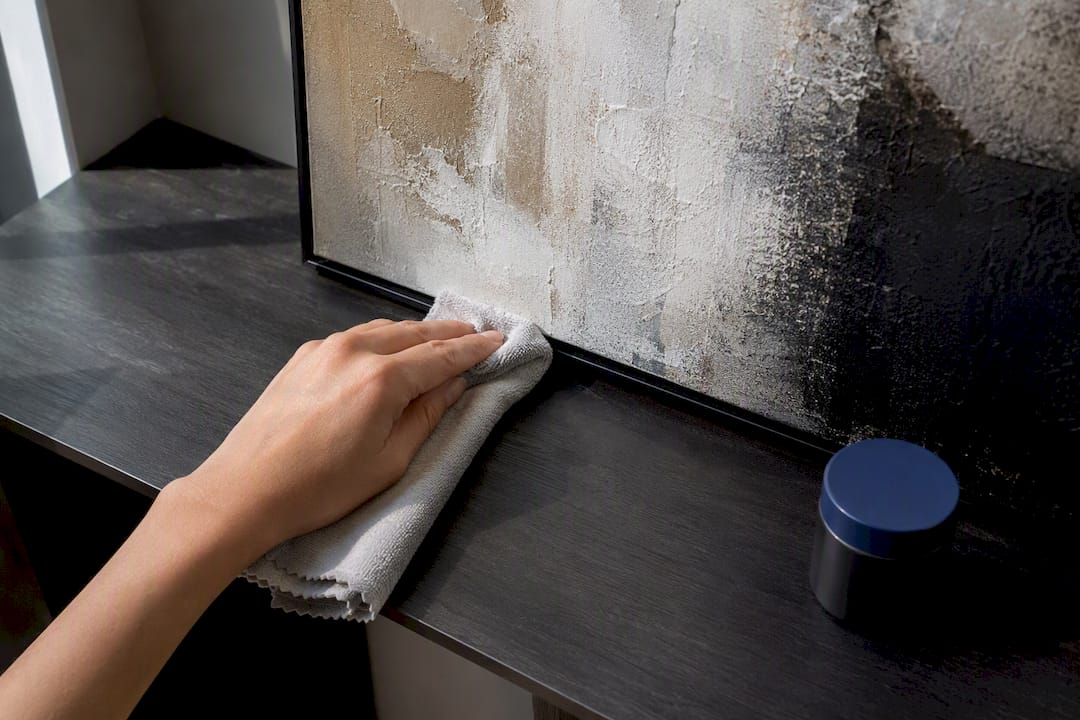
Dust with a dry, soft microfiber cloth rather than a wet one. Water and household cleaners can lift paint or warp canvas fibers, especially on unsealed DIY pieces. For resin or gloss finishes, a dry cloth also avoids streaking.
Humidity swings cause canvas to expand and contract, which over years can loosen the fabric on its stretcher bars. Keep DIY canvases away from bathrooms, kitchens near stovetops, or exterior walls prone to condensation. If a canvas does go slack, a few taps with a canvas key (the small wedges in the back corners of most stretcher frames) usually restores tension without needing to restretch.
Seal any DIY project with a matte or gloss varnish appropriate to your medium. It protects against dust, minor scuffs, and UV exposure in one step, and it’s the same reason store-bought canvases hold their finish for years without touch-ups.
Customizing Canvas Art to Match Your Space
The best contemporary canvas art ideas adapt to the room they’re hung in rather than fighting it. A mid-century living room calls for warm woods and organic abstract shapes in amber and olive tones, while a Scandinavian-style bedroom leans toward soft neutrals, thin geometric lines, and negative space.
For a home office, bold graphic or pop-art canvases add personality without cluttering a small footprint. A single statement piece behind a desk does more for the room than three smaller ones scattered across the wall. Corporate or client-facing offices tend to do better with cohesive sets, black-and-white photography-style canvases, or abstract line art that reads as polished rather than personal.
Industrial lofts and exposed-brick spaces pair naturally with graffiti-inspired or pop-culture canvases, since the rawness of the space already sets an urban tone. A mix-and-match approach with two or three complementary canvases can carry that theme across a longer wall without repeating the same image twice.
For a nursery or kids’ room, botanical line drawings or soft abstract shapes in muted pastels keep the space calm without looking babyish as the child grows. And in an open-concept living and dining area, one consistent palette across every canvas in the space, even across different rooms, helps the whole floor plan feel designed as a single flow rather than a series of disconnected zones.
Choosing a Palette That Actually Works on Your Wall
Color theory for canvas art comes down to a simpler question than most people expect: do you want the room to feel calm or energized? Muted neutrals like beige, sand, and warm gray create a settled backdrop that works in almost any room, while jewel tones like navy, emerald, or deep burgundy used sparingly as accents give a piece presence without overwhelming the space.
A common mistake is choosing a canvas palette that matches the walls exactly. Contrast, even subtle contrast, is what makes art visible as art rather than blending into the paint. If your walls are warm white, an abstract in cool gray and black will stand out more than one in a similar warm tone.
Complementary color pairs (blue and orange, purple and yellow) create the most visual energy, while analogous palettes (blues moving into greens) feel more soothing and cohesive. For a first canvas in a room, analogous or monochromatic palettes are the safer bet since they’re harder to get wrong.
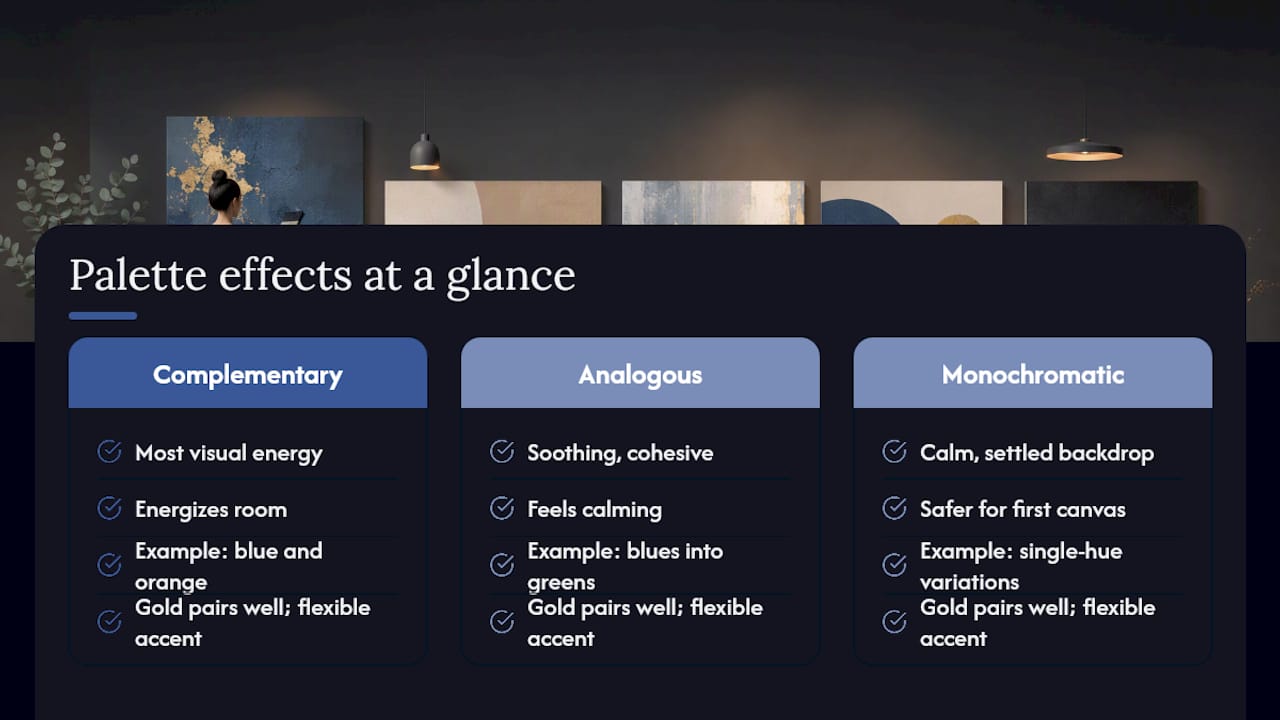
Metallic accents, gold especially, act almost like a neutral. They pair with nearly any base palette and catch light differently throughout the day, which is part of why so many contemporary abstracts now include a gold-leaf detail or metallic pour layer. If you’re unsure where to start, pulling inspiration from bold, high-contrast canvas styles can help you decide how much contrast your room can actually handle.
A Beginner Project From Blank Canvas to Finished Wall Art
Start with the geometric color-block technique since it forgives mistakes better than freehand painting. Here’s what you need and how to move through it.
Materials: a pre-stretched canvas (16x20 inches is a forgiving starting size), painter’s tape, two to three acrylic paint colors, a foam roller, a pencil, and a matte varnish.
Steps:
- Lightly sketch two or three geometric shapes onto the canvas in pencil, keeping lines simple.
- Apply painter’s tape along the outside of your first shape, pressing edges down firmly to prevent bleed.
- Roll on your first color in thin, even coats, letting each coat dry before adding the next.
- Let the section dry completely, at least an hour, before removing tape.
- Repeat the taping and rolling process for each additional shape and color.
- Peel all tape slowly while the final coat is just barely tacky for the cleanest edge.
- Let the canvas cure for 24 hours, then seal with a thin coat of matte varnish.
- Hang using a canvas hanger or D-ring hardware at the height guidance covered earlier.
This project takes about two hours of active work and produces a piece that looks intentional rather than amateur, which is really the whole goal of DIY canvas art.
Why Buying Beats DIY for Most People, and Why That’s Fine
The DIY projects above genuinely work, and painter’s tape geometry or a controlled splatter piece can look store-bought if you follow the finish details closely. But conventional advice oversells DIY as always cheaper and always better. It isn’t. Resin pours need proper ventilation and multiple curing days, fluid pours can go wrong in ways that waste materials, and a botched geometric piece still costs you the canvas, paint, and an afternoon.
What the research on 2026 trends actually supports is this: fewer, larger, more intentional pieces beat busy gallery walls, whether you make them or buy them. That’s the priority, not the production method. If you have the time and enjoy the process, geometric tape work and transfers are the lowest-risk DIY entry points. If you want the oversized statement piece without the curing time, buying ready-made from a maker who controls ink quality and stretcher construction gets you the same 2026-aligned result faster.
The honest advice is to match the method to your patience level, not your budget alone. A ready-made canvas from a quality source often costs less in frustration than a resin pour gone wrong.
— James
Ready-Made Contemporary Canvas Art, Made in the USA
If the DIY route sounds like more time than you have this weekend, Luxuryartcanvas gives you the 2026-aligned oversized statement piece without the drying time. Every canvas is made in the USA with archival inks, and the catalog spans more than 1,000 designs across pop art, graffiti, and luxury-brand-inspired styles, backed by reviews from over 10,000 customers.

Browse the Louis Vuitton wall art collection for a bold single statement piece, or explore the pop art canvas range for graphic, gallery-ready sets that follow the two-thirds sizing rule right out of the box. Pick your wall, choose your size, and check availability today.
Sources
- BHG — 14 DIY Canvas Wall Art Projects
- Bloomingfieldhome — Contemporary wall decor trends 2026
- MoMA — One: Number 31, 1950
Canvas Hanging Height at 57–60 Inches: Exact Formula Homeowners Use
Shipped in Days: US Made Reception Area Wall Art for Offices