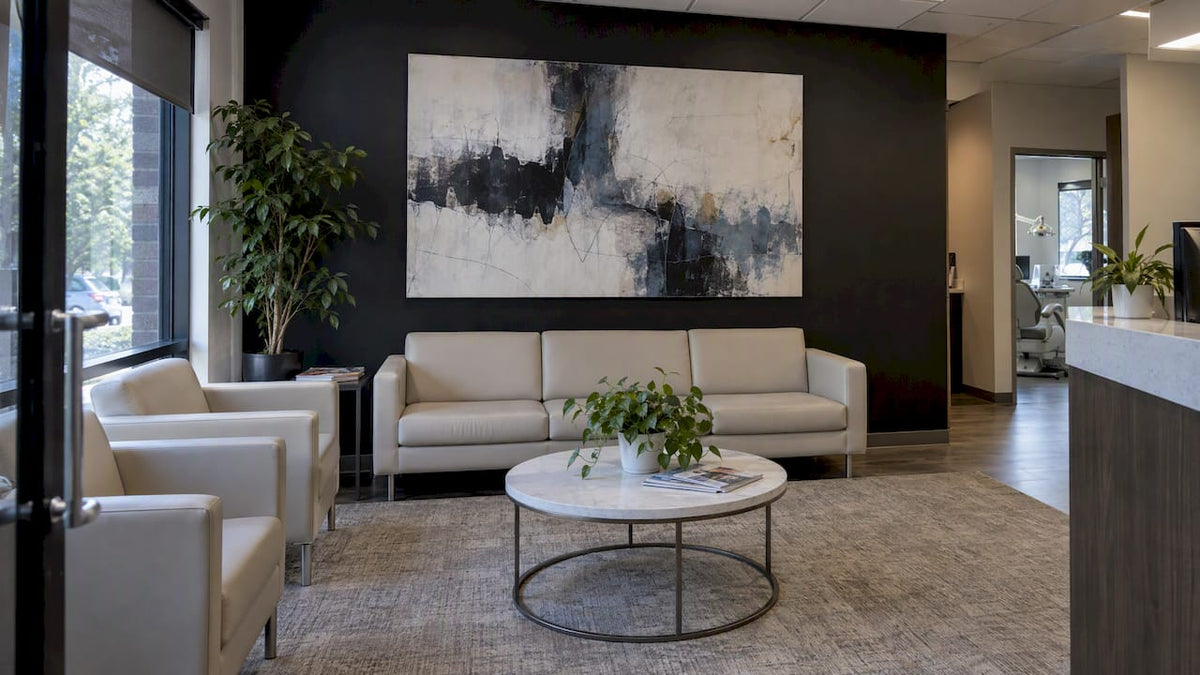
The best dental office wall art does three jobs at once: it calms a nervous patient, tells people what kind of practice they walked into, and survives daily clinical life. Nature scenes and abstract canvases are the safest starting point. Bolder pieces work in the right room for the right patients. Size, hanging height and mounting matter as much as the image itself, so this guide covers the ideas first and the practical rules after.
TL;DR
- Nature imagery (landscapes, oceans, botanicals) and abstract art are the most common dental choices because they soothe and distract. Contemporary practices are also moving toward bold abstracts and figurative work.
- Match the art to your patients. The American Dental Association (ADA) advises a tasteful reception area that is not showy and does not suggest services are unaffordable.
- Size by room: smaller pieces in treatment rooms, large statement pieces in the waiting area, hung with centers at roughly 62 to 64 inches above the floor over seating.
- Choose durable, wipeable-environment-friendly formats such as canvas, and check mounting, protrusion and cleaning rules before you buy.
Table of Contents
- Start with who sits in your chairs
- Wall art themes that work in dental offices
- Room-by-room ideas
- Beyond framed art: other wall ideas
- Size and placement: numbers to work from
- Materials, mounting and safety
- Our perspective
- Bring the look together with canvas
- A simple plan for choosing your art
- FAQ
- Sources
Start with who sits in your chairs
Before you pick an image, picture your patient list. The ADA’s reception area guidance says decor, artwork included, should be consistent with the intended patient base. Its example: a mature patient base may not connect with heavily child-oriented objects. The same guidance asks for a reception area that is tasteful rather than showy, fancy or too trendy, and one that does not make patients wonder whether your services are out of reach.
That gives you a simple filter for every idea below:
- Does it calm? Dental anxiety is the baseline mood in the waiting room.
- Does it fit the people who actually come in? A family practice, a cosmetic studio and a periodontal specialist have different audiences.
- Does it fit the brand? Colors, mood and style should look like your logo, scrubs and website belong to the same practice.
- Will it hold up? Hanging, cleaning and walkways all constrain what you can put on a wall.
Wall art themes that work in dental offices
Nature: the proven calm
Dental Economics reports that landscapes, oceans, flowers and plants are popular in dental offices because they reduce stress and give patients something calming to look at. A 2021 evidence review of art in hospitals reached a similar conclusion: natural views are reasonable choices for patient and operating rooms.
In practice, that means:
- Coastal and water scenes for treatment rooms and hygiene bays, where the patient is lying back and looking at the wall. A canvas such as our beach scene wall art or turquoise coastal wall art gives a ceiling-to-chairside escape without clutter.
- Misty mountains, forests and quiet horizons for the reception area. Wide, low-contrast landscapes such as a Japanese landscape canvas read as restful rather than decorative.
- Botanicals for hallways and restrooms, where a smaller piece does the job.
One tip: avoid images with sharp, busy detail directly in the patient’s sightline. The goal is a soft focal point, not a puzzle.
Abstract art: calm with personality
Abstract work is the other mainstay named by Dental Economics, and it is easier to match to a color palette than a landscape. Healthcare Design Magazine reports a shift toward abstract art with bold colors and shapes, and toward figurative art that reflects community diversity, moving away from the traditional nature landscape. The 2021 review adds that a mix of abstract and figurative art can suit social and public rooms.
For a minimalist or modern practice, tonal abstracts and geometric compositions are the natural fit, since they sit comfortably against clean lines. Our abstract wall art, minimalist office wall art and minimalist drawing wall art suit white, gray and warm neutral interiors. If your palette includes a brand color, a piece like our blue and coral wall art can echo it without turning the room into a logo.
Local and community art
Some of the most memorable dental offices tell a local story. The ADA’s 2023 Design Innovation Award coverage on Central Texas Periodontics describes musical photography celebrating Austin’s music scene, plus a guitar wall, that made the office distinctive and helped patients feel more at ease while waiting. You do not need a guitar wall. A set of photographs of your own neighborhood, a skyline, a trail or a local landmark gives patients a conversation starter and signals that you belong to the community.
Contemporary and street-inspired pieces, used deliberately
Pop art, graffiti and street art are not the obvious dental choice, and they are not right everywhere. They can be excellent for a practice whose patients are young professionals, teens in orthodontic care or cosmetic clients who want a modern, design-aware experience. Used in a corridor, a staff lounge or a single feature wall, a high-energy piece shows the practice is current.
The ADA’s caution still applies. In a reception area, skip anything that looks trendy for its own sake. Keep palettes controlled, avoid aggressive imagery, and choose pieces that read as art first. Our pop art canvas prints and urban expressionist wall art work best in restrained doses, with the surrounding walls kept quiet.
A word on luxury branding: big fashion-house logos are a poor fit for a dental reception area, because they run against the ADA’s advice that the space should not suggest services are unaffordable. Those pieces belong in a private office or an owner’s lounge rather than the front room.
Room-by-room ideas
| Room | Goal | Art that works |
|---|---|---|
| Reception and waiting area | Welcome, brand statement, distraction | One large statement canvas or a tight pair; landscapes, abstracts, local photography |
| Hallways | Wayfinding, rhythm | Series of three matching smaller pieces, consistent frames |
| Treatment rooms | Calm for patients lying back | Nature scenes at the chair’s eye line, ceiling-adjacent wall |
| Consultation room | Trust, privacy | Quiet abstract or minimalist art, nothing loud |
| Staff areas | Morale | Bolder, more personal art, including street-inspired pieces |
| Restrooms | Small refresh | Compact botanical or coastal pieces |
The waiting room
This is where art does the most work, because patients have time to look. A research experiment in an outpatient exam room, published as Magnitude Matters: Art Image Size and Waiting Time, found that image size significantly affected most patient judgments, and that a large image produced more positive effects than smaller images or a blank wall. Size that does not suit the wall also hurt ratings of the healthcare environment and the practitioner. In plain terms: one confident large piece beats a scatter of small ones, and an undersized piece floating on a big wall can work against you.
If you want a fuller look at reception spaces beyond dentistry, our guide to reception area wall art goes through layouts and formats. For help weighing styles across a whole office, see our types of art for office environments guide.
The treatment room
The patient is horizontal and their eyes land on the wall or ceiling. Put the art where the chair’s line of sight falls, keep the image simple, and make it a scene they can mentally step into. Water, sky and open landscapes are the usual picks. Because of the infection control considerations covered below, keep treatment rooms uncluttered and limit the number of pieces.

Hallways and consultation rooms
A series of three matching pieces gives a hallway rhythm. In a consultation room, where you discuss treatment plans and costs, choose art that feels settled and professional. Texture matters here: according to Dominate Dental, the texture and depth of canvas art suggest permanence and investment, reinforcing patient confidence in the practice’s stability.
Beyond framed art: other wall ideas
Art does not have to be a picture on a hook. A few approaches seen in dental design:
- Feature walls. Maine Dentistry, an ADA Design Innovation Awards honorable mention, used three-dimensional paneling and a wall waterfall. The panels pique curiosity, and the waterfall offers two-way viewing, natural noise cancellation and street visibility.
- Custom signs and 3D logos. Dominate Dental notes that custom signs, 3D logos, digital welcome displays and interactive waiting-area displays can be practical and attractive at once. QR codes or digital check-in can sit inside the wall design.
- Murals and accent walls. A single painted or wallpapered wall behind reception frames your logo and gives art a quiet backdrop.
The best-looking offices combine two layers: a bold architectural gesture in one place and calm, framed or canvas art everywhere else.
Size and placement: numbers to work from
Healthcare systems publish detailed art specifications, and they are a useful yardstick for a dental office. Northwell Health’s art program guidelines list:
- Exam and treatment rooms: 26×26 or 26×32 inches.
- Waiting and reception areas: formats such as 38×50, 38×38, 42×62, 42×42, 36×72, 48×72 and 48×48 inches.
- Height: art centers at least 62 inches above the finished floor over seating, generally 63 to 64 inches depending on ceiling height.
- Grouping: keep two or three images at least 12 to 24 inches apart, and avoid oversized pieces.
These are a health system’s standards, not a dental code, so treat them as a sound starting point and adjust to your walls. A practical way to test: cut paper to size, tape it up, and sit in the chair or waiting seat for a few minutes before ordering.
Our canvases come ready to hang, so a small team can hang a piece in minutes, and the size range lets you scale from a treatment-room piece to a large reception statement.
Materials, mounting and safety
Choose durable formats
For large feature pieces, Northwell’s guidance specifies canvas, metal or acrylic. Canvas has a warmer, less reflective surface than glass, which matters under bright operatory or waiting-room lighting. Art that is easy to hang and light on the wall keeps installation simple.
Mounting without damaging surfaces
The same guidance covers sites where drilling into marble or tile is prohibited. It recommends 1-inch industrial-strength dual-lock strips for small, light pieces, 2-inch strips for larger, heavier ones, or a ceiling-suspended cable system. At clinical sites it also specifies security hardware, with two locking screws at the bottom of frames wider than 12 inches. If your building has special wall finishes, ask your landlord or contractor before you hang anything.

Keep walkways clear
If art hangs along a corridor, check protrusion. Under the U.S. Access Board’s rules, objects along circulation paths can protrude any amount if their leading edges are within cane sweep (27 inches maximum) or provide at least 80 inches of headroom. Flat canvas art hung on the wall is rarely an issue, but deep shadow boxes and sculptural pieces can be. Confirm against your local requirements and your architect’s drawings.
Cleaning and infection control
The CDC says that for environmental surface cleaning, frequency, method and product selection should be determined by risk assessment, considering the potential for contamination and patient vulnerability. For art, that means treating it as part of your cleaning plan: keep treatment-room art minimal and away from splash zones, and agree with your infection control lead how and how often each piece is dusted or wiped. Pieces in waiting areas and corridors are lower-risk than anything near the chair.
Lighting
Healthcare design professionals often coordinate lighting, such as picture lights, and wall-blocking requirements early so that art works as a celebrated focal point. If you are renovating or building out, ask your contractor to plan lighting and backing for your largest pieces before the walls are closed.
Our perspective
We make canvas art, and we see why offices of every kind buy it: a good piece does more for a room per dollar of effort than almost any other change. For dental practices, our view is simple.
Start quiet. Calm nature and abstract canvases in the reception area and treatment rooms do the heavy lifting, and the research on patient experience backs them up. Then add personality where it belongs: a single bold contemporary piece in a hallway, consultation room or staff area tells people your practice has taste without pushing patients out of their comfort zone.
Our designs are made in the USA on archival materials, arrive ready to hang and span more than 1,000 designs, so a practice can build a coherent set rather than settling for a one-off. Interior designers fitting out a clinic often ask us for a cohesive palette across rooms. Our advice is to pick two or three colors from your logo and let every piece pull from them.
And resist the urge to decorate every wall. White space makes art feel intentional.
— James
Bring the look together with canvas
If you are ready to choose, browse our minimalist prints and modern wall art for calm, contemporary pieces that suit a treatment room or reception wall. Planning a statement piece for a lounge or private office? Our luxury art collection is the place to look.

Every canvas is made in the USA and ships ready to hang, and our team can help if you need pieces that work as a set across several rooms. See the full range at Luxury Art Canvas.
A simple plan for choosing your art
- Walk the space. Note each wall’s width, ceiling height, lighting and what the patient sees from the chair or seat.
- Set the palette. Pull two or three colors from your logo and interior finishes.
- Pick one theme per zone. Nature for treatment rooms, a statement abstract or landscape for reception, a series for hallways.
- Size it. Use the dimensions above, and tape paper templates to the wall first.
- Check the rules. Confirm mounting method, protrusion and cleaning routine with your landlord, contractor and infection control lead.
- Hang, then live with it. Ask staff and a few regular patients how it feels before you add more.
FAQ
What is the best wall art for a dental waiting room?
Nature imagery and abstract art are the most common choices, because they relax patients and give them something calm to look at. Choose one large piece or a tight pair over many small ones, and match the palette to your brand. Keep the overall look tasteful rather than showy, in line with ADA reception guidance.
How big should wall art be in a dental office?
As a starting point, Northwell Health’s healthcare guidelines list 26×26 or 26×32 inches for exam and treatment rooms, and sizes from 38×38 up to 48×72 inches for waiting and reception areas. Hang centers at least 62 inches above the floor over seating, generally 63 to 64 inches. Test with paper templates before you order.
Is canvas a good choice for a dental office?
Yes, for most public and semi-public areas. Canvas is among the formats Northwell specifies for large feature pieces, and its texture reads as established and permanent. Near the chair, keep art minimal and agree a cleaning routine with your infection control lead, since the CDC says cleaning should follow a risk assessment.
Can I use bold or pop art in a dental office?
Yes, if you place it carefully. It suits corridors, staff areas and practices serving younger or design-minded patients. In reception, keep it controlled and avoid anything that looks trendy for its own sake or suggests high prices.
Sources
- Ideas for a relaxing dental office esthetic, Dental Economics
- The Art of Healing: How Interior Designers Can Impact Healthcare Environments, Healthcare Design Magazine
- Evidence-based art in the hospital, PMC
- Reception Area and Office Décor, American Dental Association
- Central Texas Periodontics, ADA Design Innovation Awards
- Maine Dentistry, ADA Design Innovation Awards
- Dental Decorations Ideas to Boost Patient Trust, Dominate Dental
- Art Program, Northwell Health
- Magnitude Matters: Art Image Size and Waiting Time, HERD Journal
- Environmental Services, CDC Infection Control
- Chapter 3: Protruding Objects, U.S. Access Board
Above Bed Art Height: How High to Hang It and What Size