
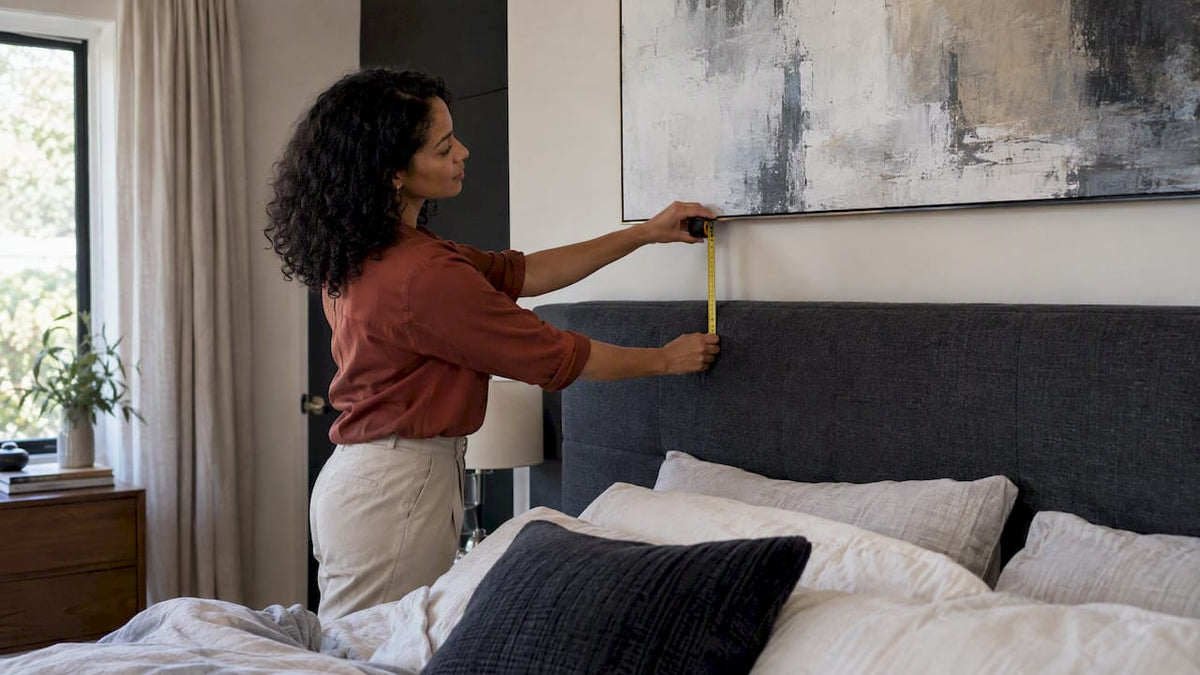
Hang the bottom edge of your art 6 to 10 inches above the top of the headboard. Make the piece about two-thirds to three-quarters as wide as the bed, and center it on the bed, not on the wall. Those three numbers settle most bedrooms. The rest of this guide covers the exceptions: tall headboards, low ceilings, no headboard, pairs and groups, and the dining room, where the same logic applies with different furniture.
TL;DR
- Leave 6 to 10 inches between the top of the headboard and the bottom of the art. Closer to 6 to 8 if pillows and sleepers will be bumping the wall.
- Aim for art that spans roughly two-thirds to three-quarters of the mattress or headboard width. Never wider than the bed.
- Center the art on the bed. If the bed is off-center on the wall, the bed wins.
- The 57-inch rule is for bare walls. Over furniture, the furniture sets the height.
- Over a bed, use two hooks or D-rings anchored into studs or rated anchors, and choose canvas or acrylic over glass.
Table of Contents
- The height rule: measure from the headboard, not the floor
- The size rule: two-thirds to three-quarters of the bed
- Center on the bed, not the wall
- When the 57-inch rule applies, and when it does not
- Tall headboards, low ceilings and high ceilings
- Single piece, pair or gallery wall?
- Hanging it safely over a bed
- How high to hang art in a dining room
- Perspective: what we see after sending thousands of canvases
- Choosing art that fits the numbers
- FAQ
- Sources
The height rule: measure from the headboard, not the floor
Most people hang art above a bed by eye, and most of the time it ends up too high. The reason is the floor-based habit: you hear “hang art at eye level” and measure up the wall. Over a bed, that logic flips. The headboard is the anchor, so you measure from it.
The published ranges are tight and mostly agree. Veranda recommends art that spans at least two-thirds of the headboard’s width and hangs about 8 to 10 inches above it. Martha Stewart gives the same 8 to 10 inches for art over a headboard. Spoak suggests 6 to 8 inches so the frame sits close enough to feel part of the bed, and so pillows are less likely to knock it. Frame Calculator lands on 6 to 10 inches, which also leaves head clearance when you sit up.
Put those together and you get a practical window:
| Situation | Gap from headboard to bottom of art |
|---|---|
| Standard bedroom, you sit up against the headboard | 6 to 8 inches |
| Tall ceilings, art needs more presence | 8 to 10 inches |
| Low, tufted or curved headboard | Measure from the highest point of the headboard, then add 6 to 10 inches |
The curved or peaked headboard point is a judgment call, not a published rule. Measure from the tallest point so the frame can never touch the headboard, then step back and check how it reads from the doorway.
What if there is no headboard?
Without a headboard there is nothing to measure from, so use the pillows. Stack them the way you normally sleep, note where the top of the stack lands, and hang the art so its bottom edge sits well clear of that line. A common designer approach is a gap of roughly 14 to 16 inches above the mattress, but treat that as a starting point and test it with a strip of painter’s tape on the wall before you drill.
The size rule: two-thirds to three-quarters of the bed

Width matters more than height for a bedroom to look finished. Frame Calculator puts the target at two-thirds to three-quarters of the mattress width. Narrower art looks lost on a big wall. Wider art looks top-heavy, and Spoak specifically warns against art that extends past the bed or headboard.
Here is the arithmetic for a few widths. Measure your own headboard or mattress first, because actual sizes vary by brand.
| Bed or headboard width | Two-thirds | Three-quarters |
|---|---|---|
| 38 inches | about 25 inches | about 28 inches |
| 54 inches | 36 inches | about 41 inches |
| 60 inches | 40 inches | 45 inches |
| 76 inches | about 51 inches | 57 inches |
A few things the table does not show:
- The total counts, not each piece. If you hang a pair or a trio, measure the whole arrangement including the gaps. Treat a pair as one piece when checking width.
- Landscape orientation usually wins. A wide, horizontal piece or a group arranged in a wide shape suits most beds, because the bed itself is a wide, low shape.
- Height of the art follows from the wall. With standard ceilings, a piece that is roughly 16 to 24 inches tall is a comfortable fit. That is our rule of thumb from hanging canvases in real rooms, not a published standard.
Worked example: a queen bed with a 60-inch headboard
Say the headboard is 60 inches wide and 48 inches tall at its peak, and the ceiling is 8 feet. Two-thirds to three-quarters gives you 40 to 45 inches of art width. A single 40 by 20 inch canvas fits. Hang it 8 inches above the headboard, so the bottom edge sits 56 inches from the floor and the top at 76 inches. That leaves 20 inches to the ceiling, plenty of breathing room, and the piece reads as part of the bed.

Now swap in three 12 by 16 inch canvases. Three pieces at 12 inches wide with two 3-inch gaps total 42 inches across. Same width target, different personality. Same hang height.
Center on the bed, not the wall
The bed is the focal point, so center the art on it. Frame Calculator advises centering on the bed rather than the wall, especially when the bed is pushed off-center by a window or a nightstand. If the art is centered on the wall while the bed sits two feet to the left, the mismatch is the first thing anyone notices.
A simple way to do it: find the center of the headboard, mark it on the wall at pencil height, and use that mark to center the hanging hardware. For a single piece with two hooks, measure the distance between the D-rings on the back, then split it around your center mark.
When the 57-inch rule applies, and when it does not
You will see “57 inches” everywhere. It is the standard for the center of a piece on a bare wall. Martha Stewart gives 57 to 60 inches from the floor as the eye-level midpoint on an empty wall. The Spruce calls it a starting point that you adjust for furniture, seated viewing, tall ceilings and the artwork’s proportions.
Above a bed, furniture takes over. The bed is a low piece, and art hung at a true 57-inch center would often float far above the headboard, disconnected from it. Frame Calculator describes the goal as one visual unit rather than two separate elements. If you want the full formula and where it breaks down, our guide to canvas hanging height at 57 to 60 inches walks through it.
In practice, check both numbers. If your art, hung 8 inches above the headboard, ends up with its center near 57 to 66 inches from the floor, you are in a happy place. If the center lands far above that, the headboard is tall and you probably need a shorter, wider piece.
Tall headboards, low ceilings and high ceilings
Headboard within 2 feet of the ceiling
This is where most bedrooms go wrong. If the headboard reaches within about 2 feet of the ceiling, a large vertical piece will crowd the space. Choose a shorter, wider piece or a short row of small frames, and leave room below the ceiling.
High ceilings
Tall walls give you more room, but they do not require you to fill all of it. Welsh Design Studio notes that keeping some breathing room is what makes a bedroom feel balanced. A wider piece or an arrangement of two or three canvases keeps proportions right without pushing the art up the wall. For rooms with serious height, see our notes on decorating a bedroom with high ceilings and two-story walls, where you look past 57 inches altogether.
Sloped ceilings and attic rooms
With a slope above the bed, hang a wide, low piece and measure clearance at its top corners, not just the center. A piece that clears at the middle can touch the slope at an edge.
Single piece, pair or gallery wall?
One large piece is the cleanest choice and the easiest to hang. It works best when its width falls in the two-thirds to three-quarters range and its proportions are horizontal.
A pair gives symmetry and suits a bed flanked by matching nightstands. Hang them with a gap of 2 to 4 inches, keep both bottom edges level, and measure the pair as one unit.
A trio or row is the answer for tall headboards or awkward walls. Equal sizes and equal gaps look intentional. Mixed sizes look curated only if the overall silhouette stays wide and centered.
Sconces or lamps beside the art can finish the focal point, as Veranda notes, where a pair of sconces alongside the artwork rounds out the arrangement. Leave room for them when you choose your art width.
For more on picking style, color and mood for the room, read our bedroom wall art style guide.
Hanging it safely over a bed
This is the one place where cutting corners can hurt someone. Anything above your pillow should be hung as if it will be bumped. Frame Calculator recommends two hooks or D-rings into studs or anchors rated for at least twice the artwork’s weight, and canvas or acrylic glazing instead of glass.
That is also why canvas is a practical choice for bedrooms: it is lighter than a glass-fronted frame and has no glass to shatter. Some tips from our side:
- Weigh the piece before choosing hardware. A bathroom scale works: weigh yourself, then weigh yourself holding it.
- Use two attachment points, never one, so the piece cannot swing or tilt.
- Find studs with a stud finder where you can. If the position does not line up, use anchors rated well beyond the weight.
- Use small bumpers on the bottom corners so the piece sits flat to the wall.
- If you rent, see our guide to hanging canvas art without damaging your walls. For the basics, start with how to hang canvas art.
If you are unsure about wall construction, such as plaster, brick or a wall with wiring or plumbing behind it, ask a licensed handyman or contractor before drilling.
How high to hang art in a dining room
The logic is the same: furniture sets the height, and the art should feel attached to it. The research I found gives one clear dining rule through the over-furniture guidance. Martha Stewart’s rule for art over furniture is a width of roughly two-thirds of the piece below and a bottom edge 8 to 10 inches above it. That applies to a sideboard, buffet or console along a dining room wall.
A few practical adjustments:
- Over a sideboard or buffet: use the two-thirds width and an 8 to 10 inch gap. Center the art on the furniture.
- On a bare wall beside the table: use the 57 to 60 inch center from the floor, and consider that people are seated much of the time. As The Spruce points out, seated viewing is a reason to adjust. Hanging a few inches lower than the standard often reads better in a room where people sit for dinner.
- Above a dining table with no furniture below: the art is seen from a seat, so err toward the lower end of the range and center it on the table, not the wall.
The same size logic carries over: bigger than you think, and never wider than what is under it.
Perspective: what we see after sending thousands of canvases
We make and ship ready-to-hang canvas wall art, and the most common mistake we hear about is the same every time: art hung too high and too small. People buy a piece they love, hang it at the “eye-level” number, and the bedroom looks unfinished.
Our advice is to decide the width first. Measure the headboard, multiply by two-thirds and three-quarters, and shop only in that window. Then hang the bottom edge 6 to 10 inches above the headboard. Everything else is refinement.
We also think bedroom art should have some attitude. A bed wall is the largest uninterrupted surface in most bedrooms, and a bold graffiti piece, a black and white image or a fashion-inspired canvas can do what a neutral landscape can’t: give the room a point of view. The sizing rules above work the same whichever style you choose, so choose the piece that makes you want to look at the wall.
— James
Choosing art that fits the numbers
Once you know your target width, the shopping gets easy. Our catalog has more than 1,000 designs, all on canvas made in the USA with archival inks and ready to hang. For a bedroom, a few collections tend to fit well. Black and white art calms a busy room. Graffiti and street art canvases give a neutral bedroom an edge. Pop art canvas prints bring color without the weight of a large abstract piece. If you want a more polished, high-fashion look, browse luxury wall art.
We also offer custom-made canvases, which helps when your headboard sits between standard sizes.

Pick a piece, check its width against your two-thirds to three-quarters range, and you can hang it the day it arrives.
FAQ
How high should I hang art above my bed?
The bottom of the art should sit 6 to 10 inches above the top of the headboard. Use the lower end if you sit up against the headboard or share a bed with pillows that move, and the higher end on tall walls where the art needs more presence.
What size art goes above a queen or king bed?
Aim for two-thirds to three-quarters of the headboard or mattress width. For a 60-inch-wide headboard, that is 40 to 45 inches. For a 76-inch-wide headboard, it is about 51 to 57 inches. A group of pieces counts as one, measured across the whole arrangement.
Should art be centered on the bed or the wall?
Center it on the bed. If the bed is off-center because of a window, door or nightstand, centering on the wall makes the art look misplaced. Mark the center of the headboard and hang from that mark.
Does the 57-inch rule apply above a bed?
Not directly. The 57 to 60 inch center is a guide for bare walls. Over a headboard, the gap above the furniture is what counts, and the result usually has a center somewhere near that range anyway. If it does not, the headboard is tall and a shorter, wider piece will fit better.
What if my headboard almost reaches the ceiling?
If there are only about 2 feet between the headboard and the ceiling, skip tall vertical art. Choose a shorter, wider piece or a row of small frames, and leave a gap below the ceiling.
Sources
- Art Above a Bed: What Size & How High to Hang (by Bed Size), Frame Calculator
- Hanging Art Above a Couch, Sofa or Console, Frame Calculator
- The Dos & Don’ts of Hanging Art Above a Bed, Spoak
- How to Hang Art the Right Way Above the Bed, Fireplace, and More, Veranda
- Decorating Rules That Will Help You Upgrade Every Room, Martha Stewart
- How High to Hang Pictures: Design Expert Rules, The Spruce
- How to Choose the Perfect Art Size Above Your Bed, Welsh Design Studio
Restaurant Wall Art Ideas That Make Dining Rooms Memorable