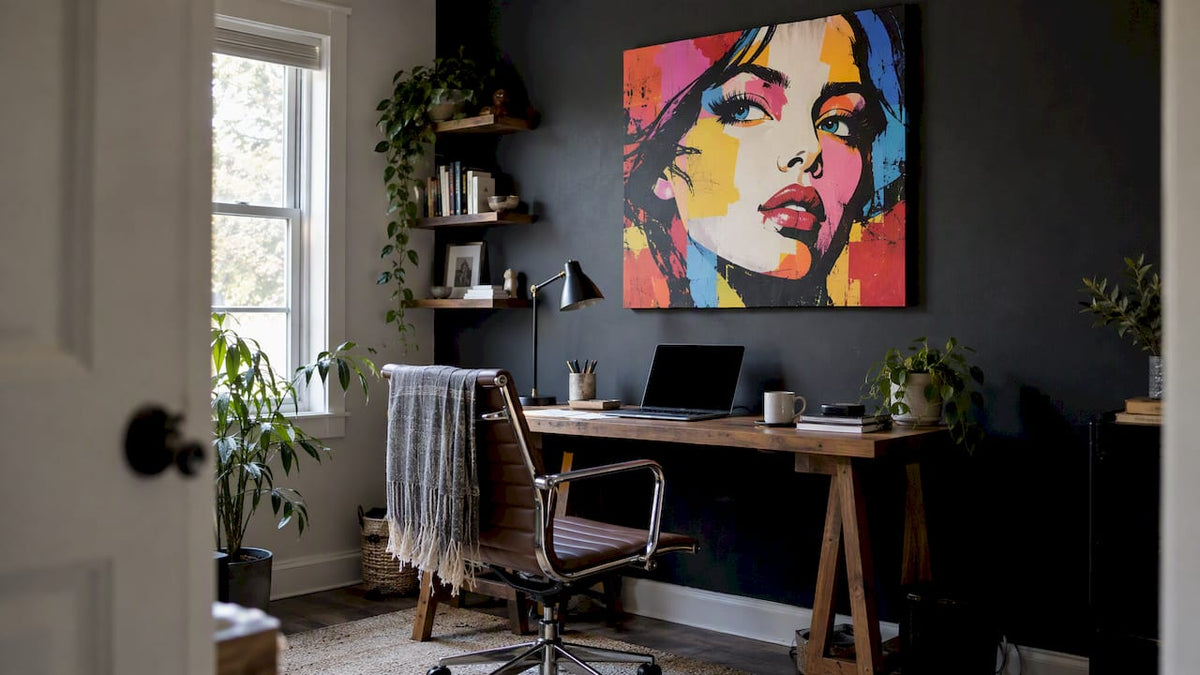
The best home office wall art does three jobs at once: it fits the wall’s scale, it matches how you work, and it looks good behind you on a video call. Pick one large statement piece or a tight grouping, size it to about two-thirds of the furniture beneath it, hang it with its center near eye level, and choose a style that gives you energy or calm, depending on the work you do.
Below you will find specific ideas by style, simple measuring rules, a few mistakes to avoid, and how to choose between bold and quiet pieces.
Table of Contents
- Start with the wall you see most
- Why the art you pick is worth getting right
- Home office wall art ideas by style
- How big should the art be?
- How high to hang it
- Choose the right color for the job
- Do not put glass over a canvas
- Light and placement
- Gallery walls versus one statement piece
- Perspective: what we see when people decorate a home office
- Refreshing a tired office without a remodel
- Find a piece for your office
- A simple plan for your weekend
- FAQ
- Sources
Start with the wall you see most
A home office usually has two walls that matter. The first is the wall you face while working. The second is the wall behind you, which shows up on every video call.
The wall you face is for you. Put the art that makes you feel something there: a landscape you can rest your eyes on, or a bold piece that wakes you up at 2 p.m. The wall behind you is for everyone else. It should look intentional, uncluttered and well lit, and it should not compete with your face.
If you only have budget or energy for one piece, choose the wall behind the desk. It does the most work and is the easiest to get right with a single large canvas.
Why the art you pick is worth getting right
There is real research behind the idea that a personalized workspace beats a bare one. University of Exeter researchers found that employees who had control over the layout of their workspace were up to 32% more productive and also happier and healthier. The study looked at offices, not home setups, but the logic travels well: a room you shaped yourself is a room you identify with.
That is an argument against buying whatever is neutral and safe. A bare, “lean” room is not the productivity win it looks like. Art you chose, for reasons you can explain, turns a spare bedroom or a corner of the dining room into a place you want to sit in.
Home office wall art ideas by style
Black and white art for focus
Black and white work suits people who want a calm, uncluttered room. With no color competing for attention, the eye settles on form, contrast and composition. It also pairs with nearly any desk, rug or paint color, so you can change the rest of the room later without replacing the art.
Good candidates are architectural photography, high-contrast portraits, city skylines at night and graphic compositions. Large pieces read as confident, while a pair of matching smaller canvases gives you symmetry above a desk. You can browse the black and white, abstract and photography collections in one place.
Minimalist art for a clear head
If your work is analytical, such as writing, coding, finance or design review, minimalist pieces keep the visual noise low. Think a single line drawing, a restrained abstract, or soft geometric shapes in two or three colors. Our minimalist office wall art and minimalist wall art decor pieces are made for this kind of room, where the art should support concentration instead of demanding it.
Landscapes for mental breaks
Work that needs hours of sustained focus tires the brain. Environmental psychology has a framework for this called Attention Restoration Theory, which holds that natural scenes engage involuntary attention and give your focused attention a chance to recover. One paper applying the theory to landscape art explains how artworks can be conceived around that idea.
The practical takeaway is simple. Hang a landscape where your eyes naturally drift when you look up from the screen: a misty forest, a coastline, a mountain ridge. It will not replace a walk outside, but it gives your eyes a place to rest during a ten-second pause.

Pop art and graffiti for energy
Some people work better in a room with a pulse. If you do creative work, run a small business, or simply dislike beige, pop art and street art bring color, humor and attitude. A large graffiti piece on a plain wall instantly becomes the focal point and gives the room a point of view.
This is the territory we know best. Our pop art canvas prints and graffiti and street art canvases work well in home offices that double as creative studios, and they photograph well in the background of a call. Keep the rest of the wall quiet so the piece can carry the room.
Tech and startup office art
The tech and startup look is usually a mix of clean lines, one loud accent and a little cultural reference. Think a bold urban expressionist canvas above a standing desk, a sneaker or streetwear-inspired piece, or a motivational print with strong typography.
Streetwear-influenced art suits this look because it signals taste without looking corporate. Our HypeBeast art collection and the urban expressionist wall art piece are good starting points. Founders working from a spare room tend to want something that feels like their own brand, not a stock poster.
Luxury and fashion art for a polished room
If your office doubles as a place to meet clients, or you simply want a more refined look, fashion and luxury pieces add a sense of occasion. Designer-inspired canvases from the fashion world, such as our Luxury Chanel wall art and Louis Vuitton wall art, sit comfortably against dark wood, leather chairs and brass lamps. The wider luxury art collection gives you more options if you prefer the mood without a specific house name.
Vintage for a library feel
For a study with books, a leather chair and warm lighting, vintage pieces feel at home. Muted tones, classic subjects and aged textures create the quiet, collected look of a private library. Our guide to vintage office decor walks through how to pair these pieces with wood and metal finishes.
How big should the art be?
Most people buy art too small. A tiny frame floating on a wide wall looks lost, and it is the most common reason a room feels unfinished.
A reliable guide is the two-thirds rule: the artwork, or the combined footprint of a gallery grouping, should cover about 66% of the width of the space it hangs over, and it should be centered on the furniture below rather than on the wall itself.
Here is how that works in practice:
| Furniture below the art | Example width | Target art width (about 66%) |
|---|---|---|
| Compact desk | 48 in | about 32 in |
| Standard desk | 60 in | about 40 in |
| Wide desk or credenza | 72 in | about 48 in |
| Bookshelf wall or sideboard | 84 in | about 55 in |
If one canvas that large is not practical, use a set of two or three matching pieces and treat the full arrangement as one unit, with consistent gaps of about two to three inches between them. For bigger rooms and commercial layouts, our guide to art scale in large offices goes deeper on proportion.
How high to hang it
The common gallery standard is to hang art so that its center sits about 57 inches from the floor, roughly average eye level. Two details trip people up:
- The 57 inches is the center of the piece, not the hook. Add half the height of the canvas to 57, then subtract the distance between the top edge and the hanging point.
- If the art hangs over a desk or credenza, bring it lower so it relates to the furniture, with roughly 6 to 10 inches of space above the surface.
Work at a desk all day? You are seated for most of it, so a slightly lower center can feel better from your chair. Stand where you stand most often, look at the wall, and trust your eye over the formula.
Choose the right color for the job
Color sets the temperature of a room. A few rules of thumb help:
- Cool tones such as blue, green and gray tend to feel calm and are good for focused work.
- Warm tones such as red, orange and gold feel energetic and suit creative or sales-driven work.
- High contrast black and white reads as sharp and professional on camera.
- One accent color pulled from the art into a lamp, a pillow or a notebook ties the room together.
These are design conventions, not laws. If you love a color, it is probably right for your room. Pull your palette from something already in the space, such as a rug, chair or wood tone.
Do not put glass over a canvas
People often assume that framing behind glass protects everything. For canvas it is not necessarily the right call. A custom framer’s guide notes that enclosing oil paintings on canvas behind glass can trap the gases they release, and recommends open-backed floater frames for canvases, saving glazing for paper works and photographs.
There is a practical bonus for home offices. Glass reflects your window, lamp and monitor, and on camera that shows up as glare. A canvas has a matte, textured surface, so there is nothing to reflect and the image stays readable from any angle. Our canvases are ready to hang, so you can skip the framing step entirely.
Light and placement
- Avoid direct sun. Ultraviolet light is one of the main environmental factors affecting paintings, as the Canadian Conservation Institute’s guidelines for paintings discuss, so a wall that takes hours of afternoon sun is not ideal for a piece you want to keep for years.
- Use a warm lamp or a picture light to give the art depth in the evening, when overhead lighting can flatten it.
- Leave breathing room around the piece. Clear space makes art look more expensive.
Gallery walls versus one statement piece
A gallery wall of mixed frames, prints and objects is one of the most popular looks, and it suits people who like to collect over time. It also takes planning, and it can get busy behind you on a call.
A single large canvas is easier. It reads as decisive, needs one nail or two, and works with almost any desk setup. If your office is small, one big piece usually looks better than six small ones. If you do build a grouping, keep one element in common, such as a color, a subject or a style, so the wall reads as a set.

Perspective: what we see when people decorate a home office
We sell canvas wall art, so we talk to people about this every week. Three patterns repeat.
First, people choose art for the room they imagine, not the one they sit in. They buy something safe and forgettable because they worry about video calls, then feel nothing when they look at it. Pick the piece that makes you want to sit down.
Second, scale is the usual mistake. A bold design looks wrong when it is small and right when it is large. If you love a piece, go bigger than your first instinct.
Third, the best offices have one clear idea. Black and white with a single accent. A graffiti piece against calm gray walls. A fashion-inspired canvas with warm wood. One idea, repeated, beats five good ideas competing.
Every canvas we sell is made in the USA, comes ready to hang, and is printed with archival inks. That matters in an office because you will look at it for years, not weeks. Our guide to the types of art for office environments covers the same question for larger workplaces.
— James
Refreshing a tired office without a remodel
You do not need new paint or furniture to change how a home office feels. Swapping outdated prints and builder-grade posters for a few well-chosen canvases changes the character of the room. We walk through the process in our piece on refreshing outdated office decor with canvases.
If you want the room to feel finished, the door counts too. These ideas for personalizing doors cover style and security, and the same thinking applies to a home office entrance: a space that feels personal is one you want to work in.
Find a piece for your office
If you are ready to choose, start with the mood you want and work outward. Our catalog has more than 1,000 designs across pop art, graffiti, black and white, abstract, photography, motivational, landscape and luxury fashion themes, all printed on canvas and ready to hang. Browse the full collection, or go straight to pop art for color or minimalist prints for calm.
A simple plan for your weekend
- Measure the furniture the art will hang over and multiply its width by 0.66 to get your target width.
- Pick the mood: focus, rest or energy.
- Choose the style from the ideas above and keep the palette to two or three colors.
- Mark the center at about 57 inches, adjusted for your desk and seated view.
- Hang, step back, and check from your chair and from your camera angle.
FAQ
What should I hang on my home office walls?
Start with one large piece on the wall you see or show on camera most, then add smaller items if the room still feels bare. Good additions include a pinboard, a shelf with books and objects, or a second canvas in the same palette. Choose subjects you enjoy looking at, since you will see them for hours each day.
What kind of art is best for an office?
It depends on the work. Black and white and minimalist pieces suit focused, analytical tasks. Landscapes give your eyes a rest, and pop art, graffiti or fashion art add energy and personality. The best choice is the one that matches your mood while you work and still looks good on camera.
What is the 2/3 rule for wall art?
The artwork, or a gallery grouping taken as a whole, should span about two-thirds of the width of the furniture or wall space it hangs over. Multiply the width by 0.66 for your target. Center it on the furniture below, not on the wall.
Is a large canvas too much for a small home office?
Usually not. One large canvas tends to look calmer and more deliberate than many small pieces in a small room. Keep the surrounding wall clear, and use the two-thirds rule so the piece still fits the furniture below it.
Conference Room Wall Art: How to Choose for Real Meetings
Coffee Shop Wall Art Ideas That Make Guests Stay