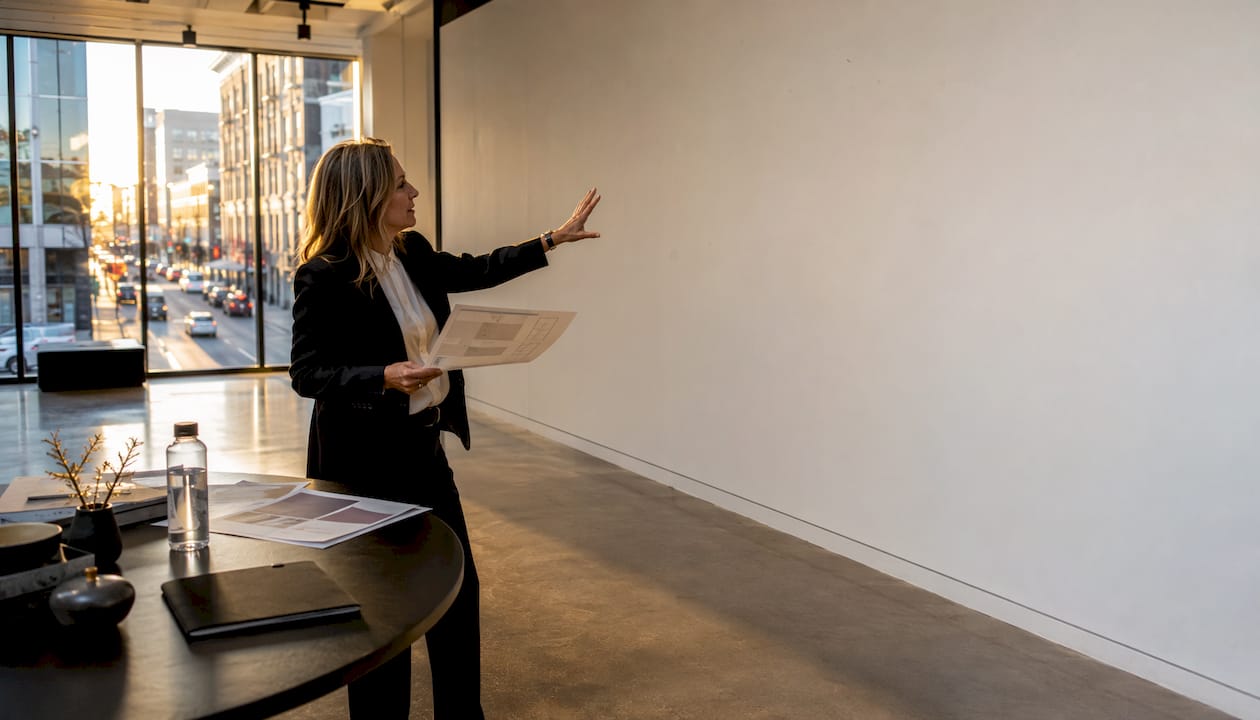
Art scale means the physical size of an artwork relative to its surroundings — the viewer’s body, the furniture anchoring the wall, and the total wall area — not just the canvas dimensions printed on a product page. Get it right and a large canvas commands a room. Get it wrong and a $3,000 piece looks like a Post-it note on a conference wall.
Three numbers to carry into every buying decision:
- About two-thirds wall coverage: your target coverage for any significant office wall
- A few inches above furniture: the standard hang height over desks, credenzas, and sofas
- A professional size range for executive offices: medium to large canvases sized to suit typical furniture; larger sizes are recommended for lobbies and focal points
Luxuryartcanvas publishes sizing guides built around these exact benchmarks, and every canvas ships USA-made to match them.
Table of Contents
- Why scale in a large office is set by the room, not the canvas
- Quick sizing and placement rules you can measure today
- How scale changes room by room
- How to measure your wall and calculate the right canvas size
- Single large piece vs. grouped composition: how to decide
- Materials, installation, lighting, and durability for large canvases
- Luxuryartcanvas delivers large-format canvases built to these specs
- Key Takeaways
- Why most offices get art scale wrong — and what actually fixes it
- Ready to order? Here is how to request a custom quote
- Sources and further reading
Why scale in a large office is set by the room, not the canvas
Scale in design is the size of an object relative to the human body and its surroundings. Proportion, by contrast, is the internal relationship among parts of a single piece. You can have a beautifully proportioned canvas that is catastrophically out of scale with the room it hangs in.
In a large office, the room sets the scale — not the other way around. A 24×36" canvas that looks commanding in a home study reads as a framed postcard in a 1,200-square-foot open-plan floor. Viewing distance is the main driver: the farther a viewer stands from a wall, the larger the work needs to be to register as intentional rather than incidental. Ceiling height compounds this — atriums and double-height lobbies above 14 feet demand monumental scale because the architectural volume dwarfs anything smaller.
The practical lesson: evaluate any candidate piece against the room’s viewing distance and ceiling height before you evaluate its subject matter or price. Oversized canvas art creates visual hierarchy precisely because it fills the perceptual field at the distances typical of large offices.
Quick sizing and placement rules you can measure today
These numbers come from professional placement guidelines and translate directly into a shopping brief.
| Measurement | Rule | Notes |
|---|---|---|
| Wall coverage | About two-thirds of available wall width | Measure the wall between architectural breaks |
| Hang height | A few inches above furniture surface | Center of canvas at an eye-level height from the floor on open walls |
| Artwork width vs. furniture | About two-thirds to three-quarters of furniture width | Applies to desks, credenzas, sofas |
| Executive office canvas | Medium to large, sized to suit the space | Single anchor piece |
| Lobby / focal point | Large size for prominent impact | Scale up for ceilings above 14 ft |
The “too small” mistake is the most common error in office art — pieces that are undersized make a space feel unfinished rather than curated. When you are deciding between two sizes, go larger. An oversized piece can be repositioned or reframed; an undersized one just looks like an afterthought.
Pro Tip: For ceilings above a certain height threshold, increase the canvas size proportionally to compensate for the greater architectural volume that diminishes perceived scale.
How scale changes room by room
Every office zone has a different viewing distance, ceiling height, and social function. The sizing rules shift accordingly.
Executive offices
A private office typically calls for one anchor piece sized to suit the furniture and viewing distance, hung a few inches above the credenza or desk. The goal is presence without aggression — the art should read clearly from the visitor’s chair, roughly 8–12 feet away. A room-by-room scaling guide can help you match canvas size to specific furniture configurations.
Conference rooms and boardrooms
- Single focal piece on the short wall opposite the entry: a large canvas sized to suit room scale for rooms seating 10 or more
- Gallery walls work when the room is long and narrow — space pieces 2–3 inches apart and treat the combined footprint as one unit hitting the 60–65% coverage target
- Avoid small pieces that will read as decorative filler in rooms with large tables
Lobbies and double-height atriums
This is where commissioning a bespoke piece often beats sourcing from a catalog. Standard sizes rarely fill a double-height wall convincingly, and installation logistics — rigging, freight lifts, floor loading — need to be engineered into the brief from the start. For client-facing reception areas, wall art in client-facing spaces follows the same 60–65% rule but with a stronger emphasis on brand narrative.
Corridors, breakout zones, and open plan
- Corridors: use a repeating series at consistent intervals; small to medium sizes work for standard ceiling heights, but scale up proportionally for taller runs
- Breakout zones: treat like a residential living area — one anchor piece or a tight cluster, sized proportionally to the seating group
- Open plan: canvas art for open plans benefits from larger individual pieces that create visual landmarks across the floor rather than a scattered collection that reads as noise
How to measure your wall and calculate the right canvas size
Follow these steps before you contact any supplier.
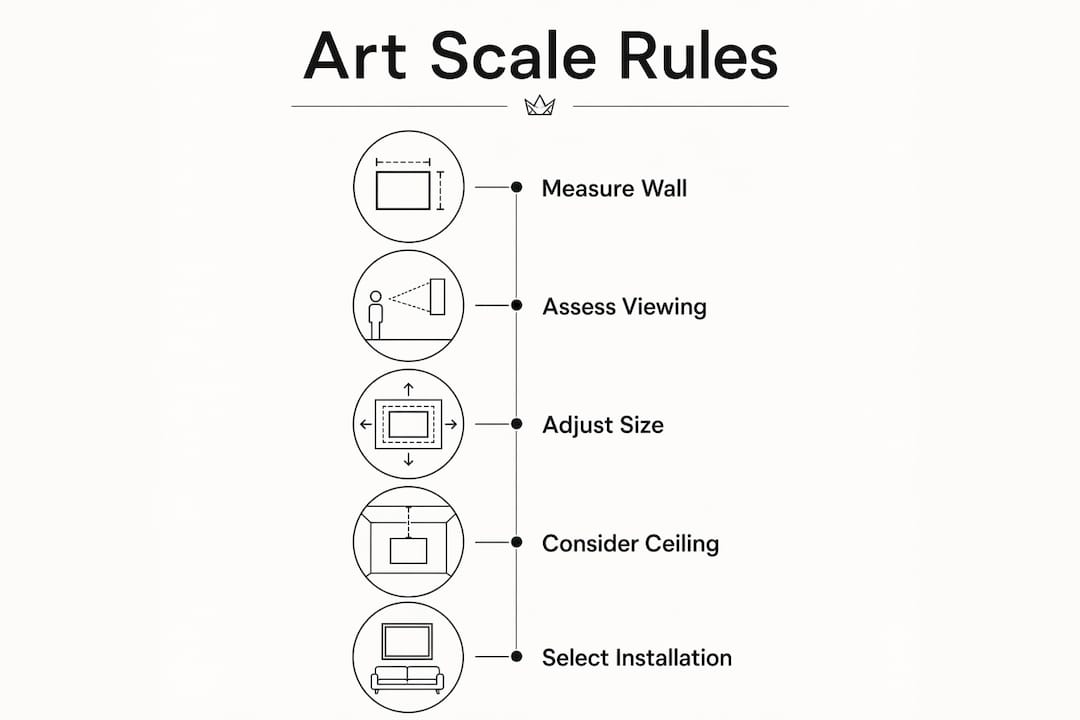
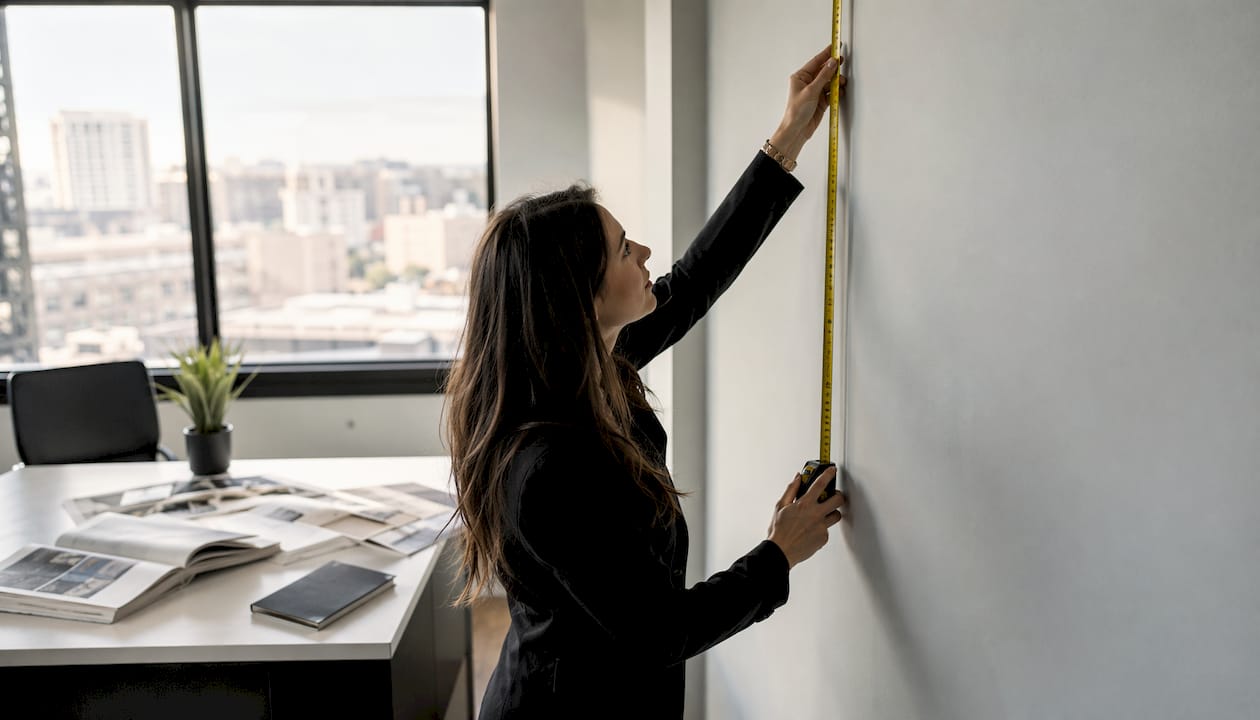
- Measure the usable wall width. Work between architectural breaks — door frames, windows, columns. This is your reference dimension, not the total wall width.
- Calculate the 60–65% target. Multiply usable width by 0.60 and 0.65 to get your size range. A 120-inch wall gives you a target of 72–78 inches for a single piece or grouped composition.
- Check furniture width. The artwork should be 2/3 to 3/4 the width of the desk, credenza, or sofa below it. A 60-inch credenza calls for a canvas 40–45 inches wide.
- Set hang height. Mark 6–12 inches above the furniture surface. Confirm the canvas center lands at 57–60 inches from the floor on open walls.
- Record ceiling height. Above 14 feet, scale up from your calculated target — the architectural volume will absorb the piece faster than the math alone suggests.
Before you finalize any order, record these on-site constraints:
- Freight elevator interior dimensions (height, width, depth)
- Narrowest doorway or corridor turn on the delivery path
- Ceiling height at the installation point
- Wall construction type (drywall, masonry, glass partition) for hardware selection
Placement best practices recommend sending this constraint list to your supplier alongside wall measurements and photos. It prevents scope surprises and shipping damage on large-format pieces.
Single large piece vs. grouped composition: how to decide
The choice between one oversized canvas and a multi-piece arrangement comes down to the wall’s architecture and the room’s function.
- Choose a single anchor piece when the wall has a clear center, the room needs one focal point, and the viewing distance is consistent (executive offices, boardroom short walls, reception desks)
- Choose a grouped composition for long corridor runs, modular desk clusters, or walls broken by structural columns — rhythm matters more than a single statement in these settings
- Spacing for grouped works: 2–3 inches between pieces for a tight gallery feel; 4–6 inches for a more open, editorial look. Treat the entire group as one unit and confirm it hits the 60–65% coverage target
- Triptychs and grids: align tops or centers consistently; mixed alignment reads as accidental rather than designed
- When to commission bespoke: non-standard walls — curved reception desks, double-height atriums, angled feature walls — rarely fit catalog sizing. A briefing conversation that engineers scale, materials, and installation to the site is usually the more cost-effective route
Materials, installation, lighting, and durability for large canvases
Material choice affects perceived scale as much as physical dimensions do.
- Stretched canvas: the standard for large-format office art; lightweight relative to size, easy to hang with standard picture-rail or French-cleat systems, and the texture adds depth at close viewing distances
- Framed canvas: adds visual weight and formality — suits executive offices and boardrooms; adds 2–4 inches to each dimension, so factor framing into your wall-coverage calculation
- Metal prints: high-gloss finish amplifies perceived size in well-lit lobbies but creates glare problems under direct spotlights; matte or satin finishes handle mixed lighting better
- Durability in commercial settings: look for UV-resistant inks, sealed edges, and a manufacturer warranty; high-traffic corridors and breakout zones need surfaces that can be cleaned without damaging the print
Installation logistics to confirm before ordering:
- Freight lift interior dimensions and weight capacity
- Door widths along the delivery path, ensuring clearance beyond canvas dimensions
- Wall construction type for appropriate hanging hardware
- Floor-load capacity for heavy sculptural or framed pieces
Lighting makes or breaks large-format art. An even wash from adjustable track lighting at 30 degrees from the wall surface reveals texture without hot spots. Avoid positioning a glossy canvas directly under a recessed downlight — the reflection competes with the image.
Pro Tip: Request a material sample or a scaled print proof before committing to a large-format order. What reads as a rich, saturated color at 12×16" can shift noticeably at 36×48" under office fluorescents.
Luxuryartcanvas delivers large-format canvases built to these specs
Buyers who have worked through the measurement steps above need a supplier that matches the numbers, not one that forces a compromise. Luxuryartcanvas produces every canvas in the USA using high-quality materials, and the catalog spans large-format graffiti canvases and bold pop-art pieces sized for executive offices, conference rooms, and lobbies.

The brand’s 10,000+ positive customer reviews reflect buyers who ordered with specific wall measurements in mind and received pieces that matched. Over 1,000 designs cover the range from understated luxury to high-impact street-culture statements — the kind of visual authority a lobby or boardroom wall actually needs. Custom sizing is available, and the published placement guides walk through the 60–65% coverage rule and hang-height standards in detail.
To get a specification-ready quote, prepare your wall measurements, ceiling height, furniture dimensions, and access constraints, then contact Luxuryartcanvas directly through the site.
Key Takeaways
Art scale in large offices is determined by viewing distance, ceiling height, and furniture relationships — not canvas dimensions alone.
| Point | Details |
|---|---|
| Art scale definition | Scale is the artwork’s size relative to its surroundings: viewer, furniture, and wall area. |
| Wall coverage target | Aim for 60–65% of usable wall width for any significant office wall. |
| Hang height and furniture | Hang 6–12 inches above furniture; canvas width should be 2/3 to 3/4 of the furniture below. |
| Executive offices: 30×40" to 36×48"; lobbies and focal points: over 40 inches on the shortest dimension. | |
| Luxuryartcanvas | USA-made large-format canvases with custom sizing, 10,000+ reviews, and published placement guides. |
Why most offices get art scale wrong — and what actually fixes it
The conventional advice is to “choose art that reflects your brand.” That sounds right and means almost nothing when you are standing in a 2,000-square-foot open-plan floor trying to decide between a 24×36" and a 40×60" canvas.
The real problem is that most buyers start with a piece they like and then try to make it fit the wall. The math runs the other way. Measure the wall, calculate the coverage target, check the furniture width, record the ceiling height — and then shop. A piece that clears those filters will look intentional. One that doesn’t will look like it was hung by whoever was available on moving day.
There is also a persistent underestimation of how much architectural volume absorbs scale. A canvas that fills a wall in a showroom photograph was almost certainly photographed in a room with 8-foot ceilings and no furniture. Put it in a lobby with 18-foot ceilings and it shrinks by half, perceptually. Scale up earlier than feels comfortable, and trust the 60–65% rule over your instincts.
Ready to order? Here is how to request a custom quote
Gather your wall measurements, ceiling height, furniture dimensions, and access constraints (freight lift size, narrowest doorway). Then visit Luxuryartcanvas to browse the graffiti wall art collection or request a custom-size canvas matched to your specification.
Send your measurements and photos through the site’s contact page and the team will confirm sizing, material options, and shipping logistics before you commit to an order.
Sources and further reading
- Wall art size guide for every room — The Moss Shop
- How much of a wall should art cover? — The Wild Rose Gallery
- Office art sizing guide — Big Ox Printing
- Office art that actually works — Giant Sculptures
- Scale and proportion in art — MasterClass
- Proportion and scale — Smarthistory
- Luxuryartcanvas — brand guidance and resources
For bespoke or very large installations, consult a local commercial art installer or include an architectural brief in your supplier conversation. Site-specific constraints — floor loading, wall construction, rigging access — are best confirmed by a professional on-site before fabrication begins.
Refreshing Outdated Office Decor with Canvases
Statement Canvases for Luxury Dining Rooms: Style Guide