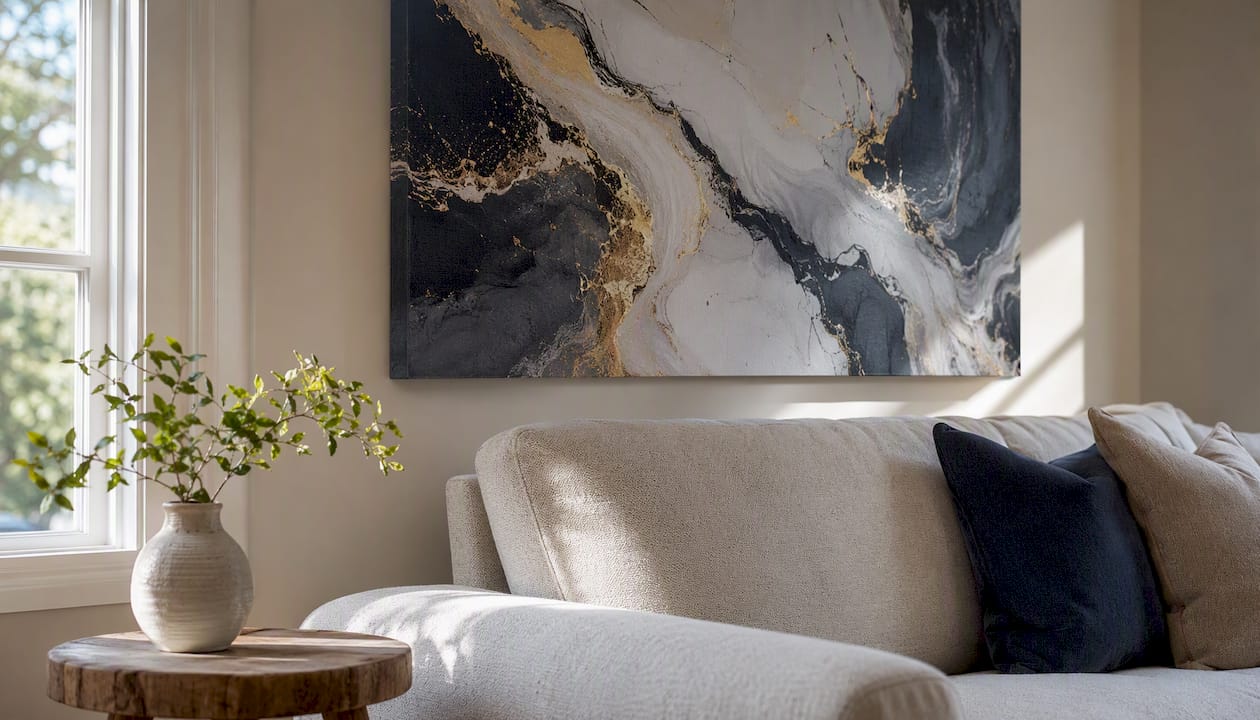
A UV-resistant canvas print is a museum-quality stretched artwork built from three non-negotiable layers: an OBA-free substrate, archival pigment or UV-cured inks, and a UV-blocking topcoat or glazing. The single most reliable predictor of real UV resistance is the ink type. Ask for it before anything else.
Before you buy, confirm these four pillars:
- Substrate: OBA-free cotton or poly-cotton, ideally 360+ gsm
- Ink: Archival pigment or UV-cured (not dye-based)
- Coating: UV-filtering varnish or acrylic glazing with a stated blocking percentage
- Finishing: Gallery-wrap stretching on kiln-dried frames, ready to hang
If a vendor cannot answer those four questions specifically, that tells you something.
Key Takeaways
Museum-quality UV-resistant canvas prints require OBA-free substrate, archival pigment inks, a UV-blocking topcoat, and kiln-dried gallery-wrap construction to reach a lifespan of 75–100+ years indoors.
| Point | Details |
|---|---|
| Ink type is the first check | Archival pigment inks (not dye) are the baseline for any print expected to last decades. |
| OBA-free substrate matters | Optical Brightening Agents degrade under UV and shift color; confirm OBA-free status before buying. |
| Topcoat extends lifespan | Quality acrylic varnishes claim above 98% UV filtering; reapply every 3–5 years in high-exposure rooms. |
| Environment is half the equation | Target 40–55% RH, use LED lighting, and keep prints away from direct sunlight to reach the 75–100+ year range. |
| Luxuryartcanvas | Produces archival pigment, OBA-free, UV-topcoated, gallery-wrapped canvases in the USA across 1,000+ designs. |
Table of Contents
- What does “UV-resistant canvas” mean for indoor wall art?
- How to choose a UV-resistant canvas print: a buyer’s checklist
- How ink type determines how long your print will last
- What protective coatings and glazing actually do for your canvas
- How to display and care for your canvas so it stays vibrant
- How long will a quality canvas print actually last?
- The production steps that separate archival prints from the rest
- How Luxuryartcanvas meets the museum-quality standard
- Why pigment-printed, OBA-free canvases should be your default
- Luxuryartcanvas: archival canvas prints made in the USA
- Sources
What does “UV-resistant canvas” mean for indoor wall art?
This guide is about one thing: archival, ready-to-hang canvas prints designed for indoor display. Not outdoor upholstery. Not marine fabric. Not canvas sold by the yard for sewing projects. Those products use different substrates, different coatings, and different performance standards entirely.
For indoor wall art, UV resistance means the print resists photochemical fading when exposed to ambient daylight, window light, and artificial lighting over years and decades. That requires the right ink chemistry, a substrate that does not contain Optical Brightening Agents (OBAs), and a protective topcoat, applied after printing.
Three vendor claims that reliably signal museum-quality production:
- Stated lightfastness rating (Blue Wool Scale or ASTM D4303 reference)
- OBA-free substrate confirmation in writing
- Domestic manufacturing transparency (where and how the print is made)
Pro Tip: If a vendor’s product page says “fade-resistant” with no ink type, no substrate spec, and no coating detail, treat it as a marketing claim, not a technical guarantee.
How to choose a UV-resistant canvas print: a buyer’s checklist
Buying a canvas print that will genuinely hold color for decades comes down to asking the right questions before checkout.
- Confirm the ink type. Ask for the ink family or printer model. Archival pigment inks are the standard for fine-art longevity. Dye-based inks are not.
- Verify OBA-free substrate. Request written confirmation that the canvas contains no Optical Brightening Agents. OBA-free media is the baseline for maximum color stability over time.
- Ask for the topcoat specification. What varnish or laminate is applied? What is its stated UV-blocking percentage? A quality acrylic varnish typically claims above 98% UV filtering.
- Check the stretcher frame. Kiln-dried wood resists warping. Ask about frame depth and wood type.
- Request a lightfastness reference. Any vendor serious about archival quality can point to a Blue Wool Scale rating or ASTM standard for their inks.
- Confirm production location. Domestic manufacturing usually means tighter quality control and faster recourse if something goes wrong.
Pro Tip: Vague answers are a red flag. “Our prints are very durable” with no specifics means the vendor either does not know their materials or does not want you to know. Walk away.
How ink type determines how long your print will last
Archival pigment and UV-cured inks deliver the best fade resistance for any print that will face meaningful light exposure. The chemistry explains why.
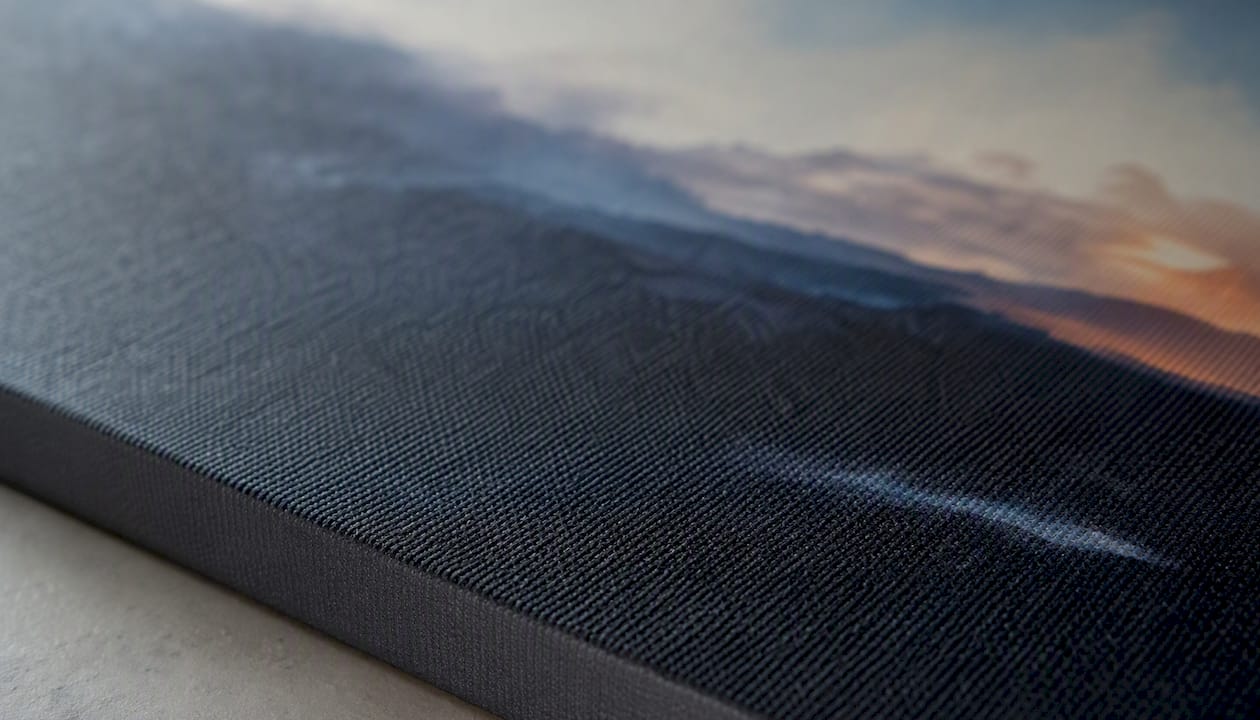
Archival pigment inks, such as Canon’s LUCIA PRO II used in the Canon imagePROGRAF PRO-1100 and PRO-310, carry color as microscopic solid particles suspended near the surface of the substrate. Those particles resist UV degradation and humidity far better than the dissolved colorants in dye inks, which penetrate the substrate and break down faster under light exposure.
| Ink Type | Fade Resistance | Water/Scratch Resistance | Best Substrate Pairing | Curing Behavior |
|---|---|---|---|---|
| Archival Pigment | Excellent | Good | OBA-free cotton/poly-cotton | Air-dry; slow |
| Dye | Poor to Fair | Poor | Coated papers/canvas | Air-dry; fast |
| Solvent | Good | Very Good | Vinyl, uncoated canvas | Air-dry; off-gassing |
| Latex | Good | Good | Coated canvas, vinyl | Heat-cured |
| UV-Cured | Excellent | Excellent | Most rigid/flexible substrates | Instant UV lamp cure |
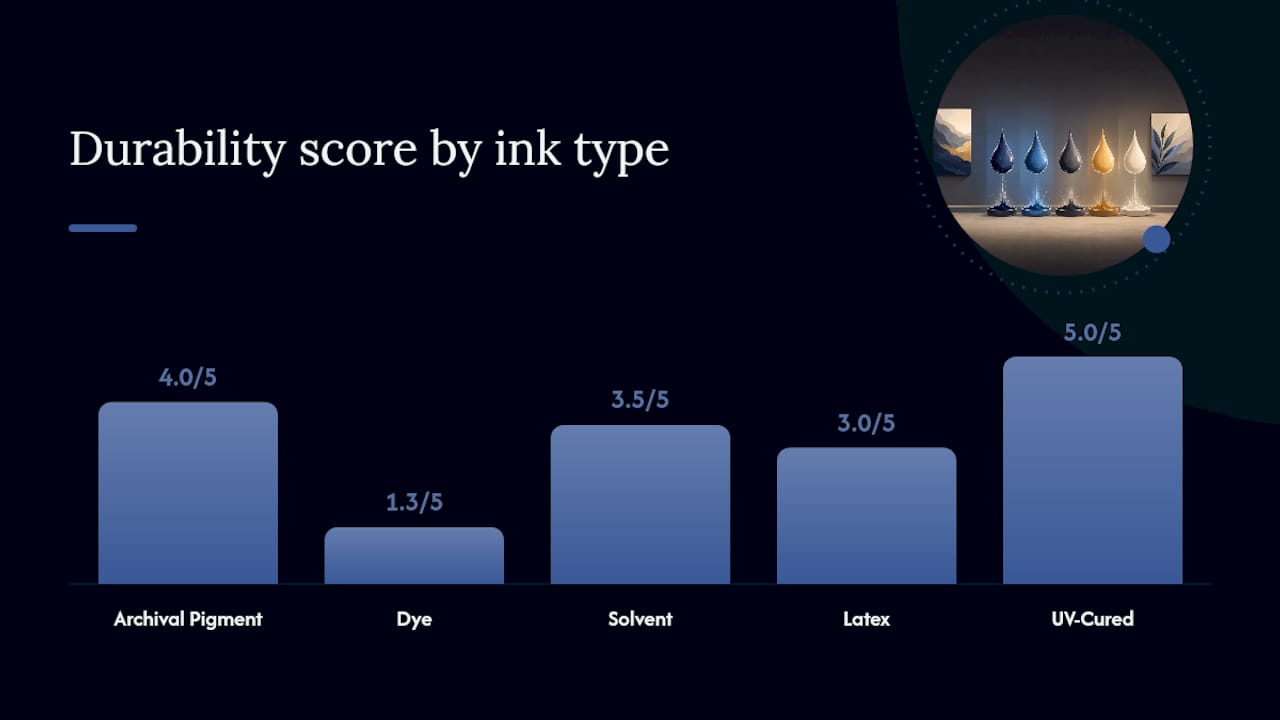
For fine-art giclée aesthetics, archival pigment is the preferred choice. UV-cured inks suit higher-traffic commercial displays where surface durability matters as much as color depth. Dye inks are the weakest option for any print intended to last.
Pro Tip: When a vendor lists their printer model, look it up. The Canon imagePROGRAF PRO-1100 and PRO-310 use LUCIA PRO II pigment inks, which signals a genuine archival system. A vendor who cannot name their printer or ink family is a vendor who cannot back their longevity claims.
What protective coatings and glazing actually do for your canvas
The topcoat is the last line of defense, and it matters more than most buyers realize. A quality UV-resistant varnish or museum glazing can add decades to a print’s life by physically blocking the wavelengths that degrade pigments.
Common protective options and their trade-offs:
- Acrylic varnish: Applied directly to the canvas surface; quality formulas claim above 98% UV filtering. Available in matte, satin, and gloss finishes. Adds scratch resistance and makes the surface cleanable with a damp cloth.
- UV laminate: A film applied over the print surface; very durable, consistent coverage, but harder to reapply later.
- Conservation-grade acrylic glazing: Used when the canvas is framed behind a panel. Blocks UV without the color distortion of standard glass. Best for high-value pieces near windows.
Varnish versus glazing comes down to display context. An unframed gallery-wrap canvas gets varnish. A framed piece near a south-facing window benefits from conservation glazing. For rooms with heavy window exposure, UV-blocking window film adds another layer of protection before light even reaches the canvas.
UV damage is cumulative and irreversible, so every layer of protection compounds over time. Varnish reapplication every 3–5 years is advisable for prints in high-exposure locations.
Pro Tip: A vendor who specifies their varnish brand, UV-block percentage, and recommends a reapplication schedule understands long-term preservation. That level of detail is a stronger quality signal than any marketing badge.
Pro Tip: For pieces displayed near large windows, pair a UV-resistant varnish with window film rated for UV blocking. The two layers together cut UV exposure more effectively than either alone.
How to display and care for your canvas so it stays vibrant
Materials only do so much. Where and how you hang a canvas determines whether those archival inks actually reach their potential lifespan.
Five display choices that protect prints:
- Avoid direct sunlight. No canvas, regardless of ink or coating, should face a south- or west-facing window without UV film on the glass.
- Use LED lighting. LEDs emit minimal UV compared with incandescent or fluorescent bulbs. Aim gallery-style spotlights at the canvas rather than flooding the room with mixed sources.
- Control relative humidity. Target 40–55% RH. Humidity fluctuations cause canvas to expand and contract, stressing the surface and accelerating coating breakdown.
- Keep prints away from kitchens and bathrooms. Grease, steam, and temperature swings are hostile to both canvas and varnish.
- Apply UV window film to nearby windows if environmental controls are limited.
For cleaning, use a soft, dry microfiber cloth and light pressure. Never use solvents, spray cleaners, or abrasive materials on a varnished surface. Do not hang canvas prints in direct contact with exterior walls where condensation can form behind the stretcher.
A simple hygrometer near your most valuable pieces costs very little and tells you immediately when conditions drift outside the safe range.
How long will a quality canvas print actually last?
Archival pigment inks paired with a UV topcoat, displayed indoors under stable conditions, can reach 75–100+ years before noticeable fading. Budget dye-ink prints in bright or humid environments may show visible color shift within a decade or two.
| Scenario | Ink Type | Coating | Environment | Expected Lifespan |
|---|---|---|---|---|
| Archival standard | Pigment | UV varnish | Stable indoor, LED lighting | 75–100+ years |
| Mid-range | Pigment | No topcoat | Moderate light, controlled RH | 75–100+ years |
| Budget | Dye | None | Bright room, uncontrolled humidity | within a decade or two |
Cost tracks closely with these tiers. Budget prints cut corners on substrate GSM, use dye inks, and skip the topcoat. Mid-range prints often use pigment inks but may omit varnish or use lower-GSM canvas. Archival-grade prints combine 360+ gsm poly-cotton or cotton substrate, pigment inks, UV varnish, and kiln-dried stretcher frames. Domestic manufacturing adds quality control that offshore production rarely matches at the same price point.
The production steps that separate archival prints from the rest
Knowing what happens between your image file and the finished canvas helps you ask the right questions and spot shortcuts.
- File proofing and color calibration. A calibrated monitor and ICC profile matching the substrate and ink combination. Ask if the vendor uses color-managed workflows and whether they offer a digital proof before printing.
- Printing. Archival pigment inks on OBA-free canvas, at the resolution and color depth the file supports.
- Drying and curing. Pigment prints need adequate drying time before varnish application. Rushing this step causes adhesion failures. UV-cured inks cure instantly under the lamp.
- Varnish or laminate application. Applied evenly across the full print surface. Ask for the varnish brand and UV-block specification.
- Inspection. Color accuracy check, surface defect review, and edge inspection before stretching.
- Gallery-wrap stretching. Kiln-dried wood frames, corners mitered cleanly, canvas pulled evenly. Ask about frame depth (1.5" is standard for gallery wrap) and wood species.
- Packing and shipping. Protective corner guards, rigid backing, and moisture-barrier packaging for transit.
Vendor questions worth asking: Do you offer an inspection photo before shipping? What is your lead time from order to dispatch? How is the canvas packed to prevent corner damage?
How Luxuryartcanvas meets the museum-quality standard
Luxuryartcanvas produces ready-to-hang canvas wall art in the USA using archival inks and UV-resistant finishes on OBA-free substrates. Every piece ships gallery-wrapped on kiln-dried frames, ready to hang without additional framing or hardware.
Key production details:
- Domestic manufacturing: Printed and finished in the United States, with quality control at each production stage
- Archival pigment inks: Color carried in stable solid particles for long-term fade resistance
- OBA-free canvas substrate: No brightening agents that degrade under UV exposure
- UV-resistant topcoat: Applied to every canvas for surface protection and cleanability
- Gallery-wrap construction: Kiln-dried stretcher frames, mitered corners, ready to hang
The catalog spans over 1,000 designs, from graffiti and street art to pop art and high-fashion-inspired pieces, with options suited to residential rooms, office lobbies, and collector spaces. More detail on material choices and construction is available in Luxuryartcanvas’s canvas durability guide.
Pro Tip: When you order from a domestic producer, you can ask for production details directly. A brand that publishes its material specs and manufacturing location is one that stands behind its archival claims.
Why pigment-printed, OBA-free canvases should be your default
The conventional wisdom in wall art buying is to focus on design and price. That is the wrong order of operations for anyone who expects a print to look the same in fifteen years as it does today.
Pigment inks on OBA-free canvas with a UV varnish is not a premium upgrade. It is the baseline for any print worth hanging in a space you care about. Dye-ink prints are cheaper to produce, and that cost difference gets passed to the buyer as a lower price and a shorter lifespan. The math rarely favors the budget option when you factor in replacement.
The edge cases are real: temporary decor, rental staging, or a very tight budget where a two-year print is acceptable. In those situations, a dye-ink print at a lower price point is a rational choice. But for a home, an office, or a collection, the archival standard is the only one worth buying.
Luxuryartcanvas: archival canvas prints made in the USA
Ready-to-hang canvas art that holds its color for decades, not years, starts with the right materials. Luxuryartcanvas builds every print with archival pigment inks, OBA-free substrates, and UV-resistant topcoats, then gallery-wraps each canvas on kiln-dried frames so it arrives ready to hang.
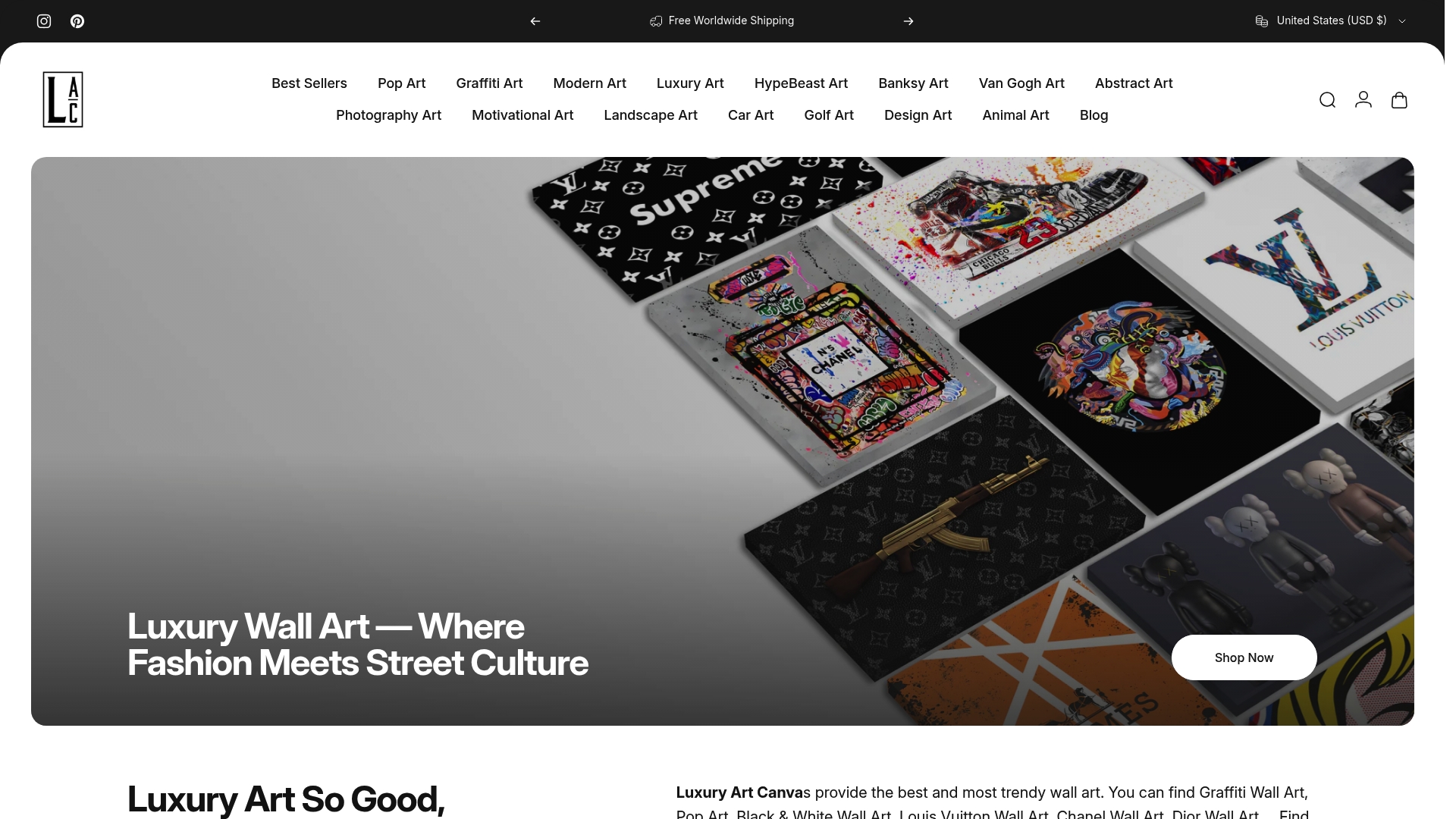
Over 1,000 designs span graffiti, pop art, street culture, and high-fashion aesthetics, all produced domestically with the same archival standard. Browse the full graffiti wall art collection or explore large-format options for statement walls in commercial and residential spaces. Every order is backed by a satisfaction guarantee. Shop the full catalog at Luxuryartcanvas.
Sources
When requesting lightfastness verification from a vendor, ask specifically for a Blue Wool Scale rating or ASTM D4303 reference for their ink and substrate combination. A vendor who can produce that documentation is operating at a genuinely archival standard.
Why Bold Art Suits Hospitality Business Interiors
Hotel Lobby Wall Art: A Designer's Buying Guide