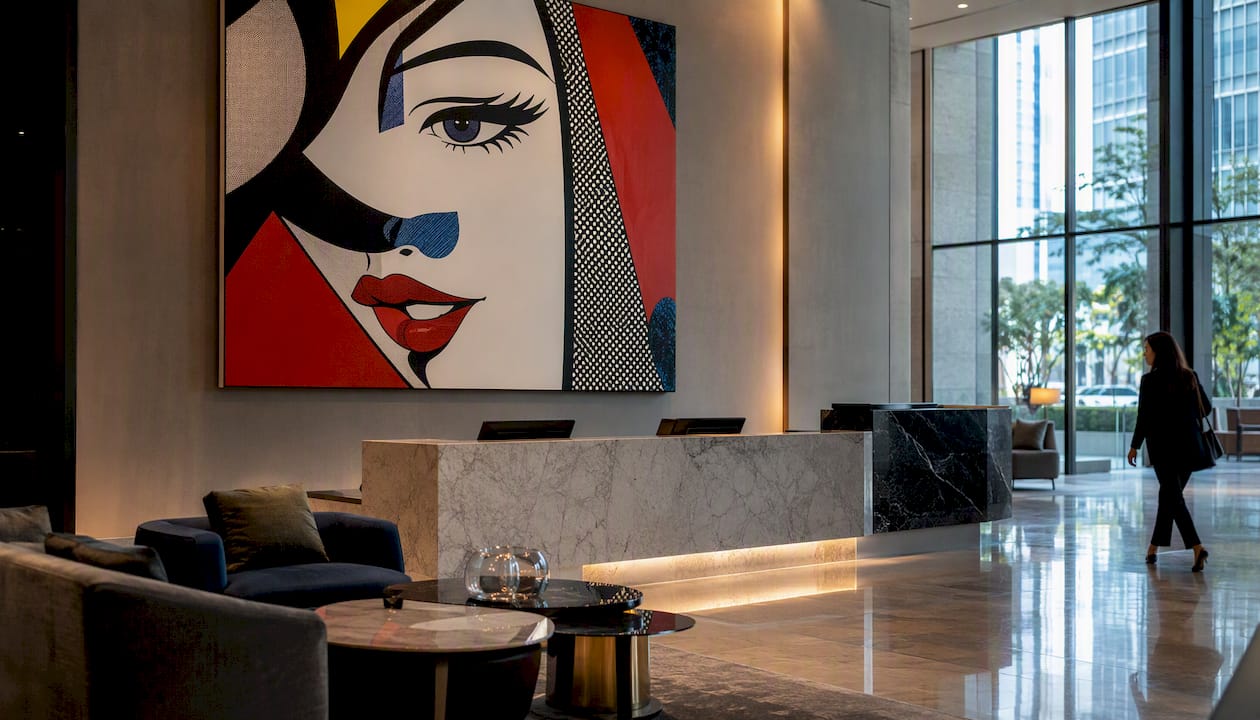
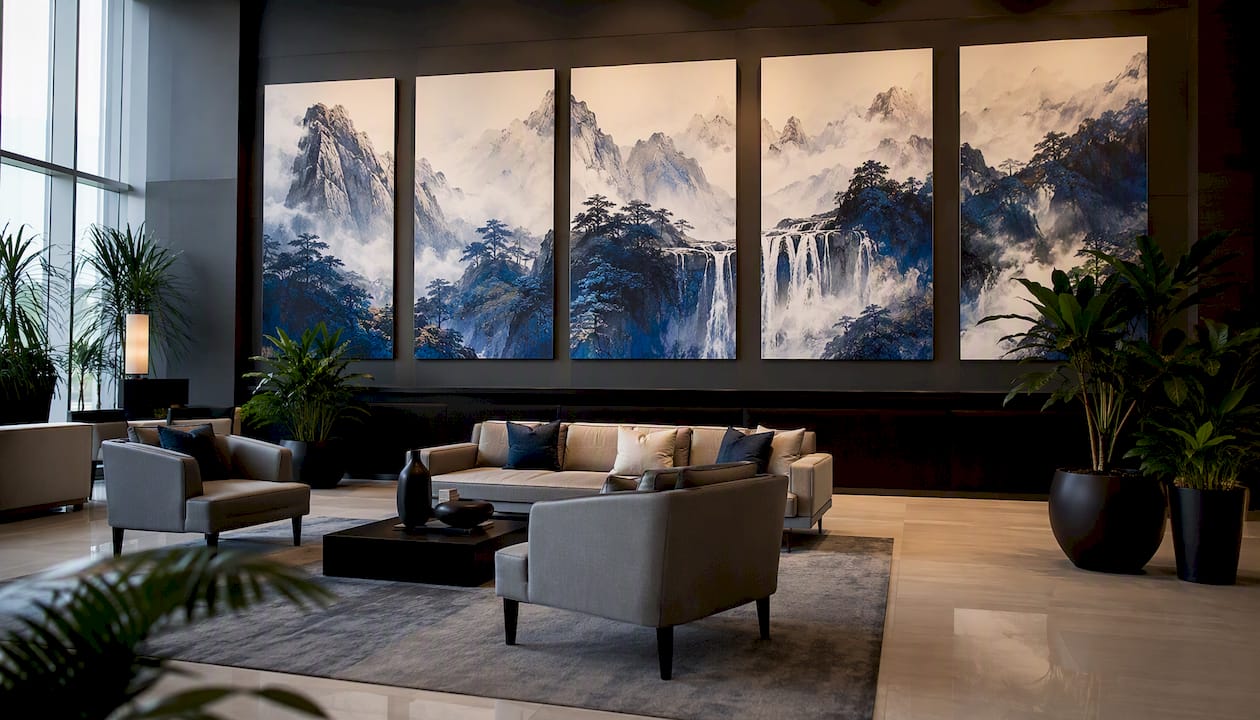
For most hotel lobbies, the right call is large-format, ready-to-hang museum-quality canvas art, either as a single oversized anchor piece or a coordinated multi-panel installation. Canvas balances visual impact with commercial durability, ships ready to mount, and scales to any wall without the lead time or cost of a custom mural. Luxuryartcanvas produces each piece in the USA with archival inks and commercial-grade finishes, making it a practical starting point for procurement teams working against a deadline.
Quick format guide:
- Statement canvas: best for arrival walls and reception backdrops where you need immediate brand impact and easy replacement if the design evolves
- Multi-panel / triptych: works well across wide walls above seating clusters; creates rhythm without requiring a single massive print
- Framed giclée prints: suited to boutique or heritage properties where a gallery feel matters more than bold scale
- Metal or acrylic prints: high-gloss, moisture-resistant option for spa lobbies or humid climates
- Murals / vinyl wallpaper: maximum drama for a feature wall, but highest cost and longest lead time; not easily swapped
- Digital LED panels: emerging option for tech-forward lifestyle brands; highest maintenance and energy cost of any format
Fire safety applies to every format. NFPA 701 sets the standard flammability test for textiles and wall coverings in commercial spaces; request a compliance certificate from any vendor before installation.
Key Takeaways
The most effective hotel lobby art strategy combines one or two large-format anchor pieces in a commercial-grade format with coordinated supporting works sized and lit to match the space.
| Point | Details |
|---|---|
| Format selection | Canvas is the most practical format for most lobbies; choose metal or acrylic for high-humidity zones. |
| Sizing rule | A single canvas should cover a majority of the wall’s width to read as intentional. |
| Lighting spec | Specify LEDs rated 3000K–4000K to reproduce artwork accurately and avoid flat, washed-out color. |
| Spec requirements | Require archival pigment inks, UV-resistant topcoat, and NFPA 701 flammability compliance from any vendor. |
| Luxuryartcanvas | Offers custom sizing, made-in-USA archival production, and bulk-order support for hospitality projects. |
Table of Contents
- What types of hotel lobby wall art work best for each space?
- How does lobby art shape guest experience and brand perception?
- Where should you place art, and how do you size it correctly?
- What materials and specs should you require from vendors?
- How do you choose art that actually fits your hotel’s brand?
- What should you expect when ordering custom or bulk lobby art?
- What does hotel lobby art actually cost?
- How should you mount and install commercial lobby art?
- How do you clean and maintain lobby art long-term?
- How Luxuryartcanvas handles hospitality and commercial projects
- What most buyers get wrong about lobby art (and how to fix it)
- Luxuryartcanvas makes it easy to outfit your hotel lobby
- Sources
What types of hotel lobby wall art work best for each space?
Canvas printing is the workhorse of hospitality interiors because it introduces warmth, scales to custom dimensions, and holds up under the cleaning and handling that public spaces demand. That said, the right format depends on the lobby’s scale, traffic, and brand voice.
Ready-to-hang gallery-wrapped canvas is the most versatile choice. It arrives with hardware included, requires no framing, and can be produced in virtually any size. For lifestyle hotels targeting a younger, design-conscious guest, bold graffiti and pop-art canvases, like the Hypebeast canvas range, read immediately and photograph well for social media. Luxury-tier properties tend toward oversized photographic panoramas or high-fashion motifs, such as Louis Vuitton or Dior-inspired pieces, that signal the brand without spelling it out.
Multi-panel sets solve the problem of wide, low walls where a single canvas would look undersized. A triptych above a banquette creates visual continuity while allowing each panel to ship and hang independently.
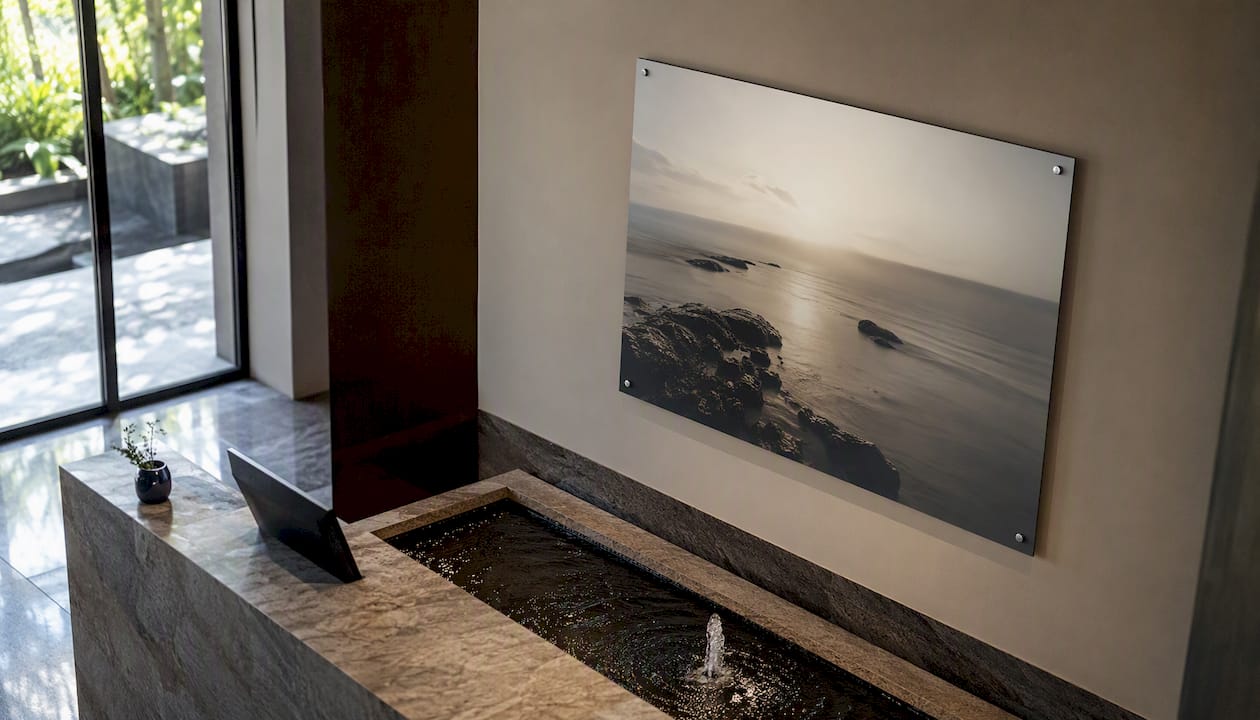
Metal and acrylic prints suit spa reception areas, pool-level lobbies, or any zone with elevated humidity. The substrate is moisture-resistant by nature and wipes clean with a damp cloth. The trade-off is a harder, more contemporary look that doesn’t suit every brand.
Murals deliver the most dramatic first impression but commit the property to a design for years. They work best when the concept is tied to a genuinely local story or a signature artist, not a trend. Designers consistently recommend commissioning local artists or using location-specific photography series for this reason: the story gives guests something to ask about.
Digital LED panels are worth considering only when the brand actively programs content, because a static image on an LED screen looks cheaper than a printed canvas at the same price point.
How does lobby art shape guest experience and brand perception?
Luxury hotel lobbies use layered lighting, rich textures, and carefully selected artwork to create a sense of quality that guests register before they consciously process it. Art is doing three jobs at once: communicating brand personality, setting an emotional tone, and giving guests a reason to stop, look, and share.
The social-media angle is real and underused in procurement decisions. A single well-lit, photogenic piece on the arrival wall generates organic content every time a guest posts a check-in photo. That’s earned reach with no media spend.
Operationally, art also guides circulation. A strong anchor piece draws the eye toward the reception desk. A series of smaller works along a corridor pulls guests deeper into the property. Lobbies that succeed mix statement pieces with clear sight-lines so art enhances the flow of the space rather than interrupting it.
By hotel type:
- Boutique: local photography or commissioned illustration; art is part of the brand story, not decoration
- Lifestyle / hype: bold, graphic, culturally relevant pieces that guests recognize and want to photograph
- Business / corporate: clean abstract or architectural photography; art signals quality without demanding attention
- Resort: oversized nature or landscape photography; scale and serenity are the goals
Where should you place art, and how do you size it correctly?
Placement and scale are where most lobby art projects go wrong.
Placement zones to prioritize:
- Arrival wall: the first surface a guest sees on entry; reserve this for your largest or most impactful piece
- Behind the reception desk: art here frames the staff and reinforces brand identity at the moment of check-in
- Seating clusters: smaller coordinated pieces at eye level (roughly 57–60 inches from floor to center) create intimacy
- Corridor approach: a series of works spaced evenly pulls guests through the space and reduces the tunnel effect
- Stair and landing walls: often overlooked; tall vertical formats work well here and reward guests who use the stairs
Sizing rules of thumb:
- A single canvas on a feature wall should cover a majority of the wall’s width to read as intentional, not lost
- For a standard ceiling height, a canvas of proportionate height is practical for most arrival walls
- Depending on the lobby size, select artwork dimensions that appropriately anchor the space, ranging from moderate to large pieces or multi-panel installations
- Hang the center of any piece at typical gallery height from the floor, adjusted as needed for ceiling height or furniture
For lighting, LEDs rated 3000K–4000K reproduce artwork accurately and avoid the flat, washed-out look that cooler temperatures produce. Pair recessed downlights with wall sconces or picture lights to create depth. A wall-mount fixture like the Crystorama Luna or Lloyd wall mount can accent a feature canvas without requiring ceiling modifications.
Pro Tip: Before finalizing placement, tape paper templates of each piece to the wall and photograph them from the lobby entrance, the reception desk, and the main seating area. What looks right on a floor plan often reads differently in the actual space.
What materials and specs should you require from vendors?
Hospitality art takes more abuse than residential art: cleaning chemicals, humidity swings, luggage contact, and direct sunlight all shorten a piece’s life if the spec isn’t right. Here’s what to require in writing.
| Specification | What to require | Why it matters |
|---|---|---|
| Ink type | Archival pigment inks (not dye-based) | Pigment inks resist fading for decades under normal light exposure |
| UV protection | UV-resistant topcoat or laminate | Prevents color shift near windows or under accent lighting |
| Canvas substrate | Poly-cotton blend on kiln-dried stretcher bars | Resists warping and humidity-related sagging |
| Surface finish | Easy-clean satin or matte topcoat | Allows damp-cloth cleaning without damaging the image |
| Flammability | NFPA 701 compliant or equivalent | Required for commercial wall installations in most jurisdictions |
| Backing | Flame-retardant backing material | Adds a second layer of fire compliance |
| Mounting hardware | Commercial-grade hanging hardware included | Reduces on-site sourcing and ensures load rating is matched |
Metal and acrylic substrates are inherently moisture-resistant and skip the canvas-warping concern, but they require anti-scratch coatings and should be specified with standoff mounts to prevent wall condensation behind the panel.
Pro Tip: Request a technical datasheet from every vendor showing UV fade test results, flammability class, and recommended cleaning products. Any reputable commercial supplier will have this documentation ready. If they don’t, treat that as a red flag.
How do you choose art that actually fits your hotel’s brand?
Random art choices are obvious to guests, even when they can’t articulate why. The selection process should start with the guest, not the artwork.
Decision framework:
- Guest profile first: who is staying here, and what do they already respond to visually? A millennial lifestyle traveler and a corporate road warrior have almost nothing in common aesthetically.
- Brand tone: map your brand adjectives (bold, serene, playful, refined) to visual equivalents before browsing any catalog
- Color palette: pull two or three dominant colors from your interior finishes and use them as a filter; art that fights the palette creates visual noise
- Texture and material: a matte canvas reads warmer than a glossy acrylic; match the material to the room’s existing surfaces
- Narrative: the strongest lobby art tells a story, whether that’s a local landscape, a cultural reference, or a brand-specific motif
Local storytelling consistently drives more guest engagement than generic abstract prints. A series of neighborhood photography or a piece by a local artist gives guests a conversation starter and signals that the property is genuinely connected to its location.
For high-end rooms and client-facing spaces, the principle is the same: the art should feel chosen, not filled in. A single strong image, what designers sometimes call an anchor piece, does more for a lobby than six mediocre ones. The concept of statement wall art is worth understanding before finalizing any selection.
For mockups, most vendors can supply a scaled digital rendering. Test it against your actual wall color and under your planned lighting before approving production.
What should you expect when ordering custom or bulk lobby art?
The ordering process for commercial art has more steps than a residential purchase, and the timeline surprises buyers who haven’t done it before.
- Initial inquiry: submit wall dimensions, preferred styles, and quantity. A good vendor will ask for photos of the space and your lighting plan.
- Sample or proof: request a physical proof for any piece larger than 24×36 inches. Color on screen and color on canvas are not the same.
- Digital mockup approval: review a scaled rendering in your actual space before approving production. This is the step most buyers skip and most regret skipping.
- Production: standard production for a single custom canvas typically runs 5–10 business days. Bulk orders of 10 or more pieces may require 3–6 weeks depending on size and finish.
- Shipping: large canvases ship in reinforced corner-protected packaging. Confirm the carrier’s handling protocol for oversized freight.
- Installation: schedule installation during low-occupancy periods. Confirm the installer has the wall substrate specs (drywall, concrete, masonry) before arrival.
Pre-order checklist:
- Exact wall dimensions (width × height) for every installation point
- Wall substrate type at each location
- Ceiling height and any obstructions (sprinklers, HVAC vents, signage)
- Lighting plan (fixture positions and color temperature)
- On-site installation contact and access hours
- Freight delivery address and dock or elevator access details
What does hotel lobby art actually cost?
Budget expectations vary widely, and the gap between entry-level and premium isn’t always about image quality. It’s about substrate, size, finish, and whether installation is included.
Budget bands:
- Entry level (under $200 per piece): standard canvas prints in stock sizes, basic hanging hardware, no custom sizing. Suitable for secondary corridors or supporting pieces.
- Mid-range ($200–$800 per piece): custom sizing, archival inks, UV-resistant topcoat, commercial-grade stretcher bars, and hardware included. This is the practical range for most lobby anchor pieces.
- Premium ($800 and above): large-format custom work, artist licensing or commission fees, specialty substrates (metal, acrylic, hand-embellished), and professional installation included.
Primary cost drivers:
- Size and quantity (larger pieces and bulk orders both affect unit cost differently)
- Substrate and finish (canvas is typically the most cost-effective; acrylic and metal cost more)
- Custom licensing for branded or artist-specific imagery
- Framing and mounting hardware
- Shipping and insurance for oversized or high-value pieces
- Professional installation, especially for high ceilings or multi-panel alignments
The highest-ROI approach for most properties: invest in one or two anchor pieces at the mid-to-premium level and use coordinated supporting pieces at entry-level pricing to fill secondary walls. The anchor piece carries the brand statement; the supporting pieces create coherence without duplicating the cost.
How should you mount and install commercial lobby art?
Installation is where projects stall or fail. The right hardware for a 10-pound canvas is completely wrong for a 60-pound multi-panel installation, and a piece that falls in a public space is a liability issue, not just an aesthetic one.
- Identify the wall substrate before ordering hardware. Drywall, concrete, masonry, and steel stud walls each require different anchor types.
- Locate studs or structural anchors using a stud finder and mark them before the installer arrives.
- Use French cleats for heavy canvases (anything over 20 pounds). A French cleat distributes load across the wall and allows easy repositioning.
- Use toggle anchors for drywall when studs aren’t available at the exact hang point. Confirm the toggle’s rated load exceeds the piece’s weight by at least 3×.
- Use masonry anchors for concrete or brick walls. Expansion anchors or sleeve anchors are appropriate; confirm depth and diameter with the wall’s structural spec.
- Specify anti-theft fasteners for any piece in a public-access area. Standard picture hooks are not adequate for high-traffic lobbies.
- Protect the floor with drop cloths before drilling, and post temporary signage if the installation area is within the guest circulation path.
When to hire a professional installer:
- Multi-panel alignments requiring precise spacing across a wide wall
- Ceiling heights above 10 feet (ladder safety and alignment both require a second person at minimum)
- Structural anchors into concrete or masonry
- Any installation in a seismically active zone or a high-traffic area where a failure would create a safety hazard
How do you clean and maintain lobby art long-term?
Commercial art in a hotel lobby gets touched, bumped, and cleaned more often than any residential piece. A maintenance plan at purchase saves money on replacements.
- Weekly dusting: use a soft, dry microfiber cloth. Never use feather dusters, which can scratch topcoats or snag canvas edges.
- Monthly surface wipe: for canvas with a satin or easy-clean topcoat, a barely damp cloth removes fingerprints and smudges. Always wipe in one direction, not circular motions.
- Quarterly hardware inspection: check hanging hardware, wall anchors, and any standoff mounts for loosening. Tighten or replace as needed.
- Immediate edge repair: canvas corners and edges are the first to show damage from luggage or cleaning carts. Keep a small supply of touch-up medium from the vendor for minor repairs.
Do not use: ammonia-based cleaners, abrasive pads, spray disinfectants directly on the surface, or steam cleaners on canvas.
Warranty expectations to request at purchase:
- Fade warranty covering archival ink performance (10 years is a reasonable minimum for pigment inks under normal indoor light)
- Manufacturing defect coverage for stretcher bar warping or delamination
- Replacement policy for pieces damaged in transit or with production defects
How Luxuryartcanvas handles hospitality and commercial projects
Luxuryartcanvas produces museum-quality, ready-to-hang canvas art in the USA using archival pigment inks and commercial-grade materials. The catalog covers over 1,000 designs across graffiti, pop art, black-and-white photography, and high-fashion motifs, including pieces inspired by Chanel, Louis Vuitton, Dior, and Versace. Custom sizing is available, which matters for lobby installations where stock dimensions rarely match the wall.
For hospitality projects, the process runs from consultation through production:
- Consultation: submit wall dimensions and style direction; the team can recommend formats and sizes
- Mockup and proof: digital mockups are available before production; physical proofs can be requested for large-format pieces
- Bulk orders: multi-piece orders are accommodated with coordinated production runs to keep finishes and color profiles consistent across pieces
- Packaging: reinforced corner protection and commercial-grade packaging for freight shipments
- Installation support: hanging hardware is included; installation guidance is available for procurement and facilities teams
Luxuryartcanvas’s client-facing design guide documents best practices for hospitality installs, including archival ink standards, custom sizing workflows, and commercial topcoat specifications. It’s a practical reference for any procurement team building a spec sheet.
The brand’s 10,000+ customer reviews reflect a track record across residential and commercial projects. For hospitality buyers, the combination of made-in-USA production, archival materials, and custom sizing in a single direct-to-consumer order is the practical advantage over sourcing through a traditional art dealer or print broker.
What most buyers get wrong about lobby art (and how to fix it)
The most common mistake isn’t choosing the wrong style. It’s choosing the right style at the wrong scale, then lighting it poorly.
A canvas that looks bold in a vendor’s product photo can disappear on a 14-foot arrival wall if the buyer ordered based on gut feel rather than a scaled mockup. The second most common error is specifying a matte finish for a lobby with strong directional lighting, which creates hot spots and makes the piece look uneven from certain angles. A satin topcoat handles directional light better in most commercial environments.
The fix is straightforward: always request a digital mockup at actual wall scale, test the lighting before the piece ships, and specify the topcoat based on the lighting plan, not personal preference. Prototype the lighting with a temporary fixture before committing to a fixture position, because moving a recessed can after installation is expensive. Small details, like lighting temperature and sight-line testing, separate a piece that defines the lobby from one that blends into the background.
Luxuryartcanvas makes it easy to outfit your hotel lobby
Hotel lobby art procurement doesn’t have to involve a six-month agency engagement or a custom artist commission. Luxuryartcanvas offers over 1,000 ready-to-hang designs, custom sizing for any wall dimension, and made-in-USA production with archival inks and commercial-grade finishes, all available through a direct online order.
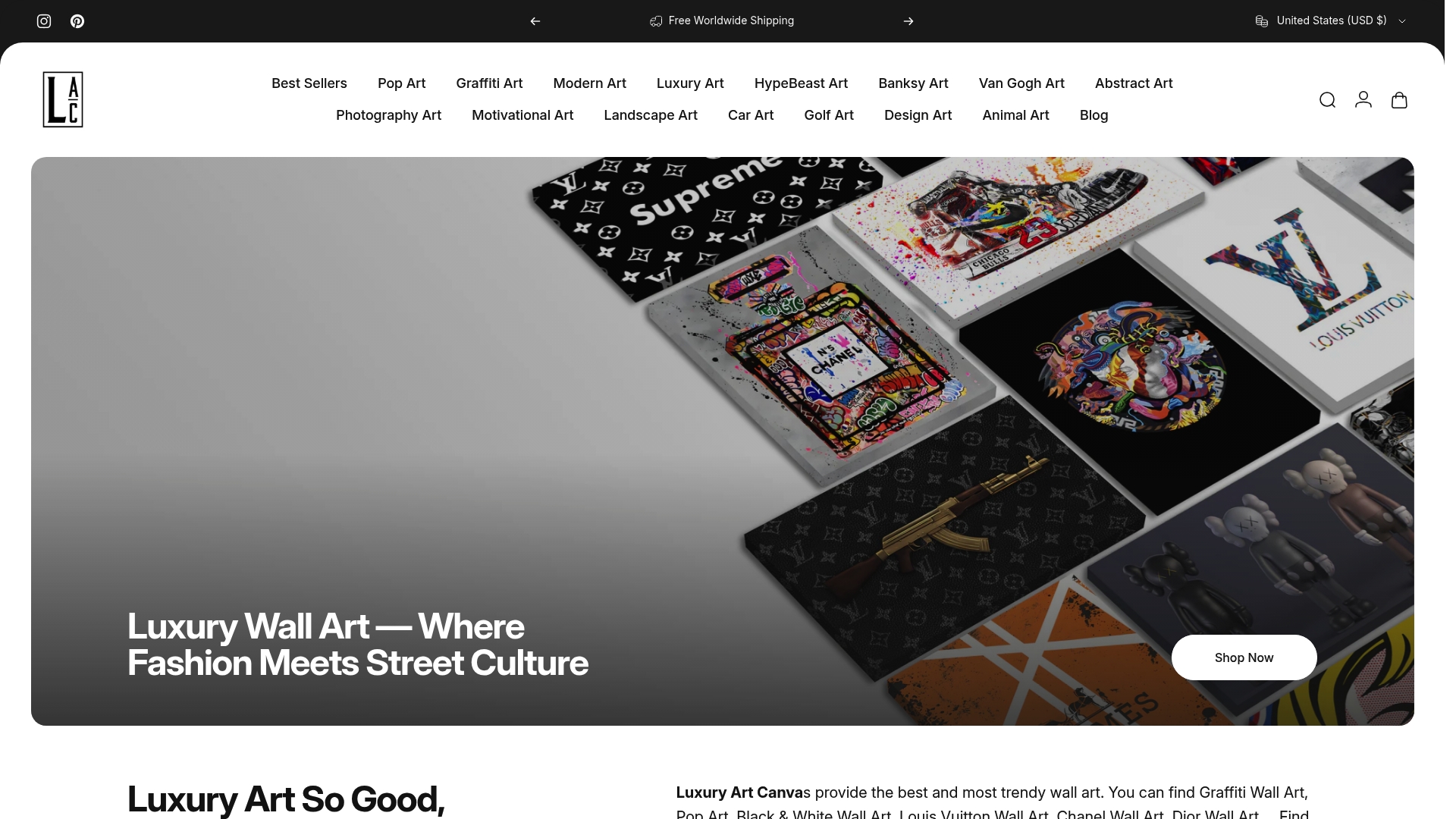
For lifestyle and boutique properties, the large-format graffiti canvas range delivers the bold, photogenic arrival-wall presence that drives guest social shares. Pop-art and high-fashion motifs suit luxury-tier lobbies where brand alignment matters as much as visual impact. Bulk orders are supported with coordinated production runs to keep color profiles consistent across a multi-piece installation.
Browse the full catalog, submit your wall dimensions, and request a mockup at Luxuryartcanvas.
Sources
- 10 Luxurious Lobby Interior Design Ideas for Hotels & Offices
- 20 Lobby Design Ideas That Don’t Suck (And Actually Make People Want to Stay)
- How Corporate Offices Use Canvas Printing to Elevate Workplace Design - Mega Format
- Lobby Interior Design: 6 Essential Strategies to Create a Welcoming First Impression - Stellaresidence
Recommended
- Wall Art in Client-Facing Spaces: A 2026 Design Guide – Luxury Art Canvas
- Why Street Art Influences Luxury Interiors: A Designer’s Guide – Luxury Art Canvas
- Romantic Wall Art That Reads Luxury: A 2026 Buyer’s Guide – Luxury Art Canvas
- Wall Art Arrangement Ideas by Room: The Pro Hang Guide – Luxury Art Canvas
UV-Resistant Canvas for Home and Office: A Buyer's Guide