
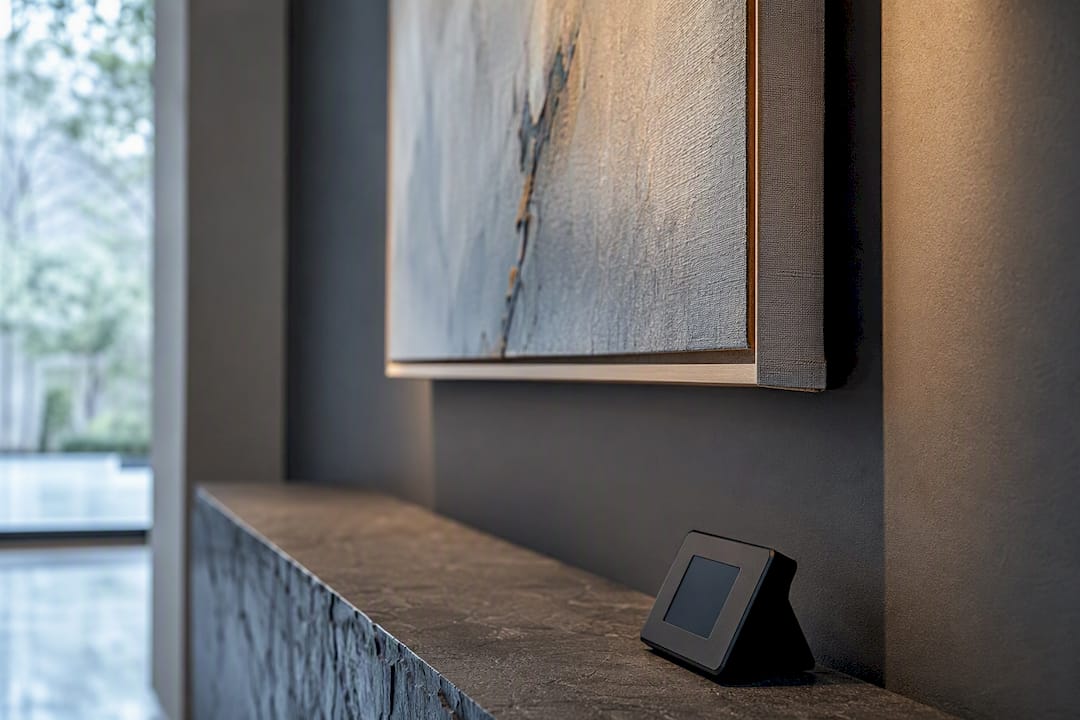
Keep canvas art at a roughly moderate relative humidity range, and treat sudden swings, not the exact number, as the real enemy. High humidity can invite mold and delamination; low humidity can make paint brittle and prone to cracking. Beyond that, placement, rigid backing, moisture buffering, and basic monitoring do most of the protective work.
Table of Contents
- What Humidity Does to Canvas Art at the Material Level
- High Humidity vs. Low Humidity: Where the Real Damage Thresholds Are
- How to Spot Early Signs of Humidity Damage
- Practical Ways to Protect Canvas Art From Humidity at Home
- Displaying Canvas Art in Bathrooms and Other Humid Rooms
- Monitoring Humidity: Tools and a Simple Maintenance Routine
- What to Look for in a Ready-to-Hang Canvas
- An Editorial Take: Why “Perfect Humidity” Is the Wrong Goal
- Find Durable, Ready-to-Hang Canvas Art Built for Real Homes
- Sources
What Humidity Does to Canvas Art at the Material Level
Canvas fabric, the glue-based sizing beneath the paint, and wooden stretcher bars are all hygroscopic. They absorb and release moisture as the air around them changes, and each one swells or shrinks at a different rate. That mismatch is where damage starts. The Museum Conservation Institute explains that this dimensional push and pull transfers stress across the paint layer and its support, which over time shows up as warping, cracking, or delamination.
A single humid afternoon rarely does the damage. It’s the repetition that wears a canvas down:
- The canvas expands and contracts slightly with every RH shift, tightening or loosening across the stretcher.
- The paint film, being less flexible than the fabric underneath it, can’t always keep pace with that movement.
- Repeated cycles fatigue the paint and sizing the way bending a paperclip back and forth eventually snaps it.
- Wooden stretcher bars swell in humid air and can bow, throwing the whole canvas out of tension.
Research on the mechanical response of canvas paintings backs this up directly: it’s the cycling, not just the absolute humidity level, that accumulates into visible damage.
High Humidity vs. Low Humidity: Where the Real Damage Thresholds Are
Institutional guidance rarely settles on one perfect number, and for good reason. Building types, climates, and heating systems vary too much for a single figure to apply everywhere. The Canadian Conservation Institute frames the target as a stable band of roughly 40–55% RH for home display, rather than a fixed target to hit exactly.
Where the risk actually spikes: sustained RH above 65 to 70% is where conservators start seeing real trouble. That’s the range where mold gets a foothold and the animal-glue sizing behind older canvases begins to soften, according to a technical bulletin on moisture sorbents.
On the dry end, canvases held below roughly 35 to 40% RH for extended periods lose flexibility. Paint that once moved with the fabric turns brittle, and that’s when hairline cracks start to appear at the tacking margins and high-stress areas.
- Above 65 to 70% RH: mold risk climbs sharply, adhesives weaken, delamination becomes likely.
- Below 35 to 40% RH: paint stiffens, cracking risk increases, especially at corners and edges.
- Swings of more than 15% within a day or two: treat as a signal to act, regardless of the absolute number.
That last point matters more than either extreme. A room that drifts from 40% to 58% overnight is doing more damage than one that sits steadily at 60%.
How to Spot Early Signs of Humidity Damage
Catching trouble early is almost always cheaper and easier than fixing it later. Walk your canvas art through this quick check every few months, and definitely after a heat wave, a flood, or a long vacation with the AC off.
- Step back and look at the surface at an angle. Raking light reveals ripples or a slight bulge in the canvas that’s invisible head on.
- Check for sagging at the bottom edge. A canvas that’s lost tension often droops slightly within the frame or stretcher bars.
- Look for discoloration or dark spotting, particularly near the edges and in corners where air circulates least.
- Inspect the front for a hazy white bloom on the paint surface, a common sign of moisture interacting with varnish.
- Turn the piece around and check the back of the canvas and the stretcher bars for staining, warping, or a musty smell.
- Gently press a clean fingertip on an inconspicuous edge to feel for flaking or tackiness (never rub the painted surface itself).
Surface bloom, active mold spots, or paint that’s actively lifting call for a conservator, not a DIY fix. Minor rippling or a slightly loose canvas, caught early, often responds to correcting the room’s humidity before it becomes structural.
Pro Tip: Photograph your canvas art every season from the same angle and distance. Side-by-side comparisons catch subtle rippling or discoloration your memory alone will miss.
Practical Ways to Protect Canvas Art From Humidity at Home
Museum-grade climate control isn’t realistic for most households, and it doesn’t need to be. A handful of low-cost adjustments cover most of the risk.
Placement matters more than any gadget you’ll buy. Exterior walls run colder and more humid than interior ones, especially in winter, and that temperature gap encourages condensation right behind the canvas. Skip walls above radiators, fireplaces, or vents, and keep pieces out of direct sunlight, which accelerates both drying and fading. The Museum Conservation Institute points to placement as one of the first decisions that determines a painting’s long-term stability, and interior walls in climate-controlled rooms are consistently the safer bet.
- Favor interior walls over exterior ones, particularly in older homes with less insulation.
- Leave a small air gap between the canvas and the wall rather than mounting it flush.
- Avoid hallways or entryways with frequent temperature swings from open doors.
Backing and framing choices do real work, too. A rigid, non-hygroscopic back plate, corrugated plastic sheeting is a common and affordable choice, mounted with small spacers, creates a stable pocket of air behind the canvas. That microclimate resists the room’s broader humidity swings, a technique supported by research on back protection and microclimate stability. For higher-value or vintage pieces, sealed glazing and framing add another layer between the art and the room.
Moisture buffering fills the gaps placement can’t fix. Silica gel packets placed inside a sealed frame or display box absorb small humidity spikes before they reach the canvas. They need to be properly conditioned to a target RH, not just tossed in dry, according to guidance on sorbent use.
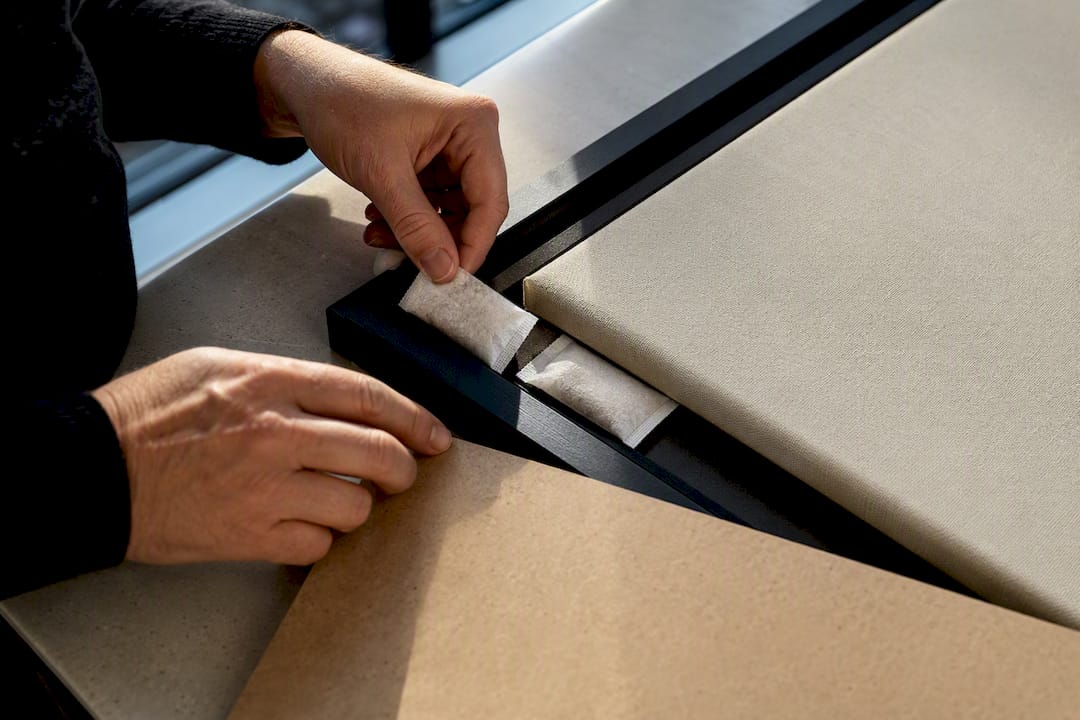
If you’re running a portable dehumidifier or humidifier in the room, keep it running steadily rather than in bursts, and never place a humidifier’s mist output close enough to leave condensation on nearby surfaces. When storing canvases, keep them vertical, sandwiched between rigid boards, and away from damp basements or hot attics where RH extremes are worst.
Pro Tip: Choosing a spot with good ambient lighting usually means it’s also away from harsh sun and heat vents, so the two goals often line up naturally.
Displaying Canvas Art in Bathrooms and Other Humid Rooms
Bathrooms are the question everyone eventually asks, and the honest answer is: it depends on your ventilation, not just the room label.
- Check your exhaust fan’s actual performance. If humidity lingers visibly on mirrors for more than 10 to 15 minutes after a shower, that room isn’t a safe default for canvas art.
- Keep artwork away from the direct splash zone, meaning several feet from the shower or tub, not just off the counter.
- If you hang it anyway, seal it properly. Use sealed glazing, an impermeable backing board, and extra silica gel packets inside the frame cavity, and run the exhaust fan continuously or on a humidity-triggered timer.
- Consider the room’s ceiling and wall condition. Visible peeling paint or mildew on the walls is a sign the room itself runs too humid for an unprotected canvas.
For genuinely high-risk rooms, a sealed, highly finished print with minimal exposed porous material is the safer choice over an open, unglazed canvas.
Monitoring Humidity: Tools and a Simple Maintenance Routine
A basic digital hygrometer with data logging, accurate to within about 2 to 3% RH, does more to protect your art than any single mitigation step, because it tells you when to act instead of guessing.
- Look for logging history, low battery alerts, and a display that updates at least every few minutes.
- Act when RH holds above 65% for more than a day or two, or swings more than 15% within 24 to 48 hours.
- Check quarterly at minimum, and always after storms, heat waves, or moving art between rooms.
- Inspect the back of frames and stretcher bars seasonally, since damage often starts where you can’t see it.
If a canvas gets wet or shows active mold, stop airflow in that room immediately to avoid spreading spores, and contact a conservator before attempting any cleaning yourself, following the emergency guidance in the National Park Service’s paintings care appendix.
What to Look for in a Ready-to-Hang Canvas
Construction choices made before a canvas ever reaches your wall affect how well it handles humidity. Some canvas art providers build their pieces with archival materials and ready-to-hang stretcher construction, which can offer a stable starting point rather than a piece that’s already prone to warping.
When ordering, it’s worth asking about stretcher rigidity, finish sealing, and whether backing or glazing options are available for the room you have in mind. A well-built stretcher resists the bowing that loose or thin wood allows, and a properly sealed finish adds a small buffer against surface moisture. Pair that foundation with the placement and backing habits covered above, and the artwork has a real chance at staying flat and vibrant for years.
An Editorial Take: Why “Perfect Humidity” Is the Wrong Goal
Most advice on canvas care fixates on hitting an exact number, and that’s the wrong target. The conservation research is consistent on this point: a room that holds steady at 50% beats one that bounces between 35% and 65%, even though the second room might average out to the same “acceptable” number on paper.
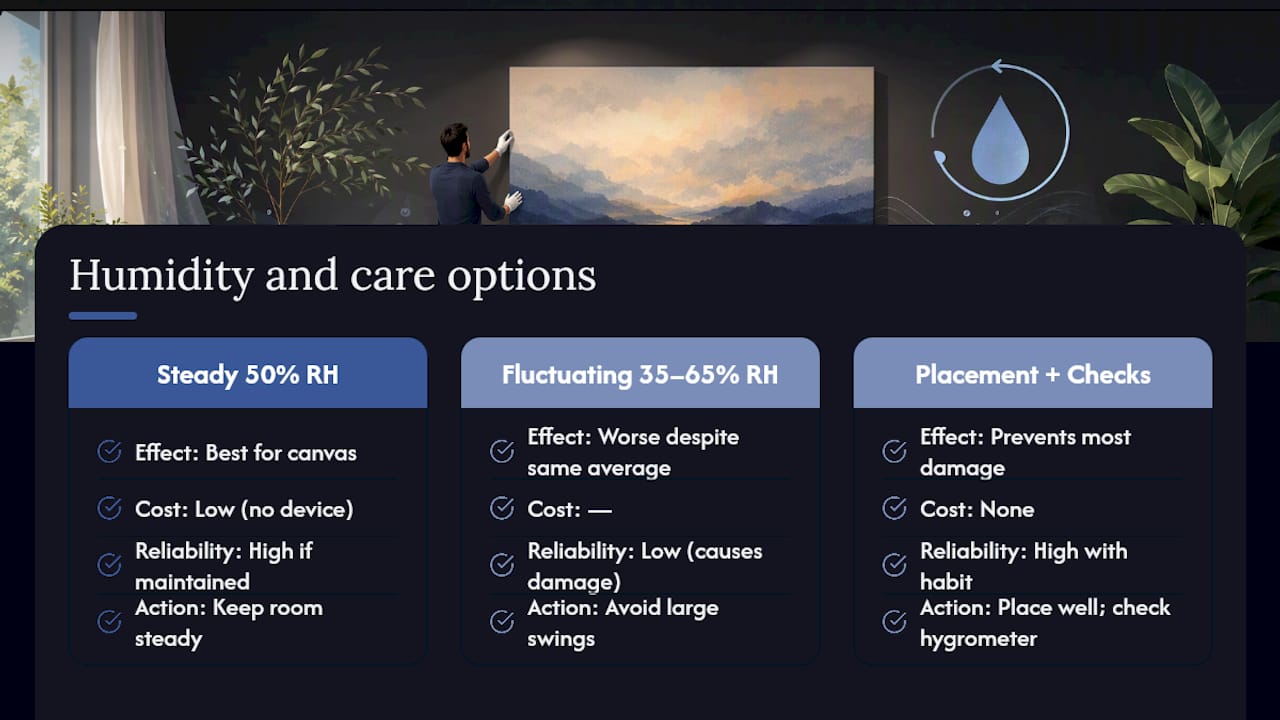
The conventional wisdom oversells fragility, too. Canvas art isn’t as delicate as most buyers assume, and it isn’t so tough that placement doesn’t matter either. The truth sits in the middle: a rigid back board, a sensible spot on an interior wall, and a habit of checking your hygrometer occasionally will outperform anyone who buys a humidifier and never looks at it again.
If you’re prioritizing one thing, prioritize placement first. It costs nothing, and it’s the decision that prevents the most damage before it ever starts.
— James
Find Durable, Ready-to-Hang Canvas Art Built for Real Homes
A canvas is only as good as the materials behind the image, and that’s where a lot of budget wall art quietly fails once humidity gets involved. High-quality canvas art is often built on rigid stretcher bars with archival inks, supporting better preservation habits.

Whether you’re drawn to bold graffiti pieces, high-fashion motifs, or minimalist statements, the construction underneath stays consistent across the catalog. If you’re furnishing a space where humidity swings are a real concern, take a look at the Louis Vuitton wall art collection or browse minimalist prints for a cleaner look that pairs easily with sealed framing. Explore the full catalog at Luxuryartcanvas and find a piece built to hold up in the room you actually have, not just the one on a spec sheet.
Sources
- Caring for Your Paintings | Museum Conservation Institute
- Environmental display guidelines for paintings (Canadian Conservation Institute)
- TB33: Use of moisture sorbents and humidity control (Technical Bulletin)
- Micro climates and moisture induced damage to paintings — Marion Mecklenburg / Conservation Physics
One Statement Wall + Selfie Zone: Salon Wall Art That Gets Photos
4 Office Wall Art Ideas for Leased Spaces, Room by Room