A limited edition is a fixed, numbered run of prints that stops forever once it sells out. An open edition has no cap and can be reproduced as long as there’s demand. Choose limited if you want scarcity and resale potential; choose open if you want a specific image, at a lower price, without waiting on secondary markets.
TL;DR:
- Limited editions have a fixed number of prints announced before production, and no additional prints should be made once that run is sold out, ensuring scarcity.
- Edition numbers, accompanied by signatures and provenance, are essential for verifying authenticity, with added notes like artist’s proofs and hors commerce reflecting special prints.
- Changing edition sizes post-release damages trust and signals potential undervaluation, undermining long-term credibility and resale confidence.
- Most high-volume canvas reproductions function as open editions, prioritizing availability and consistent price over collectibility or scarcity.
Table of Contents
- Limited Edition vs Open Edition: Definitions and Documentation
- How Edition Size Shapes Value and Resale Potential
- Authentication: Signatures, Certificates, and Red Flags
- A Practical Buying Checklist for Either Edition Type
- Where Luxury Art Canvas Fits Into the Picture
- Why Collectors Buy Limited vs Open Editions
- How Edition Practices Evolved Over Time
- What Edition Choices Signal About an Artist
- Spotting Counterfeits and Verifying Authenticity
- Choosing With Your Eyes Open
- Find Your Next Piece at Luxury Art Canvas
- Sources
- FAQ
Limited Edition vs Open Edition: Definitions and Documentation
The core difference comes down to a number that either exists or doesn’t. A limited edition has a fixed print count set before production begins, and once that run is complete, no more prints should ever be made from it. An open edition carries no predetermined ceiling, so the artist or publisher can keep printing copies for as long as they choose to offer the piece.
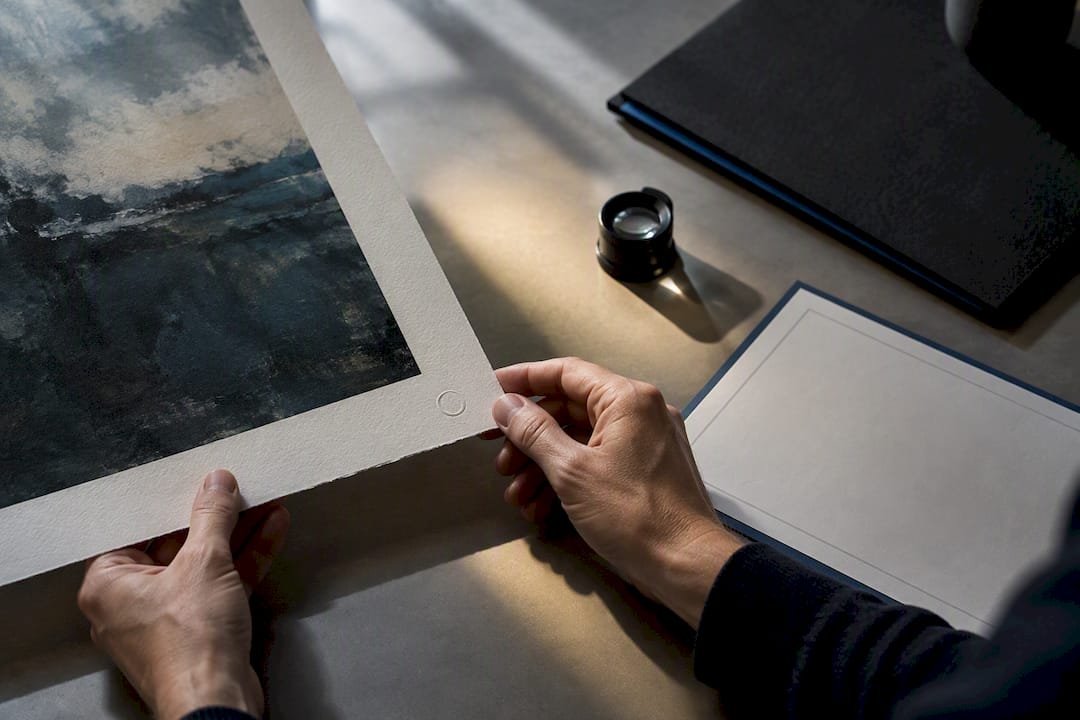
You’ll usually see a limited edition print marked with two numbers separated by a slash, like 14/100. The second number is the total edition size; the first is that specific print’s position in the run. It doesn’t indicate quality or printing order, just an assigned identifier. Numbering, alongside signatures and provenance records, is how collectors verify an edition’s authenticity and a print’s place within it.
Beyond the standard numbered run, a few edition variants show up regularly on certificates and print margins:
- Artist’s Proof (AP): Printed for the artist’s own records, typically excluded from the main edition count but often just as official, and sometimes more sought after by collectors.
- Hors Commerce (HC): French for “not for trade,” these are extra prints meant for exhibitions or promotional use rather than sale.
- Printer’s Proof (PP): Retained by the printing studio as a quality reference copy.
- Trial Proof (TP): An early test print used to check color and registration before the final run begins.
Medium matters here too. A photographic edition might be capped tightly because the image was captured once and printed on demand from a digital file. A hand-pulled printmaking edition (etching, lithograph, screen print) is often limited by the physical wear on the plate or screen itself. Canvas reproductions of an existing painting sit differently again: the “original” already exists, so the print run is a separate commercial decision rather than a technical limit.
How Edition Size Shapes Value and Resale Potential
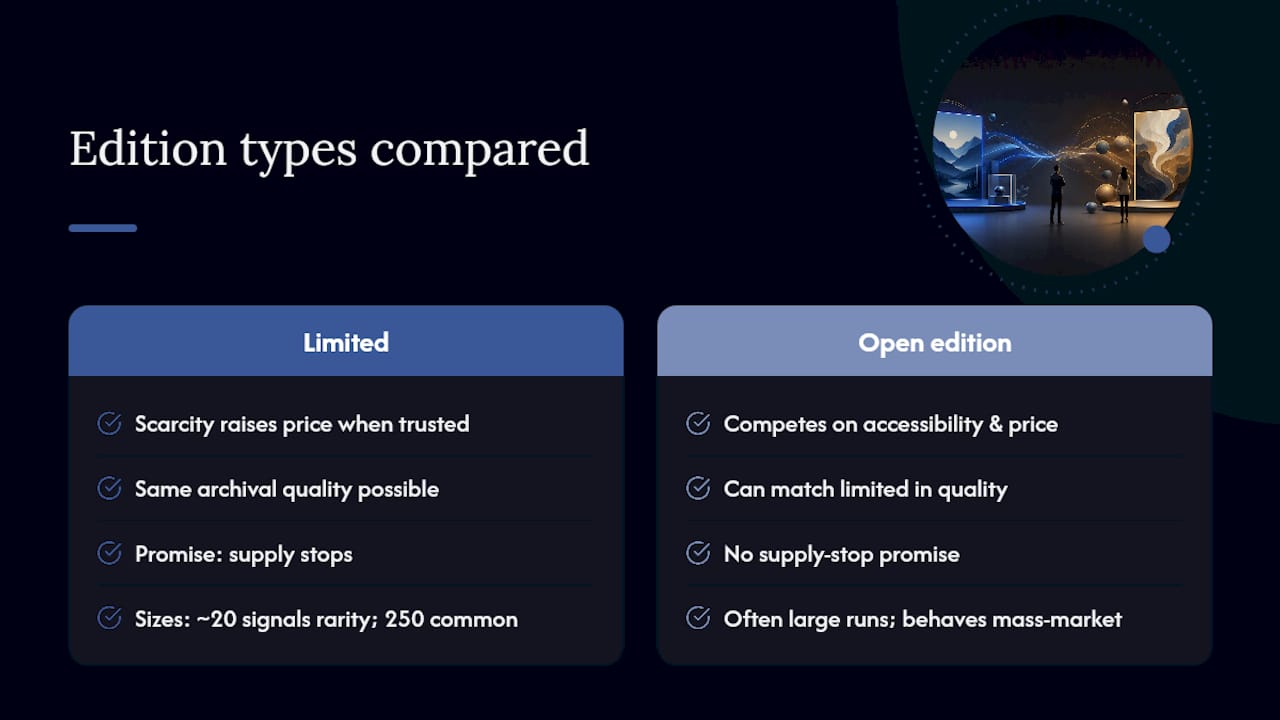
Scarcity creates upward pressure on price, but only when the market believes the scarcity is real and permanent. A fixed, small run gives collectors confidence that demand can’t be diluted by a publisher simply printing more later. That confidence is fragile: some artists and publishers have quietly increased edition sizes after release, and the practice is widely viewed as a breach of collector trust that can follow an artist’s reputation for years.
Open editions play a different game entirely. Instead of betting on appreciation, they compete on accessibility and price. A well-produced open edition print can use the same archival materials and printing standards as a limited run, which means quality is not automatically the deciding factor between the two categories. What you’re really paying for in a limited edition is the promise that the supply stops.
Statistic to know: Artwork Archive notes that edition sizes suited for collectibility commonly fall within a moderate range, depending on the artist’s market strategy and how exclusive they want the run to feel… This depends on the artist’s market strategy and how exclusive they want the run to feel. A 20-piece edition signals rarity and tends to sell out fast among serious collectors. A very large run still counts as “limited” on paper, but it behaves more like a mass-market product once resold.
Edition type is only one input, though, and not the most important one. Sotheby’s guidance on multiples stresses that documentation and provenance are the primary value signals, not the raw print count. An artist with a strong exhibition history and consistent gallery representation will often see stronger resale demand on a 250-piece edition than an unknown name’s 20-piece run. Condition counts just as much: a foxed, faded, or poorly stored print loses value regardless of how exclusive the edition was on release day.
Authentication: Signatures, Certificates, and Red Flags
A credible certificate of authenticity should name the artist, the title, the medium, the exact edition size, the print’s number within that edition, and the publisher or printing studio responsible for producing it. It should also carry a signature, either from the artist or an authorized representative of the publisher, matching the one on the print itself.
Signatures come in a few acceptable forms, and knowing the difference protects you from overpaying for something you assumed was hand-signed:
- Hand-signed in pencil or ink directly by the artist, usually in the margin below the image. This commands the highest premium.
- Stamped signature, applied by the studio with the artist’s authorization, common on posthumous editions or very large runs.
- Seller or publisher authorization, where the certificate itself carries the signing authority rather than the print. This is standard for reproduction canvases and should be disclosed clearly, not implied.
A trustworthy seller puts the edition size in writing on the certificate, not just on a website listing that can be edited later. If the printed number and the stated edition size don’t match what’s on the invoice, that’s worth questioning before you pay.
Pro Tip: Ask the seller directly whether the edition size has ever changed since the original release. A confident “no, and here’s the original documentation” is a good sign. Hesitation or a vague answer is not.
Watch for these warning signs before buying:
- No stated edition size anywhere in the listing or paperwork.
- A certificate that arrives separately from the print with no matching serial number.
- An edition that mysteriously “expanded” from an earlier catalog listing.
- Missing provenance for a piece claimed to be decades old.
Edition type alone doesn’t guarantee value, and neither does a certificate by itself: the paperwork has to match what’s physically in front of you.
A Practical Buying Checklist for Either Edition Type
Start with intent, not aesthetics. If you’re buying for potential appreciation, a limited edition with solid documentation and a reputable artist matters more than the image itself. If you’re buying to fill a specific wall in a specific room, an open edition print that fits your budget and size needs is the more sensible route, and there’s nothing lesser about that choice.
Tiered pricing is standard practice in limited runs. Earlier buyers in a print run often pay less, while the final numbers in the edition get sold at a premium to reflect the shrinking remaining supply. Knowing this before you buy helps you judge whether a listed price reflects genuine scarcity or just markup.
Before handing over payment, ask the seller these questions directly:
- What is the total edition size, and is it stated in writing anywhere besides the listing?
- Does the certificate of authenticity match the printed number on the piece?
- What printing method and materials were used, and are they archival grade?
- What’s the return policy if the piece arrives damaged or doesn’t match the description?
If you’re buying more than one print for a matched set, ask whether the seller can hold consecutive or close numbers, since collectors sometimes pay attention to sequential numbering when displaying a series together. For framing, decide up front whether you want the frame to reveal the full margin (including the signature and edition number) or crop tighter for a cleaner look. Both are common; just decide before you order rather than after.
Where Luxury Art Canvas Fits Into the Picture
A provider offers ready-to-hang canvas art, with a large selection of designs spanning pop art, graffiti, and fashion-inspired pieces, supported by customer reviews. The materials and print quality aim for durability, suitable for décor or collection purposes.
Most of the canvases sold by this provider function closer to open edition territory: produced on demand rather than capped at a fixed number. That’s a deliberate fit for buyers who want a specific design, at a consistent price, without hunting a secondary market for a sold-out run. If your priority is filling a space with bold, high-quality work rather than chasing appreciation, that model serves you well. Buyers weighing collectibility against décor should look at each product page for production details before deciding.
Why Collectors Buy Limited vs Open Editions
The motivation behind a purchase usually reveals which edition type actually fits. Someone building a long-term collection, tracking an emerging artist, or hoping a piece appreciates in value gravitates toward limited runs, where the fixed count and documentation create a paper trail that supports resale later. That buyer treats the certificate almost as seriously as the print.
Someone decorating a home, office, or rental unit is usually solving a different problem: they want a specific image, in a specific size, at a price that doesn’t require negotiating with a private seller. Open editions serve that need directly, and there’s no shame in prioritizing wall impact over investment upside. A lot of collectors actually do both: a handful of limited pieces they’ve researched carefully, surrounded by open edition or decorative canvas work that fills out the rest of the room without the pressure of provenance paperwork.
Gift buying tends to skew open edition too, since certificates and edition numbers rarely matter to the recipient the way the image itself does. Corporate and hospitality buyers, outfitting multiple rooms or locations with a consistent look, almost always choose open editions or licensed reproductions, since sourcing dozens of matched limited prints is neither practical nor necessary for that use case.
How Edition Practices Evolved Over Time
Numbered editions became standard practice in printmaking well before photography or digital printing existed, when artists worked directly on plates, stones, or screens that physically degraded with each pull. Limiting the run wasn’t a marketing decision back then; it was a technical reality; a copper plate could only produce so many clean impressions before the image started to blur.
Photography complicated that logic considerably. A negative or digital file doesn’t wear out the way a printing plate does, so photographic editions became a market convention rather than a physical necessity. Galleries and publishers started capping photographic runs deliberately to preserve the same scarcity model that printmaking had built organically.
Canvas reproduction added another layer entirely. Once a painting could be scanned and reproduced at high fidelity, publishers had a choice: treat the reproduction like a traditional print edition, or sell it as an open, ongoing product. Most decorative canvas art today follows the second path, which is why terms like “limited edition” carry less automatic weight on a mass-market canvas listing than they do on a gallery print with a documented plate history.
What Edition Choices Signal About an Artist
An artist’s edition strategy sends a message to the market whether they intend it to or not. A tightly capped run, priced high and sold through a gallery, signals that the artist is positioning themselves toward serious collectors and long-term value building. A large or open run signals a broader, more accessible strategy aimed at name recognition and volume rather than exclusivity.
Neither approach is inherently better, but mixing them carelessly can backfire. An artist known for scarce, high-value limited runs who suddenly floods the market with an open edition version of a signature image risks diluting the perceived value of everything they’ve sold before. Collectors talk, and a reputation for consistent, honest edition practices tends to support pricing across an artist’s entire body of work, not just the piece in question.
This is part of why altering a stated edition size after release does lasting damage: it doesn’t just affect the collectors of that one print. It signals to the broader market that the artist’s numbers can’t be trusted going forward, which affects resale confidence on every edition they’ve ever released.
Spotting Counterfeits and Verifying Authenticity
Counterfeiting in the edition market usually targets the paperwork rather than the print itself, since a certificate is easier to forge convincingly than a signature under close inspection. Cross-check the edition number on the print against the number on the certificate, and confirm the total edition size matches what the artist or publisher has stated publicly, on their own site or through a gallery that represents them.
For higher-value limited pieces, ask whether the publisher maintains a registry or ledger of who owns which number in the run. Reputable print studios often keep this internally and will confirm a specific number’s ownership history on request, which adds a layer of provenance beyond the certificate alone.
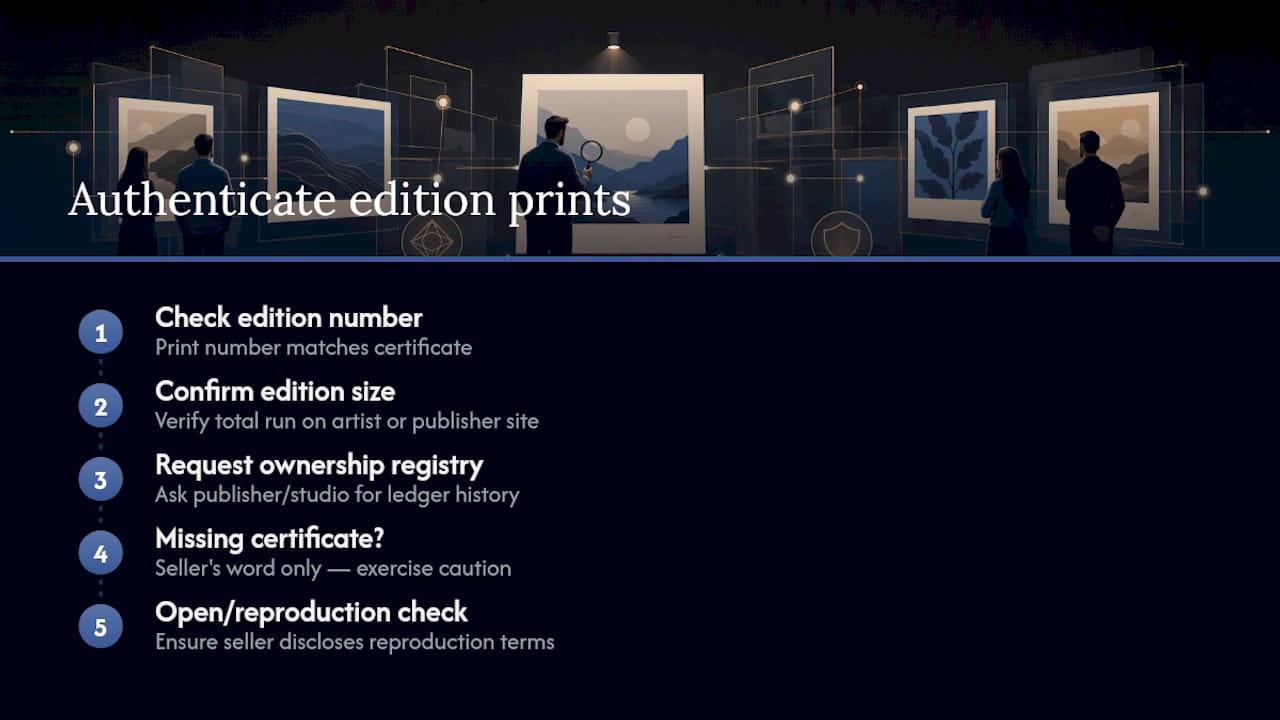
Be especially cautious with secondhand limited editions sold without their original certificate. A missing certificate doesn’t automatically mean the piece is fake, but it does mean you’re relying entirely on the seller’s word for edition size and signature authenticity. For open edition and reproduction canvas purchases, authenticity concerns shift: the question isn’t whether the piece is an unauthorized copy of a limited run, but whether the seller is transparent about the piece being a reproduction rather than implying false scarcity. A seller who markets an open, reproducible design using limited-edition language without disclosing the actual print terms is the clearest red flag in this category.
Choosing With Your Eyes Open
Buy what moves you first. Understanding edition mechanics protects you from bad deals, but manufactured scarcity has burned enough collectors that skepticism toward vague edition claims is earned, not paranoid.
— James
Find Your Next Piece at Luxury Art Canvas
This provider offers a third option between chasing sold-out limited runs and settling for generic mass-market decor: a large selection of made-in-the-USA designs available without waiting lists or secondary-market markups.
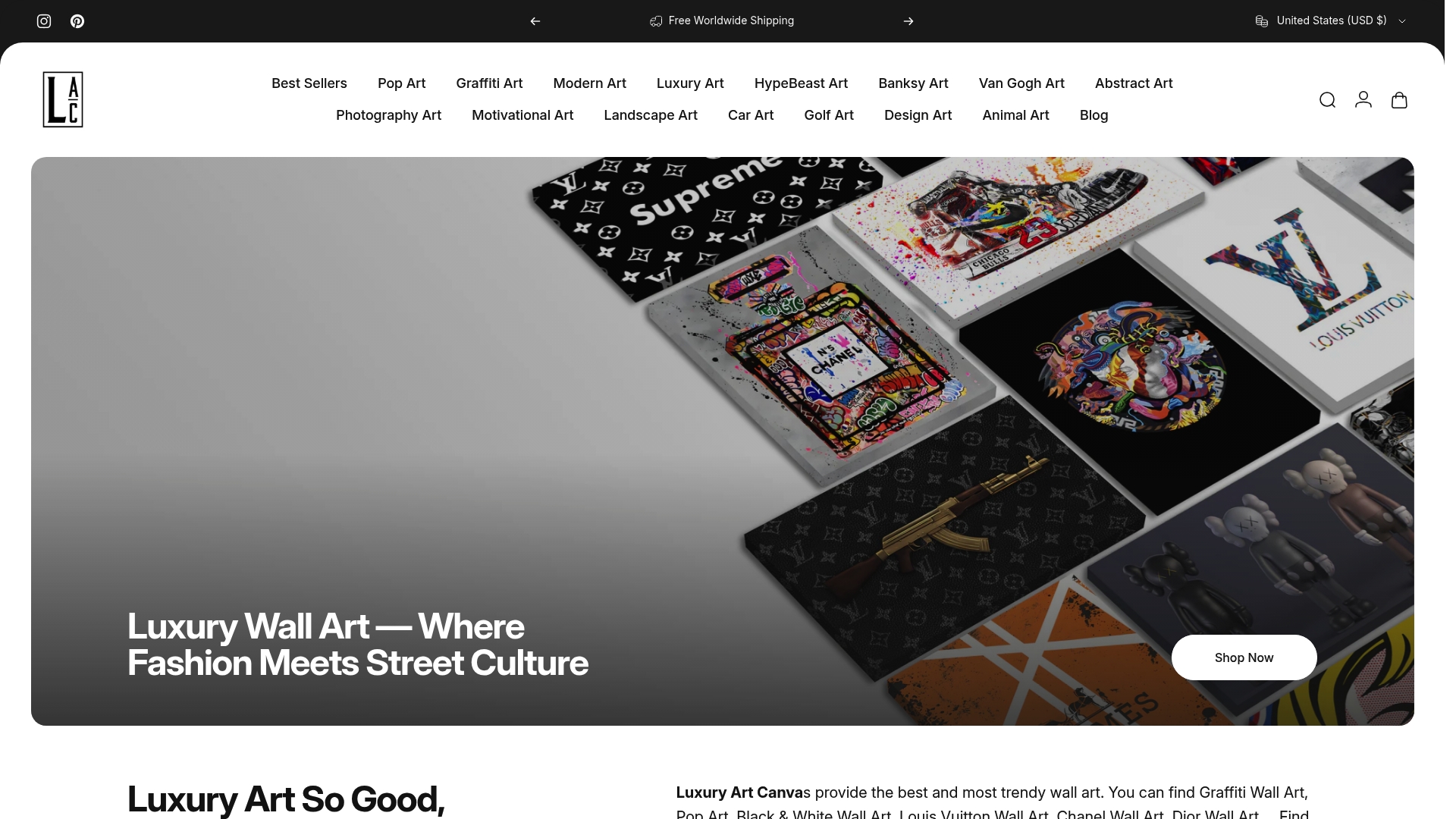
If bold, statement-making work is what you’re after, the Pop Art Canvas Prints collection covers everything from graphic color blocks to pop culture icons, while the Graffiti Wall Art & Street Art Canvas line brings raw, street-level energy into a living room or office without needing provenance paperwork to enjoy it. Every canvas ships ready to hang, so there’s no framing decision to make and no certificate to track down before it goes on your wall. Browse the current designs and check production details on each product page before you order, and pick the piece that fits your space today rather than waiting on an edition that might never come back in stock.
Sources
For deeper research beyond this guide, Artwork Archive’s breakdown of edition practices covers numbering and edition-size ethics in detail. Sotheby’s guide to multiples explains proofs and provenance from an auction-house perspective, Avant Arte’s glossary defines open edition terminology clearly, and Artelino’s explainer walks through value considerations beyond edition size alone.
- 9 Things to Know About Art Editions | Artwork Archive
- What is an Open Edition? | A guide to art terminology
- Prints, Photographs, Sculptures, and Multiples: Understanding Edition Types | Sotheby’s
- Limited Edition Prints Explained: Open Editions, Proofs, and Value
FAQ
Is It Worth Buying Limited Edition Prints?
It depends on your goal. A limited edition with solid documentation and a reputable artist can hold or grow in value over time, but edition type alone never guarantees a return; condition, provenance, and the artist’s market standing matter just as much.
What Is the 70/30 Rule in Art?
This isn’t a standard, widely documented edition or pricing rule in the art market, and definitions of it vary depending on the source. Rather than rely on an unofficial percentage split, focus on verified edition size, signed documentation, and provenance when judging a print’s value.
What Are the Different Types of Limited Editions?
Beyond the standard numbered run, you’ll commonly see artist’s proofs (AP), hors commerce (HC) prints not intended for sale, printer’s proofs (PP) kept by the studio, and trial proofs (TP) used for testing before the final run. APs are typically excluded from the main edition count but are still official and sometimes more desirable to collectors.
What Are the Rules for Limited Edition Prints?
A legitimate limited edition states its total size in writing before production and never increases that count after the run is complete. Increasing an edition after release is widely viewed as damaging to collector trust and should be treated as a serious red flag if you discover it happened.
Does Luxury Art Canvas Sell Limited Editions?
Luxuryartcanvas focuses on ready-to-hang canvas reproductions spanning many designs, which function closer to an open edition model built for accessibility and consistent availability. Check each product listing for specific production and material details before ordering.
Boutique Closet in an Afternoon: Renter Friendly Closet Wall Art Ideas