
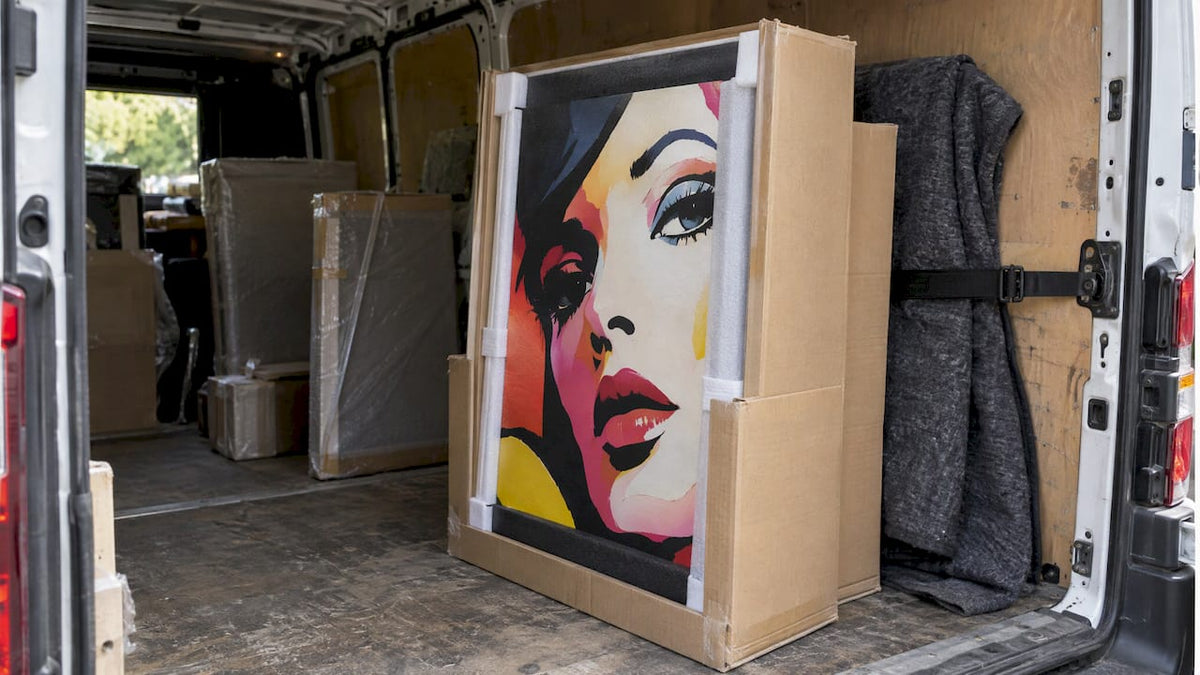
To move canvas art safely, protect the painted face with a smooth, non-stick layer, cushion the corners, add rigid board on both sides, box it snugly and carry it upright. Then keep it away from heat, cold and damp until it hangs on your new wall. Bubble wrap, tape and plastic should never touch the painted surface. The steps below cover what to check first, how to wrap each piece, how to load the truck and where to keep canvases if they have to wait.
Table of Contents
- Check each canvas before you pack
- Gather the right packing materials
- How to wrap a canvas, step by step
- Transporting canvas art on moving day
- Storing canvas art during and after the move
- Our perspective on moving canvas art
- Unpacking and hanging in your new home
- A fresh start for the new walls
- FAQ
Check each canvas before you pack
Start with a quick inspection. The Canadian Conservation Institute advises checking for flaking paint and making sure the frame is stable, with no loose decorative elements, before anyone handles a painting. If either has a problem, a conservator or museum technician should stabilize it first.
That is mostly a concern for older or valuable originals. Its guidance on travel adds that paint with cracks that have lifting or curling edges, paint loss or powdering should not travel until it has been treated. A new, fully cured print on stretched canvas rarely shows any of this, but the check takes a minute and tells you what you started with.
Photograph the condition
Take clear photos of the front, back and corners before wrapping. The same guidance recommends documenting a painting’s condition in notes and images before travel, so that any damage can be traced to when and where it happened. If you hire movers or file an insurance claim, those photos are your baseline.
Take off the hardware
Remove wires, hooks and other hanging devices before storage or long transport. The National Park Service says these can pierce canvas and scratch varnished surfaces and frames. Put the hardware in a labeled bag and tape the bag to the back of the stretcher bars or to the outside of the box, never the canvas face.
Gather the right packing materials
You do not need specialist crates for most decor canvases. You need a short list:
- Acid-free, unbuffered tissue paper or glassine for the first layer
- Corner protectors, or folded cardboard or foam corners
- Bubble wrap or foam sheets
- Two sheets of stiff cardboard or foam board, larger than the canvas
- Picture boxes or mirror boxes sized close to the piece
- Packing tape and a marker
MovingPlace explains why the first layer matters: anything pressed against the surface can leave an impression, transfer residue or stick to the paint. Its advice for dry, cured canvases is acid-free, unbuffered tissue as the first-contact layer.
Glassine works the same way. One moving guide describes it as smooth and slightly waxy, and it does not stick to varnish, which is why framers and galleries use it.

One detail from conservators is easy to miss. Cardboard absorbs and releases moisture, so the CCI recommends keeping it in the same environment as the painting for at least one day before wrapping. Buy your boxes a few days ahead and leave them in the room where you will pack.
How to wrap a canvas, step by step
- Lay it face up on a clean, flat surface. Wipe your hands, or wear clean cotton gloves, so nothing transfers to the surface.
- Cover the face. Place tissue or glassine over the whole front. For canvas with no glass, STI Moving & Storage suggests a glassine or clean plastic sheet over the front, secured to the back of the stretcher bars. Tape goes on the back or the bars only, never on the canvas.
- Protect the corners first. Jacksons Moving notes that corners are the most fragile part of a stretched canvas, and that nothing else should touch the piece until they are cushioned.
- Wrap the whole piece. Use bubble wrap or foam with light, even pressure. One packing guide recommends two layers on a large piece and one on a small one, with the bubbles facing out, away from the glassine.
- Add rigid board. Sandwich the wrapped canvas between two sheets of stiff cardboard or foam board cut a few inches larger on every side. This stops pressure points and punctures.
- Box it snugly. Stand the canvas upright in a picture box and fill any gaps with crumpled paper or foam so it cannot slide.
- Label it. Mark the box with the artwork’s name, “Fragile, canvas art” and arrows showing which end is up.
The same sources agree on one rule: never wrap plastic directly against the paint. If you only have plastic, put paper between it and the surface.
Large or heavily textured pieces
For big, thick or impasto works, Chubb’s art advisor guide describes wooden handling frames. They need permanent clips fixed to the back of the piece, with carefully drilled holes and screws short enough not to puncture the canvas. That is a job for an art handler, not a weekend project. For most decor canvases, a well-built box with board on both sides does the work.

Transporting canvas art on moving day
The rule is simple: canvases travel on their edge, never flat. Suddath Moving explains that standing a canvas vertically spreads weight properly and prevents pressure damage, and that it should be strapped or braced so it cannot shift or fall.
A few more habits make a difference:
- Load last, unload first. Jacksons Moving recommends putting paintings among the last items on and the first off, upright against a flat wall of the truck where furniture and boxes cannot crush them.
- Nothing on top. Do not rest boxes, lamps or mattresses against the face or edges of a packed canvas.
- Strap, don’t squeeze. Straps across the frame or box hold the piece to a padded wall. Chubb’s guidance adds that pieces should be strapped snugly to the truck walls and that an inventory list should be prepared for each packed item.
If you are doing a self-move, the vehicle matters. A cargo space with a flat wall and room to stand pieces on edge is what you want, and it helps to know how van pickup and delivery work for renters before you book one for a carload of boxed art.
Heat, cold and humidity in transit
Canvas and wood respond to the air around them. The CCI explains that a well-sealed wrapping lets the wood and linen inside moderate the humidity in the enclosed air space, as long as temperature does not swing widely. If a change of more than a few degrees is expected, it says insulation is needed too.
In practice, that means:
- Do not leave art in a parked truck or car any longer than necessary. Extreme heat, cold and damp are what to avoid.
- Use a planning range of roughly 60–80°F and 40–60% relative humidity, which one fine-art mover suggests for transit. The same source suggests placing a temperature and humidity logger inside the packing environment for valuable pieces.
- If a package arrives cold, wait. MovingPlace advises letting it return to room temperature before opening, so moisture is less likely to condense on the artwork.
For winter moves or long-distance routes, ask your mover whether the truck is climate controlled, and plan to carry the most important pieces in your own car’s cabin instead.
Storing canvas art during and after the move
Sometimes the new walls are not ready. Paint is still drying, or closing dates do not line up. Here is how to keep canvases in good shape in the meantime.
Where to keep them at home
The National Park Service recommends storing paintings at 64–75°F and 40–55% relative humidity, away from attics, basements, exterior walls, vents, water pipes and heavy vibration, and at least four inches off the floor. Public Storage gives similar advice, suggesting a clean, dry indoor area with stable conditions and avoiding garages, sheds, damp basements and vehicle trunks.

A spare bedroom closet on an interior wall usually fits the bill. Stand the pieces upright, separate each one with padding, and keep frames from touching.
Why such narrow ranges? The NPS notes that wood and sizing are especially hygroscopic: wood expands and contracts and sizing makes canvas shrink when dry and swell when damp, which can be damaging once paint becomes brittle. Our own guide to keeping canvas art within a safe humidity range goes deeper on this.
Short-term versus long-term storage
| Situation | What to do |
|---|---|
| A few days in your new home | Leave canvases boxed or wrapped, upright, in a conditioned interior room |
| A few weeks | Same, but unpack the outer wrapping if the room is stable, and cover with a cotton sheet |
| Longer than a few weeks | Consider a climate-controlled unit, which holds a steady temperature and humidity and helps prevent stretching, shrinking and mildew |
Without climate control, MovingPlace suggests silica gel packs or a small dehumidifier nearby, replaced or emptied every few months, with a cotton sheet over the art to keep off dust without trapping humidity.
For long storage, don’t seal canvases tightly in plastic. Public Storage warns that plastic can hold moisture against the artwork. Fit canvases with a rigid backing board too, which the NPS says blocks the reverse of the canvas and protects it from damage.
When you lift a canvas, hold it by both sides of the frame or stretcher, never by the hanging wire.
Our perspective on moving canvas art
We make and ship canvas art for a living, so we think about what happens to a piece after it leaves the studio. Our canvases are crafted in the USA with archival inks and quality materials, and they are ready to hang, which means the same stretched structure you hang is the structure you pack.
Our advice is to treat a move as one more stage in the life of the piece, not an emergency. Photograph it, protect the face, cushion the corners, keep it upright, and give it a stable room at the other end. Those four habits cover nearly every problem we hear about.
The other part is planning. Decide where each canvas will hang before you pack, and label the boxes by room. When the truck is unloaded, the art should go straight to its wall or to a quiet interior room, not into a garage pile. A well-chosen piece deserves a careful move, and with a little care it will look as good on the new wall as it did on the old one.
James
Unpacking and hanging in your new home
Unpack in a clean, dry room. Open the box on the side where the label says “top,” remove the board and wrap slowly, and lift the paper off the surface rather than dragging it. Wait first if the package is cold, as noted above.
Then compare the canvas with your before photos. If you see damage, photograph it right away and contact the mover or your insurer promptly.
When you are ready to hang, we have step-by-step guides for hanging canvas art without damaging your walls, plaster, brick or tile walls and canvas without a frame. If your move has you rethinking empty walls, see our guide to transforming blank walls with canvas art.
A fresh start for the new walls
A move is a natural moment to refresh a room. If you are looking for bold pieces to greet you in the new place, we offer more than 1,000 designs across pop art, graffiti, black and white, motivational and high-fashion styles, all ready to hang.

Browse the Luxury Art collection, explore pop art canvas prints, or start from the Luxury Art Canvas home page to see every style.
FAQ
Should I pack canvas art flat or upright?
Upright, on its edge. Suddath Moving says vertical placement distributes weight properly and prevents pressure damage. Keep it strapped to a padded wall so it cannot slide, and put nothing on top of it.
Can I use bubble wrap directly on a canvas?
Not against the painted surface. Put acid-free tissue or glassine on the face first, then wrap with bubble wrap, bubbles facing out. Tape should only touch the back or the stretcher bars, never the canvas.
How do I store canvas art at home without damaging it?
Choose an interior room with steady conditions, ideally around 64–75°F and 40–55% relative humidity. Stand the canvas upright, off the floor, away from vents, pipes and exterior walls. Avoid attics, basements and garages.
Do I need a climate-controlled storage unit?
For more than a few weeks, it is the safest option according to MovingPlace, because it holds temperature and humidity steady. For short gaps, a conditioned room at home works well.
How to Prevent Canvas Warping and Fix It if It Happens
Fashion Art at Home: How to Bring Runway Style to Your Walls