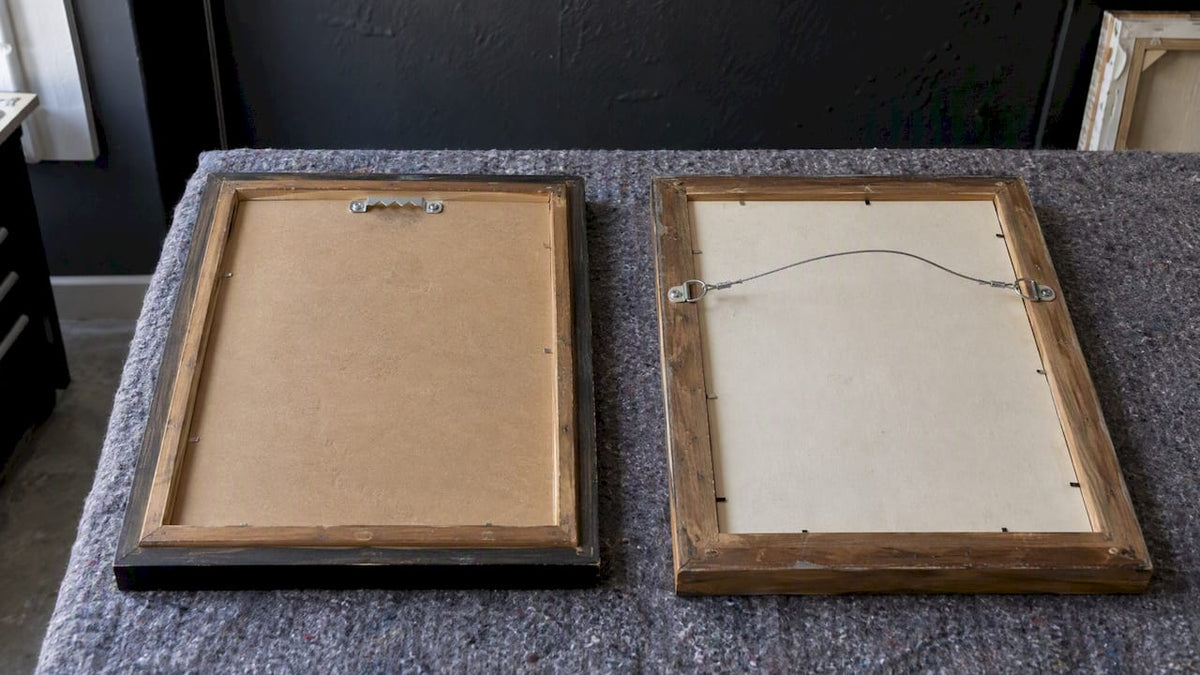
Use a sawtooth hanger for small, lightweight pieces you want sitting flush and tidy on one nail. Use wire (ideally on D-rings, hung on two hooks) for anything larger or heavier, or when you want to fine-tune the level after the piece is up. Sawtooth hangers are quick and sit close to the wall, but they cannot be adjusted sideways once installed. Wire is forgiving, but it pulls the top of the art forward if it is attached too low.
The rest of this guide covers how each option behaves, what weight it can carry, what to pick for a stretched canvas, and how to install it without wrecking the frame or the wall.
TL;DR
- Sawtooth hangers suit small, light pieces. Most are rated under about 25 pounds, and some common frame hangers are rated at only 20.
- Wire lets you level the piece after hanging, but it needs correct placement and two hooks for the best stability.
- D-rings with two wall fasteners give the flattest, most stable hang for medium and large canvases.
- Several sawtooth hangers on one frame do not add up to more capacity. Match the hardware and the wall anchor to the real weight.
- Pick wall fasteners rated for 25% to 50% more than the piece weighs.
Table of Contents
- Sawtooth hanger vs. wire at a glance
- When a sawtooth hanger is the right call
- How much weight a sawtooth hanger can hold
- How wire works, and where it goes wrong
- D-rings: the option most people overlook
- What this means for canvas art
- A quick decision guide
- How to install each option correctly
- Match the wall fastener to the weight
- Wire or cord?
- Our view: hardware is part of the design
- Bring a statement piece home
- FAQ
- Sources
Sawtooth hanger vs. wire at a glance
| Factor | Sawtooth hanger | Picture wire |
|---|---|---|
| Best for | Small, lightweight pieces | Medium to large pieces |
| Wall profile | Sits flush | Leaves a small gap, and the top can tilt forward |
| Leveling | Easy on one hook, but no sideways adjustment after install | Easy to adjust after hanging |
| Hooks needed | One nail or screw | One hook, or two for better stability |
| Install effort | Seconds | A few minutes of measuring and wrapping |
| Typical weakness | Limited weight rating, can shift over time | Tilt, and strain on a single hook |
The split in that table matches what hanging-hardware specialists describe: a sawtooth hanger is easy to level on a single hook but has no lateral adjustment once installed, which is why it works best on small, light frames.
When a sawtooth hanger is the right call
A sawtooth hanger is a small metal bracket with a zigzag edge. You nail or screw it to the top of the frame, and the piece drops onto a single nail or screw in the wall. Its appeal is simplicity and a slim profile.
It makes sense when:
- The piece is small and light, such as a compact print, a mini canvas, or a gallery-wall filler.
- You want the art flat against the wall with no wire showing and no dangling loop.
- You are hanging a lot of small pieces and want fast, repeatable placement.
- The piece will stay put and not be bumped, moved, or rotated.
It makes less sense when the frame is wide, the piece is heavy, or you expect to nudge it level after hanging. Because the hanger sits on one point, a slightly off-center nail means the art is slightly off level, and the only fix is to pull the nail and start again.
There is a practical reason to know the limits, too. Professional venues tend to avoid the format: most galleries do not accept framed art on sawtooth hangers because of hanging-system restrictions and the risk of the piece being knocked off the wall. That does not make sawtooth hangers wrong at home. It does tell you they are a light-duty tool.
How much weight a sawtooth hanger can hold
Ratings vary by hanger, so read the packaging. A few reference points:
- One hanging-hardware supplier says most sawtooth hangers suit wood-frame art under 25 pounds, while special heavy-duty versions are made for much more.
- A home guide from The Spruce puts standard sawtooth frame hangers at a 20-pound maximum.
The safe move is to take the lower number, and to treat the hanger as only one link in the chain. The nail or screw, the frame wood, and the wall behind it all have to hold the load too.
One common mistake: adding a second standard sawtooth hanger does not double the rating. Weight ratings are not cumulative, so two ordinary hangers on one frame do not raise the safe capacity. A second hanger can still help with stability and leveling, but it is not a weight upgrade. If the piece is heavy, change the hardware type instead.
How wire works, and where it goes wrong
Picture wire runs between two anchor points on the back of the frame, and the loop in the middle hangs on a wall hook. Its strength is forgiveness. You can slide the piece left or right on the hook, which makes leveling easy, and you can hang art on different hook types.
The usual problems come from installation, not the wire itself:
- Attached too low. Wire fixed too far down the frame tips the top of the art away from the wall. Hardware specialists point to the forward tilt as wire’s main drawback, and note it is reduced by proper placement and quality hardware.
- Too slack. A long, loose wire lets the piece hang away from the wall and swing. It should be pulled tight enough to keep the art close to the wall, and finished with a proper locking wrap so it cannot slip.
- One hook doing all the work. A single hook can put heavy tension on the wire or cord. A standards guide on hanging by wire and cord notes that this risks breakage, fastener pull-out, or a split or bowed frame, and that two hooks with near-vertical wire reduce those forces.
So wire is not weak. It is simply easy to install badly. Done right, it handles considerably more than a typical sawtooth hanger.
D-rings: the option most people overlook
The real comparison for larger pieces is often not sawtooth against wire but D-rings against both. A D-ring is a small metal loop on a plate that screws into the back of the frame. You can run wire between two of them, or skip the wire completely.
Without wire, you align a D-ring at each upper corner and hang the piece on two independent wall fasteners. That gives two firm contact points that reduce frame swing, keeping art flatter than wire does. A framing-hardware writer also describes D-rings used without wire as a more secure, flush mount when aligned vertically at the upper corners.
Two practical benefits:
- Stability. Two hooks mean the piece resists tilting when someone brushes past or a door slams.
- Load sharing. Each fastener carries half the weight.
The trade-off is leveling. With two fixed hooks you must measure carefully before you install them, since the piece cannot slide to level itself. A small spirit level and a pencil solve that.
What this means for canvas art
Canvas is a different animal from a glass-fronted frame. A stretched canvas is a fabric surface on a wooden stretcher bar, usually lighter than a framed, glazed print of the same size, and the back is open wood. That affects your options.
Small canvases: A sawtooth hanger on the top bar works, provided the piece is well under the hanger’s rating and the wood is solid enough to hold the fastener.
Medium and large canvases: D-rings, or D-rings with wire, are the more dependable pick. Some professional installers go simpler still: the Minneapolis College of Art and Design’s installation guidelines say canvas is normally hung by resting the stretcher’s top bar on two drywall screws, using more screws for very large canvases. That is the same two-point principle as D-rings, just without hardware on the canvas.
Heavy or very large pieces: Think about the wall system as much as the hanger. A rail-and-cable system can support up to 300 pounds and allows repositioning without new wall holes, according to a hanging-systems supplier. For most homes that is overkill, but it is worth knowing about for a large statement piece or an office wall where you rotate artwork.

If you want a full walkthrough for your specific canvas, see our guide on how to hang canvas art, or the one on hanging canvas without damaging your walls if you rent.
A quick decision guide
- Under about 5 pounds, small, flush look wanted: sawtooth hanger on one nail.
- 5 to 20 pounds, medium size: D-rings on two hooks, or wire on D-rings with a properly rated hook.
- Over 20 pounds, or a wide canvas: D-rings on two anchored fasteners, using a stud or rated anchors.
- Piece you will adjust or move often: wire or a rail system.
- Hung in a high-traffic spot (hallway, near a door): two points, not one.
When the weight sits near a limit, step up one category. Hardware is cheap compared with replacing a damaged piece or repairing a wall.
How to install each option correctly
Wire on D-rings
- Measure down about one-third from the top of the frame or stretcher bar on each side and mark the center point for the D-ring, as professional wiring instructions describe.
- Screw the D-rings in with the screw oriented at 90 degrees to the pull of the wire, which resists wire tension better than an eye hook.
- Pre-drill dry wood. Screw eyes can split dry wood when they go in without a pilot hole.
- Thread the wire through both rings and wrap it securely. Leave it taut enough that, when pulled up to its peak, the wire sits roughly halfway between the D-ring and the top of the frame, which is the measurement the same wiring guide gives.
- Hang on a rated hook, ideally two spaced hooks with the wire running near-vertical between them.
Sawtooth hanger
- Find the center of the top bar and mark it.
- Fasten the hanger with small screws rather than the tiny tacks that often come in the pack. A framing-hardware writer notes small #3 screws beat the supplied nails, which can pull out of soft woods like pine.
- Mark the wall at the height you want, check level, and drive the wall fastener in at a slight downward angle so the hanger seats in a notch.
- Check the piece after hanging. If it is off, you will need to move the nail, so mark carefully the first time.
For height, our formula in canvas hanging height shows where to place the center of the piece.
D-rings without wire
- Fix a D-ring at each upper corner, a few inches in from the edge, with the opening facing up.
- Measure the exact distance between the two rings.
- Mark that distance on the wall using a level, and install two fasteners.
- Lower the piece onto both at once.
Match the wall fastener to the weight
The best hanger in the world will not help if the wall fails first. A few rules:
- Hang from a stud when you can. Conservators recommend a wall with a stud to anchor hooks securely, away from heat sources and direct sunlight, in reasonably stable humidity.
- In drywall without a stud, use rated anchors. Some toggle and molly-style hardware is rated up to 100 pounds without a stud.
- Add margin. Home-improvement experts say to choose anchors rated for 25% to 50% more weight than the item you are hanging.
- Match the anchor to the wall material. Using the wrong type for the load can cause significant wall damage or injury.
For a heavy piece on plaster, brick, or concrete, ask a hardware store specialist or a licensed handyman which anchor suits that wall.
Wire or cord?
Some people ask about cord instead of wire. A UK framing supplier’s article argues that low-stretch polyester cord can be stronger than some wire if it is rated for the load and knotted securely. In practice, for canvas, wire on D-rings is the common, easy-to-find setup, and cord is a choice for those who already know how to tie a secure knot. Whichever you pick, rate it for at least the piece’s weight, and use two hooks.
Our view: hardware is part of the design
We sell wall art for people who care how a room looks, and we see the same pattern again and again: a bold piece loses its impact when it hangs crooked, tilts off the wall, or sits on a flimsy hook. A graffiti canvas or a high-fashion piece is meant to command a wall, and it deserves a hang that looks deliberate.
Our pieces are made in the USA on a ready-to-hang basis, so the goal is that you spend your time choosing the right spot, not hunting for parts. Our approach to hanging is simple:
- Treat the hanger as a weight decision first and a style decision second.
- For anything larger than a small accent piece, favor two points of support over one.
- Level before you commit, since sawtooth hangers do not forgive a miss.
- Anchor to a stud when you can, and use rated anchors when you cannot.
- Think about the whole wall, not just one piece. A group of pieces looks best when every hanging height is planned in advance.
A well-hung canvas looks like it belongs to the room, which is exactly what you paid for.
— James
Bring a statement piece home
If you are planning a wall now, browse our pop art canvas prints for color and energy, our graffiti and street art canvas for an urban edge, or our luxury wall art collection for high-fashion pieces. With over 1,000 designs, there is a canvas for a living room, a rental apartment, or an office wall.

Not sure about your wall type? Our guide to hanging canvas on a wall walks through the basics before your order arrives.
FAQ
When should I use a sawtooth hanger?
Use one on small, lightweight frames or canvases when you want a quick, flush hang on a single nail. It works best on pieces that will stay in place. For anything wide, heavy, or likely to be adjusted, choose D-rings or wire.
How much weight will a sawtooth hanger hold?
It depends on the hanger. Many suppliers rate standard ones under about 25 pounds, and some guides list 20 pounds as the maximum. Use the lower figure, check the packaging, and remember that two standard hangers do not double the rating.
Is wire or D-rings better for hanging canvas?
D-rings on two hooks give the most stable, flattest hang, since they reduce swing. Wire on D-rings makes leveling easier after hanging. For a medium or large canvas, either is a better choice than a single sawtooth hanger.
What is the best way to hang a canvas?
For most homes, put two fasteners into a stud or rated anchors, and hang the canvas by D-rings or by resting the top stretcher bar on both. Art-school installation guidelines describe resting the top bar on two screws. Add more points for very large pieces.
Can I use a single hook with wire?
You can, but it puts more strain on the wire, the hook, and the frame. Two hooks with the wire running nearly vertical spread that load. Use one hook only on light pieces, and make sure it is rated well above the piece’s weight.
Sources
- Sawtooth Hangers vs Wire: Which Is Better?
- When to use sawtooth hangers and when to upgrade
- How to Hang a Heavy Picture on Drywall: 4 Proven Methods
- Do’s and Don’ts When Using Sawtooth Hangers
- How to Hang a Picture, The Spruce
- Installing Artwork and Media Guidelines, MCAD
- Frame and hang your art like a pro, Monroe Walton Center for the Arts
- Wiring Instructions
- Steel and Strap Hangers
- Framing Hardware Basics
- Hanging artwork by wire and cord
- Caring for Your Paintings, Smithsonian
- Types of Drywall Anchors, Family Handyman
Luxury Pop Art Style: Designer Pop Art for Your Walls