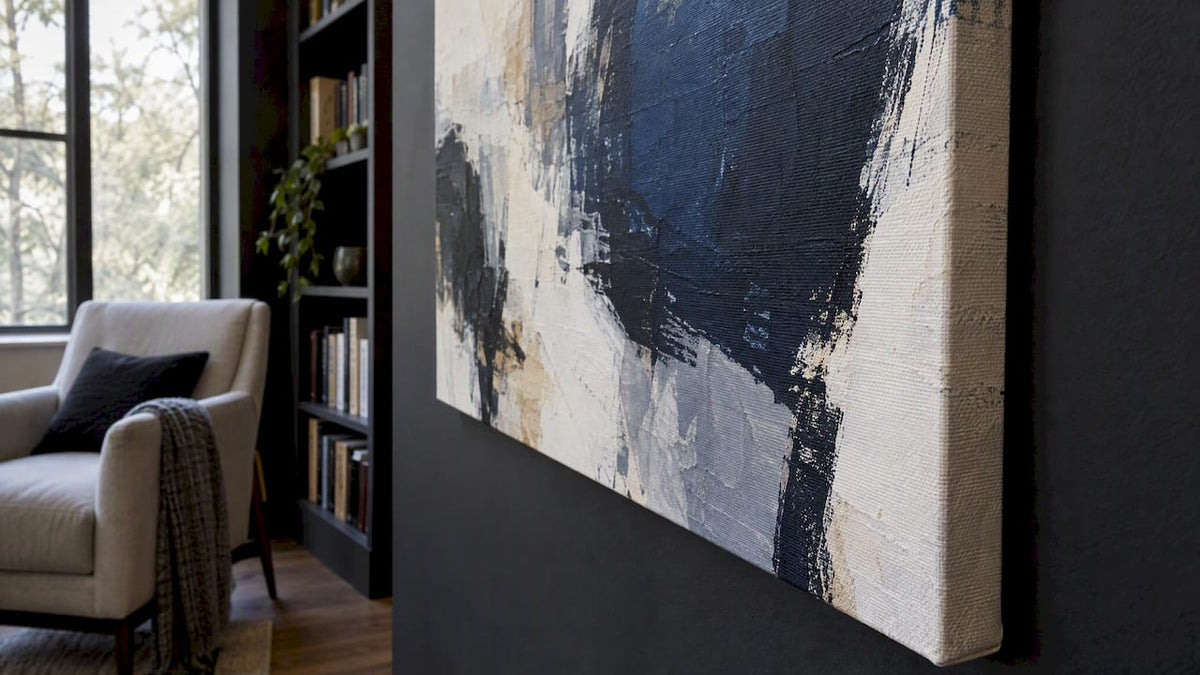
A canvas print does not come with one fixed expiry date. Its life depends on four things: the inks, the canvas, any protective coating, and the room it hangs in. Well-made pieces kept out of direct sun and away from damp air can look good for decades. A cheap print in a sunny window can look tired within a few years. This guide explains what drives that difference, how to slow fading, why a new canvas can smell, and what to ask about production and shipping before you order.
TL;DR
- Lifespan is set by ink type, canvas quality, coating and placement, not by the calendar. Light and humidity do most of the damage.
- Sunlight (UV) and airborne pollutants such as smoke, ozone and cleaning chemicals are the main causes of fading.
- Keep canvas away from direct sun and swings in humidity, and handle it clean and dry.
- A new canvas can smell faintly while inks and coatings finish curing. Give it time to air out before you hang it.
- Ask any seller for the production time and the shipping time separately, because the two add up to your wait.
Table of Contents
- How long do canvas prints last?
- Do canvas prints fade?
- What actually shortens a canvas print’s life
- How to make a canvas print last longer
- Why does a new canvas print smell?
- Canvas art shipping time and lead time
- What to look for when you buy
- Ready to hang, built to last
- FAQ
- Sources
How long do canvas prints last?
The honest answer is a range, and anyone quoting a single number is simplifying. Conservation researchers at the Image Permanence Institute note that how sensitive a digitally printed object is to its environment varies widely and depends on the product, so each piece should be treated on its own terms and checked from time to time.
A trade report on canvas longevity makes a similar point from the printing side. It found that virtually none of the canvas products it described would last beyond 100 years without visible fading, unless they were liquid laminated or covered with UV-protecting glass. That report is from 2007, so inks and coatings have moved on since, but the underlying logic still holds: light is a slow, steady force, and protection is what buys time.
For a buyer, that translates into a practical way of thinking:
| Factor | What helps a canvas last | What shortens its life |
|---|---|---|
| Ink | Archival pigment inks | Cheap dye-based inks |
| Canvas | Sturdy, evenly woven fabric on a solid stretcher frame | Thin fabric, flimsy frame that sags or warps |
| Coating | A protective finish designed to resist UV | No coating, or a coating that yellows or cracks |
| Light | Indirect light, no hours of direct sun | A south or west window with daily sun |
| Air | Stable humidity, clean air | Kitchens with grease, smoke, damp basements |
| Handling | Clean hands, gentle dusting | Rubbing, spray cleaners, sticky hooks that tug |
None of these is exotic. Most of them are decisions you make once, at purchase and at hanging.
Do canvas prints fade?
Yes, all of them do eventually. Fading is a slow chemical change in the colorants, and the rate depends on the exposure. The same trade report identifies UV radiation from sunlight and airborne impurities such as ozone, smoke, cleaning chemicals and dust as the things that cause fading.
What that looks like in a real home:
- A canvas opposite a window. It gets hours of daylight every day. Bright reds and warm tones are often the first to look dull, and the whole image can shift in tone.
- A canvas over a stove or near a fireplace. Cooking vapor, smoke and soot settle on the surface and dull it, even when light is not the problem.
- A canvas in a hallway or a bedroom with softer light. This is the easy case. With little direct sun, change can be very slow.
Black and white pieces tend to be forgiving visually, because there is less color to shift. Bold color work, like pop art with saturated reds and yellows, rewards a bit more care about where it hangs. That is a reason to plan placement, not a reason to avoid color.
What actually shortens a canvas print’s life
Light
Direct sun is the biggest single risk. If a wall gets strong sun for part of the day, the choices are simple: pick another wall, add a window film or shade, or choose a piece made with UV protection in mind. Our guide to UV-resistant canvas for home and office goes through those choices in more detail.
Gallery-style lighting also matters. Spotlights placed very close to the surface, or bulbs that run hot, add exposure and heat. Our note on how art lighting shows off canvas at home covers placing lights so the colors look rich without cooking the piece.
Humidity
Light fades color. Humidity attacks the structure. Conservation guidance from the Smithsonian explains that canvas paintings are sensitive to extremes of relative humidity, which change the tension of the canvas and can put the paint layer at risk. That text is about paintings, but a printed canvas is stretched fabric on a frame too, so the same physics applies to how it sags or tightens.
The Canadian Conservation Institute adds that short-term swings in humidity can damage paintings, which is why stable conditions matter more than hitting one perfect number. If your home has a humidifier or dehumidifier, steady settings are better than constant adjusting. We lay out a practical target range in our guide on keeping canvas art at stable humidity.
The rooms that cause trouble are predictable: bathrooms right next to a shower, unfinished basements, and walls with a radiator or vent blowing directly on the canvas.
Dirt, vibration and a bare back
The Smithsonian guidance also points out that many paintings have no backing board and that a rigid backing helps reduce vibration, dirt and humidity change. For a print on a busy wall near a door that slams, or in a room with heavy foot traffic, a well-built stretcher frame and a snug fit to the wall are worth caring about.
Handling
Skin oils and fingerprints are a quiet cause of permanent marks. Canson, a maker of printing media, advises that prints be handled with clean cotton gloves to avoid transferring oils and contaminants to the surface, which can cause permanent stains. You do not need gloves to hang a canvas on a normal day, but clean, dry hands and a habit of gripping the sides of the frame, not the image, cost nothing.

How to make a canvas print last longer
These are the habits that make the biggest difference, in rough order of impact:
- Choose the wall before you choose the piece. Note where sun hits at 10 a.m., noon and 4 p.m. A wall that stays in indirect light is the best home for color-heavy art.
- Keep it off the kitchen range, fireplace and bathroom wall. Smoke, grease and steam are slow, constant stressors.
- Stabilize the room. Avoid big swings in humidity. A modest, steady indoor climate does more than a perfect number reached now and then.
- Leave a small gap behind it. A canvas that sits flush against a cold exterior wall can pick up moisture. Small bumpers on the bottom corners let air move.
- Dust gently. A soft, dry, clean brush or microfiber cloth once in a while is enough. Skip sprays and wet wipes.
- Hang it securely and without strain. A sagging hook or a weak anchor invites falls and frame stress. See our guide to hanging canvas art without damaging your walls.
- Rotate what you display. If you own several pieces, swapping them seasonally spreads out light exposure.
- Check it once a year. Look for sagging, ripples, dull patches or surface marks. The IPI guidance recommends periodic condition checks for printed objects, and a yearly look is an easy version of that.
A word on cleaning a mark: test any cleaning method on a hidden spot first, such as the back edge of the stretcher fabric, and wait to see if color moves. The idea is the same one crafters use when they run a colorfast test on fabric before washing, and it saves you from turning a small smudge into a large stain.
Why does a new canvas print smell?
A faint odor on a freshly made canvas is common and usually harmless. The Image Permanence Institute links odor from new prints to the curing of inks, coatings or solvents used in printing and finishing, and it notes that how long it lasts is not standardized. In other words, nobody can honestly promise a number of days.
What you can do is give it air:
- Unbox it right away. Remove plastic wrap and protective sleeves so the surface can breathe.
- Rest it in a ventilated room. A spare room with the window cracked, or a garage that is dry and clean, works. Keep it out of damp spaces and out of direct sun while it airs.
- Wait before you seal it in. Canson recommends letting canvas printouts dry for up to 24 hours before framing or exhibiting them. That guidance is for printmakers, but the principle carries over: do not trap a fresh piece behind glass or in a closed cabinet.
- Hang it where air moves. A living room or hallway with normal circulation clears faint odors faster than a closed closet.
If a strong, sharp smell persists for a long time, or anyone in the home is sensitive to odors, contact the seller. Ask what finish was used and for care advice for that product.
Canvas art shipping time and lead time
Your real wait is two numbers added together: production (or lead) time, and transit time. Many sellers publish them separately. Ready-made stock ships faster than a piece made to order or in a custom size, and shipping speed depends on your address, the carrier and the season, with delays more common around major holidays.
We do not want to quote a figure here that you would have to take on trust, and delivery windows change. What we suggest is a short checklist before you buy from any shop:
- Is the production time listed on the product page, and does it differ by size or finish?
- Is it a calendar-day or business-day estimate?
- Does the shipping estimate start when you order or when the piece leaves the workshop?
- Is the canvas shipped rolled or stretched, and how is it packed to protect corners?
- Is there tracking, and what is the return process if the piece arrives damaged?
If you are decorating for an event, a move or a launch, order with a cushion of a couple of weeks. Then you have time to let the canvas air out, check the frame and hang it without stress. For current timing on our pieces, check the product page for the design you want.
Our perspective on canvas longevity
We hear the lifespan question often, and we think it is the right one to ask before spending on wall art. A canvas is a long-term piece of your home, not a poster you swap out each season.
In our view, longevity starts at production. That is why our canvases are made in the USA with archival inks and quality materials, and why we design them to be ready to hang, so you do not have to work out stretching and framing on your own. Archival materials are designed to hold color well, and a solid stretched build is designed to stay taut and square on your wall.
We also think the best durability advice is the least dramatic. Give the piece a wall with gentle light, keep the room’s humidity steady, and handle it with clean hands. Do those three things and a well-made canvas has every chance to keep looking the way it did when you unpacked it.
Bold art deserves that care. Graffiti, pop art and high-fashion pieces carry strong color, and strong color is exactly what you want to protect. Choose with the room in mind and the art will repay you for years.
James
What to look for when you buy
If lifespan matters to you, and for a piece you will live with for years it should, check the following before you add a canvas to your cart.
Ink. Ask whether the print uses archival pigment inks. Seller descriptions that never mention ink at all are worth a question.
Canvas and frame. Look for a sturdy fabric and a solid stretcher frame with even tension across the front. Our guides on canvas durability, premium canvas materials and what separates canvas quality for collectors explain what to look at in photos and descriptions.
Finish. Ask what protective coating is used and what it is designed to do.
Build for the wall. A piece that arrives ready to hang with hardware included is less likely to be mishandled on day one. If you are comparing canvas against cheaper paper options, see why canvas prints outlast wall posters.
Hand finishing for street art. Edges, corners and wrapped sides show quality quickly on bold graphic work. Our five checks for hand-stretched street art canvas is a quick way to inspect a piece.
Room fit. Even a very good canvas will not like a steamy bathroom. For kitchens, choose a wall away from the range, such as our kitchen canvas wall art.

Ready to hang, built to last
If you are choosing art for a room you plan to keep for years, start with a collection that matches your style. Our canvases are made in the USA, arrive ready to hang, and come in more than 1,000 designs.

Browse pop art canvas prints for saturated color, graffiti and street art canvas for urban energy, or our luxury wall art collection for fashion-house style. The full range, including black and white, abstract and photography pieces, is on our home page.
FAQ
How long do canvas prints last?
There is no single number, because lifespan depends on the ink, the canvas, the coating and where the piece hangs. A well-made print kept out of direct sun, with steady humidity, can stay in good condition for many years. Researchers advise treating each printed object individually and checking it periodically.
Do canvas prints fade in sunlight?
Yes. UV light from the sun and airborne impurities such as smoke, ozone and cleaning chemicals are the main causes of fading. Hang canvas on a wall without direct sun, or use window film or shades to cut exposure.
Why does my new canvas print smell?
The smell usually comes from inks, coatings or solvents finishing their cure after printing, and how long it lasts is not standardized. Unbox the canvas, let it air in a ventilated room, and keep it out of sealed spaces. If a strong smell lingers, contact the seller.
How long does canvas art take to arrive?
Your wait is production time plus shipping time, and both vary by seller, size, finish and season. Look for each figure on the product page, check whether it counts business days, and order a couple of weeks ahead for a deadline.
What humidity is best for canvas art?
The key is stability. Conservation guidance warns that short-term humidity swings can damage paintings. Avoid bathrooms, damp basements and walls with vents blowing on the art.
Sources
- Digitally-Printed Images, Image Permanence Institute
- Canvas: How long will it last? Wide Format Image
- Smithsonian conservation guidance on canvas paintings
- Environmental Guidelines for Paintings, Canadian Conservation Institute
- Handling, Printing & Storing Canson Infinity Supports
- 5 Minute Colorfast Test: Wash Cross Stitch Without Ruining Colors
Sawtooth Hanger vs. Wire: Which Should You Use?
Custom Graffiti Canvas Design: How to Get It Right