

A statement piece is a single, standout element — large wall art, dramatic lighting, or bold furniture — that becomes a room’s primary visual anchor and sets the tone for everything around it. The rule is simple: pick one per room and let everything else support it.
That constraint is the whole game. Designers at publications like Elle Décor and Real Simple return to this principle constantly, and Luxuryartcanvas builds its entire canvas line around it. One intentional piece. Everything else follows.
Table of Contents
- What does a statement piece actually do in a room?
- Why one standout piece beats a room full of competing items
- How do you choose and place a statement piece?
- What are the best examples of statement pieces by room?
- Common mistakes that undercut a statement piece
- Where do you shop for statement pieces, and what should you budget?
- How canvas wall art works as a statement piece
- Key Takeaways
- The case for testing before you commit
- Luxuryartcanvas makes the statement piece decision easier
- Useful sources for deeper design reading
What does a statement piece actually do in a room?
A statement piece does three things at once: it creates a focal point, organizes the layout decisions around it, and signals the room’s personality before anyone sits down. Think of it as the first sentence of a paragraph. Everything else in the room is the supporting text.
The functional roles stack up quickly once you see them clearly:
- Focal point: Gives the eye a place to land and rest, preventing the restless scan that happens in rooms with no clear anchor.
- Layout organizer: Furniture, rugs, and lighting naturally arrange themselves in relation to the dominant piece.
- Tone-setter: A moody abstract canvas reads differently than a bright pop-art print, even in the same room with the same furniture.
- Scale reference: A large piece establishes the room’s visual scale, making smaller objects feel intentional rather than random.
- Conversation starter: Pieces with personal meaning or uncommon origins give guests something real to ask about.
A statement piece should reflect the homeowner’s taste or a personal story. That’s what separates a curated room from one that looks assembled from a catalog.
Why one standout piece beats a room full of competing items
Restraint produces stronger, more memorable spaces. Furniture designer Reagan Hayes put it plainly: “If everything is special, then nothing is special.” When every item in a room competes for attention, the eye has nowhere to settle, and the space feels exhausting rather than inviting.
When a single piece contrasts clearly with quieter surroundings — through color, texture, or form — it reads with authority. The supporting decor doesn’t disappear; it amplifies.
Contrast is the mechanism. A bold canvas on a white wall works because the wall does nothing. A sculptural pendant light over a simple dining table works because the table steps back. Strip away the competition, and the focal object gains power it never had when surrounded by noise.
Before/after: imagine a living room with a gallery wall of twelve small prints, a patterned throw, a colorful rug, and a velvet sofa in a contrasting hue. Now remove eleven of those prints, swap the rug for a solid neutral, and hang one large-format canvas above the sofa. Same furniture, same square footage. Completely different room.
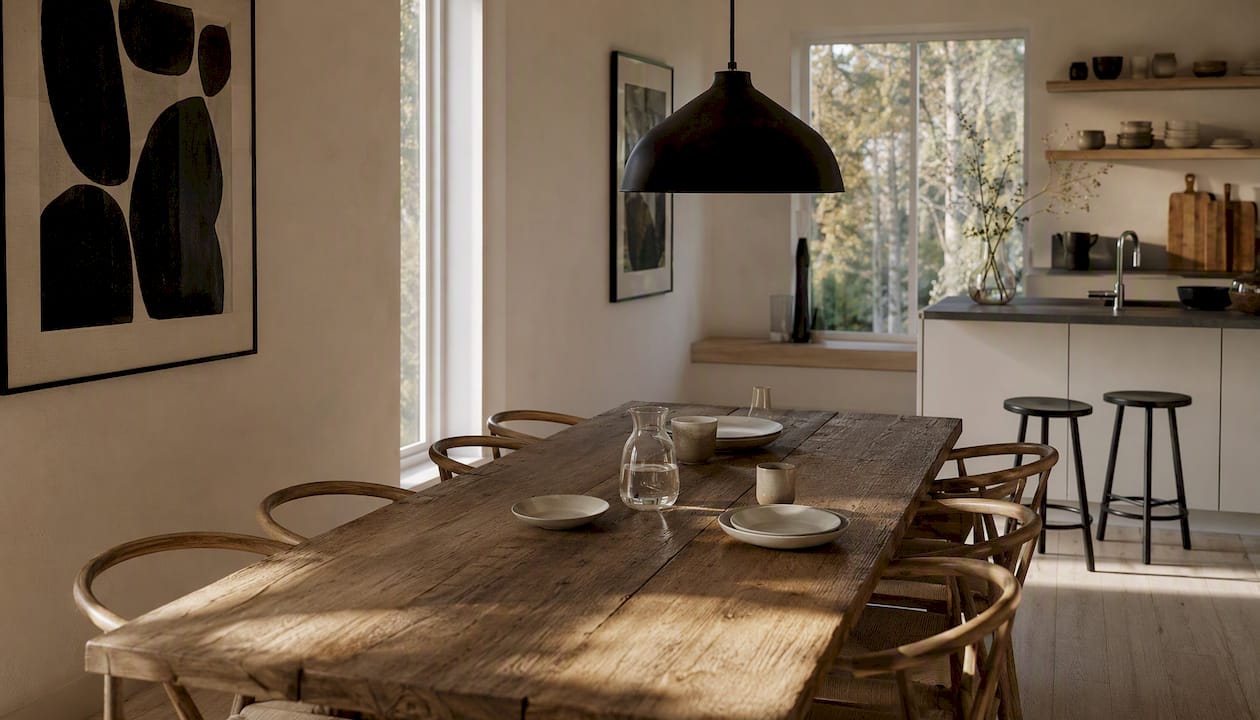
Pro Tip: Before committing to a statement piece, photograph the room with your phone and squint at the image. Whatever your eye goes to first is already acting as the focal point — and it may not be what you want.
How do you choose and place a statement piece?
Selection and placement are where most people go wrong, usually by choosing something they love in a store without checking how it fits the room. Work through these steps before you buy:
- Identify your anchor wall. Stand at the main entry point and note where your eye lands naturally. That wall, or the furniture mass in front of it, is where your statement piece belongs.
- Measure before you commit. A piece that feels large in a showroom can disappear on a 12-foot wall. Designers scale canvases to feel balanced with wall width and the furniture mass below, not to an exact formula.
- Check visibility from the entry. A statement piece should be visible from the room’s primary sightline and proportionate to the space. If you can’t see it clearly from the doorway, it isn’t anchoring the room.
- Connect it to the room’s palette. The piece doesn’t need to match, but it should share at least one color, finish, or material tone with something nearby. That echo is what keeps it from feeling dropped in.
- Consider texture and finish. A matte canvas reads differently than a high-gloss lacquered panel. Choose a finish that contrasts with the dominant surface in the room — matte art on a glossy-painted wall, for example.
- Ask whether it has personal meaning. Trend pieces date quickly. Something you genuinely love tends to age better and makes the room feel like yours.
Pro Tip: Cut a piece of kraft paper or newspaper to the exact dimensions of the art or furniture you’re considering and tape it to the wall. Live with it for a day. You’ll know immediately whether the scale is right.
For placement specifics: hang wall art so the center sits roughly at eye level (around 57–60 inches from the floor), or slightly higher above a sofa or console. For large-format pieces on oversized walls, the bottom edge of the frame should clear the furniture below by about 6–8 inches. Keep traffic flow clear — a dramatic floor lamp or sculptural chair should never block a walkway.
What are the best examples of statement pieces by room?
A statement piece can be art, furniture, lighting, a rug, a mirror, or an architectural treatment — any category works as long as it creates a clear focal point and connects to the room’s palette. Here’s how each category plays out in practice.
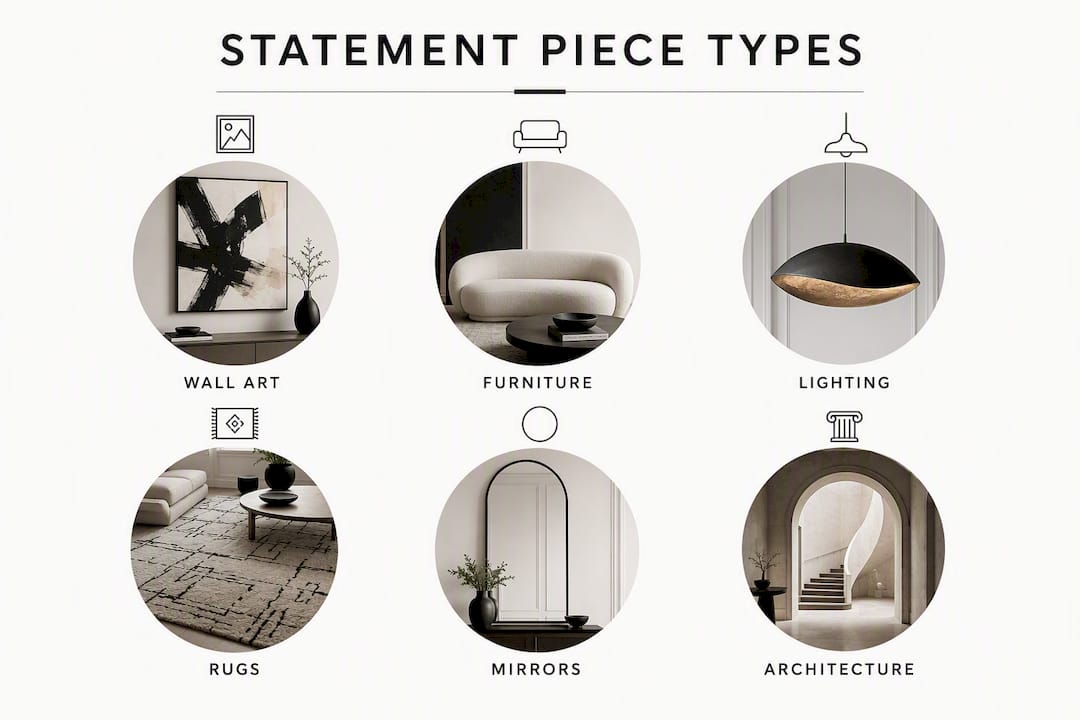
Wall art is the most flexible option because it delivers high visual impact without consuming floor space. Oversized canvases are especially effective in entryways and living rooms precisely for this reason. A single large-format piece above a sofa or console can anchor an entire room without requiring you to rearrange furniture.
Furniture works best when the piece has an unusual silhouette or material. A curved velvet sofa in a room of straight lines, or a live-edge dining table among upholstered chairs, earns its statement status through contrast.

Lighting is the most underused category. A sculptural pendant or a cluster of globe lights above a dining table does double duty: it functions and it draws the eye upward, making ceilings feel taller.
Rugs anchor a seating arrangement from below. A bold geometric or high-contrast pattern under a neutral sofa defines the zone and gives the room a floor-level focal point.
Mirrors amplify light and create the illusion of depth. An oversized arched mirror in a narrow entryway is one of the most reliable tricks in residential design.
Architectural treatments — a statement interior door, a shiplap accent wall, or bold wallpaper on a single surface — work particularly well in rentals or new builds where you want permanent-feeling impact.
| Category | Best rooms | Visual impact | Floor space needed |
|---|---|---|---|
| Wall art / canvas | Living room, entryway, bedroom | High | None |
| Statement furniture | Living room, dining room | Very high | Significant |
| Pendant / sculptural lighting | Dining room, kitchen, foyer | High | None |
| Bold rug | Living room, bedroom, office | Medium–high | Full zone |
| Oversized mirror | Entryway, bathroom, hallway | High | Minimal |
| Accent wall / wallpaper | Any room | Medium | None |
Common mistakes that undercut a statement piece
Most rooms that feel “off” have the same problem: too many things trying to be the statement. Here’s what to watch for.
- Multiple focal points competing. A gallery wall, a bold sofa, and a patterned rug in the same room split attention three ways. The “one statement piece” rule exists for exactly this reason. Pick one and quiet the others.
- Wrong scale. A small piece on a large wall reads as an afterthought. A massive piece in a tight space feels oppressive. Measure first, always.
- Ignoring sightlines. A statement piece tucked in a corner or behind a door never gets seen from the entry. Visibility is the whole point.
- Clashing finishes. Mixing too many competing textures or sheens around the focal piece creates visual noise. Keep supporting surfaces calm.
- No connection to the room. A piece that shares nothing — no color, no material echo, no tonal link — with the rest of the room looks like it was left there by accident.
Quick fixes: desaturate the surroundings (swap patterned throw pillows for solids, replace a busy rug with a neutral), remove accent pieces that repeat the statement’s color or form, and reposition the focal item to the most visible wall.
Where do you shop for statement pieces, and what should you budget?
Sources range from local galleries and vintage markets to online specialty retailers and custom makers. The right channel depends on what you need.
- Local galleries and art fairs offer originals with genuine provenance, but lead times and prices vary widely.
- Vintage and antique markets are reliable for furniture with unusual silhouettes; condition checks matter.
- Online specialty retailers like Luxuryartcanvas give you access to large-format, ready-to-hang canvases with consistent quality standards and clear return policies — useful when you’re buying art without seeing it in person.
- Custom makers suit buyers with very specific scale or color requirements, though lead times can run weeks.
Budget tiers break down roughly like this: entry-level statement pieces (mass-market art prints, basic accent chairs) sit at the accessible end; mid-range covers quality canvas art, well-made lighting, and solid-wood furniture; investment pieces include original artwork, designer furniture, and custom architectural treatments.
Pro Tip: Spend more on the piece that will anchor the room for years, and less on everything around it. A $50 throw pillow next to a well-chosen canvas looks intentional. A cheap canvas next to expensive furniture just looks cheap.
When assessing quality on canvas art specifically, check for archival inks, solid stretcher bars, and pre-installed hanging hardware. A good return policy matters more than you’d think when buying art online.
How canvas wall art works as a statement piece
Oversized wall art is a preferred statement solution for homeowners who want large impact without losing floor space. A large canvas above a sofa, console, or bed does exactly what a statement piece should: it anchors the room, sets the tone, and leaves the floor plan intact.
Luxuryartcanvas produces ready-to-hang canvases in large formats suited to this role. A bold graffiti or pop-art canvas in a living room, for example, establishes the room’s energy before a single piece of furniture is arranged. The bold wall art examples in their catalog span graffiti, high-fashion brand imagery (Chanel, Louis Vuitton, Dior), and contemporary street-art styles — categories that read as statement pieces by design.
When evaluating any canvas for statement use, check these specifics:
- Scale: Does it fill at least two-thirds of the wall width above the furniture it anchors?
- Color saturation: High-saturation prints hold their impact from across the room; faded or low-contrast prints disappear.
- Mounting hardware: Pre-installed hardware means you hang it the day it arrives, no extra trips to the hardware store.
- Archival inks and materials: These determine whether the piece looks the same in ten years.
- US production: Luxuryartcanvas canvases are made in the USA, which typically means tighter quality control and faster shipping.
Pro Tip: For oversized wall art placement, hang the canvas so its center sits at eye level — roughly 57 inches from the floor — unless it’s positioned above furniture, in which case leave 6–8 inches of breathing room between the bottom of the frame and the top of the piece below.
Key Takeaways
A statement piece works because it gives the room one clear visual anchor — and restraint is what makes that anchor powerful.
| Point | Details |
|---|---|
| One piece per room | Limiting to a single standout item prevents visual competition and makes the space feel intentional. |
| Visibility and scale matter | Place the piece on the most visible wall from the entry and scale it to balance the furniture mass below. |
| Connect it to the room | Repeat at least one color, finish, or material tone nearby so the piece feels curated, not dropped in. |
| Quiet everything else | Desaturate surrounding accents — solid pillows, neutral rugs — so the focal piece reads clearly. |
| Luxuryartcanvas for wall art | Large-format, ready-to-hang canvases in graffiti, pop art, and fashion-brand styles are built for the statement role. |
The case for testing before you commit
The advice in every design article, including this one, assumes you already know what you want. Most people don’t, and that’s fine. The best statement pieces are usually found by accident — you see something, you can’t stop thinking about it, and then you figure out where it goes.
What I’d push back on is the idea that you need to get it right the first time. Tape a paper template to the wall. Hang a temporary print with removable strips. Move the lamp to three different corners before you decide. Renters especially have more options than they think: freestanding sculptural pieces, leaning canvases, and removable mounting systems all deliver real impact without a single nail hole.
The goal isn’t a perfect room. It’s a room that feels like you made a choice. One confident choice, held up by everything around it.
Luxuryartcanvas makes the statement piece decision easier
Ready-to-hang canvas art is one of the lowest-effort ways to add a genuine focal point to any room — no furniture rearranging, no contractor, no floor space lost. Luxuryartcanvas offers over 1,000 large-format designs, from bold graffiti wall art to high-fashion-inspired canvases featuring Chanel, Louis Vuitton, and Dior imagery, all produced in the USA with archival inks and pre-installed hanging hardware.

Every canvas arrives ready to hang, which means you can test placement the same day it arrives and return it if the scale isn’t right. For homeowners and renters who want a high-impact statement piece without a long sourcing process, browse the full collection and find the piece that anchors your room at Luxuryartcanvas.
Useful sources for deeper design reading
- Elle Décor — “9 Ways to Make a Statement Piece Work in Your Home”: Practical designer advice on integrating bold pieces without overwhelming a space, including the widely cited “if everything is special, nothing is special” principle.
- Luxuryartcanvas — “What Is Statement Wall Art? Your Complete Design Guide”: The publisher’s deeper guide on selecting, scaling, and hanging large-format canvas art as a room anchor.
Dinosaur Wall Decor for Luxury Interiors: A Buyer's Guide
Streetwear-Inspired Home Decor: What It Is and How to Do It