
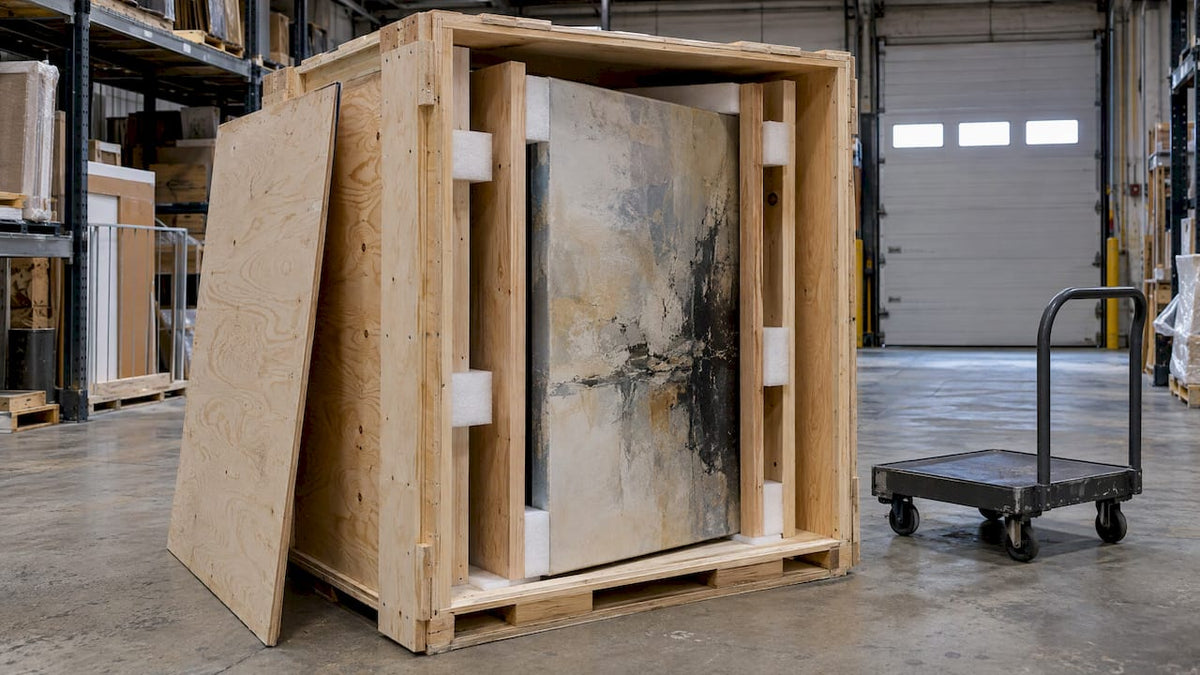
Shipping an oversized canvas is possible, but it is the most expensive and riskiest way to get a large piece onto your wall. Past roughly 48 inches on a side, you are dealing with surcharges, crating and damage claims that a standard parcel never sees. If you are buying new art rather than relocating something you own, the simplest path is to order a ready-to-hang canvas made in the USA and sent to you once, which is what we make at Luxury Art Canvas. If you do have to ship a large canvas yourself, this guide covers the limits, the real costs and the packing method that protects it.
Table of Contents
- Who this guide is for
- What counts as oversized
- What oversized canvas shipping costs
- Stretched flat or rolled?
- How to pack a large stretched canvas
- Insurance and who is responsible
- Why buying a new canvas beats shipping an old one
- Choosing a size that suits the room and the route
- Our perspective
- Find a ready-to-hang canvas for your space
- FAQ
Who this guide is for
Two readers search this phrase. One is moving an existing canvas: a painting, a collected piece or art from an old office. The other is decorating a new home, apartment or workspace and wondering what happens when a big canvas travels across the country. The first reader needs the packing and carrier detail below. The second needs to know what shipping size does to cost and risk, so that the choice is made before the purchase.
What counts as oversized
Carriers do not use the word “oversized” the way an artist does. They measure length plus girth. Girth is twice the width plus twice the height of the package, measured around its thickest cross-section. According to UPS’s own guidance on avoiding charge corrections, a domestic package is a Large Package when its length plus girth exceeds 130 inches or its length exceeds 96 inches. Its maximum is 150 pounds, 108 inches in length and 165 inches in length plus girth.

A canvas is thin, so girth rarely drives the number on its own. The longest side does. A 60 x 40 inch canvas needs a box that is at least 66 to 70 inches long once padding is added. That puts it into surcharge territory on length alone, even though the piece weighs very little.
Carrier limits at a glance
| Carrier | Max weight | Max length plus girth | Notes |
|---|---|---|---|
| UPS | 150 lb | 165 in | Max 108 in length; Large Package rules start at 96 in length or 130 in length plus girth |
| FedEx | 150 lb | 165 in | Additional Handling and oversize charges apply to big boxes |
| USPS | 70 lb | 108 in (130 in for Ground Advantage) | Rarely workable for large canvas |
The UPS row comes from UPS’s page above. The FedEx and USPS limits follow ShipCore’s 2026 carrier comparison, which also notes that since August 2025 UPS and FedEx round each dimension up to the next whole inch before calculating dimensional weight. Rounding up matters for a canvas in a box that is already close to a limit.
What oversized canvas shipping costs
The base rate is rarely the problem. Surcharges are. The Mail Station’s June 2026 guide gives a 2026 snapshot of FedEx Additional Handling at $18.50 to $31.50 per package and a UPS Large Package Surcharge of $97.50 when girth exceeds 96 inches. It also notes that these charges often do not show up in online quote tools unless the package is flagged as oversized, which is why a quote at the counter can differ from one on a website.
Two practical lessons follow:
- Quote with the packed dimensions, not the canvas dimensions. Add the padding, boards and outer box before you enter a size.
- Compare the quote with the value of the piece. Surcharges, a crate and insurance can add up to more than a new canvas of the same size.
Surcharge schedules are revised by the carriers, usually once a year, and peak season adds temporary fees. Treat any figure here as a snapshot and check the current rate tables on the carrier’s page before you book.
For a crated, high-value work the numbers move into another category. UNION’s 2025 fine art logistics guide lists domestic large-scale white-glove shipping at $1,500 to $3,000 and standard transit insurance at 0.8 to 1 percent of declared value per month. That is the right tier for a painting worth thousands. It is rarely the right tier for decor.
When freight makes sense
ShipWave’s large-package guide suggests considering freight when a package exceeds 96 inches in length plus girth, when its dimensional weight tops 70 pounds, or when the parcel quote passes $100 to $125. Freight is priced by freight class, which is based on density, and the guide says it is often 30 to 60 percent cheaper than parcel for big items. The trade-off is logistics: pallets, terminals and delivery appointments are built for crates, not for a single flat box leaning against a hallway wall.
Stretched flat or rolled?
This is the decision that most affects cost and risk. A stretched canvas on its wooden bars is rigid, so it needs a large flat box. A canvas removed from its bars and rolled fits in a tube that is much cheaper to ship, but the paint is under stress.
The Smithsonian Institution’s conservation guidance notes that most damage to paintings occurs during handling, deinstallation, packing or unpacking, and that extremely large paintings often must be removed from the stretcher and rolled. When they are, the paint layer is rolled facing outward, a larger roller radius puts less stress on the paint film, and the roll should carry its weight on a central axle rather than on the painted surface.

For a practical rule, it says to ship flat unless the canvas is large, flexible and fully dry. It advises never rolling thick or textured paint, old or brittle paint, cracked or flaking paint, or wet paint.
So the choice comes down to the piece:
- Printed canvas or thin acrylic, fully dry and flexible: rolling can be an option if the stretcher bars are the only thing making it too long to ship.
- Textured, heavy or older paint: ship flat, stretched, in a crate or a very well padded box.
- Anything you could not afford to see crack: do not roll it. Ask a professional fine art handler, or a paintings conservator, how to move it.
A rolled canvas also has to be restretched on arrival, which is a job for a framer or a gallery handler, and the cost of that belongs in your comparison.
How to pack a large stretched canvas
Several guides agree on the same sequence. Here is the routine, with what to watch at each step.
1. Photograph and document the piece
Take clear photos of the front, back and corners before you touch the packaging. If you later need to file a claim, those photos and a short written condition note are your evidence.
2. Make sure the surface is dry and clean
ForthMovers’ guide says to confirm paint is fully dry before packing, noting that oil paint can take months to cure. Wearing cotton or nitrile gloves keeps skin oils off the surface.
3. Protect the face
Cover the front with acid-free or glassine paper. Glassine is a smooth, translucent paper that does not stick to paint. Do not tape it to the artwork. Tape it to the back of the stretcher instead, or hold it in place with the bubble wrap.
4. Protect the corners
Fit foam or cardboard corner protectors on all four corners. Corners take most of the knocks in transit, and a dented stretcher bar is visible on the front of a canvas.
5. Wrap in bubble wrap
Use at least two layers of large-bubble wrap, with the bubbles facing the canvas and tape only on the wrap itself. Do not cinch it so tight that it presses into the canvas.
6. Add rigid boards
Sandwich the wrapped canvas between two sheets of rigid board, such as corrugated cardboard or foam core, slightly larger than the piece. This keeps a stray elbow or forklift tine from pressing through the face of the work.
7. Choose the outer box
The outer box should be about 3 to 6 inches larger than the wrapped work on every side, depending on the guide, and filled so nothing shifts. We puts the minimum at 3 to 4 inches, and ForthMovers recommends 4 to 6. Seal every seam with heavy-duty tape.
Buying a box that is large enough is a challenge in itself. Ordinary stores do not stock boxes for 60-inch pieces. Many guides suggest mirror boxes, picture boxes or telescoping boxes, which are made for flat items.
8. Crate above 48 inches
FreightAmigo’s logistics guide says pieces larger than 48 x 48 inches need a custom wooden crate with ISPM 15-compliant wood, internal supports and a 2 to 3 inch foam buffer between the frame and the crate wall. ISPM 15 is the international standard for heat-treated shipping lumber. A crate is the sensible choice for a valuable work, and it is also heavy, which changes the freight class and the price.
Insurance and who is responsible
Carrier liability is limited, and a claim often requires the original packaging, photos and proof of value. For a decorative canvas, declared value on the shipment may be enough. For a collected work, a separate transit policy is the safer path, and the person to ask about it is a fine art insurer or a broker who handles collections. Whoever packs the item usually bears the burden of showing it was packed properly, which is one more reason the packing steps above are not optional.
Why buying a new canvas beats shipping an old one
If your goal is a large piece on a wall, not the transport of a specific object, then the cost and risk above are largely avoidable. A canvas made to order in the USA and delivered once removes several steps from your list: the crate, the freight quote, the claim form and the conservation risk of rolling. You also avoid the situation where a $400 piece is shipped in a $500 crate.
That is the idea behind how we work at Luxury Art Canvas. Each canvas is crafted in the USA with high-quality materials and archival inks, and it arrives ready to hang. You can see how pricing and delivery fit together in our guide to canvas art cost for U.S. buyers, and our walkthrough on moving canvas art covers packing and storing pieces you already own.
If you are moving pieces you already own
For pieces you are carrying to a new home, the main variable is how much the move costs in time and handling. Wrap each canvas as described above, keep them upright and never stack heavy items on them. Moving them in a personal vehicle is cheaper and usually safer than any carrier, because you control every handoff.
Choosing a size that suits the room and the route
Size is a design decision first, but it also changes shipping. A few pointers for designers, homeowners and office managers planning several pieces:
- A single very large canvas makes a strong focal point over a sofa or a reception desk. The tradeoff is a bigger box and a surcharge if you have to ship it yourself.
- Multiple medium canvases can hang as a grouped layout with the same visual weight. Each piece ships in a box that is easier to handle, and each stays within standard limits.
- Horizontal formats suit long walls. A piece like our horizontal abstract wall art fills a wide space without needing a tall box.
- Large statement pieces such as our large abstract wall art work for open living rooms and lobbies.
If you are furnishing a rental or an office, hanging several mid-sized canvases in a grid also gives you flexibility when you move. Each can be taken down, wrapped and carried by one person.
Our perspective
Most of the damage we hear people worry about happens when a large canvas is handled again and again: unpacked, repacked, handed to a carrier, put on a pallet. The fewer of those handoffs, the better for the work.
That is why we think the best oversized canvas is one that was made for your wall and never needed to be moved twice. Ours are made in the USA with archival inks and quality materials, and they come ready to hang, so the first time you handle the piece is the day you put it up.
With more than 1,000 designs across graffiti, pop art, black and white, abstract and high-fashion themes, you can pick the size and style for the room rather than adjusting the room to the shipping limits. Our customers, more than 10,000 of them, have left positive reviews of that experience.
James
Find a ready-to-hang canvas for your space
If you are decorating and want a bold statement piece without a freight quote, start with the collection that matches your room. Our Graffiti Wall Art & Street Art Canvas and Pop Art Canvas Prints collections suit apartments and offices that want street culture on the wall, and our Luxury Art collection brings high-fashion designs to living rooms and studios. Each is made in the USA, ready to hang.

If you are furnishing a whole property or an office and want to ask about volume discounts, you can browse the full range on our main site.
FAQ
How do you ship a large canvas?
Pad the face with glassine or acid-free paper, add corner protectors, wrap it in at least two layers of bubble wrap, and sandwich it between rigid boards. Place it in a box several inches larger than the wrapped work on every side and seal every seam. For pieces above 48 x 48 inches, a custom crate is the safer choice.
Is FedEx or UPS better for shipping a large canvas?
Both accept up to 150 pounds and 165 inches in length plus girth, so for a light canvas the limits are the same. The difference is in the surcharges and the zone, so get a quote from each using the packed dimensions. USPS is capped at 70 pounds and a much lower size limit, which makes it unsuited to large canvas.
Can you roll a large canvas to ship it?
Sometimes, but only when the canvas is large, flexible and fully dry. Conservators advise rolling paint-side out around a wide core, and never rolling thick, textured, cracked or wet paint. When in doubt, ship the canvas flat on its stretcher bars.
Why is my oversized canvas quote higher at the counter than online?
Online quote tools often leave out surcharges unless the package is flagged oversized. A counter or a carrier account measures the actual box and adds length, girth or weight charges. Always quote with the packed size and ask for the total.
Do I need insurance to ship a canvas?
Declared value gives basic coverage, but carriers can dispute claims, so photograph the piece, keep the packaging and keep a written condition note. For a valuable work, ask a fine art insurance broker about a separate transit policy.
Art Deco Canvas Decor: How to Choose and Style It