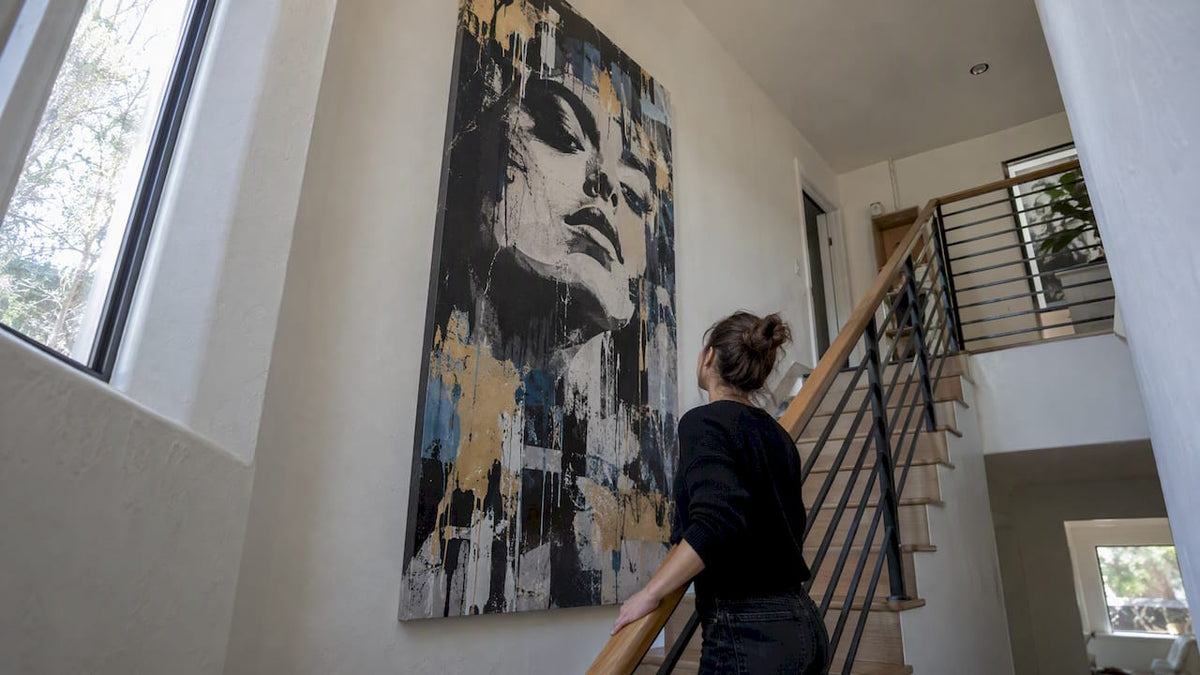
For most two-story living walls, choose a single oversized statement piece or a vertical multi-panel set anchored low, near the room’s main sightline. Scale and viewing angle are the reason: art hung at standard height gets swallowed by the volume above it, while a large piece tied to your seating area reads clearly from both floors.
TL;DR:
- Art above a sofa spans two thirds of its width and sits 8 to 10 inches above it, with 3 to 6 inches between pieces.
- Before ordering, measure the wall and every doorway or stairway on the route; tall installations may require scaffolding, a lift, or specialized installers.
- For stairwells and narrow access routes, choose coordinated panels that can be carried and hung individually rather than one massive canvas.
- Use wall washers for even coverage when artwork changes, picture lights for one focal piece, and UV filtering glazing or archival inks in sunny rooms.
- Renters can create scale with picture rails, leaned prints, removable wallpaper, or adhesive strips, but strips must stay within their rated weight limits.
Table of Contents
- Which layout approach fits your tall wall?
- How do you size and place art on a double-height wall?
- What do you need to hang art at height?
- How should you light and finish tall art?
- What are the best renter-friendly options?
- Why do canvas and multi-panel prints suit two-story walls?
- Measure first, then budget for the install
- How can we help you fill a two-story wall?
- FAQ
- Sources
Which layout approach fits your tall wall?
Pick the approach that matches your architecture and your collection, not just your taste.
- Single oversized piece: Works best on great-room and entry walls where one bold image can own the space. Designers often go larger than feels natural, because residential-scale art tends to disappear on two-story walls.
- Vertical diptych or triptych: Better for stairwells and tight access routes, since each panel is easier to move and hang.
- Salon-style gallery: A dense floor-to-ceiling arrangement is a classic for high ceilings, but it needs many varied pieces or it clashes with furniture and looks cluttered.
- Architectural treatments: Millwork, paneling, wallpaper murals and color drenching can frame art or carry the upper wall while the art holds the lower zone. Color drenching can visually lower a ceiling, while vertical slat panels emphasize height.
From the ground floor, a single piece reads as one confident statement. From the stairs and landing, multi-panel sets and galleries give your eye more to follow as you move.
If a door or archway sits near the wall, treat it as part of the composition. Doors can serve as focal points that your art should complement rather than compete with.
How do you size and place art on a double-height wall?
Start by dividing the wall into zones. Anchor your main art in the lower zone, close to furniture, so it connects to the seating area instead of floating in empty space.
For a living room, the usual rules still guide the lower zone. Better Homes & Gardens suggests the combined width of art above a sofa should be about two-thirds of the furniture width, with 8–10 inches between the sofa top and the bottom of the art.
Leave 8-10 inches of space between the top of a sofa and the bottom of the artwork; space multiple pieces in a group 3-6 inches apart. That spacing keeps a group reading as one composition instead of scattered pieces.
The familiar 57-inch eye-level rule is a gallery standard, and Architectural Digest notes that standard placement rules are poor guides for double-height walls. Measure the full wall height, then trust the sightline from your main seat.
On a stairwell, measure the vertical run, favor larger sizes, and consider vertical orientation or coordinated panels. Still Space Studio points out that scale rules for standard rooms stop applying here.
Before ordering, map the layout with painter’s tape and step back to view it from the sofa, the stairs and the landing.

What do you need to hang art at height?
Plan the installation before you buy, because access often decides what is realistic. Still Space Studio notes that these installs typically need scaffolding, a lift or specialized installers, so budget for that as its own line item.
- Measure the full wall height and the width of every door and stairway the art must pass through.
- Decide between one large panel and a multi-panel set. Panels are easier to ship, carry and hang, and multi-panel sets give a cohesive look that is often preferable to one massive panel.
- Ask installers whether they can hang in stages, one panel at a time.
- Match hardware to the wall and weight. Drywall, studs and masonry each need different anchors, and adhesive strips only work within their rated weight limits. French cleats spread heavy loads well.
- Treat craning as a last resort: very large pieces may need specialized delivery if they cannot fit through doors or stairways.
Pro Tip: Use a laser line level when hanging a vertical set so every panel stays plumb from top to bottom.
For more on equipment and technique, see our oversized wall art placement guide.
How should you light and finish tall art?
Lighting decides whether your art looks rich or flat from across the room.
- Wall washers or track systems: Wall-wash lighting gives even coverage and means you rarely need to re-aim fixtures when you swap art. The tradeoff is a more technical install on a high ceiling.
- Picture lights: These add intimacy and emphasis for a single piece, but each fixture lights only one work.
- UV protection: If the wall gets long hours of daylight, choose UV-filtering glazing or archival inks so colors hold up.
- Wall and ceiling color: Deep, matching color on walls, trim and ceiling makes a tall room feel cozier, while light walls with strong vertical art push the eye up.
What are the best renter-friendly options?
You can still go big without drilling a grid of holes.
- Ledges or picture rails: Sized for large panels, they let you swap art with very few holes.
- Leaned oversized prints and large mirrors: Temporary, but they deliver real scale on the lower wall.
- High-tack adhesive strips: Stay inside the rated weight limit and split a heavy piece across several lightweight panels.
- Removable wallpaper or fabric panels: A non-permanent way to add a mural effect above the art.
Why do canvas and multi-panel prints suit two-story walls?
-
Lighter, ready-to-hang canvas: Panels are far easier to carry up stairs and lift into place than heavy framed glass.
-
Archival inks: Worth the extra cost on walls that catch strong light.
-
Framing choices: A gallery-wrapped canvas keeps weight down and gives a clean edge, while heavier frames add weight and visual border.
Our guide to scaling wall art for large spaces covers sizing across other rooms too.
Measure first, then budget for the install
Most disappointing tall-wall projects fail on planning, not taste. People order what looks right on a screen, then discover the piece is too small for the volume or cannot reach the wall. Measure, mock up with tape, and price the installer early. The art matters most, but the plan decides whether it lands well.
A quick checklist:
- Measure the full wall height
- Choose single or multi-panel
- Confirm the access route
- Pick your lighting
- Budget for an installer
— James
How can we help you fill a two-story wall?
We make big walls simple. Our museum-quality canvas prints are made in the USA, are available in pop art, graffiti and abstract styles, and arrive ready to hang.

- Ready to hang: No framing step before you install.
Browse our pop art canvas prints and graffiti and street art canvas to find a set that fits your wall, then read why oversized canvas makes such an impact.
FAQ
How do you decorate a two-story wall?
Anchor large art in the lower zone near your furniture, then use paint, lighting or vertical elements to handle the upper wall. A single oversized piece or a vertical multi-panel set usually works best.
How high should you hang art on a two-story wall?
The 57-inch center rule often feels too high or disconnected on double-height walls, so designers suggest adjusting for the room’s scale. Keep the main piece in the lower portion, with a little space above a sofa.
Is a multi-panel set better than one large canvas?
For stairwells and tight access routes, usually yes. Panels are easier to ship and hang, and the set still reads as one image.
How do you light art on a tall wall?
Wall washers give even coverage across the whole wall, while picture lights highlight a single piece. Choose based on whether you plan to swap art often.
Sources
- 7 Ideas for How to Decorate a Large Wall with the Perfect Scale
- Abstract Art for Staircases and Double-Height Walls
- Large Wall Art Styling Tips | Architectural Digest
New Home Wall Art: 7 Bold Ideas and a Masking Tape Test