
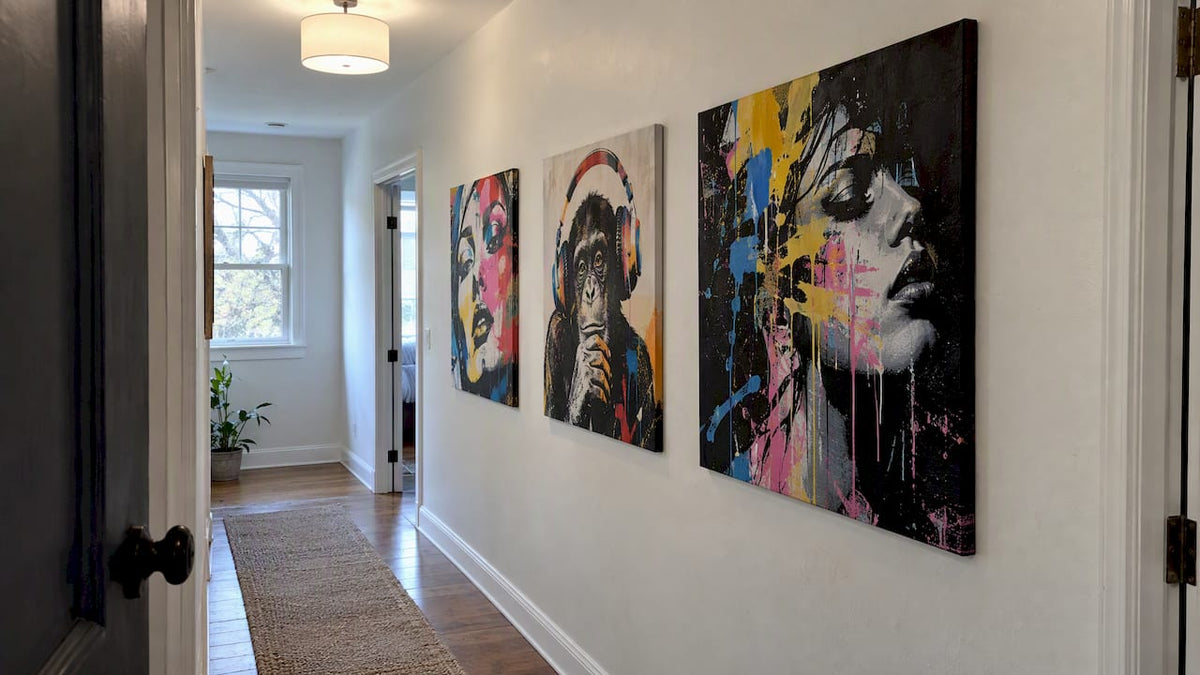
For most hallways, hang art so its center sits 57 to 60 inches from the floor. Keep the gaps between pieces consistent, usually 2 to 3 inches. In a narrow corridor, stay with a single row of flat pieces so nobody brushes the art on the way past. The rest of this guide covers the numbers, the exceptions and how to mark the wall before you drill.
A hallway is an odd room. People walk through it standing, the wall is long and thin, and light is often poor. Spacing rules written for living room sofas don’t always carry over. Below, we adapt them to corridors, with worked examples you can follow with a tape measure.
Table of Contents
- The height rule: where the center line goes
- Spacing between pieces
- Sizing: how much wall should the art fill
- Layouts that work in a hallway
- Narrow hallways: protect the pathway
- Where in the hallway not to hang art
- How to hang it: a five-step process
- Our perspective
- Choosing canvases for your hallway
- Common hallway spacing mistakes
- FAQ
- Sources
The height rule: where the center line goes
Start with height, because every other measurement hangs from it. The usual standard for galleries and hallways is to put the middle of the artwork, or the middle of a group, 57 to 60 inches from the floor. The same source explains the reasoning: where viewers are mostly standing, art should sit a little higher than it would in a room where people sit.
A hallway is the clearest example of a standing space. Nobody lingers on a sofa there. So if you are choosing between 57 and 60, go toward 60 in a hallway with high ceilings or tall residents, and stay near 57 in a standard 8-foot corridor.
If you want a deeper walkthrough of this number, we cover the formula in our guide to canvas hanging height at 57 to 60 inches. There is also a version for the corridor itself in our hallway canvas guide.
How to find the top edge
The center line tells you where the middle of the piece goes. You still need to know where to put the nail. Framebridge describes the method: measure the height of the piece, halve it, and add that to 57 inches to find where the top of the frame lands.
Example: a canvas 30 inches tall.
- Half of 30 is 15.
- 57 + 15 = 72 inches. The top edge sits 72 inches from the floor.
- Now check the hanger. If the wire or D-ring sits 3 inches below the top edge when pulled taut, the nail goes at 69 inches.
Spacing between pieces
When you hang more than one piece in a row, the gap does the work. Designers quoted by House Beautiful list inconsistent spacing among the mistakes they spot immediately, and one of them keeps a set distance between pieces even on organic arrangements.
What distance? Published guides cluster in a narrow band:
- [2 to 3 inches]between frames is the common recommendation for groups.
- Tight spaces often call for the lower end of that range.
- Over furniture, 6 to 8 inches between the bottom of the frame and the furniture.
For canvas, where there is no frame border, a gap of 2 to 3 inches can look a touch tight on very large pieces. That’s a judgment call. Try 3 inches for canvases above about 24 inches on a side, and 2 inches for small ones. Whatever you choose, apply it to every gap, vertical and horizontal.
A quick reference table
| Situation | Center height | Gap between pieces | Notes |
|---|---|---|---|
| Single canvas, open wall | 57 to 60 in. | n/a | Lean toward 60 in. in a standing-only corridor |
| Row of 3 matching canvases | 57 to 60 in. (center of the row) | 2 to 3 in. | Measure the whole row, then center it |
| Above a console table | 6 to 8 in. above the table | 2 to 3 in. | Art about two-thirds of the table width |
| Narrow hallway | 57 to 60 in. | 2 in. | One low-profile row only |
| Stair hallway | Follow the stair slope | Consistent | See our staircase sizing guide |
The table shows starting points, not laws. Walls have light switches, doors and thermostats, and your eye has the final vote.
Sizing: how much wall should the art fill
Spacing and size are linked. A beautiful gap between two tiny prints on a 14-foot wall still looks lost.
The widely repeated two-thirds rule sizes art to about two-thirds of the width of the furniture beneath it. In a hallway with a console, bench or radiator cover, that gives you a quick target. A 48-inch console pairs with art roughly 32 inches wide in total, counting the gaps between pieces.

For a bare wall with no furniture, House Beautiful’s designer roundup mentions a 70 to 75 percent wall coverage target and suggests custom matting to enlarge the footprint of smaller pieces. With canvas, there is no mat, so the practical route is to go larger or add a piece to the row.
A worked example for a 10-foot (120-inch) hallway wall:
- Target coverage of about 70 percent: roughly 84 inches of art plus gaps.
- Three canvases at 24 inches wide = 72 inches.
- Two gaps of 3 inches = 6 inches.
- Total = 78 inches. Close enough. The remaining 42 inches split into 21 inches on each end, which gives you the equal end margins that make a row look intentional.
Equal end margins matter. Exhibition hanging guidance from the Irish-Australian Craft Association lists uneven end spaces and inconsistent gaps as the faults that make a hang look unbalanced.
Layouts that work in a hallway
The single statement piece
One large canvas at the end of a corridor, or on the wall you face when you enter, is the cleanest answer. The center line is 57 to 60 inches, there are no gaps to calculate, and the piece reads from a distance. Bold graphics, such as pop art or large-scale street art, suit this because they hold up when seen at an angle while walking.
The horizontal row
Three to five canvases in one line, same height, same gap. It is the safest layout for narrow corridors because the row adds little depth and keeps your eye traveling along the wall. Pick a unifying element: a color story, a single subject, or matching scale.
The gallery cluster
A cluster suits wide hallways, landings and areas that open into a larger room. Designers often suggest organizing pieces on the floor first and building around a focal point. Cleveland Magazine’s designer panel describes working outward in a cloud-like arrangement from that anchor. Treat 57 to 60 inches as the center of the whole cluster, not of each piece. For more on building groups, see our guide to gallery walls and the notes on layering statement canvases.

The salon stack on a tall wall
If your hallway has a high ceiling, you can stack two rows. Keep the 2 to 3 inch gap between rows, and put the center of the whole block at the usual line. The lower row then ends up around 40 inches or so from the floor, which is still above hip height, so check the clearance before you commit.
Narrow hallways: protect the pathway
In a corridor 36 inches wide or less, depth is as important as spacing. Museum guidance says the pathway is part of the display: clear the space before you finalize a layout, and don’t let the depth of the art encroach on circulation. If the hallway is too narrow for comfortable passage, it recommends a single low-profile row.
That is where canvas helps. A gallery-wrapped canvas sits shallow against the wall, with no protruding frame lip, no glass and no sharp corners at shoulder height. For tight corridors, we’d choose portrait-oriented pieces to use the vertical wall and keep the horizontal footprint small. Our tight foyer ideas apply here as well, and the broader entryway design piece covers the tone-setting side.
One more caution from conservation guidance. Hallways are high-traffic zones, so the Canadian Conservation Institute cautions against hanging art at knee or foot level without protection, and recommends low-profile pieces in narrow corridors to avoid bumps from bags and clothing. A bump can damage both the art and the wall surface.
If you need to protect a framed piece with glazing near a busy entry, this comparison of acrylic and glass explains the trade-offs, including UV and impact behavior.
Where in the hallway not to hang art
Spacing is not only about inches between pieces. Where the wall sits matters too.
- Exterior walls. Insurer guidance from AIG’s installation brochure says to avoid exterior walls if possible, since temperature swings and condensation can damage canvas. If you must use one, use a backing board on the canvas and spacers to hold it 0.5 to 1 inch off the wall for air circulation.
- Heat sources. The same brochure gives ideal display conditions of 45 to 65 percent relative humidity and 68 to 75°F, and says to avoid heating vents, radiators, fireplaces and bathrooms. Hallway radiators and floor registers are easy to overlook.
- Wide swings in humidity. Our note on humidity and canvas art goes through what to watch for in a typical home.
Those spacers add depth, which is a further reason to plan the corridor clearance first.
How to hang it: a five-step process
- Clear and measure. Measure the wall width and note switches, vents and door swings. Mark the 57 to 60 inch line lightly in pencil or with painter’s tape.
- Lay it out on the floor. Gualala Arts’ guidance is to arrange everything on the floor before you pick up a hammer, so you can test spacing and composition in real time.
- Do the math. Total width of the pieces plus gaps, subtract from the wall width, divide by two for the end margins.
- Mark the hardware. Measure from the wire or D-ring, not the top edge, to find each nail position.
- Check the load. AIG advises that hanging hardware support 25 to 50 percent more weight than the heaviest the artwork can weigh. Weigh the piece, check the wall type (drywall, plaster or masonry) and pick anchors for it.
For the full hardware walkthrough, our guide on how to hang canvas art covers the steps, and our room-by-room arrangement guide shows how a hallway compares with the rest of the house. If you are hanging a heavy canvas on plaster or masonry, a local handyman or contractor can confirm the right anchors.
Our perspective
We make canvas wall art, and hallways are where we see the most spacing trouble. People buy a great piece, then hang it at the height they would use in a living room, or space a trio by eye and end up with gaps that drift by half an inch. The art is fine. The spacing makes it look accidental.
Our advice is plain. Decide the center line first, then the gap, then the margins, and don’t change any of them halfway across the wall. A bold piece can take clean, boring geometry around it. Graffiti, pop art and fashion-inspired canvases already carry plenty of energy, so the spacing should be the calm part.
We also like a hallway canvas that is ready to hang. Every piece we sell is made in the USA and arrives ready to go on the wall, which cuts down the number of variables when you are trying to hit a specific nail height. For a narrow corridor, we point people toward a single row of matching-scale canvases, and we would rather you skip a fourth piece than crowd a passage.
— James
Choosing canvases for your hallway
If you are filling a hallway and want pieces with presence, our catalog has over 1,000 designs. Good starting points for a corridor are graffiti and street art canvases for energy, luxury wall art for a fashion-forward statement, and HypeBeast art for a streetwear edge. Browse the full range at Luxury Art Canvas, and measure your wall using the steps above before you choose sizes.
Common hallway spacing mistakes
- Hanging too low. Art placed at sofa-room height feels sunken in a corridor where everyone is standing.
- Measuring from the top edge. The wire drop shifts the piece by an inch or more.
- Uneven gaps. Even small differences are visible along a long straight wall.
- Art too small for the wall. A single small print on a long wall looks stranded. Go bigger or build a row.
- Forgetting the end margins. Unequal ends make a row look unbalanced.
- Ignoring depth. Frames and spacers can poke into a narrow passage.
FAQ
How far apart should two pieces of art be in a hallway?
Keep the gap between 2 and 3 inches, and make it identical wherever pieces sit side by side. In a very narrow corridor, use the smaller end of that range. Measure the gap from edge to edge of the canvas or frame, not from hanger to hanger.
How high should I hang art in a hallway?
Center the piece or group 57 to 60 inches from the floor. Because people are standing in hallways, the upper end of that range often looks best. For a group, the center line applies to the whole arrangement.
Can I hang art on both sides of a narrow hallway?
Only if people can still pass comfortably with room to spare. Museum guidance suggests a single low-profile row when the corridor is tight, so put art on one wall and leave the other clear. A shallow canvas takes up less depth than a framed piece with glass.
Are gallery walls still a good idea for hallways?
They can be, especially in wider hallways, but a smaller, more curated group usually reads better than a crowded one. The NYIAD report on displaying art notes a 2026 trend toward fewer pieces, around five to seven in total. In a narrow hallway, a single row is still the safer choice.
Two Story Wall Art for Homeowners and Renters: Look Past 57 Inches