
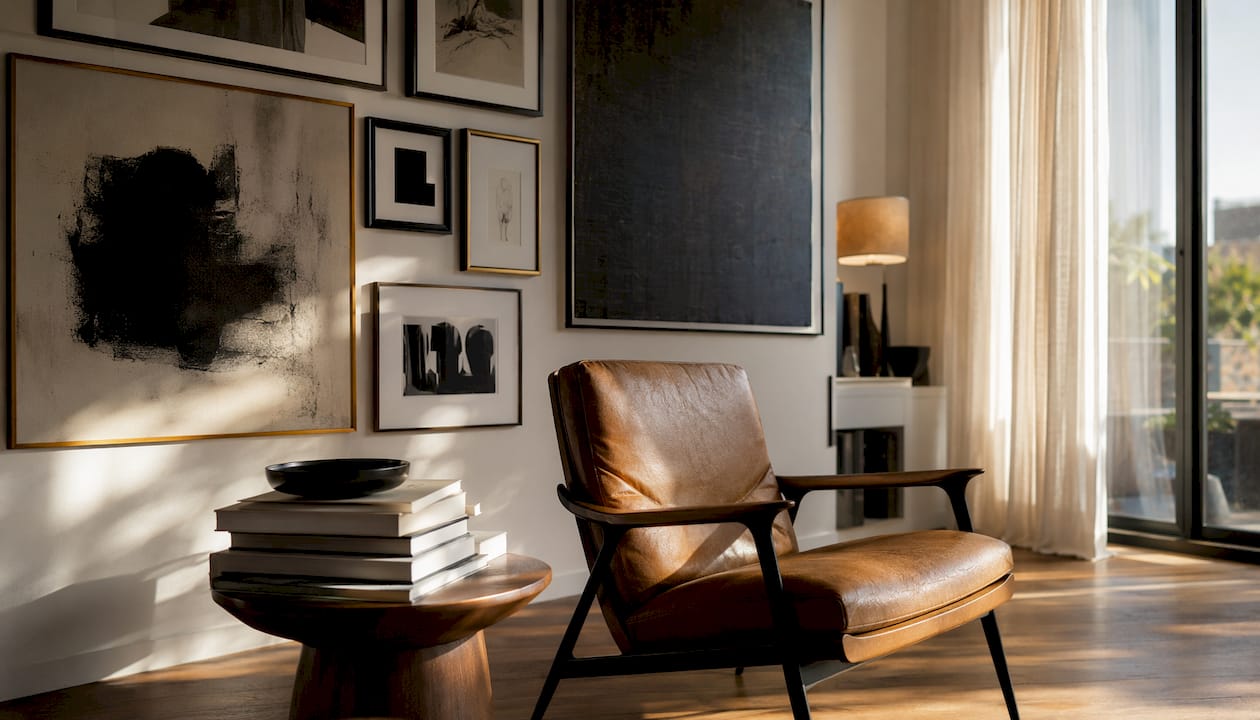
A gallery wall is a curated composition of multiple artworks, photographs, or objects arranged on a single wall so the whole reads as one intentional focal piece. That distinction matters: you are not hanging individual pictures. You are designing a single visual statement from many parts.
Two measurements govern every successful arrangement. First, the optical center of the entire cluster should land at standard museum hanging height around average eye level. Second, when the wall sits above furniture, the arrangement should span a majority of the furniture’s width and the bottom edge should clear the furniture back by a small, proportional gap.
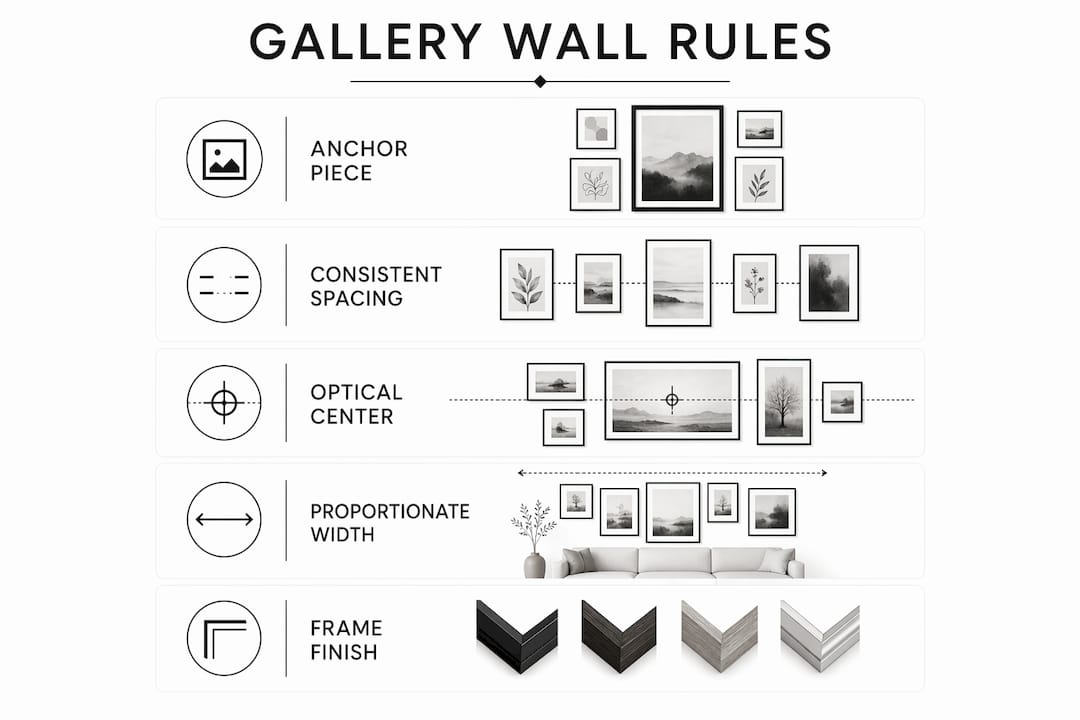
Before you touch a nail, confirm these three things:
- Anchor piece: one dominant work that organizes everything else
- Consistent spacing: 2–3 inches between frames throughout the cluster
- Unified finish: one or two frame finishes, not four
Table of Contents
- Why gallery walls still command attention in luxury interiors
- Core rules and measurements for a polished gallery wall
- Which layout template fits your wall and mood?
- What materials and finishes produce a luxury gallery-wall look?
- How to hang a gallery wall without unnecessary holes
- Styling and lighting tips that make a gallery wall feel editorial
- How ready-to-hang canvases from Luxuryartcanvas perform in gallery compositions
- How to maintain and preserve artwork on a gallery wall
- Budgeting guidance for a gallery wall
- Key Takeaways
- The case for treating a gallery wall as a single design decision
- Luxuryartcanvas makes gallery-wall building straightforward
- Further reading and sources
Why gallery walls still command attention in luxury interiors
A well-executed gallery wall creates a single commanding focal point that organizes an entire room’s visual energy. Nothing else you can do to a wall achieves that at the same scale without a renovation budget.
The format has a long history. Salon-style dense hangings that packed paintings floor to ceiling in 17th- and 18th-century European exhibitions were the original model. Contemporary designers stripped that density back and introduced mixed media, allowing textiles, mirrors, and three-dimensional objects to enter the composition. The result is richer and more personal than a single large print, yet far more controlled than the original salon approach.
What makes the format work visually is contrast held in balance. Varied sizes and orientations prevent the rigid, corporate feel of a matched set, while an anchor piece keeps the eye from wandering without resolution. The anchor does not need to be the largest piece on the wall. It needs to be the most visually weighted.
Pro Tip: Repetition is your cohesion tool. A shared frame finish or a consistent color that threads through every piece ties the collection together without making it feel like a set.
Core rules and measurements for a polished gallery wall
Follow a short set of repeatable rules and the result looks intentional every time: anchor piece, consistent spacing, optical center, and proportional footprint.
The optical center height guideline applies to the cluster as a whole, not any individual frame. For shorter sofas, hang slightly lower; for very tall rooms, hang slightly higher. These guidelines serve as starting points rather than strict limits.
The width of the arrangement above furniture should span about 60%–75% of the furniture’s width. A vertical gap between the bottom edge of the art and the furniture helps visually link the elements without floating.
Spacing between frames should be consistent and balanced, with tighter spacing lending a polished look and wider spacing offering a relaxed feel better suited to larger walls.
| Rule | Guidance |
|---|---|
| Optical center height | Near average eye level when standing |
| Arrangement width above furniture | A large, balanced portion of furniture width |
| Bottom edge above furniture back | A clear visual gap to connect art and furniture |
| Spacing between frames | Consistent and harmonious spacing throughout |
Pro Tip: Treat the cluster as one artwork. Measure the total outer boundary of the arrangement and center that boundary on the wall. Hanging individual frames without this step is how compositions end up drifting left.
For more on oversized canvas placement within these proportional rules, Luxuryartcanvas has a dedicated guide worth reading before you finalize dimensions.
Which layout template fits your wall and mood?
Pick one pattern and commit. Grid for formality, salon cluster for collected warmth, linear for horizontal spaces, diagonal for stairs. Mixing approaches is where gallery walls go wrong.
- Grid: Matching frames in even rows and columns. Clean, modern, ideal above a sofa or in a home office. Works best with black-and-white photography or a single consistent subject.
- Salon/cluster: Frames of varying sizes packed close together in an organic arrangement. Suits dining rooms, stairwells, and reading nooks. Mix metals, woods, and art styles for a collected-over-time feel.
- Linear: A single horizontal row, usually same-size frames at the same height. Best for hallways, above kitchen banquettes, or staircase landings where vertical space is limited.
- Stair-step/diagonal: Frames follow the angle of the staircase, with the center line of each piece parallel to the stair slope. The most forgiving layout for irregular wall shapes.
For count and size mix: a 2×3 or 3×3 grid needs uniform frames; a salon cluster works best with one anchor piece flanked by four to six smaller works of varied sizes.
Pro Tip: Picture ledges let you rearrange without new hardware. Float-mounted canvases skip the ledge entirely and read cleaner on a minimalist wall. Both approaches are worth considering before you commit to fixed hooks.
What materials and finishes produce a luxury gallery-wall look?
Choose archival materials, limit frame finishes to two, and match the framing approach to the aesthetic you want. Float-mount for an editorial feel; narrow frames for minimalism; wide white mats to elevate smaller prints to fine-art status.

Canvas versus framed prints is a real choice. A ready-to-hang canvas at large scale delivers immediate visual weight without the added depth of a frame, which suits contemporary and editorial interiors. Framed prints with wide mats work better for photography and works on paper.
Limit frame finishes to two, for example matte black paired with aged gold. Mixing three or more finishes risks an accumulated look rather than a curated one. That single discipline separates a gallery wall that reads as designed from one that reads as collected randomly.
Luxuryartcanvas produces its canvases in the USA using archival inks and museum-grade materials, which matters for longevity and color fidelity. For buyers selecting canvas art for high-end rooms, made-in-USA production and archival materials are the two quality signals worth confirming before purchase.
- Protective UV coatings extend color life, especially on south-facing walls
- Glazing (non-reflective glass) is worth the cost for framed works in bright rooms
- French cleats and D-ring hardware hold heavier canvases more securely than standard picture hooks
How to hang a gallery wall without unnecessary holes
Plan and mock up everything first, then hang. That single step prevents the most costly mistakes.
- Measure the wall section and mark the outer boundary with painter’s tape.
- Lay all frames on the floor within a tape outline matching the wall zone.
- Photograph the arrangement from above. This is your reference.
- Trace each frame onto kraft paper, cut the templates, and tape them to the wall.
- Mark the optical center of the cluster at 57–60 inches from the floor.
- Measure from the top of each frame to its hanging hardware; transfer that measurement to the corresponding paper template and mark the nail position.
- Hang the anchor piece first, then work outward. Never start from a corner.
- Use a level after every two or three frames. Step back frequently.
For drywall, picture-hanging hooks rated for the frame weight are the standard. For heavier canvases, wall anchors or a gallery rail system give more reliable support. For renters, heavy-duty adhesive strips work up to roughly 16 pounds per strip.
Pro Tip: Confirm lighting and sightlines before driving the first nail. Walk the room at the time of day you use it most. A piece that looks perfect at noon can disappear under evening lighting.
Styling and lighting tips that make a gallery wall feel editorial
Finish with consistent lighting, an intentional color story, and enough negative space that the collection can breathe.
- Lighting: Picture lights mounted directly on frames or adjustable track lighting aimed at the wall are both effective. Warm-white bulbs (2700–3000K) suit most art; cooler temperatures (3500K+) work for photography and black-and-white work.
- Color palette: Limit the dominant colors in the artwork to three or fewer. A repeating motif, a shared background tone, or a consistent subject thread unifies mixed-media collections without requiring matching frames.
- Negative space: Resist filling every inch. The gaps between frames are part of the composition.
- Depth and texture: A small mirror, a ceramic object on a ledge, or a sculptural piece adds dimension that flat prints alone cannot achieve. Use these sparingly; one or two three-dimensional elements per cluster is enough.
How ready-to-hang canvases from Luxuryartcanvas perform in gallery compositions
Ready-to-hang canvases simplify scale and finish decisions while delivering gallery impact. No framing decisions, no glazing choices, no mat widths to calculate.
- Living-room salon cluster: A set of branded pop canvases featuring Chanel or Louis Vuitton motifs grouped around one large-format anchor creates an immediate editorial statement. The consistent canvas depth reads as a unified finish without matching frames.
- Dining-room grid: A 2×3 grid of monochrome canvases in the same size works cleanly above a long dining table. The grid format suits the symmetry most dining rooms already have.
- Staircase run: Mixed orientations, portrait and landscape alternating, follow the stair slope naturally. Vogue-inspired canvases or street-art pieces in varied sizes keep the diagonal from feeling rigid.
All Luxuryartcanvas pieces are produced in the USA with archival inks and museum-grade materials, which means color fidelity holds over time without protective glazing.
Pro Tip: Pair one oversized canvas as the anchor with two or three smaller canvases from the same collection. The shared palette and production standard create cohesion instantly, no additional styling required.
How to maintain and preserve artwork on a gallery wall
Dust canvas surfaces gently with a soft, dry microfiber cloth every few months. Avoid damp cloths or cleaning sprays directly on the canvas face. For framed works behind glass, a dry cloth on the glass surface is sufficient; never let moisture reach the mat or the paper beneath.
Keep gallery walls away from direct sunlight and HVAC vents. UV exposure fades pigments over time, and humidity fluctuations cause paper and canvas to expand and contract, which eventually warps frames and loosens hanging hardware. Archival inks and UV-protective coatings extend color life significantly, but placement still matters.
Check hardware annually. Picture hooks and wall anchors can loosen gradually, especially on plaster walls. A quick tug test on each frame takes two minutes and prevents a costly fall.
Budgeting guidance for a gallery wall
Gallery walls scale to almost any budget, but the cost range is wide. A thoughtfully assembled collection of mid-range frames and quality prints can run $75–$300 for a five-to-seven piece arrangement. Custom framing for heirloom pieces or original artwork pushes costs to $300 and well beyond, depending on frame depth, mat width, and glazing choices.
Ready-to-hang canvases occupy a practical middle ground. They eliminate framing costs entirely and arrive sized and finished for immediate installation. For a luxury interior, the relevant cost comparison is not canvas versus budget print. It is canvas versus custom framing, where canvas consistently wins on both speed and simplicity.
Hardware costs are easy to underestimate. Quality picture hooks, wall anchors, and a laser level for large installations add $30–$80 to any project. A gallery rail system, which allows repositioning without new holes, runs higher but pays back quickly on walls that get rearranged seasonally.
Key Takeaways
A gallery wall succeeds when the cluster is treated as a single artwork: centered at 57–60 inches, spanning 60%–75% of the furniture width below, and unified by a consistent finish and anchor piece.
| Point | Details |
|---|---|
| Optical center height | Center the full arrangement at 57–60 in from the floor, not individual frames. |
| Furniture proportion | Span 60%–75% of furniture width; keep the bottom edge 6–8 in above the furniture back. |
| Frame spacing | Maintain 2–3 in between frames for a gallery-quality finish throughout the cluster. |
| Mock up before hanging | Lay out on the floor, photograph it, then tape kraft-paper templates to the wall before any nails. |
| Luxuryartcanvas | Ready-to-hang, made-in-USA canvases with archival inks simplify finish and scale decisions for luxury gallery walls. |
The case for treating a gallery wall as a single design decision
Most people approach a gallery wall the wrong way: they collect pieces they love and then try to make them fit a wall. Designers do the opposite. They define the wall zone first, establish the proportional rules, and then select pieces that fill the composition.
That sequencing shift is the real insight here. The measurements, the anchor piece, the two-frame-finish rule — none of those are arbitrary aesthetic preferences. They are the structural decisions that make a collection read as designed rather than accumulated. Skip the sequencing and even beautiful individual pieces end up looking like a yard sale.
The other thing most guides understate: negative space is not wasted wall. The gaps between frames are part of the composition. A gallery wall that fills every inch reads as anxious. One that breathes reads as confident.
For buyers considering ready-to-hang canvases, the practical advantage is real. Consistent canvas depth across a cluster functions as a unified finish without any framing decisions. That is not a shortcut. It is a design choice that happens to save time.
Luxuryartcanvas makes gallery-wall building straightforward
If you want turnkey gallery-wall impact without the framing decisions, Luxuryartcanvas is worth a close look. Every canvas ships ready to hang, produced in the USA with archival inks and museum-grade materials, across more than 1,000 designs.

The catalog covers the styles that work best as gallery anchors and cluster pieces: large-format graffiti canvases that command a wall on their own, pop art canvases in bold color for salon clusters, and branded editorial designs featuring Chanel, Louis Vuitton, and Dior for collectors who want a high-fashion narrative. The brand’s graffiti canvas collection is particularly well suited to anchor-plus-orbit arrangements where one strong piece organizes the rest.
More than 10,000 satisfied customers have used these canvases in residential and commercial spaces. Browse the full catalog at Luxuryartcanvas.com or explore the gallery wall ideas guide to see curated sets before you buy.
Further reading and sources
- Gallery wall sizing, spacing, and layouts above furniture — primary source for the 60%–75% furniture-span rule and 6–8 inch vertical gap
- Gallery wall layout planning with mockups — kraft-paper template method and floor mockup sequence
- Gallery wall layout ideas: planning, arranging, and hanging — source for the 2–3 inch spacing standard and the cluster-as-one-artwork approach
- How to make a gallery wall: no-fail formula — anchor piece concept, varied orientations, and the two-finish rule
- Floor-to-ceiling: evolution of salon hangings — historical context for the salon-style origin of gallery walls
- Luxuryartcanvas.com — product source for ready-to-hang, made-in-USA canvases with archival materials; 1,000+ designs across graffiti, pop art, and branded editorial styles
Wall Art Arrangement Ideas by Room: The Pro Hang Guide
Street Culture Art for Bedroom Walls: Styling & Buying Guide