
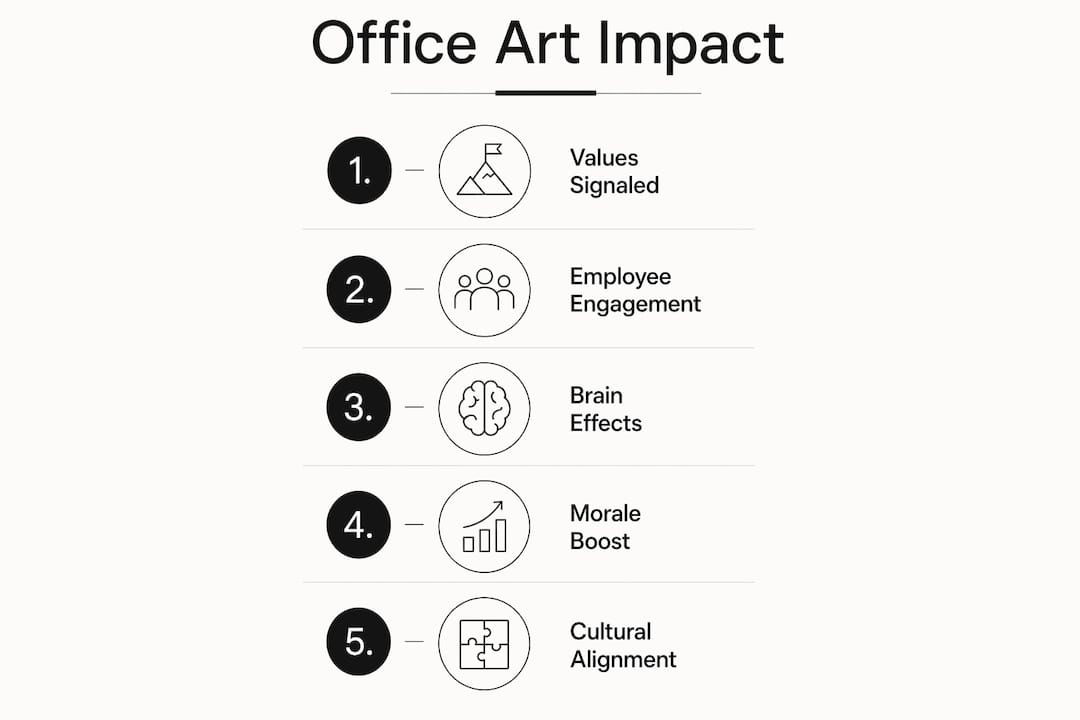
Office art reflects company culture by functioning as what organizational theorist Edgar Schein called artefacts: the visible, tangible signals that employees and visitors decode to understand what an organization truly values. Unlike mission statements or company handbooks, art is always on display. It communicates without words, and it does so every single day. Research confirms that artefacts signal cultural realities more reliably than any internal messaging campaign. For HR managers and business owners, this means every canvas on your wall is either reinforcing your culture or quietly contradicting it.
Why office art reflects company culture more than you think
The connection between office decor and company culture runs deeper than aesthetics. Schein’s model of organizational culture places artefacts at the outermost layer, the first thing anyone sees, yet they carry the weight of the assumptions and values buried beneath. A law firm that hangs austere black-and-white photography signals precision and formality. A tech startup that covers its walls in bold graffiti and pop art signals risk tolerance and creative energy. Neither choice is accidental, and employees read both instantly.
The mechanism works in three directions. Art signals values to new hires before their first meeting. It reinforces those values to existing employees through daily exposure. And it communicates brand identity to clients and partners the moment they walk through the door. Strategically chosen art communicates values and fosters the kind of informal interactions that build team cohesion, particularly in hybrid offices where desk personalization is limited.
The risk of getting this wrong is not just aesthetic. When art contradicts stated values, employees notice immediately. A company that claims to prioritize inclusion but hangs only work by a narrow demographic sends a louder message than any diversity statement. Contradictions between artefacts and stated values erode trust rapidly because people trust what they see over what they are told.

Co-creation changes this dynamic entirely. When employees help select or contribute to the art in their workspace, the pieces become genuine cultural artefacts rather than imposed decoration. The result is higher engagement and a stronger sense of shared ownership.
Pro Tip: Before adding new art, ask a colleague who has never visited your office to walk through and describe what they think your company values. Their first impressions reveal exactly what your current artefacts are communicating.
What does office art actually do to employees’ brains?
The importance of art in workplaces extends well beyond symbolism. Neuroaesthetics, the study of how the brain responds to visual stimuli, frames art as a physiological intervention that shifts stress and attention states in measurable ways. This is not a soft claim. It has direct implications for productivity, retention, and the quality of your workplace culture.
Nature-themed and biophilic art produces the most documented benefits. A 2026 longitudinal study found that exposure to biophilic art environments produced morning cortisol reductions of M = -2.8 µg/dL compared to control groups, accounting for a 23% effect on depression symptoms and a 31% effect on anxiety symptoms. That is a meaningful reduction in two of the most common drivers of employee burnout and absenteeism.
“Art in the workplace is not decoration. It is an environmental intervention that shapes how people feel, think, and perform throughout the day.” — Neuroaesthetics research, Frontiers in Psychology, 2025
Multisensory art environments amplify these effects. Nature-based recharge setups combining visual art with complementary audio and scent stimuli produce large, immediate reductions in self-reported stress after short sessions. The practical implication is that a dedicated art-rich breakout space, not just art in corridors, can function as a genuine wellbeing tool. Organizations that treat office art as part of an experience strategy see measurable gains in perceived workplace quality and employee retention.
The connection to office art and employee morale is direct. Employees who work in visually stimulating, thoughtfully curated environments report higher job satisfaction. That satisfaction feeds into discretionary effort, the extra work people do because they want to, not because they have to.
Effective vs. ineffective office art: what separates them?
Not all office art programs deliver cultural alignment. The difference between art that strengthens culture and art that undermines it comes down to four characteristics: specificity, visibility, co-creation, and meaning.
The table below contrasts the signals sent by strong versus weak art choices:
| Art approach | Signal sent | Cultural outcome |
|---|---|---|
| Custom mural created with employee input | “We value your voice and creativity” | High ownership, strong culture reinforcement |
| Generic motivational poster from a catalog | “We filled wall space cheaply” | Cynicism, perceived inauthenticity |
| Local artist commissions tied to company story | “We are rooted in this community” | Pride, belonging, brand coherence |
| Stock photography of generic cityscapes | “No one thought about this” | Neutral at best, disengaging at worst |
| Bold graffiti or pop art reflecting brand energy | “We embrace boldness and originality” | Creative confidence, brand alignment |
The contrast is stark. A company that invests in a ship’s bell mounted in a visible location, as one well-documented culture example describes, creates a specific, memorable artefact tied to a real story. A company that orders the cheapest possible supplies and hangs generic posters creates the opposite signal: that stated values are aspirational theater rather than lived reality.
Here is a practical audit workflow for evaluating your current environment:
- Walk your office as a stranger would. Note the first three things you see and what they communicate.
- List every piece of art or visual element and assign it a value it signals (collaboration, ambition, inclusion, etc.).
- Compare that list to your stated company values. Identify gaps and contradictions.
- Prioritize removing or replacing contradictory pieces before adding new ones.
- Identify two or three values that have no visual representation and plan art selections to address them.
Pro Tip: Fixing contradictions delivers more cultural value than adding new art. One misaligned piece can undermine ten well-chosen ones.
How to select and implement art that actually reinforces your culture
Selecting art for cultural alignment is a process, not a purchase. The most effective programs treat office art as a behavioral system where placement and repeated exposure matter as much as the art itself. A powerful piece in a rarely visited corridor does almost nothing. The same piece in a high-traffic collaboration zone shapes behavior every day.
Start with your culture audit findings from the workflow above. Then apply these principles when building your art program:
- Involve employees in selection. Run a short survey or hold a small committee review. Co-created artefacts carry more cultural weight and cost less to maintain because employees protect what they helped build.
- Tell company stories through art. Commission pieces that reference your founding city, your industry, or a defining moment in your company’s history. Narrative art creates conversation and reinforces identity.
- Use art to define space purpose. Bold, energetic pieces like graffiti-style canvases signal that a space is for creative thinking. Calmer, nature-themed work signals a space for focus or recovery. Match the art to the intended behavior.
- Address hybrid and flexible workspaces deliberately. When employees do not have permanent desks, shared art becomes the primary source of environmental identity. Invest more heavily in communal areas.
- Rotate art periodically. Static environments become invisible over time. Rotating pieces every six to twelve months maintains the psychological impact of novelty and signals that the organization is alive and evolving.
- Represent your actual workforce. Art that reflects the diversity of your team, including work by artists from different backgrounds, sends a credible inclusion signal. Diverse office art that genuinely reflects your team’s makeup builds belonging far more effectively than a policy document.
The goal is not a gallery. The goal is an environment where every visual element either reinforces a value or starts a conversation worth having. Art programs that audit first and co-create second consistently outperform those that treat art selection as a procurement task.
Key takeaways
Office art reflects company culture because it functions as a behavioral system of visible artefacts that employees decode daily, and misalignment between art and stated values destroys trust faster than any communication effort can rebuild it.
| Point | Details |
|---|---|
| Art as cultural artefact | Every piece of office art signals values whether you intend it to or not. |
| Physiological impact | Biophilic art reduces cortisol and anxiety, directly supporting employee wellbeing and retention. |
| Contradiction is the biggest risk | Art that contradicts stated values erodes employee trust faster than generic art does nothing. |
| Co-creation multiplies value | Involving employees in art selection increases ownership and cultural authenticity at lower cost. |
| Placement drives behavior | High-traffic placement and periodic rotation maintain art’s psychological and cultural impact over time. |
The part most leaders get completely wrong
I have reviewed dozens of office environments over the years, and the pattern is consistent: organizations spend real money on new art while leaving the contradictions in place. A company will commission a beautiful mural about collaboration and still have a corner office with a closed door and a “do not disturb” sign visible from the main floor. The mural does not fix that. It makes it worse, because now the contradiction is louder.
The uncomfortable truth about cultural expression through office design is that art does not create culture. It reveals it. If your culture has problems, new art will not paper over them. Employees will see the gap between the aspirational canvas and the daily reality, and that gap will breed exactly the cynicism you were trying to avoid.
What actually works is treating art as one component of a behavioral system. The question is not “what art reflects our values?” It is “what does our entire environment, including art, furniture, signage, and spatial layout, tell someone about how we actually operate?” When you answer that question honestly, the art selection becomes obvious. And when the art is honest, it does something no poster ever could: it makes people feel that the culture they were promised is the culture they actually live in.
— James
Transform your office walls into a culture statement with Luxuryartcanvas
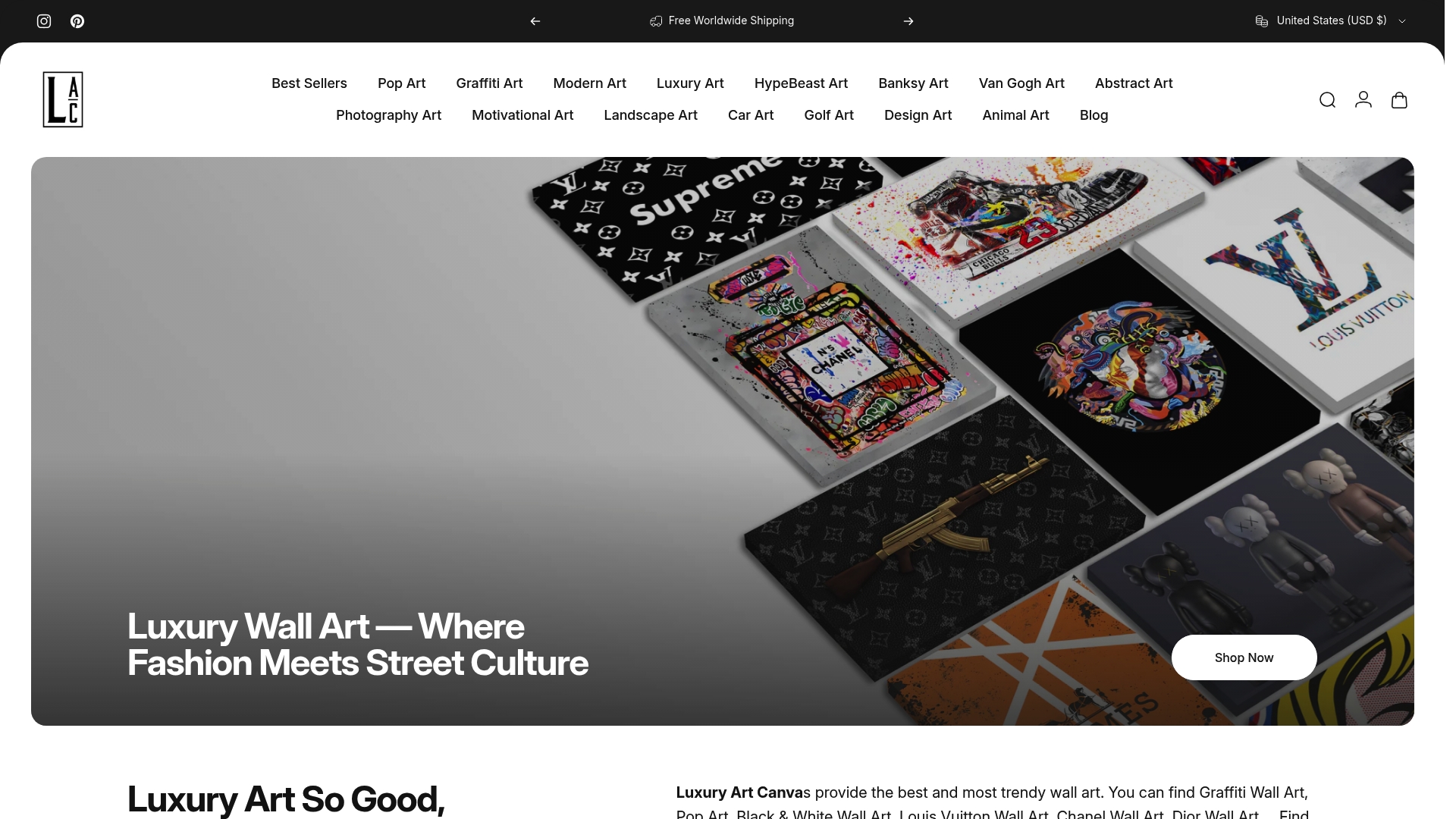
Luxuryartcanvas offers over 1,000 distinct canvas designs crafted in the USA, built specifically for organizations that want their walls to say something worth hearing. Whether your culture calls for the raw energy of bold graffiti wall art or the sharp visual confidence of pop art canvases, the collections span the full range of corporate identity expressions. Every piece is made with high-quality materials for lasting visual impact in high-traffic environments. More than 10,000 satisfied customers have used Luxuryartcanvas to turn blank walls into deliberate culture signals. Browse the full collection at Luxuryartcanvas and find art that does the work your mission statement cannot.
FAQ
Why does office art reflect company culture?
Office art functions as a visible artefact in Edgar Schein’s organizational culture model, signaling the values and assumptions that define how a company operates. Employees and visitors decode these signals immediately, often before any verbal communication occurs.
Can art actually improve employee morale and wellbeing?
Yes. A 2026 longitudinal study found that biophilic art environments reduced morning cortisol levels by an average of 2.8 µg/dL and accounted for a 31% reduction in anxiety symptoms compared to control groups. Nature-themed and multisensory art installations produce the strongest documented effects.
What makes office art ineffective for culture alignment?
Generic, catalog-sourced art imposed without employee input sends a signal of inauthenticity. The biggest risk is art that contradicts stated values, such as hanging “teamwork” messaging in a siloed, closed-door environment, which accelerates employee cynicism rather than reducing it.
How often should organizations update their office art?
Rotating art every six to twelve months maintains the psychological impact of novelty and prevents visual habituation, where employees stop noticing the pieces entirely. Periodic updates also signal that the organization is actively engaged with its own culture rather than treating it as a fixed backdrop.
Does co-creating art with employees really make a difference?
Co-created artefacts carry significantly more cultural weight than purchased or imposed pieces because employees develop ownership over what they helped build. Research on culture-aligned art programs confirms that co-creation reduces costs and increases engagement simultaneously.
Transforming Blank Walls with Canvas Art: 2026 Guide
Hanging Canvas Art Without Damaging Your Walls