
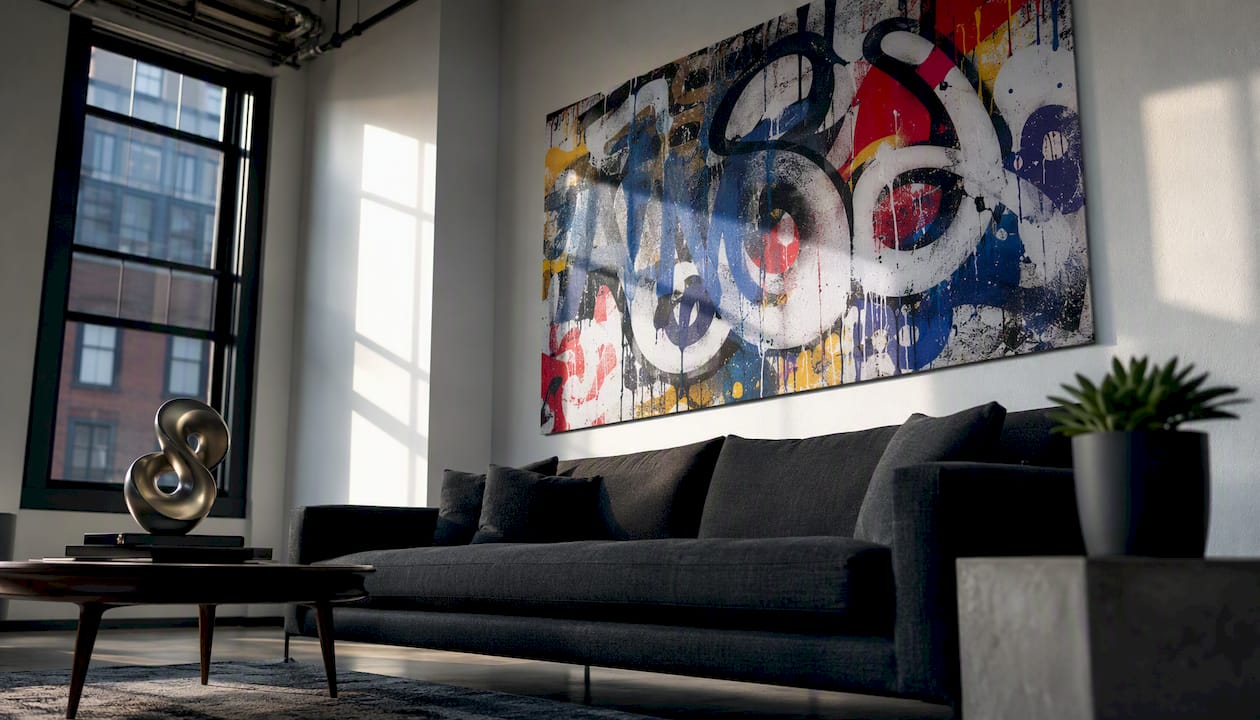
Street aesthetic reshapes contemporary rooms because it injects curated authenticity, visual friction, and personal identity into spaces that would otherwise read as generic showroom sets. A single graffiti canvas over a mid-century sofa does something a matching art print never could: it signals a lived point of view. Three forces drive this shift into homes right now. Culturally, the creator economy and platforms like Instagram and TikTok have made identity-driven decorating a form of self-publishing, turning street style into a global visual language that spreads faster than any single design movement in decades. Visually, the mix of high-gloss furniture against raw materials and typographic art creates the kind of contrast designers now chase on purpose. Psychologically, a bold mural fragment or a neon sign gives a room the same emotional charge a favorite jacket gives an outfit: something that says this space belongs to a real person.
The effects show up in three consistent ways once a room absorbs this influence:
- A built-in focal point. A single graffiti-style or typographic canvas does the visual work that five smaller accessories usually try and fail to do.
- Texture and material contrast. Concrete, reclaimed wood, and metal fittings sit against velvet, marble, or lacquer, and that friction is the whole point.
- Personal storytelling over trend-following. The room stops looking staged and starts looking collected, which is exactly what makes it feel current.
Key Takeaways
Street aesthetic influences contemporary rooms because it replaces showroom polish with curated authenticity, material contrast, and a visible point of view.
| Point | Details |
|---|---|
| Cultural driver | Identity-focused decorating, accelerated by social platforms, replaced trend-following as the main motivator for homeowners. |
| Visual signal | High-low contrast, industrial materials, and typographic art create the friction that makes a room feel alive rather than staged. |
| Design discipline | Limiting the dominant palette to two or three colors keeps a bold anchor piece from tipping into visual chaos. |
| Sourcing choice | Ready-to-hang canvases offer museum-quality impact without the cost, licensing risk, or lead time of a commissioned mural. |
| Where to start | Luxuryartcanvas provides U.S.-made, ready-to-hang graffiti and pop art canvases as a practical way to apply the high-low mix at home. |
Table of Contents
- Why Street Aesthetic Influences Contemporary Rooms Culturally
- What Counts as Street Aesthetic Versus Street Art or Industrial Style
- What Cultural Forces Make Street Style Relevant to Homeowners Now
- Key Visual and Material Signals of a Street-Inspired Room
- How Do Designers Incorporate Street Elements Into Contemporary Rooms?
- Which Materials and Formats Work Best for Street-Inspired Walls?
- Where to Source Street-Influenced Art and What It Costs
- Quick Rules for Mixing Street Elements With Contemporary Furnishings
- Three Room Vignettes That Show the High-Low Mix in Action
- How Street Aesthetic Evolved Into a Recognized Interior Design Language
- Who Popularized Street Aesthetic in Contemporary Interior Design?
- Why Street Aesthetic Feels Emotionally Different in a Living Space
- A Curator’s Take on Mixing Street and Luxury
- Get the Look Without Commissioning a Mural
- Sources
Why Street Aesthetic Influences Contemporary Rooms Culturally
The pull toward street-inspired interiors is not a fluke of algorithm-driven taste. It is the direct result of how identity, media, and material culture have collided over the last decade. Homeowners who grew up watching skate videos, hip-hop culture, and sneaker drops shape mainstream style now expect their rooms to carry the same authenticity they demand from their wardrobes.
Three overlapping forces explain the momentum:
- Identity replaced trend-chasing. Street style has moved from subculture to mainstream fashion precisely because it rewards individual expression over seasonal conformity, and interiors are following the same script.
- Social platforms compress the feedback loop. A styling idea posted on Tuesday can be replicated in living rooms worldwide by the weekend, something designers now treat as a live data feed rather than a slow-moving trend cycle.
- Polish fatigue is real. After a decade of identical neutral-toned showroom interiors, homeowners started craving rooms with texture, contradiction, and a pulse.
Researchers describe this as a search for “curated authenticity” and “friction,” the idea that street-derived decor counterbalances overly polished interiors by pulling in the raw energy of public life.
The street aesthetic provides curated authenticity and friction in contemporary rooms, functioning as an intentional response to dense, layered urban experience and borrowing its visual rhythms from streets, transit systems, and music scenes.
That framing, drawn from research on curated authenticity in interior aesthetics, explains why a graffiti panel in a $2 million penthouse doesn’t read as a contradiction. It reads as a choice.
What Counts as Street Aesthetic Versus Street Art or Industrial Style
These three terms get used interchangeably online, and that confusion leads to a lot of mismatched Pinterest boards. Street aesthetic in interiors describes a broader visual language: urban graphic cues, typography, reclaimed materials, and curatorial objects assembled to feel collected rather than decorated. Street art is one ingredient inside that language, specifically the graffiti-rooted, mural-style imagery itself. Industrial style is a structural cousin, built around exposed brick, ductwork, and raw metal, but it can exist with zero graffiti or graphic art anywhere in the room.
Here’s how the three actually relate:
- Street aesthetic is the umbrella: a mix of graphic art, typography, industrial finishes, and thrifted or collectible objects assembled with intention.
- Street art contributes the imagery itself, whether that’s a full mural, a stenciled canvas, or a typographic piece referencing tags and signage.
- Industrial style contributes the bones: concrete floors, exposed pipes, steel shelving, the raw architectural shell the art then sits inside.
Scale and intent separate a subtle nod from a full statement. A mural spans a wall and demands the room be built around it. A framed print or mid-size canvas works as one element among several. The gesture matters too: a piece heavy on typography and symbols reads as expressive and personal, while a piece chosen mainly for its rough texture is closer to industrial styling that happens to use art as a device.
What Cultural Forces Make Street Style Relevant to Homeowners Now
Street aesthetic didn’t infiltrate contemporary design by accident. It arrived through a specific combination of economic and media shifts that changed how people think about their homes.
The creator economy turned personal space into a stage. Homeowners increasingly treat rooms the way they treat a wardrobe or a social feed: a canvas for self-expression rather than a neutral backdrop. That shift is directly tied to platforms where DIY and drop-culture signals move from niche to mainstream almost instantly, compressing what used to take design magazines years to popularize into a matter of weeks.
Youth and subcultural influence still drive the aesthetic vocabulary, even as it reaches buyers well past their twenties. Skate culture, hip-hop, and sneaker collecting shaped a generation’s visual instincts, and those instincts don’t disappear when someone buys their first house. They just get applied to a living room instead of a locker.
There’s also a documented backlash against showroom polish. A generation raised online has seen every version of the same beige sectional and matching throw pillow set; it no longer photographs as interesting or feels personal. Street aesthetic offers the opposite: unpredictability, color, and reference points that feel earned rather than purchased as a set.
One additional driver deserves its own mention: authenticity has become a durable cultural value rather than a passing look. As one outlet put it, street style has become part of the cultural mainstream precisely because it’s accessible and tied to identity, not tied to a season that expires.
Key Visual and Material Signals of a Street-Inspired Room
You can spot a street-influenced room from across a listing photo. The signals are consistent, even when the execution ranges from a $40,000 renovation to a single well-chosen canvas.
Look for these hallmark elements:
- Graffiti-style or typographic art used as a wall’s central statement
- Exposed brick, poured concrete, or raw plaster left intentionally unfinished
- Metal fixtures: black steel shelving, factory-style pendant lights, pipe-frame furniture
- Thrifted or “drop culture” collectibles displayed like gallery objects, from sneakers to vinyl
- One or two saturated color accents against an otherwise neutral base
- Layered textures, such as a leather sofa against a rough plaster wall or a velvet throw over a metal-frame chair
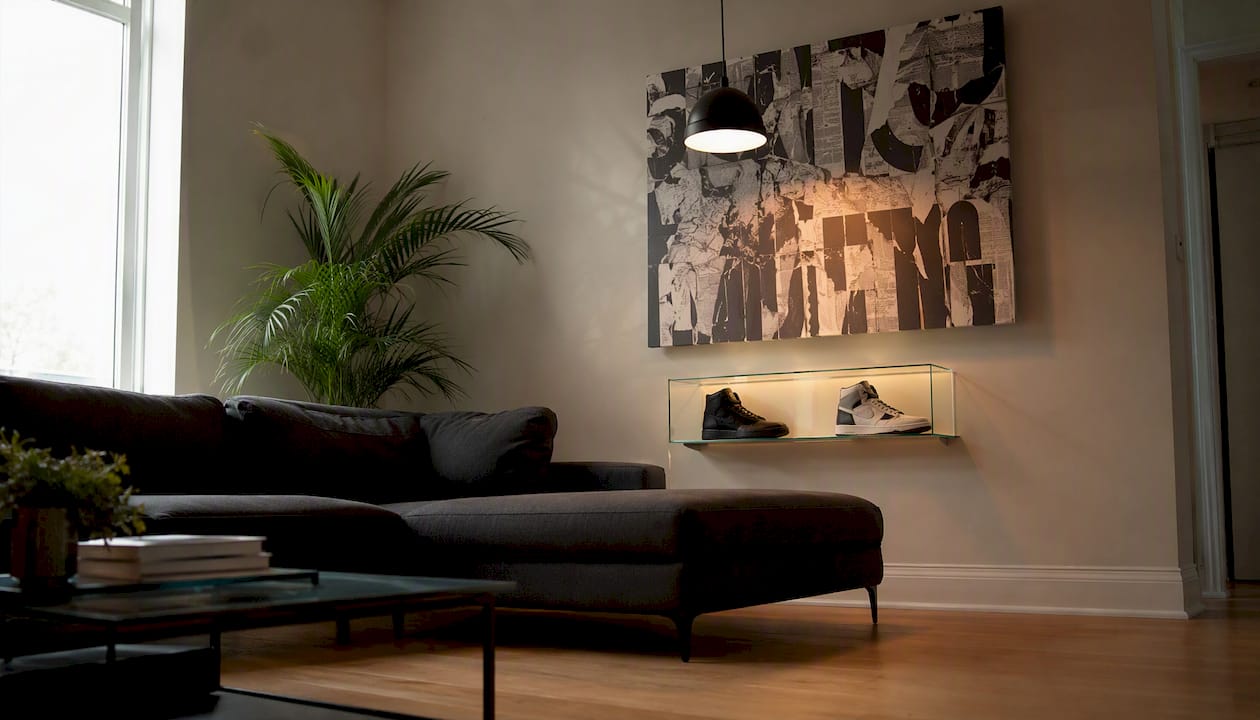
Picture three quick scenes. In a living room, a five-foot typographic canvas hangs above a low-profile sofa, with a single factory-style pendant light overhead and a glass shelf below holding three curated sneakers like museum pieces. In a bedroom, a fragment of a mural or a small cluster of three framed prints sits above the headboard, paired with linen bedding in muted tones and one neon sign as the only bright accent. In a home office, a poster-style street print hangs beside a thrifted desk that’s been refinished, with a woven rug adding warmth against a concrete-look floor.
Pro Tip: Treat your street piece the way a gallery treats its centerpiece. Give it breathing room, at least eighteen inches of clear wall on each side, so it reads as an intentional focal point instead of one more thing competing for attention.
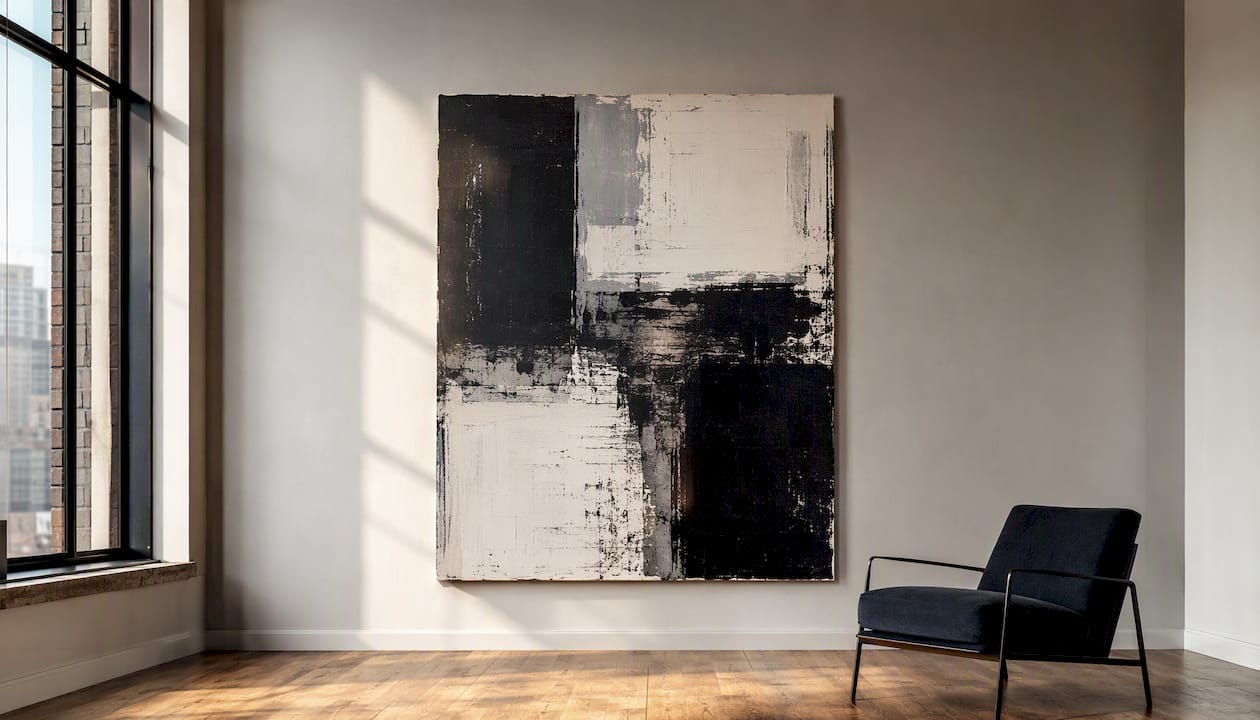
The mistake most homeowners make is layering three or four loud elements at once. Urban-inspired interiors succeed when they balance raw energy with editorial editing, pairing one expressive piece with calm furniture rather than competing statements everywhere you look.
How Do Designers Incorporate Street Elements Into Contemporary Rooms?
Turning inspiration into an actual room takes a method, not just good taste. Designers working in this style tend to follow a repeatable sequence.
- Choose one anchor piece first. Pick the mural, canvas, or sculptural object that will carry the room’s personality before buying anything else.
- Limit your dominant palette to two or three colors. Designers consistently recommend this ceiling to keep a high-low mix from tipping into visual chaos, even when the anchor piece itself is loud.
- Edit every other surface down. If the art is doing the talking, the walls, floors, and large furniture pieces should stay quiet.
- Repeat one material for rhythm. Black metal on the light fixtures, the shelf brackets, and a side table ties a room together without anyone consciously noticing why it works.
A few do’s and don’ts prevent the most common mistakes:
- Do pair one raw, expressive piece with refined furniture like a lacquered credenza or a marble side table.
- Don’t stack multiple loud focal points in the same sightline; competing statements cancel each other out.
- Do let negative space around the art do some of the work.
- Don’t match your art to your throw pillows. The friction is the feature, not a flaw to smooth over.
In practice, a living room might pair a bold graffiti canvas with a single tan leather sofa and nothing else on that wall. A bedroom might use a smaller-scale piece so it doesn’t overpower a space meant for rest. A home office often works best with poster-style prints that add personality without pulling focus from actual work.
Which Materials and Formats Work Best for Street-Inspired Walls?
The format you choose changes everything about cost, permanence, and how the piece reads in a room. Here’s how the main options stack up.
| Format | Best for | Trade-offs |
|---|---|---|
| Original mural (site-painted) | Permanent statement walls, commercial or large residential spaces | Highest cost, requires a skilled muralist, difficult to remove or resell |
| Commissioned mural on panel | Custom sizing with some future flexibility | Mid-to-high cost, longer lead time, still a major commitment |
| Large-format canvas | Living room focal walls, renters and owners alike | Lower cost than murals, fully repositionable, wide style range |
| Limited-edition print | Collectors who want provenance and resale value | Requires framing, can be pricier per square inch than canvas |
| Framed poster | Budget-conscious rooms, offices, rental apartments | Least durable, can look less substantial at large scale |
Sourcing decisions send their own signal. Commissioning an original artist says the room was built around a singular vision. Licensing a limited print says you value provenance and are willing to pay for it. Buying a ready-to-hang canvas says you want museum-quality visual impact without the six-month wait or the fragility of an original.
Pro Tip: If you expect your taste to evolve over the next few years, favor canvas over a built-in mural. A canvas moves with you; a painted wall doesn’t.
This is where a source like Luxury Art Canvas fits naturally into the conversation. It sells ready-to-hang, museum-quality canvases in graffiti, pop art, and high-fashion-adjacent designs, made in the USA with archival materials, which gives homeowners the visual weight of a statement piece without commissioning an original or waiting on a custom order.
Where to Source Street-Influenced Art and What It Costs
Budget planning here depends heavily on which format you’re chasing, so it helps to think in brackets rather than fixed numbers.
Sourcing options generally fall into five categories:
- Local street artists and muralists, found through Instagram or regional arts councils, for a fully custom and site-specific piece
- Online marketplaces and print shops offering limited editions and open editions at a range of price points
- Ready-to-hang canvas retailers, which skip the framing and installation guesswork entirely
- Gallery representation, useful for collectors who want documented provenance
- Thrift and DIY channels, where flipped furniture and found objects supplement purchased art
On cost brackets: entry-level prints and mid-size ready-to-hang canvases tend to sit at the accessible end of the spectrum, since they’re produced in volume without custom labor. Commissioned murals and gallery-represented originals sit at the higher end, since you’re paying for the artist’s time, exclusivity, and often a site visit. Where you land depends on square footage, whether the piece is one-of-one, and how fast you need it installed.
One legal note worth taking seriously: reproducing a specific artist’s copyrighted work without a license, even as “inspired by” wall art, can create real exposure. If you’re commissioning a mural on a shared or rented wall, get permission in writing from the property owner before the paint goes up, and if you’re buying a print, confirm the seller actually holds reproduction rights to the design.
Quick Rules for Mixing Street Elements With Contemporary Furnishings
Keep this list nearby when you’re actually shopping or arranging a room, since it’s easy to second-guess yourself in the moment.
- Start with one anchor piece. Choose it before anything else, and let the rest of the room support it.
- Cap your dominant palette at two or three colors. This single rule prevents more decorating disasters than any other.
- Balance every raw texture with a refined surface. Concrete needs marble or lacquer nearby to feel intentional rather than unfinished.
Avoid these common traps:
- Avoid placing two bold focal pieces on walls that share a sightline; your eye won’t know where to land.
- Avoid mismatched scale, like a small poster on an oversized wall that swallows it whole.
- Avoid treating every surface as a canvas; empty space is part of the design, not a gap to fill.
Three Room Vignettes That Show the High-Low Mix in Action
Living room: A seven-foot typographic canvas anchors the main wall above a low, tailored sofa in a neutral fabric. A black steel pendant light hangs slightly off-center to avoid competing with the art, and a glass shelf beneath displays three curated sneakers, spaced like objects in a gallery case. Nothing else on that wall competes for attention.
Bedroom: Instead of one large piece, a cluster of three small framed prints sits above the headboard in a loose grid, each drawing from the same color family. Bedding stays in muted linen tones so the art carries the personality, and a single neon sign glows softly from a nearby shelf as the room’s one saturated accent. Restraint here matters more than anywhere else in the house.
Home office: A poster-style street print hangs at eye level from the desk chair, chosen specifically because it’s energizing without being distracting during work hours. The desk itself is a thrifted piece refinished in matte black, and a thick wool rug plus a woven wall hanging add acoustic softness against an otherwise hard-surfaced room.
How Street Aesthetic Evolved Into a Recognized Interior Design Language
Street aesthetic didn’t start in design showrooms. It started on walls, subway cars, and skate parks, decades before any interior magazine took it seriously. Street style itself emerged from youth and urban subcultures, documented candidly rather than staged, and it built its authority precisely by existing outside institutional fashion and design systems.
The migration indoors happened gradually through the 1990s and 2000s as graffiti artists began gallery representation and street photography became a legitimate documentary practice. By the 2010s, boutique hotels and restaurants had started commissioning murals as branding tools, borrowing the energy of the street to signal that a space was current rather than corporate. Residential interiors followed roughly a decade later, once street art wall decor moved fully into living rooms, offices, and boutique hospitality settings, driven by the same appetite for authenticity over polish. What changed most recently isn’t the aesthetic itself but its acceptance in high-end contexts. A graffiti-style canvas next to a Chanel-branded print no longer reads as a contradiction; it reads as a deliberate high-low statement.
Who Popularized Street Aesthetic in Contemporary Interior Design?
No single architect invented this movement, and that’s part of the point. It grew from a network of overlapping influences rather than one visionary’s signature style. Street artists who transitioned into gallery and commercial work, from figures who built careers bridging graffiti and fine art to the muralists commissioned by hospitality brands, did much of the early legitimizing work by proving street imagery could hold its own in curated spaces.
Interior designers working in boutique hospitality deserve real credit here too. Hotel groups looking to differentiate from generic luxury chains began commissioning local muralists and street artists specifically to give properties a sense of place, a practice that trickled into residential design once homeowners saw it in person and wanted the same energy at home.
Social media itself functions as a kind of anonymous, collective tastemaker. Street-style photography feeds directly into how designers and consumers think about visual language, creating a constant real-world feedback loop that no single design authority controls. That decentralization is arguably why the style has staying power: it belongs to a culture, not a brand.
Why Street Aesthetic Feels Emotionally Different in a Living Space
There’s a reason a graffiti canvas in your living room hits differently than a landscape print. Street-derived imagery carries connotations of rebellion, identity, and lived experience, and those associations don’t switch off just because the piece is now hanging in a hallway instead of on a subway wall.
The psychological pull ties back to identity performance. Street style has always functioned as a way for people to signal who they are without saying a word, and that same identity-driven function carries over when the visual language moves indoors. A room stops being a neutral container and starts operating as a stage for personal narrative, something that says more about the person living there than a matched furniture set ever could.
There’s also a comfort dimension that’s easy to overlook. Rooms that feel too polished can feel unlived-in, almost like a hotel room you’re borrowing rather than a home you own. Introducing texture, imperfection, and a visible point of view creates psychological permission to relax into a space rather than tiptoe around it. That’s the quieter half of why friction works: it’s not just visually interesting, it makes a room feel like it can be messed up without falling apart.
A Curator’s Take on Mixing Street and Luxury
I’ve watched enough rooms come together to notice a pattern: the ones that work aren’t the ones with the most expensive art, they’re the ones where the art actually disagrees with something else in the space. A raw graffiti piece next to a polished marble console isn’t a mismatch. It’s the entire reason the room holds your attention longer than three seconds.
What surprises people most is how little street-influenced art actually needs to dominate a room to change its personality. One well-placed canvas, chosen with intention rather than trend-chasing, does more work than five coordinated accessories ever will. That’s part of why a source of ready-to-hang, U.S.-made canvases in graffiti and pop styles has become a practical entry point for homeowners who want that visual friction without commissioning an original mural or gambling on an unlicensed print.
Get the Look Without Commissioning a Mural
You don’t need a muralist on retainer or a five-figure budget to get this look right. Local artists and gallery prints are real options, but they come with long lead times, licensing questions, and prices that scale fast once you’re talking about custom work. Luxuryartcanvas offers a faster route to the same visual effect: over 1,000 ready-to-hang designs in graffiti, pop art, and high-fashion-inspired styles, crafted in the USA with archival inks that hold their color for years.
Every piece ships ready to install, no framing runaround, no waiting on a commission timeline, no guessing whether a print seller actually holds reproduction rights. If you’re ready to anchor a living room the way this article describes, start by browsing the wall art graffiti collection or the large graffiti wall art sized for a true statement wall, and pick the one piece your room will build itself around.
Sources
- Curated authenticity and friction in interiors (RISD digitalcommons)
- How street style became a global fashion language — AYERHS Magazine (2025)
- Worleygig
- Street style has officially become the new high fashion — RollingOut (2026-04-07)
Recommended
- Streetwear-Inspired Home Decor: What It Is and How to Do It – Luxury Art Canvas
- How to Make Every Room a Statement: The Interior Design Approach to Ar – Luxury Art Canvas
- Street Culture Art for Bedroom Walls: Styling & Buying Guide – Luxury Art Canvas
- Why Street Art Influences Luxury Interiors: A Designer’s Guide – Luxury Art Canvas
Hotel Lobby Wall Art: A Designer's Buying Guide
What Modern Office Interior Design Really Means