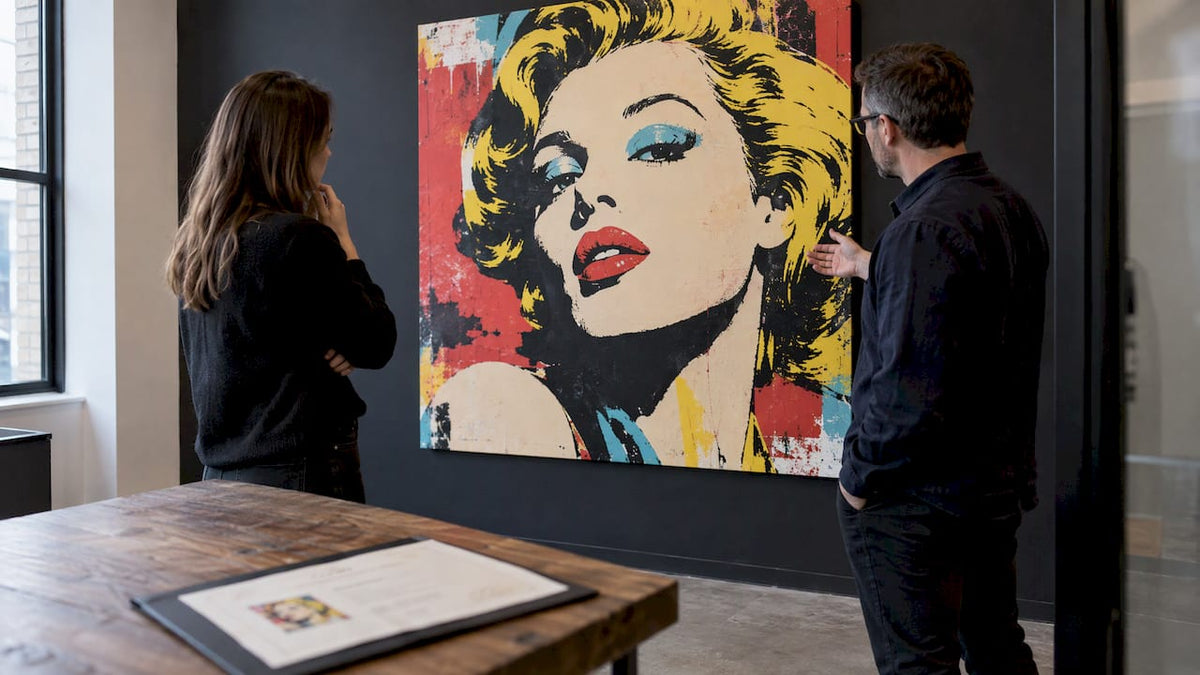
A certificate of authenticity (COA) is a signed document that identifies a specific canvas and attributes it to a named artist or issuer. It is a record, not a verdict. According to Artlogic’s guide for galleries and artists, it is not conclusive proof of authenticity, and its credibility depends on who issued it and what records stand behind it. Below you will find what a COA should contain, how to judge one, and how to keep the paperwork for any canvas you buy.
TL;DR
- A COA identifies one canvas and links it to an issuer. It supports provenance, insurance, appraisal and resale, but it does not set value.
- A solid certificate names the artist, title, year, medium, dimensions, edition details, issuer, signature, date and a photo of the work.
- Judge a COA by its issuer first. Security features cannot make up for a weak issuer or vague documentation.
- No COA does not automatically mean a fake, and a COA alone does not automatically mean genuine.
- Keep the certificate, invoice and order records together, in one place, for as long as you own the piece.
Table of Contents
- What a certificate of authenticity means for a canvas
- Original, edition or print: what the certificate should say
- What a good canvas COA includes
- How to check whether a COA is credible
- What if there is no certificate?
- Building a paper trail for your canvas
- What this means if you are buying decorative canvas wall art
- Our perspective
- Find a canvas that fits your space
- FAQ
- Sources
What a certificate of authenticity means for a canvas
The plain meaning: a COA is a written statement that a particular artwork is what the issuer says it is. Artlogic describes it as a document identifying an artwork and attributing it to a particular artist. Artwork Archive adds that a COA often travels with other verification, such as the artist’s signature.
Three points help you read the term correctly:
- It describes one object. A certificate should point to this canvas, not to a general series or a style.
- It starts a paper trail. Artemble notes that a COA does not set a painting’s value. It starts the work’s provenance record.
- It is only as strong as its author. The same source says a certificate from an unknown third party counts for less than one from the artist.
That last point matters most when you shop. A COA signed by the creator or by the business that produced the piece carries a clear chain of responsibility. A certificate from a stranger who has no link to the work is just a printed page.
Original, edition or print: what the certificate should say
Canvas wall art falls into very different categories, and the certificate should make clear which one you are buying.
| Type of canvas | What a COA usually documents | What matters to you |
|---|---|---|
| One-of-a-kind original | Artist, title, year, medium, surface, size, signature | Who signed it and how that ties to the artist |
| Limited edition | All of the above plus edition size and the number of your piece | Whether the edition is truly capped and numbered |
| Open-run decorative canvas | Usually product details such as size, materials and origin | Materials, where it was made, how it was printed |
The distinction protects you from confusion. A decorative canvas bought for a living room or an office does not need to claim to be a museum original. It needs honest descriptions: what it is, what it is made of and where it was made. A one-of-a-kind painting needs a much deeper paper trail.
In some places the law pushes sellers toward clear description. California, for example, requires art dealers to furnish certificates with specified descriptive information for multiples in covered transactions. That is a California rule for certain transactions, not a national standard, so check the rules of your own state if you are buying a high-value edition.
What a good canvas COA includes
Sources agree on a core set of fields, with a few optional extras.
The essentials
Artlogic lists these core fields:
- Artist name
- Artwork title
- Creation date
- Medium
- Dimensions
- Edition information, where applicable
- Issuer
- Issuer signature
- Issuance date
- Issuer contact information
- A photograph of the work
Format’s guide also recommends an authenticity statement that addresses relevant copyrights.
Details that make it harder to dispute
- Specific materials. Contemporary Art Issue advises documenting the technique, every medium used and the surface, rather than writing only “mixed media.”
- Signature location. The same guide recommends recording whether and where the work is signed, and whether it is unique or part of an edition.
- A reference number. Artlogic says an inventory, stock or unique reference number can link the physical certificate to the issuer’s records and distinguish the canvas from similar works.
- Optional extras. Format mentions completion location, a tracking code, care instructions, and publication or exhibition history.
Two dates often get confused. Artwork Archive explains that the creation date describes the piece, while the COA date is when the certificate was completed and signed. Both belong on the document, and they should not be the same field.
How to check whether a COA is credible
A certificate cannot vouch for itself. Run through these checks before you pay, and again when the canvas arrives.
1. Look at who issued it
Artlogic advises checking the issuer’s relationship to the artist. ARTERNAL advises seeing the COA and its documentation before purchase, and confirming it is signed by the artist, an established dealer or agent, or a certified expert, not merely a casual reseller.
2. Compare the paper with the object
The image, size, medium and title on the certificate should match the canvas in front of you. The College Art Association recommends verifying data such as medium, dimensions, mode of signature, inscriptions, and the verso or stretcher. Turn the canvas over. Look at the stretcher bars, the back, and any labels or stamps. Investigate any mismatch you cannot explain.

3. Read for vagueness
A certificate full of general phrases and missing fields gives a false sense of security. If the medium, size or year is blank, the document proves little.
4. Remember fancy security features are not trust
Holograms, QR codes and embossed seals look reassuring. Artlogic states that security features cannot compensate for an unreliable issuer or weak documentation.
5. Scale the effort to the stakes
For expensive works, authentication is a bigger exercise. WIPO’s CLIP Visual Arts guidance says authentication may involve examining signatures, historical documentation, scientific evidence, expert opinions, an artist’s authentication committee or a catalogue raisonné, and that a COA may be helpful but is not always decisive. The College Art Association likewise recommends combining art-historical documentation, stylistic expertise and technical or scientific analysis rather than leaning on one certificate or one opinion. If you are spending serious money on an original, bring in an independent appraiser or specialist before you buy.
What if there is no certificate?
Missing paperwork is a reason to ask questions, not proof of a fake. ARTERNAL notes that works on the secondary market may lack a COA and can be supported instead by invoices, bills of sale, and a fact sheet documenting ownership, exhibitions and press.
For decorative canvases, the equivalent is simple: a clear product description, an order confirmation and an invoice that names what you bought. If you ever need to file an insurance claim, resell the piece or settle a question about what you were sold, those records do the work.

Building a paper trail for your canvas
Whether you buy an original, an edition or a decorative canvas, build one folder for the piece:
- The certificate, if one exists, with its reference number
- The invoice or order confirmation, showing the seller, date, title, size and price
- Photos of the front, back, corners and any signature or label, taken when the canvas arrives
- Care or materials information supplied with the order
- Any later appraisal, framing or conservation records
Artists and sellers who want to do this well treat it as one continuous workflow. Art2App’s studio guide recommends recording front, back, signature and detail photographs before the work leaves the studio, issuing the certificate from that same record, sending certificate and invoice together, and keeping a dated copy. A seller that publishes a clear quality assurance and warranty policy is applying the same habit of putting commitments in writing, and it gives you something concrete to file next to your receipt.
Treat the folder as a living file. Add to it whenever the canvas changes hands, gets reframed or is appraised. A canvas with a tidy history is easier to insure, easier to sell and easier to identify years later.
What this means if you are buying decorative canvas wall art
Most people searching for a canvas COA are not buying a museum original. They are decorating a home, a rental or an office, and want to know the piece is what it claims to be. For that buyer, the questions that matter are practical:
- Is the canvas described honestly, as a print, an edition or an original?
- What are the materials, including canvas, inks and stretcher frame?
- Where was it made?
- Is it ready to hang?
- How will it hold up in sunlight?
Our own guides go deeper on each. See why canvas quality matters in fine art, the role of premium canvas materials, how to verify made in USA origin, and how a UV-resistant canvas behaves at home and in the office. If you collect street-inspired work, the graffiti canvas collector’s guide and our checks before ordering a Banksy inspired canvas explain what to look for in the description.
Our perspective
We sell decorative and contemporary canvas wall art, and we think buyers deserve clarity about what they are getting. A certificate is one way to build that clarity. It is not the only way, and it is never a substitute for honest description.
That is why we put the basics front and center: every canvas is crafted in the USA with archival inks and quality materials, and it arrives ready to hang. Our catalog of more than 1,000 designs spans graffiti, pop art, black and white, motivational and contemporary pieces, including designer-inspired work. Each is presented as exactly what it is: wall art made to bring a bold look into your space.
When you evaluate any canvas, ours or someone else’s, look at the materials, the origin, the description and the records you receive. Keep your order confirmation with the piece. Good records and a well-made canvas are what make a purchase easy to stand behind years later.
James
Find a canvas that fits your space
If you are ready to decorate, we make it simple to browse by style. Start with our pop art canvas prints for color and energy, or our graffiti and street art canvas for a raw urban edge.
Prefer a more polished look? Explore our luxury wall art collection or the full range on our home page, from black and white to photography and abstract. Every piece is crafted in the USA and ready to hang when it arrives.
FAQ
Does a certificate of authenticity prove a canvas is genuine?
Not by itself. A COA identifies the work and the issuer, but its weight depends on who signed it and what records back it up. WIPO’s CLIP guidance says a certificate may be helpful but is not always decisive.
Does a certificate of authenticity increase a canvas’s value?
It does not set value. Artemble says a COA starts the provenance record instead. A clear record can make a piece easier to insure, appraise and resell, but the artwork itself and the market drive its price.
What is the difference between a COA and an invoice?
An invoice records the sale: who sold what, when and for how much. A COA describes and attributes the artwork itself. Art2App recommends issuing both from the same record and sending them together.
Can I buy a canvas without a certificate?
Yes, and it does not make the canvas fake. ARTERNAL says works without a COA can be supported by invoices, bills of sale and a fact sheet on ownership and exhibitions. For decorative canvas, a clear product description and order confirmation are the records to keep.
Who should sign a certificate of authenticity?
The artist, an established dealer or agent, or a certified expert, according to ARTERNAL. A casual reseller with no link to the work is a weaker issuer.
Sources
- Artlogic: Certificates of Authenticity for galleries and artists
- California Civil Code, art dealers and certificates
- Artwork Archive: importance of provenance
- Artemble: what a certificate of authenticity means
- Format: Certificates of Authenticity, a complete how-to guide
- Contemporary Art Issue: how to create a certificate of authenticity
- Artwork Archive Help: generating a certificate of authenticity
- WIPO CLIP: authenticity and provenance disputes
- College Art Association: authentication guidelines
- ARTERNAL: Certificates of Authenticity guide
- Art2App: certificates of authenticity and QR verification
How to Prevent Canvas Warping and Fix It if It Happens