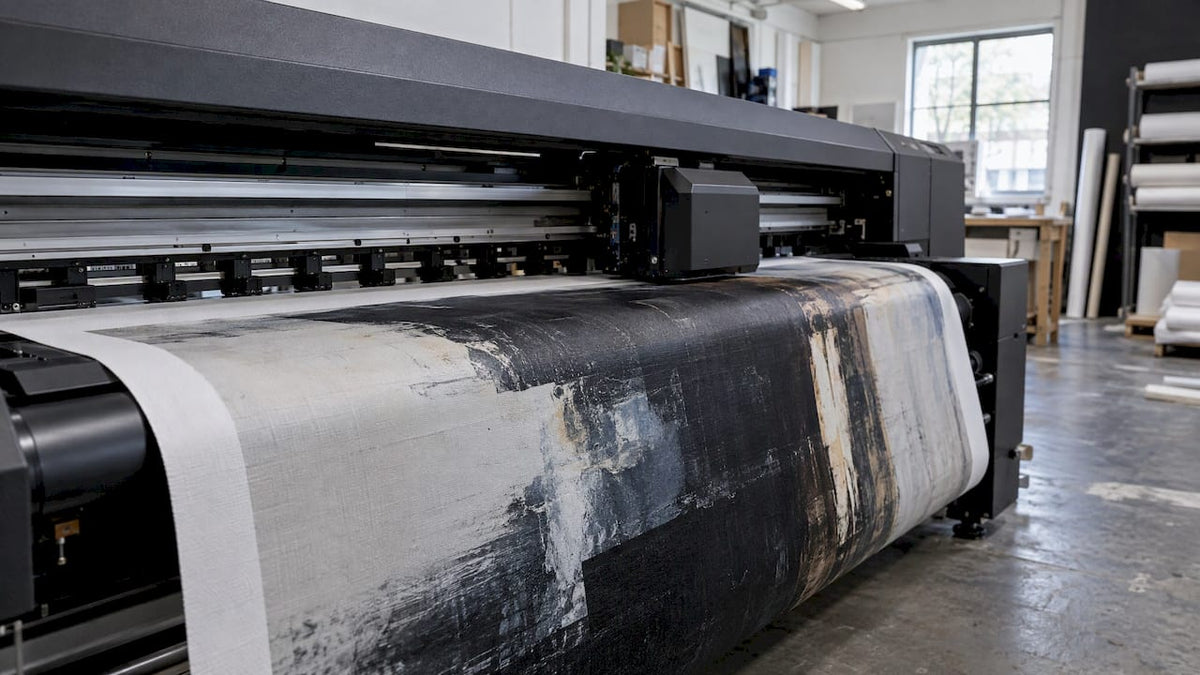
Giclée canvas printing is inkjet printing at fine-art standard: very fine droplets of archival ink, laid onto a canvas made to hold them, then finished so the image stays stable on your wall for decades. The word itself is a trade term, so the useful question is never “is it giclée?” but “what ink, what canvas, and what finish?” Those three answers decide whether a print looks rich in year one and still looks right in year twenty. Our canvases are made in the USA with archival inks and materials, and we built this guide so you can judge any canvas for your home, office or collection on the same criteria.
Table of Contents
- What giclée printing on canvas actually means
- Cotton vs. polyester vs. poly-cotton canvas
- What determines how long a print lasts
- Resolution and file quality
- A buyer’s checklist for any giclée canvas
- Canvas vs. posters and paper prints
- Our perspective
- Find your canvas
- FAQ
What giclée printing on canvas actually means
The word comes from the French for “to spray” and was first used for early fine-art inkjet prints. Today it is used for prints made on wide-format inkjet printers with fine-art inks on archival media. Nothing about the word guarantees a result, so it works best as a description of intent: a print made to look like the artwork and to last.
Here is how that differs from a basic canvas print.
| Standard decorative canvas print | Giclée-quality canvas print | |
|---|---|---|
| Ink | Often dye-based, chosen for speed and cost | Archival pigment inks, often in an extended color set |
| Canvas | General-purpose fabric | Acid-free, purpose-coated canvas made for inkjet |
| Color | Bright but narrower range | Smoother gradients, deeper blacks, wider gamut |
| Finish | Light or no protective coat | Protective coating or varnish matched to the canvas |
| Longevity | Depends heavily on light exposure | Designed for long display life |
For a buyer, the practical difference shows up in three places: how smoothly color transitions across a skyline or a face, how deep the blacks look in a black-and-white piece, and how the print ages in a sunny room.
Why ink type matters
Dye inks dissolve in liquid and soak into the surface. Pigment inks are tiny solid particles of color that sit on and in the coating. Pigment is the usual choice for longevity. The conservation leaflet above lists the colorant (dye versus pigment), the paper or substrate, and the combination of materials as the factors that most affect how long a digital print lasts.
That last point is easy to miss: permanence is not a property of the ink alone or the canvas alone. The same leaflet notes that permanence tests are specific to one ink on one substrate, so swapping either part does not give the same result. A good print is a matched system.
Why the canvas and its coating matter
Inkjet canvas is not raw artist’s canvas. It carries a receiving coating that holds ink droplets where they land, keeps edges crisp and lets the surface flex over a stretcher bar without cracking. One U.S. canvas maker, for example, publishes a factsheet for its matte poly-cotton canvas listing a 2:1 double weave, a 65% polyester and 35% cotton blend, a 395 g/m² weight, 21 mil thickness and an acid-free coating that stays flexible when stretched. That is the level of detail that separates an engineered inkjet canvas from a generic fabric.

Cotton vs. polyester vs. poly-cotton canvas
If you are comparing canvases, fiber is the first thing to understand. Here is how the three families differ for a wall print.
| Fiber | Look and feel | Strengths | Good fit |
|---|---|---|---|
| 100% cotton | Traditional, natural texture, slightly softer tooth | Classic artist’s-canvas character, excellent ink absorption | Painterly reproductions, fine-art and collector pieces |
| 100% polyester | Smoother, more uniform, more synthetic hand | Durable, dimensionally stable, resists moisture | Commercial spaces, humid rooms, high-traffic areas |
| Poly-cotton blend | Balanced texture, consistent weave | Combines cotton’s feel with polyester’s stability | Large formats, offices, everyday decor |
A canvas-media guide summarizes the same split in plain terms: cotton suits inkjet printing for its traditional feel and absorption, polyester offers durability, and poly-cotton blends balance the two. I am citing it only for that general comparison.
How to choose by room and purpose
- Living room or bedroom with stable conditions: cotton or poly-cotton both work. Choose cotton if you want the most traditional canvas texture, and a blend if you want a very even surface across a large piece.
- Office, lobby or restaurant: blends and polyester are practical where temperature swings, foot traffic or cleaning routines are a factor.
- Kitchen, bathroom or entryway: moisture resistance matters, so a coated blend or polyester base is the natural direction.
- Collector pieces: weave texture and surface character matter most, and cotton’s traditional look is often the reference point.
Weight and weave count too. The 395 g/m² figure above shows what a heavy, tightly woven canvas looks like on a spec sheet. A heavier canvas hangs flatter, wraps around the stretcher bar more cleanly and shows less weave pattern through dark areas.
What determines how long a print lasts
Buyers often ask for a number of years. The honest answer is that longevity is a system outcome, and the conservation literature breaks it into three parts: the materials, how they work together, and the conditions on the wall.
Materials
Look for an acid-free canvas, a stable ink set and a protective coating designed for that canvas. Optical brightening agents, fluorescent additives that make a base look whiter, are a known concern in media for long display. A canvas-media company’s guide to OBA-free canvas reports that OBA-containing media can shift toward yellow or grey as UV exposure builds, and recommends OBA-free bases for permanence. You rarely see that on a product page, which is why material information from the maker matters.
Display conditions
The Northeast Document Conservation Center recommends keeping relative humidity below 50%, ideally 30 to 40%, and temperatures between 65 and 70°F for digital prints. You do not need a gallery to approximate this. It translates into a few habits:
- Keep direct sun off the surface. A south- or west-facing window is the fastest way to age any print. Our guide to UV-resistant canvas for home and office covers placement and light.
- Avoid heat sources. Radiators, fireplaces and the wall above a range are poor spots.
- Avoid damp rooms without ventilation. Steady, moderate humidity is the goal, not a perfectly dry room.
- Dust gently with a dry, soft cloth rather than cleaning products.
For a longer treatment of how these factors play out on a real wall, see our piece on how long canvas prints last and the explanation of what canvas durability means in art.
Resolution and file quality
A beautiful canvas starts with a sharp file. Wall-sized prints are viewed from a few feet back, so the file needs enough pixels for the size you want, but not as many as a handheld photo print. Our note on why 150 PPI, not DPI, is the useful number for sharp canvas prints explains how to check a file against a size. If you are choosing from a finished catalog rather than uploading your own image, this is already handled for you.
A buyer’s checklist for any giclée canvas
Whether you are furnishing a new home, styling a rental or dressing an office, these are the points that separate a lasting canvas from a short-lived one:
- Ink: archival inks, ideally pigment-based, matched to the canvas.
- Canvas base: acid-free, designed for inkjet, with a clear fiber (cotton, poly-cotton or polyester) that fits the room.
- Coating or varnish: a finish made for the canvas that stays flexible and does not yellow.
- Construction: a sturdy stretcher bar, tight corners and wrapped edges so the piece hangs flat.
- Ready to hang: hardware attached so it goes on the wall the day it arrives.
- Origin: where it was made and with what, stated plainly.
- Placement plan: light, heat and humidity in the spot you have in mind.
For the collector’s angle on why base quality shows up in the final image, read why canvas quality matters in fine art and the role of premium canvas materials.
Canvas vs. posters and paper prints

Paper prints need glass and a frame to survive, and a poster on bare paper marks and fades easily. A stretched canvas needs no glass, shows no reflections and carries texture that makes graffiti and pop art feel like objects rather than images. That durability argument is laid out in why canvas prints outlast wall posters.
Our perspective
We make canvases for people who want a wall to say something: bold graffiti, pop art, black-and-white statement pieces and high-fashion designs inspired by Chanel, Louis Vuitton, Dior, Hermès, Versace and Prada.
Every canvas is made in the USA with archival inks and materials, and every one arrives ready to hang. We think that is the right order of priorities: the image should grab you from across the room, and the materials should make sure it still does years later.
The giclée conversation can get technical, but your decision is simpler. Pick the design you cannot stop looking at, hang it out of direct sun, and enjoy it. With over 1,000 designs, there is a piece for a studio apartment, a boardroom or a collector’s wall.
James
Find your canvas
If you would like museum-quality, ready-to-hang canvas in contemporary styles, start with our pop art canvas prints, our graffiti and street art canvas or the luxury wall art collection. Interior designers, new homeowners and office managers can browse the full range at Luxury Art Canvas.
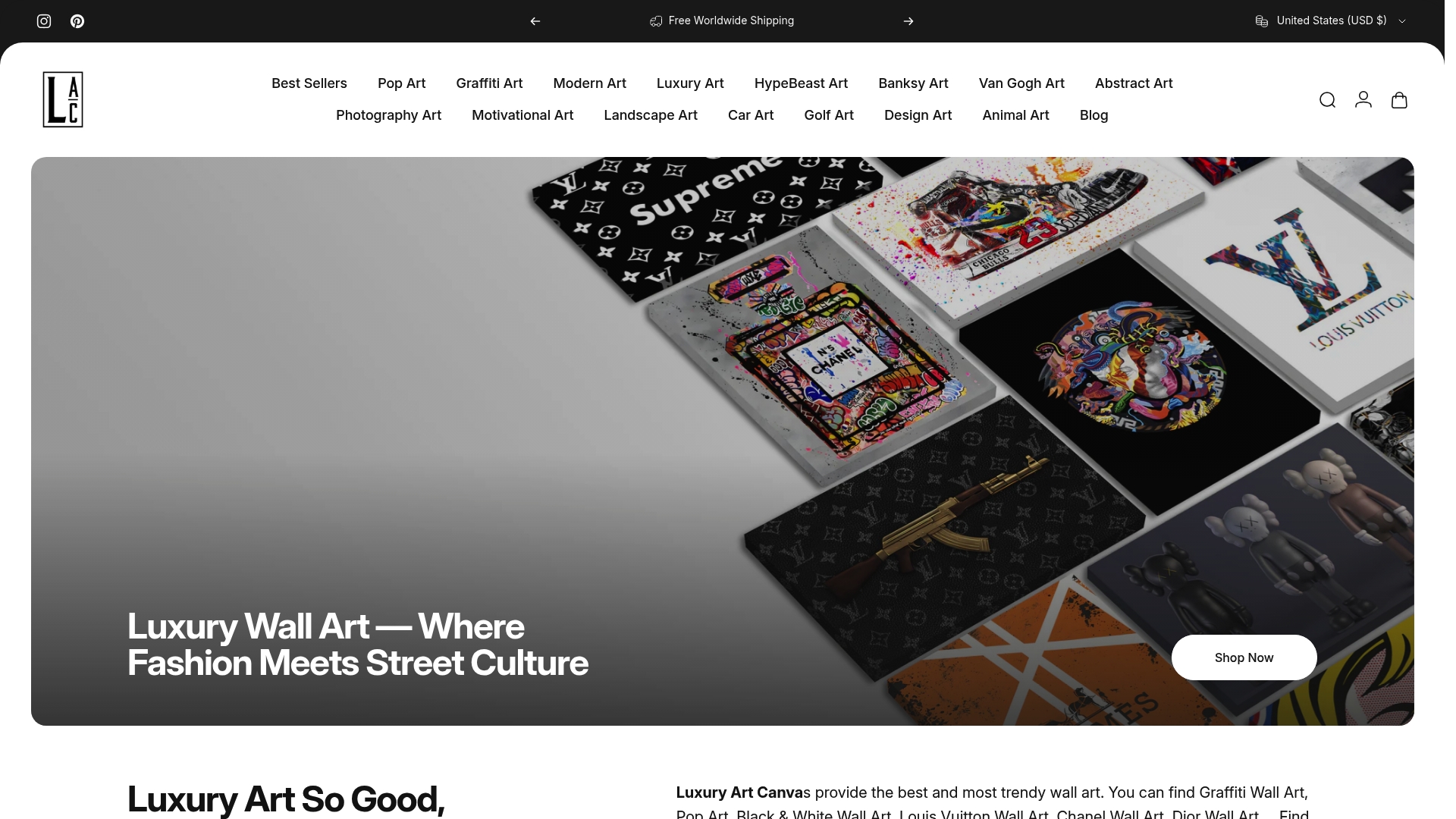
Each piece is made in the USA with archival inks and materials, so the bold look you choose is made to hold up on your wall.
FAQ
What is a giclée print on canvas?
It is an inkjet print made with fine-art inks on a canvas designed for inkjet, then finished with a protective coating. The term is a trade description rather than a certification, so the ink, canvas and coating tell you more than the label does.
Is giclée better than a regular canvas print?
Giclée-quality printing aims for a wider color range, smoother gradients and a longer display life through archival inks and acid-free media. The difference is most visible in detailed images, deep blacks and rooms with strong light.
Is cotton or polyester canvas better for prints?
It depends on the setting. Cotton offers the traditional canvas look and feel, polyester is valued for durability and moisture resistance, and poly-cotton blends combine the two. For a typical living space, any well-coated canvas can look excellent.
How should I hang and care for a canvas print?
Keep it out of direct sunlight and away from radiators and damp areas. The Northeast Document Conservation Center suggests humidity below 50% and temperatures of 65 to 70°F for digital prints. Dust with a soft, dry cloth.
Can I use canvas art in an office or commercial space?
Yes. Canvas needs no glass, so there is no glare under office lighting, and a ready-to-hang piece goes up quickly. Keep it away from windows with strong direct sun to protect the color.
Console Table Art Size: How Big and How High to Hang It
How to Hang Art Over Wainscoting: Heights, Gaps and Sizes