
Hang art over wainscoting by centering the piece at roughly 57 to 62 inches from the floor, then checking that its bottom edge clears the top of the paneling by at least a few inches. Wainscoting changes one thing about the usual rule: the paneling cap, not the floor, becomes the line your eye measures against. Get that gap right and a canvas looks anchored. Get it wrong and the piece looks like it is sliding off the rail or squeezed against the ceiling. A ready-to-hang canvas from Luxury Art Canvas arrives with its hanging hardware attached, so the only work left is measuring, and this guide covers exactly that.
TL;DR
- Center most pieces 57 to 62 inches from the floor, then confirm the bottom edge sits a few inches above the top of the wainscoting.
- Leave at least 1 to 2 inches above the molding for small pieces and at least 3 inches for large ones.
- On tall wainscoting, choose horizontal or smaller art and hang slightly higher so the piece does not feel trapped between rail and ceiling.
- Treat a gallery wall as one big piece: plan it on the floor, tape it on the wall, then drill.
- Above a console or sideboard, hang 6 to 8 inches over the furniture and span about two-thirds to three-quarters of its width.
Table of Contents
- Start by measuring your wainscoting, not guessing
- The height rule: where the center goes
- How much space to leave above the trim
- Choosing the right size for the wall above
- Gallery walls above wainscoting
- Tall wainscoting, high ceilings and tight walls
- Hanging on or inside the paneling
- Hanging it without damaging walls or trim
- Pick the canvas for the wall you measured
- Our view on art over paneling
- FAQ
- Sources
Start by measuring your wainscoting, not guessing
Every decision below depends on one number: how high the top of your paneling or chair rail sits. The most common chair rail height is 30 to 36 inches from the floor, roughly a third of a standard 8-foot wall. Contemporary guides suggest 36 to 40 inches at 9-foot ceilings and 40 to 44 inches at 10-foot ceilings, so do not assume yours is 36.
Measure three things before you buy or hang anything:
- Floor to the top of the wainscoting cap or chair rail.
- Top of the cap to the ceiling or crown molding. This is your usable wall.
- The width of the wall section, or of the furniture below the art if there is any.
Example: a room with a 96-inch ceiling and 36-inch wainscoting leaves 60 inches of open wall. Every example below uses that room.
The height rule: where the center goes
The broad rule comes from galleries and museums: 57 inches from the floor to the center of the piece, which matches average eye level. Some designers argue it runs low. One interior design firm notes that 58 to 62 inches suits pieces roughly 6 to 36 inches tall, and that her own eye level at 5 feet 4 inches is closer to 60 inches. If you want the long version of the baseline, our guide to canvas hanging height at 57 to 60 inches walks through the formula.
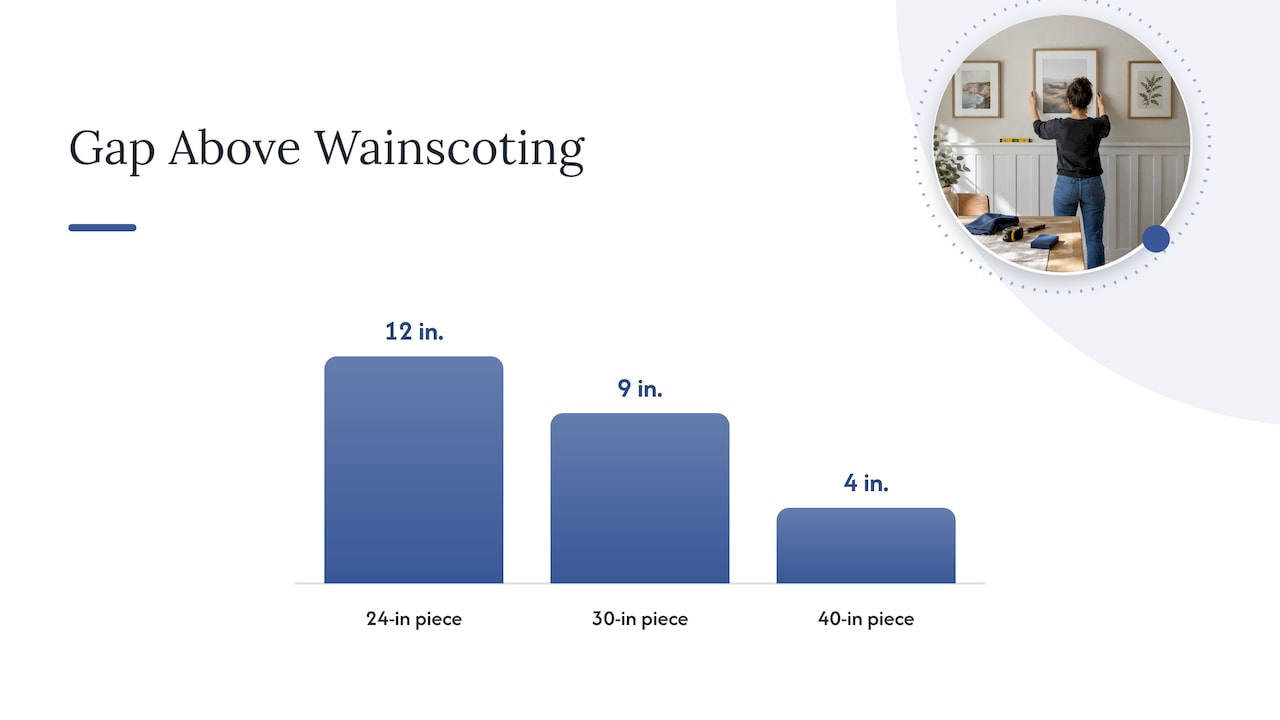
Over wainscoting the same source adds a second check: with standard 36-inch paneling and a piece 30 inches or taller, the art sits about 4 to 6 inches above the top of the wainscoting. For a piece around 40 inches tall, the two rules land on the same spot. For shorter pieces, the center rule usually leaves a bigger gap above the rail, and that is fine.
Worked example in the 96-inch room, 36-inch wainscoting:
| Piece height | Center at 60 in. | Bottom edge | Gap above rail | Top edge |
|---|---|---|---|---|
| 24 in. | 60 in. | 48 in. | 12 in. | 72 in. |
| 30 in. | 60 in. | 45 in. | 9 in. | 75 in. |
| 40 in. | 60 in. | 40 in. | 4 in. | 80 in. |
All three leave plenty of wall above. If your eye tells you the piece looks too low against the rail, lift it an inch or two. If it floats, bring it down. One designer quoted by Architectural Digest observes that most clients hang pieces too high, and lowering them a few inches makes a wall feel more considered.
How much space to leave above the trim
The gap between the molding and the bottom of the art is where wainscoting walls most often go wrong. Houzz advises at least 1 to 2 inches above the molding for small pieces and at least 3 inches for larger ones, meaning roughly 36 inches wide or 24 inches tall and up. For very large pieces, aim for roughly symmetrical space above and below.
In practice:
- Under 1 inch reads as an accident. The frame looks like it landed on the rail.
- 3 to 6 inches reads as deliberate and keeps the art tied to the paneling.
- 8 to 12 inches works for smaller or lighter pieces centered at eye level, as in the table above.
If the rail is a ledge, a slim canvas can also rest on it, leaning against the wall. That is a styling choice, not a hanging method, and it suits a lower-traffic spot.
Choosing the right size for the wall above
Scale causes more disappointment than placement. A Boston interior designer points out that a small piece centered on a large wall feels tentative, and even a beautiful artwork fails when undersized. Her fix is cheap: cut paper templates to the size of the piece, tape them up and live with them for a few days.
Useful proportions:
- Above wainscoting alone: in the 96-inch room, a piece up to about 24 to 30 inches tall fits the 60 inches of open wall comfortably, with air above and below.
- Above furniture: art should span roughly two-thirds to three-quarters of the width below it. A 60-inch console takes a piece or group 40 to 45 inches wide.
- Above a sideboard or console: leave about 6 to 8 inches between the furniture top and the bottom of the frame, a little more above a sofa.
When a console sits against the wainscoting, the furniture top may land above the rail or below it. Measure from the furniture, not from the rail, and then check the rail gap. If the two conflict, the furniture relationship usually wins, because the art and the piece below it read as one unit.
For very large statement pieces, our guides on oversized wall art placement and focal walls with oversized canvases cover scale in more depth.
Gallery walls above wainscoting
Treat a gallery as a single large artwork. Lay every piece on the floor with the spacing you want, measure the overall height of the arrangement, and hang the center of the whole group at 58 to 64 inches for a gallery 24 to 36 inches tall, or 48 to 56 inches for taller ones. Mark it with painter’s tape before any hole is drilled.
Spacing rules that hold up:
- Keep consistent gaps between frames of about 2 to 3 inches, starting your layout with the largest piece, per the Boston designer’s guidance.
- Make the gap between the whole grouping and the molding below wider than the gaps between pieces, a point Houzz makes as well.
- Do not obsess over identical gaps. One designer quoted by Architectural Digest says exact equal spacing is not required, since some pieces need more breathing room than others.
For a bold look, anchor the group with one large canvas and add smaller ones around it. A single oversized graffiti or pop art piece can carry a wall on its own, while a trio of black and white pieces in matching sizes gives a calmer rhythm. Our hallway art spacing guide shows gap and layout options for narrow walls, which is where wainscoting often lives.
Tall wainscoting, high ceilings and tight walls
When the paneling is taller than 36 inches, the 58 to 62 inch rule may have to give way to proportion. Smaller pieces can still follow the gap guideline, but a large piece may be too big for the wall space left.
Try this in order:
- Go horizontal. Landscape-format art fits the band of wall between rail and ceiling and feels less boxed in than a tall portrait piece.
- Move up a little. Hang slightly higher than the center rule suggests so the art does not crowd the rail.
- Match the wall’s shape. A taller, narrower wall suits vertical art or vertical groupings, while a wider wall suits horizontal layouts, as one designer told Architectural Digest.
- Keep room at the top. Leave breathing space below the ceiling or crown molding rather than pushing the frame against it.
Example: a 10-foot ceiling with 44-inch paneling leaves 76 inches of open wall. A 24-inch-tall landscape canvas centered at about 64 inches sits 8 inches above the rail with plenty of room overhead. On very high walls, such as stairwells, our piece on two-story wall art and the staircase sizing method go further.
Hanging on or inside the paneling
If the wainscoting runs up toward the ceiling or eye line, you can hang on top of the molding or inside its panels. Houzz suggests that when a piece is more than half the width or height of a molding pane, center it inside so the molding works like a second frame. Over rustic wainscoting or beadboard without evenly sized bands, ignore symmetry against the wall and place the art relative to other pieces.
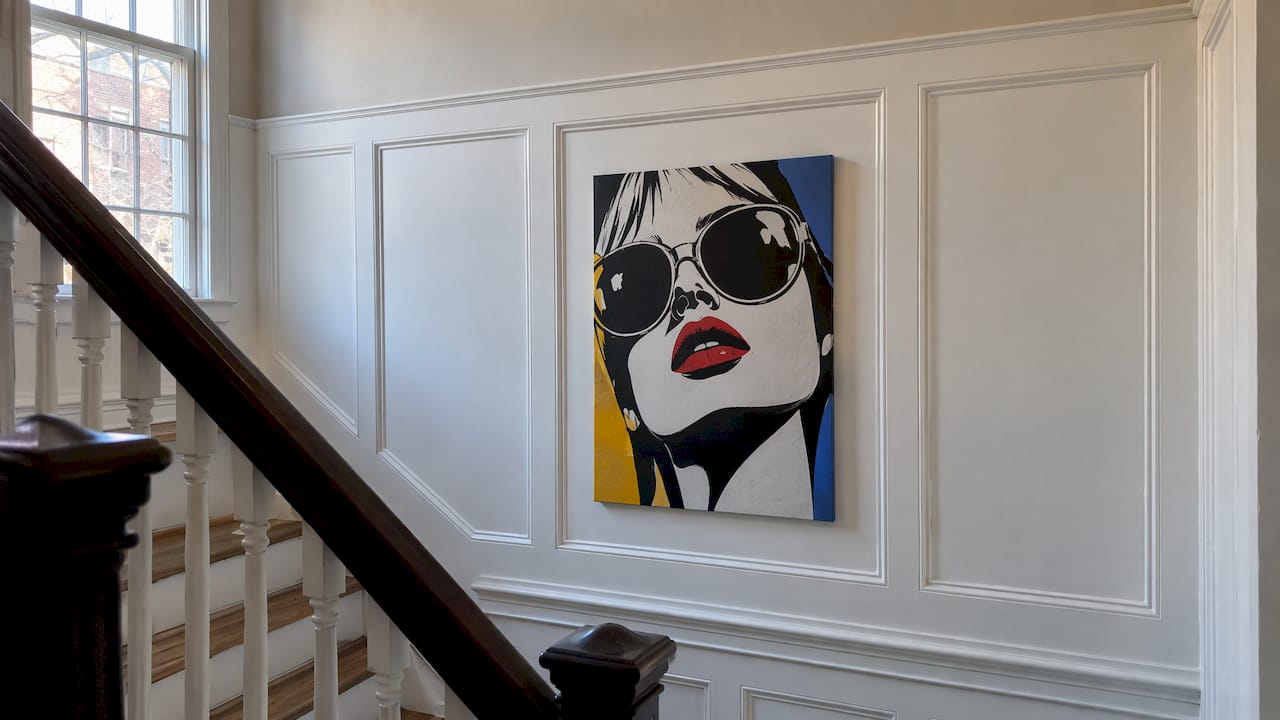
On picture-frame molding, line the art up with the panel’s center line, not the room’s center. That keeps the canvas aligned with the visible grid your eye is already reading.
Hanging it without damaging walls or trim
- Map the wall with tape. Measure each piece, cut painter’s tape or paper to size and stick it up to preview the arrangement. Houzz suggests a printed photo or newspaper cut to size for the same purpose.
- Get a helper. One designer advises in Architectural Digest to always hang art with a second person who holds the piece while you step back.
- Mark the hanging point. Measure from the hardware on the back of the canvas, not the top edge, then transfer that to the wall.
- Hang above the cap, never into it. Keep nails and screws in the drywall or plaster above the paneling so the trim stays intact.
- Level, then step back. Check from across the room, and adjust before you commit to a second hole.
Canvases from Luxury Art Canvas are ready to hang, so there is no framing or wire to fit. You only need to set the height.
Pick the canvas for the wall you measured
Once you know your open wall, the choice gets simple. For a hallway or entry with 30 to 40 inches of usable height, a horizontal or mid-size piece fits. Our Pop Art Canvas Prints and Graffiti Wall Art & Street Art Canvas collections suit rooms where the paneling gives a traditional backdrop and you want contrast. Our Luxury Art collection brings high-fashion imagery to dining rooms and offices with classic wainscoting.
Each canvas is made in the USA with archival inks and materials, and the catalog runs to over 1,000 designs, so you can match the format to your measurements rather than the other way around.

Browse the full range at luxuryartcanvas.com and use your wall measurements to filter by shape.
Our view on art over paneling
Wainscoting is a frame the room already gave you. The best walls we see let a bold canvas contrast with that traditional backdrop instead of hiding from it. A graffiti or pop art piece over a crisp white rail is a deliberate collision, and it works because the measurements are right.
That is why we start with numbers: the height of the rail, the open wall above it, the width of whatever sits below. Choose the canvas after you have those, not before. A piece that fits the wall at 57 to 62 inches looks like it was always meant to be there.
Our canvases are ready to hang and made in the USA with archival inks, so the effort goes into placement, where it pays off. Tape it up, step back, and trust the proportions.
James
FAQ
How high should I hang art above 36-inch wainscoting?
Center most pieces about 57 to 62 inches from the floor. For pieces 30 inches or taller, keep the bottom edge roughly 4 to 6 inches above the wainscoting top. Smaller pieces will leave a larger gap, which is fine.
How much space should I leave between the art and the chair rail?
Houzz suggests at least 1 to 2 inches for small pieces and at least 3 inches for larger ones. Many designers prefer a visibly deliberate gap of 3 to 6 inches so the piece does not look like it is resting on the rail.
Can I hang art on the wainscoting itself?
Yes, when the paneling reaches high up the wall. Center the art in a molding panel if it is more than half the panel’s width or height, so the molding frames it. Above furniture, art on the paneling looks anchored when it spans about two-thirds to three-quarters of the furniture’s width.
What if my wainscoting is taller than standard?
Choose horizontal or smaller art and hang slightly higher so it does not crowd the rail. A large piece may not fit the wall left above, so test with paper templates before you buy.
Sources
- What’s The Best Way to Hang a Picture? Our Expert Guide (Architectural Digest)
- The Right Height to Hang Artwork and Mirrors (Kylie M Interiors)
- How to Design With Wainscoting, Paneling, Molding and Other Trim (Houzz)
- Boston Interior Designer Trevor Fulmer: How to Fill a Blank Wall
- Chair Rail vs. Wainscoting vs. Picture Frame Moulding (Luxe Architectural)
Giclée Canvas Printing: What It Is and What to Look For